Chainalysis says banks and traditional financial institutions now apply stricter crypto transaction monitoring standards than exchanges. | Credit: CCN.com
Share
Key Takeaways
Traditional financial institutions are now applying stricter crypto transaction monitoring standards than crypto exchanges, according to Chainalysis.
Banks and TradFi firms flag suspicious crypto flows at much lower dollar thresholds than exchanges, especially for indirect exposure.
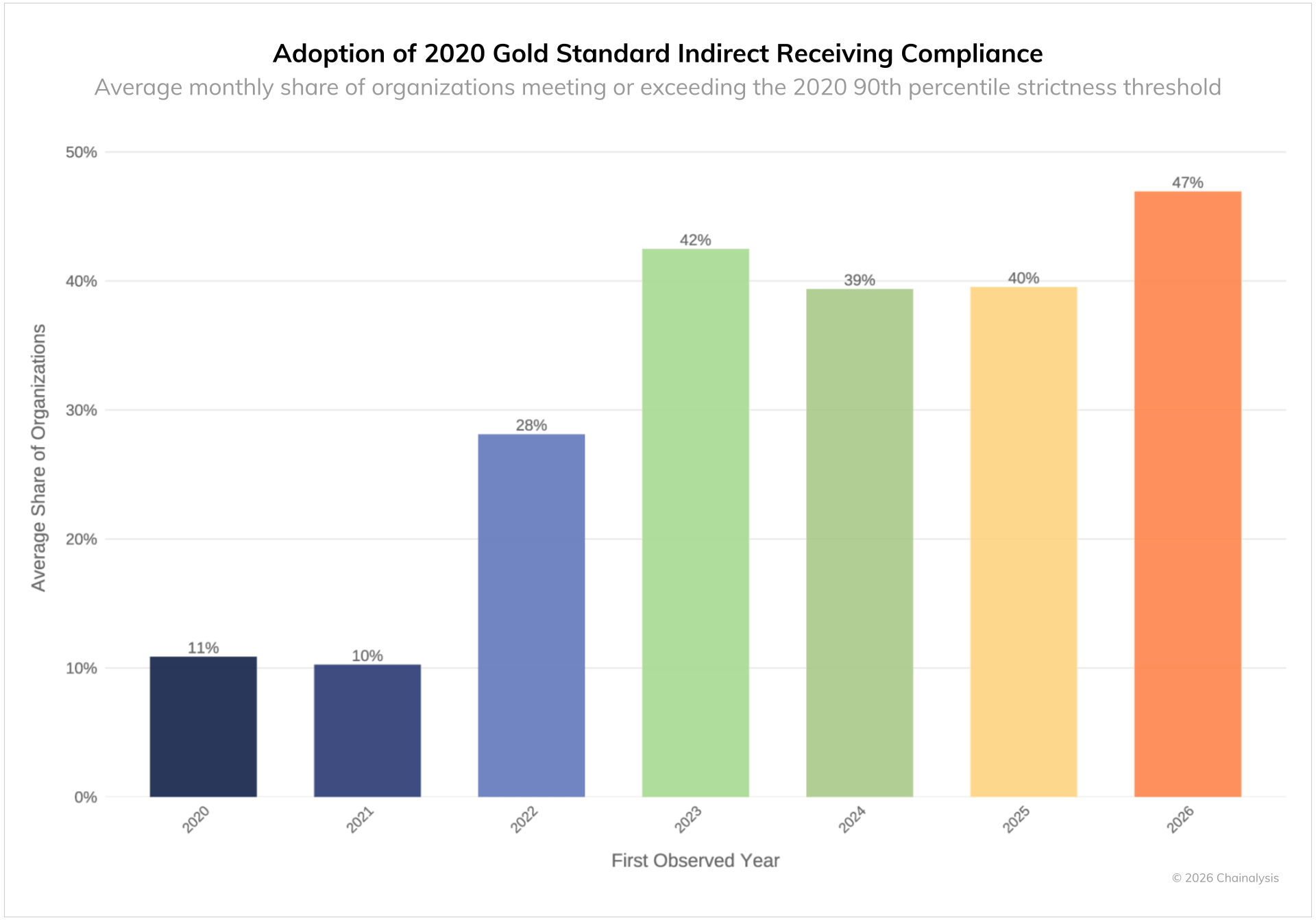
Nearly half of organizations onboarded in 2026 operate at compliance standards that would have ranked among the strictest 10% in 2020, showing rapid industry maturation.
Traditional financial institutions are now monitoring crypto transactions more aggressively than crypto-native exchanges, according to a new report from blockchain analytics firm Chainalysis.
The findings highlight how banks and regulated financial firms are tightening oversight of digital asset activity as regulators worldwide increase scrutiny over illicit finance risks in crypto markets.
The report found that compliance standards across the industry have risen sharply over the last five years, with financial institutions adopting significantly stricter alerting thresholds than exchanges.
Try Our Recommended Crypto Exchanges
Sponsored
Disclosure
We sometimes use affiliate links in our content, when clicking on those we might receive a commission at no extra cost to you. By using this website you agree to our terms and conditions and privacy policy.
Financial Institutions Set Stricter Monitoring Thresholds Than Exchanges
According to Chainalysis, traditional financial institutions maintain much lower transaction-detection thresholds than crypto exchanges for both illicit and non-illicit activity.
Lower thresholds mean organizations generate alerts for smaller transaction amounts, allowing them to identify suspicious behavior earlier.
The difference is particularly visible in how the two sectors monitor indirect exposure to non-illicit flows.
Crypto exchanges set average alert minimums at roughly $950, while financial institutions set thresholds closer to $150. Even for illicit activity, banks remain stricter, flagging suspicious flows starting at approximately $55 compared to $100 at exchanges.
Adoption of the 2020 gold standard indirect receiving compliance. | Credit: Chainalysis
Chainalysis said the stricter posture reflects the heightened regulatory obligations that financial institutions inherited from traditional finance.
“Traditional financial institutions exhibit a lower tolerance for receiving suspicious flows of any type than crypto exchanges do,” the report stated.
The report also found that the industry’s compliance baseline has strengthened dramatically since 2020.
Nearly half of the organizations onboarded in 2026 now operate at monitoring standards that would have placed them among the top 10% of strictest compliance configurations five years ago.
“Standard compliance configurations today would have been considered industry-leading just five years ago,” Chainalysis wrote.
Indirect Exposure Remains a Key Weakness in Crypto Compliance
While direct exposure monitoring has become relatively standardized across the industry, Chainalysis identified indirect exposure as a major area of inconsistency and potential vulnerability.
Direct exposure refers to funds received directly from a known illicit source, such as a sanctioned wallet or ransomware operator. Indirect exposure occurs when funds pass through intermediary wallets before reaching their destination.
The report found that organizations typically apply much looser monitoring standards to indirect exposure. In many cases, indirect thresholds are 10 to 20 times higher than direct thresholds for the same category of illicit activity.
For example, a compliance system configured to flag $10 in direct ransomware exposure may not generate an alert for indirect ransomware exposure until it reaches $100.
The discrepancy is especially pronounced for categories such as ransomware, fraud shops, scams, darknet markets, and sanctioned jurisdictions.
“Illicit actors are aware of these discrepancies and design laundering strategies around them,” Chainalysis warned.
However, some categories continue to receive near-zero tolerance treatment worldwide. Organizations set extremely low thresholds, sometimes as little as one cent, for transactions linked to terrorism financing, child abuse material, sanctioned entities, and special measures.
Chainalysis said firms that fail to treat indirect exposure as a core compliance issue could leave themselves vulnerable to increasingly sophisticated laundering tactics.
Regional Compliance Standards Continue to Diverge
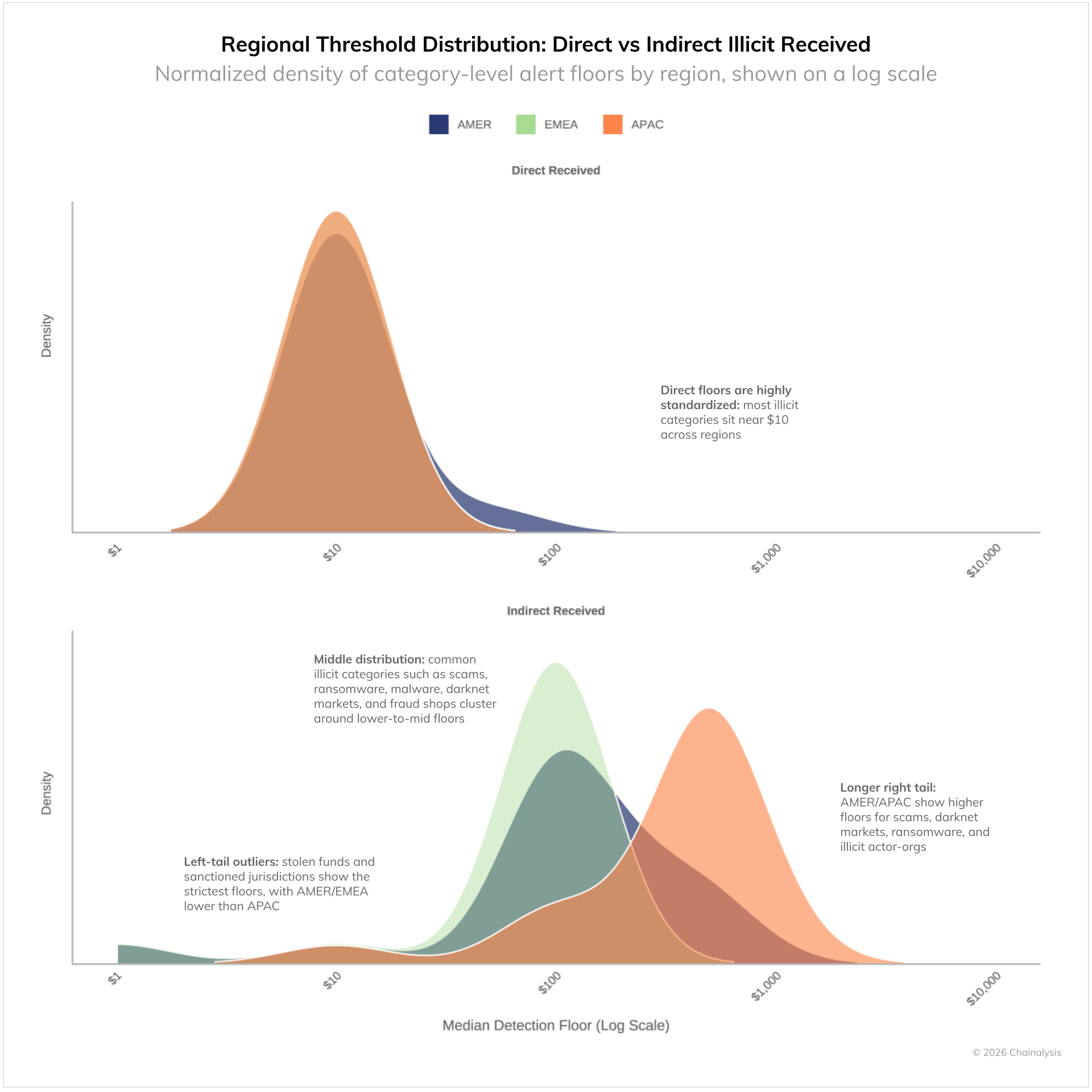
The report also found meaningful regional differences in how organizations monitor indirect exposure to suspicious transactions.
Firms headquartered in Europe, the Middle East, and Africa (EMEA) were found to maintain the strictest indirect monitoring standards, often setting alert thresholds near the $100 level for high-risk categories, including scams, fraud shops, and ransomware.
Organizations in the Americas showed moderately strict standards but with greater variation across categories. Meanwhile, Asia-Pacific (APAC) firms generally operated with the most lenient indirect exposure configurations overall.
Regional threshold distribution: direct vs. indirect illicit received. | Credit: Chainalysis
By contrast, direct exposure monitoring standards were remarkably consistent across all regions, reflecting what Chainalysis described as a global consensus around the risks of receiving funds directly from sanctioned or illicit actors.
“The implication: an APAC-headquartered counterparty may operate with different indirect monitoring standards than an EMEA-headquartered one, even if both use the same compliance tooling,” the report stated.
Chainalysis said the regional divergence could become increasingly important as institutions expand cross-border partnerships and evaluate counterparties in global digital asset markets.
The findings come as institutional participation in crypto markets continues to grow through stablecoins, tokenized assets, and blockchain-based financial infrastructure.
As regulators push for stronger anti-money laundering and sanctions compliance controls, Chainalysis argued that robust monitoring systems are quickly becoming a competitive advantage for firms entering the sector.
“In an industry where institutional capital increasingly demands regulatory defensibility, the rigor of an organization’s monitoring configuration becomes a competitive asset,” the company said.
Giuseppe Ciccomascolo began his career as an investigative journalist in Italy, where he contributed to both local and national newspapers, focusing on various financial sectors.
Upon relocating to London, he worked as an analyst for Fitch's CapitalStructure and later as a Senior Reporter for Alliance News. In 2017, Giuseppe transitioned to covering cryptocurrency-related news, producing documentaries and articles on Bitcoin and other emerging digital currencies. He also played a pivotal role in establishing the academy for a cryptocurrency exchange website. Crypto remained his primary area of interest throughout his tenure as a writer for ThirdFloor.