Bitcoin “going to zero” searches hit multi-year highs after a 50% drop, but institutional data and macro signals tell a more nuanced story. | Credit: CCN.com
Share
Key Takeaways
“Bitcoin going to zero” searches are at their highest level since the 2022 FTX collapse.
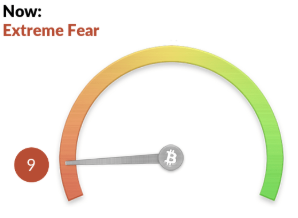
The Bitcoin Fear and Greed Index has plunged into Extreme Fear, reflecting intense retail anxiety.
Unlike 2022, today’s fears are macro-driven and not caused by internal crypto failures.
Dollar-debasement fears appear overstated in bond markets, suggesting Bitcoin’s drop may reflect macro tightening rather than a systemic collapse.
Google searches for “Bitcoin going to zero” have surged to their highest level since the post-FTX panic of November 2022, according to Google Trends. The spike comes as Bitcoin has fallen from its Oct. 6, 2025, all-time high near $126,000 to around $66,500, a drawdown of nearly 50%, based on CoinGecko data.
At the same time, the Bitcoin Fear and Greed Index has plunged to 9, deep in “Extreme Fear” territory, levels last seen during the Terra collapse and FTX fallout.
The parallels look alarming. But beneath the surface, today’s fear appears structurally different.
Bitcoin Price Crash 2025 vs. the 2022 FTX Collapse: What’s Different?
In 2022, panic was triggered by internal failures: the collapse of lenders, liquidity crises, and the implosion of one of the industry’s largest exchanges. Trust in crypto’s infrastructure itself was shaken.
Today’s anxiety is more macro-driven.
“Bitcoin going to zero” search activity hits a new record high. | Credit: Google Trend
Crypto intelligence firm Perception, which analyzed sentiment across 650 crypto media sources, argues that current fear is being amplified by broader economic uncertainty and repeated bearish commentary.
Bloomberg analyst Mike McGlone has warned of a potential crash toward $10,000 and drawn comparisons to 2008, and according to Perception founder Fernando Nikolic, the steady amplification of these warnings likely contributed to the spike in search interest.
In short, this wave of fear appears rooted more in macro pessimism than in structural breakdown inside crypto itself.
Retail Investors Panic While Institutional Bitcoin Buying Continues
One notable divergence this cycle is between retail sentiment and institutional behavior.
While retail investors are searching for signs of collapse, institutional buyers appear to be accumulating. Sovereign wealth funds, including Abu Dhabi’s, have reportedly increased exposure to Bitcoin ETFs, and public companies such as Strategy continue adding BTC to their balance sheets.
Perception’s data shows that professional media sentiment bottomed in early February and has been stabilizing for roughly two weeks, even as retail “Bitcoin going to zero” searches peak.
Nikolic notes that retail fear typically lags professional narrative shifts by 10-14 days. By the time public panic reaches its maximum intensity, institutional positioning may already be stabilizing.
This divergence suggests that fear and capital flows are not moving in lockstep.
Record-High Global Uncertainty and Its Impact on Bitcoin
The broader macro backdrop helps explain the intensity of the reaction.
The World Uncertainty Index, tracked by the Federal Reserve Bank of St. Louis, is currently at its highest level in the dataset, exceeding peaks seen during both the 2008 financial crisis and the COVID-19 shock.
Today’s spike in fear is unfolding against a backdrop of:
The surge in apocalyptic search terms becomes easier to understand.
Quantum fears tend to amplify existing bearish moves rather than drive them independently.
In other words, multiple anxiety narratives are converging at once, creating a powerful feedback loop in sentiment.
Bitcoin Fear and Greed Index at Extreme Fear: Buy Signal or Warning?
The Fear and Greed Index’s plunge into single digits has reignited a familiar debate: does extreme pessimism signal opportunity?
Analytics firm Santiment has argued that spikes in negative sentiment often coincide with retail capitulation, moments when weaker hands exit the market. Historically, some of the best long-term entry points have emerged during periods of maximum despair.
Bitcoin Fear and Greed Index is now in Extreme Fear territory. | Credit: Alternative.me
Critics counter that 90 days may be too narrow a window. On a 12-month horizon, Bitcoin has historically delivered far stronger returns following extreme fear episodes.
The lesson is less about whether fear is bullish or bearish and more about the timeframe.
Short-term traders and long-term accumulators may read the same signal differently.
Bitcoin Fundamentals vs. Market Panic: What the Data Shows
Despite the correction, Bitcoin remains far above its 2022 lows. Institutional participation is structurally deeper than during the FTX era, and integration into traditional finance has expanded through spot ETFs and corporate treasury strategies.
Volatility is not new to Bitcoin. The asset has endured:
The “going to zero” narrative resurfaces in nearly every downturn because Bitcoin is framed in binary terms: total success or total failure. When prices fall sharply, that framing returns, reinforcing emotionally driven search behavior rather than reflecting measurable collapse in fundamentals.
Dollar Debasement Fears, U.S. Treasuries, and Bitcoin’s Hedge Narrative
The renewed zero narrative is unfolding alongside broader chatter about a “dollar debasement” trade.
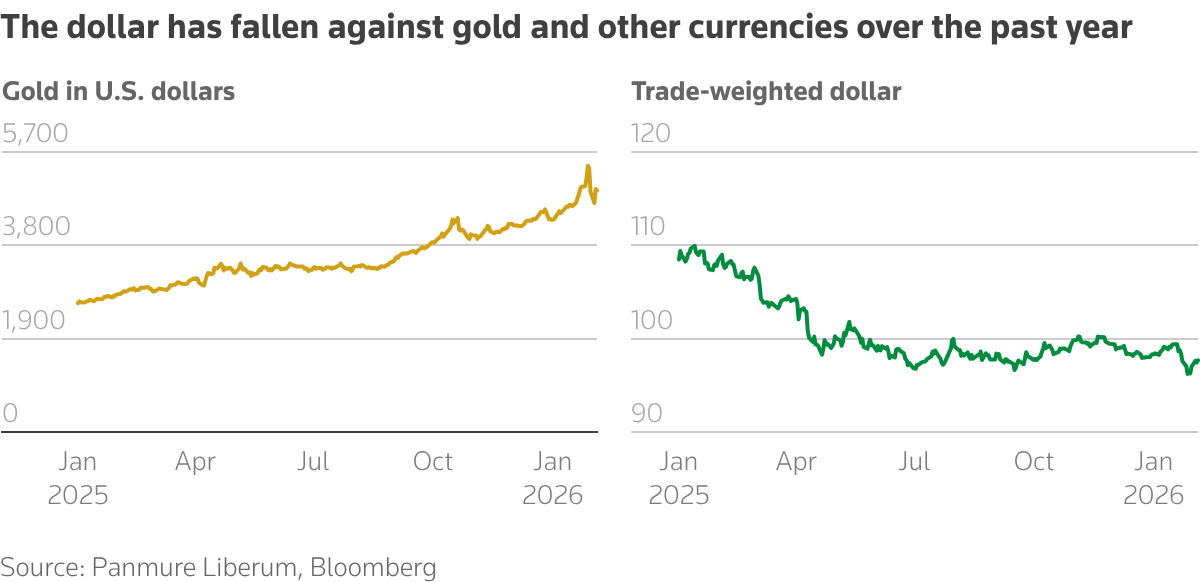
Over the past year:
The U.S. dollar has weakened against major currencies.
Gold has surged to record highs.
Precious metals have significantly outperformed.
This combination has fueled speculation about long-term fiscal erosion. But one key market measure, the so-called “convenience yield,” suggests that fears of imminent dollar collapse may be overstated.
The dollar has fallen against gold and other currencies over the past year. | Credit: Panmuer Liberum, Bloomberg
The convenience yield reflects the premium investors are willing to pay to hold dollars or U.S. Treasuries directly rather than replicate them synthetically through complex trades. If markets were truly bracing for debasement, this premium would be falling sharply.
Investors still appear to prefer holding actual dollars.
There is no sign of acute flight from reserve currencies.
Treasury markets show longer-term fiscal concerns, particularly versus German Bunds, but much of that repricing occurred during the 2010s amid persistent U.S. deficits, not suddenly in recent months.
This distinction matters. Bitcoin is often positioned as a hedge against fiat debasement. But if bond markets are not signaling acute dollar risk, Bitcoin’s drawdown may reflect:
Long-term fiscal deficits, projected near or above 6% of GDP, could eventually pressure Treasury risk premiums. But today’s signals suggest gradual structural concerns rather than immediate systemic panic.
Is Bitcoin Price Really Going to Zero?
Bitcoin’s 50% drawdown has reignited existential fears. Search interest in “Bitcoin going to zero” is at multi-year highs. The Fear & Greed Index sits deep in extreme fear. Macro uncertainty is elevated.
But this cycle lacks the internal structural failures that defined 2022. Instead, macro anxiety and amplified bearish commentary appear to be driving sentiment, even as institutional accumulation continues.
The narrative may be roaring back.
The data, however, suggests something more complex than imminent extinction.
There is currently no evidence suggesting Bitcoin is heading to zero. While Google searches for “Bitcoin going to zero” have surged amid a nearly 50% price correction, institutional accumulation continues, and there are no signs of systemic exchange failures like in 2022. The spike in search interest reflects fear, not necessarily fundamentals.
How does this Bitcoin crash compare to the 2022 FTX collapse?
The 2022 crash was driven by internal failures in the crypto industry, including exchange bankruptcies and liquidity crises. The current drawdown appears more macro-driven, tied to global uncertainty and risk-off sentiment rather than structural failures within the crypto industry.
Are institutional investors still buying Bitcoin?
Yes. Sovereign wealth funds and corporations continue to hold or increase Bitcoin exposure, particularly through spot ETFs and treasury allocations. Institutional behavior currently appears more stable than retail sentiment.
Is Bitcoin supposed to benefit from dollar debasement?
Bitcoin is often viewed as a hedge against long-term fiat currency debasement. However, current bond market indicators, such as dollar convenience yields, do not signal acute fears of immediate dollar collapse. That suggests Bitcoin’s recent drop may be more about macro tightening than a breakdown in the dollar system.
Disclaimer:
The information provided in this article is for informational purposes only. It is not intended to be, nor should it be construed as, financial advice. We do not make any warranties regarding the completeness, reliability, or accuracy of this information. All investments involve risk, and past performance does not guarantee future results. We recommend consulting a financial advisor before making any investment decisions.
Giuseppe Ciccomascolo began his career as an investigative journalist in Italy, where he contributed to both local and national newspapers, focusing on various financial sectors.
Upon relocating to London, he worked as an analyst for Fitch's CapitalStructure and later as a Senior Reporter for Alliance News. In 2017, Giuseppe transitioned to covering cryptocurrency-related news, producing documentaries and articles on Bitcoin and other emerging digital currencies. He also played a pivotal role in establishing the academy for a cryptocurrency exchange website. Crypto remained his primary area of interest throughout his tenure as a writer for ThirdFloor.


 Easy
Easy