You’re Watching the Wrong Chart: The Real Bitcoin Rally Is Happening Off-Exchange.
Share
Key Takeaways
ETFs and companies are buying more Bitcoin than miners can produce, resulting in a long-term supply shortage.
Most big Bitcoin purchases happen off-exchange, so the price chart doesn’t show the full demand.
Exchange reserves continue to shrink, meaning fewer coins are available for traders to purchase.
Over 95% of Bitcoin is already mined, and the new supply grows more slowly every halving cycle.
If you’re only looking at Bitcoin’s price on Coinbase or Binance, the end of 2025 looks a bit… disappointing. Bitcoin is well below its October peak, and exchange-traded funds (ETFs) are having big outflow days.
But beneath these surface examinations, there’s something else you must pay attention to:
Spot-ETF flows were net negative in November 2025, meaning ETFs weren’t the buyer: record $3.79B outflows across U.S. spot BTC/ETH ETFs; Coinbase noted November set a record for cumulative net outflows.
Exchange reserves kept falling into mid/late November, implying coins moved off exchanges (less visible spot buy pressure on CEXs). CryptoQuant flagged accelerating declines in BTC held on exchanges.
Derivatives/regulated venues activity hit records, pointing to institutional, off-exchange execution: CME crypto futures posted record daily and record November ADV; CME volumes surged amid the move.
Price recovered in early December (toward $95K on Dec 9) even as research still described muted ETF demand / weak spot liquidity, consistent with flows occurring away from spot CEX order books (derivatives, OTC/RFQ).
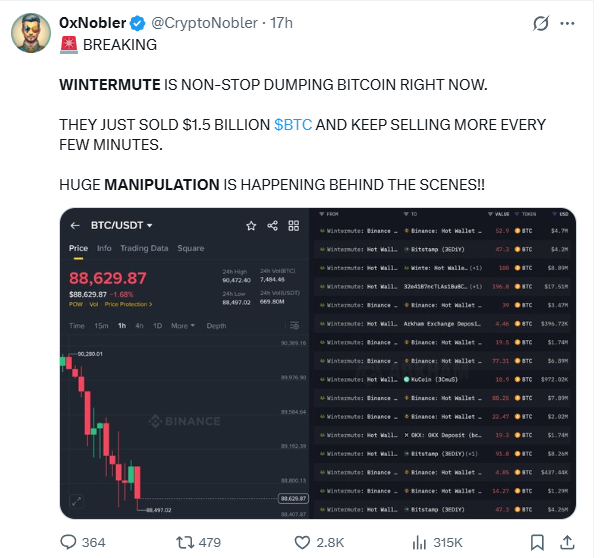
On December 14, 2025, DeFi researcher @CryptoNobler claimed on X that major market-making firm Wintermute was aggressively offloading Bitcoin in large volumes.
Is Wintermute manipulating Bitcoin price? | Source: @CryptoNobler on X
In November 2025, on-chain analyst @DeFiTracer reported that Wintermute wallets were sending large amounts of crypto to Binance, suggesting possible efforts to influence market movements.
🚨 BREAKING:
WINTERMUTE SENDING MILLIONS OF CRYPTO TO BINANCE
LAST TIME THEY DID IT TO PUMP LOWCAPS AND LIQUIDATE SHORT POSITIONS
While the posts sparked widespread concern about potential market manipulation, no verified on-chain or regulatory evidence has confirmed the allegations, and Wintermute has not publicly commented on the claims.
Notably, Bitcoin supply was dropping on exchanges in late 2024 as well. As flagged by crypto analyst Quinten Francois, Bitcoin supply on crypto exchanges might be plummeting, but all of that supply is going somewhere.
Source: QuintenFrancois on X
According to Francois’ post, over the last two weeks in December 2024:
Spot Bitcoin ETFs bought more than 35,000 Bitcoin
Strategy purchased 21,550 Bitcoin
And miners have released around 450 new Bitcoin each day
Fast-forward to late 2025, and the same structural dynamic resurfaced — only this time, it worked in reverse. On the surface, Bitcoin’s price on Coinbase and Binance looked disappointing, sitting well below its October highs.
The point here is, pay attention to supply, not just price. Supply is where the real story is.
Try Our Recommended Crypto Exchanges
Sponsored
Disclosure
We sometimes use affiliate links in our content, when clicking on those we might receive a commission at no extra cost to you. By using this website you agree to our terms and conditions and privacy policy.
Evidence Bitcoin’s December 2025 Rally Is Happening Off Exchanges
In December 2025, Bitcoin’s market behavior suggested that much of the buying and accumulation was happening off exchanges, even as spot trading activity and ETF inflows appeared weak.
Despite ETF outflows and thin liquidity on centralized exchanges (CEXs), Bitcoin’s price recovered toward the $95,000 range. This divergence points to a rally driven by off-exchange accumulation, derivatives activity, and long-term supply tightening rather than visible spot buying. On-chain data, exchange reserve trends, and institutional volume patterns all support this interpretation.
Falling exchange reserves: According to CryptoBriefing, over 403,000 BTC moved off exchanges between December 2024 and December 7, 2025, reducing available supply and indicating strong accumulation outside of public trading venues.
Binance holdings at record lows: Binance data showed its Bitcoin reserves dropped to the lowest level since 2018, consistent with users withdrawing BTC to self-custody or OTC deals rather than selling.
ETF outflows despite price stability:Reportedly, U.S. spot Bitcoin ETFs saw some of their largest outflows in early December, meaning ETFs weren’t the main buyer driving prices up.
Weak spot liquidity, strong derivatives activity: Analysts noted that institutional trading volumes increased on CME and other regulated derivatives markets, even as spot exchange liquidity remained thin.
Price near $95K despite weak visible demand: As Forbes reported on December 9, 2025, Bitcoin approached $95,000 amid weak ETF demand, reinforcing the idea that off-exchange accumulation and supply shortages were lifting prices.
Separately, social media and market rumors claimed that Binance and Wintermute coordinated large BTC transfers ahead of price moves, suggesting possible planned sell-offs or liquidity hunting, though these are claims circulating among traders and are not verified as factual manipulation by regulators.
Historical incidents, like the October 10 crypto flash crash in 2025 that wiped out billions in leveraged positions, saw community scrutiny toward Wintermute’s role as a major liquidity provider, leading to accusations of market impact (e.g., large transfers to exchange wallets before the drop), although Wintermute executives have publicly denied manipulation and attributed volatility to broader market conditions.
What It Means When a Bitcoin Rally Happens “Off Exchanges”
When analysts say a Bitcoin rally is happening off exchanges, they mean that the buying activity driving prices higher isn’t visible on public trading platforms like Coinbase, Binance, or Kraken. Instead, most of the accumulation is occurring in off-exchange channels such as:
OTC (Over-the-Counter) desks, where large investors and institutions buy Bitcoin directly to avoid moving the market.
Derivatives markets like CME futures, where traders gain exposure to Bitcoin’s price without trading the underlying asset.
Private custody and cold storage, as coins are withdrawn from exchanges for long-term holding.
This shift matters because it changes how Bitcoin’s supply and demand are reflected in price. When coins leave exchanges, it reduces the liquid supply available for trading, often a bullish signal. However, it also makes price movements look “muted” or disconnected from traditional spot volumes, since much of the real demand is happening out of sight.
In short, an off-exchange rally suggests that institutional accumulation and long-term holders are driving Bitcoin’s strength, even if public exchange data, like ETF flows or spot volumes, appear weak.
Why Bitcoin’s Supply Situation Doesn’t Completely Show Up on a Price Chart
It’s natural to wonder if Bitcoin’s demand is so high, why doesn’t its price reflect that?
Because a lot of this buying doesn’t happen on public exchanges.
Strategy’s purchases, for instance, usually happen via over-the-counter (OTC) desks, not on regular markets. Basically, this hides the buying pressure from the public, meaning charts aren’t going to react.
The process can be considered a “vampire of volatility,” meaning large buyers and new financial products that drain liquidity and volume from traditional exchanges.
In other words:
The price chart you watch every day might not be where the most activity happens.
Instead, what’s important is who controls supply.
More coins continue to disappear from exchanges.
Source: @glassnode on X
How Spot Bitcoin ETFs Are Reshaping the Market and Tightening Supply
Spot Bitcoin ETFs are now one of the biggest forces in the entire market as well. ETF inflows have taken in billions of dollars, even during tough weeks.
By the middle of 2025, BlackRock’s Bitcoin ETF (IBIT) held over 700,000 Bitcoin alone, which is more than 3% of the total Bitcoin supply.
ETFs buy Bitcoin from exchanges and store their holdings in massive cold wallets. There’s almost no reason that Bitcoin would ever return to said exchanges, which tightens supply over time.
Why Bitcoin’s Shrinking Supply Matters More Than Its Price
Bitcoin has a hard cap of 21 million coins, and we’re getting closer and closer to that limit.
Remember that the last 5% of that 21 million is all that remains locked away, as 95% of it has already been mined. That last 5% will take over 100 years to finish, due to Halvings continually restricting miner rewards.
As of this writing, miners earn around 3.125 BTC per block, which is how you get the 450 BTC per day. If 450 BTC is entering the market every day, but thousands are being taken off, the coins that you or I can buy keep shrinking.
Shrinking supply is one reason many analysts say Bitcoin’s price is no longer the best tool for understanding what’s going on. Price reacts to emotion, news, and short-term trading pressure. Supply, on the other hand, shows how much Bitcoin is actually available for the next set of buyers. If that supply keeps dropping, it only takes a small increase in demand to send the price shooting upward again.
That’s what makes the current situation, and everything affecting it, so important. Large buyers keep piling up their holdings behind the scenes. They are not trading it. They are not flipping it. They are keeping it in cold storage for years.
The point is, Bitcoin might look like it’s dropping if you’re only paying attention to exchange charts. But its price might react to this shift in supply and demand soon. Fewer Bitcoins on exchanges means fewer coins for traders to buy quickly when the next bull run starts.
If exchanges, or the “store shelves” of Bitcoin, keep emptying, it will only take a small number of buyers to push the price up fast. So don’t just watch the charts, watch where the supply is going. That’s where the rally may begin.
Why doesn’t Bitcoin’s price go up if demand is strong?
Because most large buys happen off-exchange. OTC deals and ETF purchases do not hit public order books, so they don’t move the price right away.
What does “exchange supply is dropping” mean?
It means fewer Bitcoin are sitting on exchanges ready to be traded. More coins are going into cold wallets, ETFs, and company treasuries.
Why are ETFs so important for Bitcoin?
ETFs buy and hold Bitcoin for long periods. They remove coins from the trading pool and store them in cold custody, which tightens supply over time.
How does the Bitcoin halving affect supply?
Each halving cuts miner rewards in half. In 2025, miners earn 3.125 BTC per block, so only around 450 BTC enter the market each day.
Disclaimer:
The information provided in this article is for informational purposes only. It is not intended to be, nor should it be construed as, financial advice. We do not make any warranties regarding the completeness, reliability, or accuracy of this information. All investments involve risk, and past performance does not guarantee future results. We recommend consulting a financial advisor before making any investment decisions.
Max Moeller is a Chicago‑based writer and video editor passionate about games, tech, and crypto. Whether it’s crafting clear, insightful articles or piecing together engaging video retrospectives, he’s driven by curiosity and takes pride in keeping things human. Since 2017, Max has been published in a variety of notable crypto magazines.


 Intermediate