Jim Cramer Is 100% Bearish on Bitcoin: His Calls From 2021–2025 and What Bitcoin Did Next. | Source: Steven Ferdman/Patrick McMullan via Getty Images.
Share
Key Takeaways
Third-party sentiment trackers officially labeled Jim Cramer as “100% bearish” on Christmas Eve 2025.
Despite Cramer’s grim forecast, Bitcoin continues to trade robustly between $87,000 and $88,000 this Christmas Day.
Cramer famously told investors he “wouldn’t touch crypto in a million years” in late 2022 when Bitcoin was at $16,800. Since that call, the asset has surged over 500%.
From the collapse of Bear Stearns to his 2024 “technological marvel” praise (which preceded a local top), Cramer’s timing has become a cornerstone of crypto-native trading strategies.
On December 24, 2025, as families gathered for Christmas Eve, the crypto community received a familiar kind of “gift.” A wave of social media posts began circulating, claiming that Jim Cramer had officially turned “100% bearish” on Bitcoin.
This classification, popularized by third-party sentiment trackers like Unbias, signaled that the veteran financial commentator had fully soured on the asset classes’ prospects for the new year.
To the uninitiated, Jim Cramer is the high-energy, button-mashing host of CNBC’s Mad Money and a fixture on Squawk on the Street. A former hedge fund manager and Goldman Sachs alumnus, Cramer has spent decades as a household name, attempting to demystify Wall Street for the “Main Street” investor. However, in the world of digital assets, he is often viewed through a different lens: the “Inverse Cramer” effect.
This holiday season, the Grinch of Christmas Eve has arrived in the form of a bearish forecast. But for many traders, this isn’t cause for concern, it’s a reason for optimism.
As Bitcoin Historian Pete Rizzo pointed out in March 2024, Cramer’s track record with timing market collapses is legendary; exactly 15 years ago, Cramer urged investors to stick with Bear Stearns just weeks before its total collapse. Now, with Bitcoin trading in the high-$80,000s this Christmas Day, his bearishness is being treated by enthusiasts as a major “buy” signal.
✨ Jim Cramer telling investors to buy Bear Sterns weeks before it collapsed, exactly 15 years ago
Today, Jim calls #Bitcoin a “bubble” when it’s trading at all-time highs above $70,000 on a weekend and Wall Street is FOMOing in 🚀
This article reviews Cramer’s documented Bitcoin-related comments from 2021 through 2025 and examines what Bitcoin’s price did after those moments.
From his 2022 declaration that he “wouldn’t touch crypto in a million years,” only for the asset to surge over 500%, to his current holiday warnings, it analyzes whether the “Grinch” is once again providing the ultimate bottom for the market.
Date of Call
Jim Cramer’s “Mad Money” Directive
BTC Price at Call (approx.)
1-Year Result / Outcome
Apr 2021
Sold BTC to pay mortgage; “Fake money for real money.”
$63,314
Market topped; entered multi-month decline.
Dec 2022
“It’s never too late to sell an awful position.”
$16,975
Market Bottom. BTC began its massive recovery.
Dec 2022
“I wouldn’t touch crypto in a million years.”
$16,800
BTC surged +500% over the next 3 years.
Jan 2024
“You can’t kill it… it’s a technological marvel.”
$44,958
Local Top. BTC dipped shortly after his praise.
Dec 2025
“100% Bearish” (The Grinch Call)
$87,700
TBD (History suggests a bullish reversal).
Timeline of Cramer’s Notable Bitcoin Calls (2021–2025) and What Happened Next
1) April 2021: “It Was So Great To Pay Off A Mortgage” (Risk-Off / Profit-Taking)
In mid-April 2021, Cramer said he sold half of his Bitcoin position (widely reported at the time as tied to locking in gains / paying for real-world obligations).
.@jimcramer discloses that he bought a lot of bitcoin when it was around $12K. He says he sold half of it to pay off his mortgage yesterday. "It was like phony money paying for real money… I think I won." https://t.co/L909N1g6x0pic.twitter.com/hfkzTmIdWl
Next trading day (Apr. 16, 2021 close): $61,572.79
One week later (Apr. 22, 2021 close): $51,762.27
About one month later (May 14, 2021 close): $49,880.54
After the April 2021 profit-taking comment, Bitcoin declined −2.7% the next day, −18.2% one week later, and −21.2% about one month later.
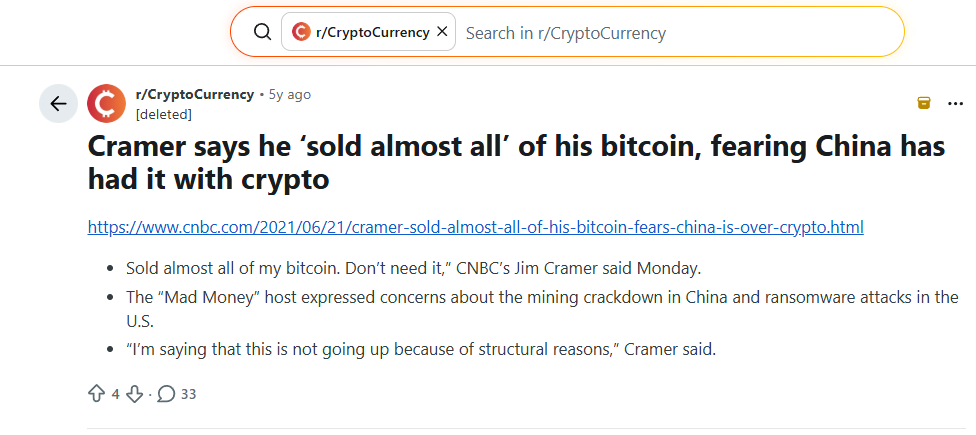
June 2021: “Sold Almost All Of My Bitcoin. Don’t Need It”
In June 2021, Cramer said he had sold most of his remaining Bitcoin and expected further downside, as the market was already under pressure following earlier highs.
In June 2021, Cramer said he had sold most of his remaining Bitcoin. | Source: Reddit
July 21, 2021 close (about one month later): $32,111
Following the June 2021 comment, Bitcoin rose +8.7% over one week and was +1.4% about one month later, despite continued volatility.
December 2022: “It’s Never Too Late to Sell and Awful Position”
In early December 2022, during the post-FTX downturn, Cramer urged investors to exit crypto positions, stating that it was “never too late to sell an awful position.”
Jim Cramer & Bitcoin:
Jun. 21, 2021: 'I sold almost all of my Bitcoin. Don't need it.'
Dec. 5, 2022: 'It's never too late to sell an awful position, and that’s what you have if you own these so-called digital assets.'
Cramer also warned that “marginal” tokens like Dogecoin (DOGE), XRP, Cardano (ADA), and Polygon risk crashing to zero soon, criticizing the industry’s bloated valuations. He questioned Tether’s $65 billion market cap, skeptical of its dollar-pegged stability.
Comparing the current climate to the dot-com bubble, he argued that crypto advocates are struggling to prop up a failing market much like investors did with failing tech stocks years ago.
Bitcoin price at the time
December 5, 2022 close: $16,975
What Bitcoin did next
December 6, 2022 close: $17,090
December 12, 2022 close (one week later): $17,102
January 5, 2023 close (about one month later): $16,837
Bitcoin rose +0.7% the next day, was +0.7% one week later, and −0.8% about one month later, indicating short-term stability rather than immediate continuation in either direction.
Dec. 23, 2022: “I would not touch crypto in a million years”
However, just 2 days before Christmas 2022, he said ‘I would not touch crypto in a million years.’
In a classic display of the “Inverse Cramer” phenomenon, the market has moved in total opposition to Jim Cramer’s 2022 declaration that he had exited all his positions and wouldn’t touch digital assets “in a million years.”
JIM CRAMER IN 2022: "I sold all my crypto. I announced everything on TV. I wouldn't touch crypto in a million years."
While he used his televised platform to warn viewers away from the sector, Bitcoin has defied his bearish outlook by surging over 500% (as of Dec. 13, 2025) since that exit. For many traders, this serves as yet another example of the “never fails” rule: when Cramer definitively calls an end to a trend, the exact opposite often seems to be right around the corner.
October–November 2023: Bearish Comment Followed by Reversal
October 2023: “Truly a Sham Market, You Should Stick With Gold”
In early 2023, Cramer posted strongly negative views about crypto market structure and manipulation concerns, using “sham market.”
the manipulation higher of crypto shows you this is truly a sham market….
Other coverage (and commentary about his shifting stance) also references him urging investors to sell crypto because it “cannot be trusted,” placing that around the same broad timeframe.
What Bitcoin did next:
By January 2024, Bitcoin was materially higher than the early-2023 lows referenced in those discussions, with some data providers noting the move to the mid-$40k area.
November 2023: “I Was Premature” and If You Like Bitcoin, Buy Bitcoin”
Roughly one month later, Cramer said he had been premature in selling and stated that those who like Bitcoin could buy it.
Bitcoin’s price was +19.2% higher than its late-November 2023 close, indicating continued upward momentum into early 2024.
January–February 2024: The “Inverse Cramer” Meme Becomes Productized (and Then Unwinds)
The “Inverse Cramer” idea, doing the opposite of Cramer’s calls, became culturally prominent enough that a real exchange-traded product tied to that concept existed (SJIM, the “Inverse Cramer Tracker ETF”). Its closure/liquidation was announced and reported in early 2024.
Later, a press release stated the Inverse Cramer Tracker ETF would close, with the last trading day noted as February 13, 2024.
This doesn’t prove Cramer is “wrong”; it proves the meme had enough attention to be financialized, then the product was shut down for business/structure reasons described in coverage.
Late 2025: From Qualified Support to “100% Bearish”
November 21, 2025: “I Like Bitcoin… But not Derivatives/Mining Plays”
In November 2025, Cramer said he likes Bitcoin but does not like many derivative/adjacent products built around it (such as certain “ways to play it”).
Almost feels like a cabal is trying to keep Bitcoin above $90,000. I like Bitcoin but i do not like any of the derivatives created to play it or game it or mine it.
By December 25, 2025, Cramer has once again solidified his reputation as the ultimate counter-indicator for the holiday season. Sentiment trackers and market analysts have officially labeled his recent stance as “fully bearish,” following a string of warnings throughout late 2025 where he urged investors to steer clear of digital assets.
JIM CRAMER GOES FULL GRINCH ON BITCOIN 🎄👀
He just flipped 100% bearish on #Bitcoin, calling for more downside and warning investors to stay away.
Funny thing? Every time Cramer gets this confident on the downside, CT starts whispering the same two words: Inverse Cramer.… pic.twitter.com/FZrbQDXiUz
Much like a financial Grinch trying to steal the joy from the October rally, Cramer spent the weeks leading up to Christmas dismissing the market’s resilience, even as Bitcoin hovered near the $87,000–$90,000 range.
While the Mad Money host preached a grim outlook and predicted a winter of “horrible” starts for speculative assets, the crypto community has largely embraced the skepticism as a bullish gift.
For many, his “bah humbug” approach to Bitcoin, even after its massive climb from the 2022 lows he once touted as the end, is seen as the final signal that the uptrend remains intact. To traders, there’s no better Christmas present than a bearish call from Cramer to keep the green candles burning.
Bitcoin price around Christmas 2025
December 25, 2025 trading range: $87,000–$88,000
Because this classification is very recent, there is insufficient post-event price data to evaluate performance beyond normal daily fluctuations.
Here are two sections analyzing the impact of Jim Cramer’s calls and the reality behind the “Inverse” phenomenon.
How Cramer’s Bitcoin Calls Impact the Market
While Cramer is a major media figure, his impact on Bitcoin is often more psychological than structural. Unlike a small-cap stock where a “buy” recommendation on Mad Money can cause an immediate liquidity spike, Bitcoin’s multi-trillion dollar market is too deep for a single commentator to move the needle on price alone.
Instead, his impact manifests in two ways:
Retail sentiment shifts: Cramer’s “100% bearish” stance on Christmas Eve acts as a sentiment barometer for the main street audience. When he warns of a “horrible start” to the year, it often triggers a wave of retail selling or hesitation.
The “meme-ification” of trading: In the crypto world, Cramer has become a contrarian indicator. His bearishness often triggers the opposite reaction from crypto-native traders who view his skepticism as a sign that the “weak hands” have finally exited, marking a local bottom. This “Inverse Cramer” effect creates a self-fulfilling prophecy where traders buy specifically because he told them to sell, ironically propping up the price he predicted would fall.
What the “Inverse Cramer” Record Doesn’t Prove
Despite the viral success of the “Inverse Cramer” meme and the massive 500% gain since his 2022 exit, it’s important to distinguish between humor and a proven financial strategy.
The record doesn’t necessarily prove that Cramer is “always wrong,” but rather highlights a few market realities:
Survivor bias: Humans tend to remember the spectacular misses (like Bear Stearns or “not touching Bitcoin in a million years”) while forgetting the routine calls that were actually correct. For example, his April 2021 call to take profits occurred just weeks before a significant 20% drawdown.
The difficulty of timing volatility: Cramer’s style is high-frequency; he makes dozens of calls a week. Bitcoin’s extreme volatility makes it easy to find a timeframe where any prediction looks “wrong” in hindsight.
Business vs. prediction: The closure of the SJIM (Inverse Cramer ETF) in 2024 proved that even a popular meme doesn’t always translate into a profitable, long-term investment product. Shorting a person’s daily opinions is expensive, complex, and often yields worse results than simply holding a diversified index.
To Trade or Not to Trade: Should You Follow Cramer’s Calls?
When a high-profile figure like Jim Cramer turns “100% bearish” on Bitcoin, especially on a major holiday like Christmas Eve, it creates a storm of social media noise. However, for a responsible investor, the decision to act should be based on data and personal financial health, not a television segment.
1. Distinguish Entertainment from Fiduciary Advice
Cramer is a financial commentator and entertainer; he is not your fiduciary. A fiduciary is legally obligated to act in your best interest based on your specific financial situation.
The conflict: Television shows thrive on high-energy, daily “buy/sell” calls to maintain ratings.
The risk: Cramer’s calls are “one-size-fits-all.” They do not account for your age, your emergency fund, or your specific risk tolerance. Acting on them is essentially following a script written for an audience of millions, not a plan built for you.
2. The Danger of “Chasing the Tape”
Data often shows a “Cramer Bounce” (or dip) where retail investors rush to follow a call immediately after a broadcast.
The reality: These moves are often short-lived. Historically, by the time a retail investor executes a trade based on a TV segment, the “smart money” has often already moved, leaving the retail trader to buy the top or sell the bottom.
Historical context: While the “Inverse Cramer” meme is popular, it stems from the fact that his most extreme calls often occur when market sentiment is already at an exhausted breaking point (like his “million years” call at the 2022 bottom).
3. Use Technical Floors Instead of Social Noise
Rather than reacting to a bearish headline, look at the objective market structure for Christmas 2025. If you are deciding whether to hold or sell, professional analysts point to these specific levels:
The $86,500 support: This is the current “battleground.” As long as Bitcoin stays above this floor, the long-term uptrend remains technically intact regardless of bearish commentary.
The December 26 options expiry:Tomorrow is a major volatility event. Dealers are currently “pinning” the price near $87,000. Acting before this expiry settles is often considered premature and high-risk.
4. The “Inverse” as a Sentiment Tool (Not a Strategy)
If you use the “Inverse Cramer” effect, treat it as a sentiment gauge, not a trading bot.
High sentiment value: When a major media figure turns 100% bearish while the Fear & Greed Index is at 27 (Fear), it suggests that the market may be nearing “max pain.” Historically, this is when “weak hands” exit and long-term “diamond hands” accumulate.
The your-money-your-life- (YMYL) rule: Never bet money you cannot afford to lose on a contrarian meme. Diversification remains the only “free lunch” in finance.
So following Cramer, either with him or against him, is a strategy rooted in reaction. Successful long-term investing is rooted in planning.
If Cramer’s bearishness makes you feel anxious, it may be a sign that you are over-leveraged in crypto. Instead of “panic selling” or “spite buying,” you may consider rebalancing your portfolio to a level where a 20% swing in either direction doesn’t affect your ability to sleep at night.
Disclaimer:
The information provided in this article is for informational purposes only. It is not intended to be, nor should it be construed as, financial advice. We do not make any warranties regarding the completeness, reliability, or accuracy of this information. All investments involve risk, and past performance does not guarantee future results. We recommend consulting a financial advisor before making any investment decisions.
Dr. Guneet Kaur is a senior editor at CCN.com and a Science Fellow at Exponential Science. She is a fintech and blockchain expert with extensive experience in digital finance education, blockchain ecosystems, and cryptocurrency markets. She has worked with global media such as Cointelegraph, as well as education and blockchain platforms, to design and lead strategic content and learning initiatives. As an educator and assessor for top-tier executive programs, she bridges real-world fintech trends with academic insight.
Dr. Kaur is also a published researcher and peer reviewer across fintech and data science journals, including Financial Innovation Journal and International Journal of Big Data Intelligence and Applications. Her work spans data-driven analysis, Web3 innovation, and technical content development. With a strong foundation in both industry and academia, she translates complex financial technologies into practical applications, empowering learners, professionals, and institutions across the rapidly evolving digital finance landscape.


 Easy
Easy