US Treasury yields are rising as bonds sell off. Could this trigger a sharp drop in Bitcoin, Ethereum and XRP prices? | Credit: CCN.com
Share
Key Takeaways
Denmark’s Akademiker Pension fund is selling its U.S. Treasury holdings, citing concerns over U.S. public finances.
U.S. Treasuries remain central to global liquidity, meaning stress in bond markets can spill over into crypto through tighter financial conditions and risk-off sentiment.
Ethereum and XRP are more sensitive to liquidity conditions and may face larger drawdowns than Bitcoin if Treasury yields spike.
For crypto investors, key indicators to watch include Treasury yields, dollar strength, credit spreads, and stablecoin supply, rather than headlines alone.
A fresh warning sign is flashing in global bond markets, and crypto investors are watching closely.
This week, Denmark’s Akademiker Pension fund announced it would sell off its holdings of U.S. Treasury bonds, citing concerns over the sustainability of U.S. public finances. While the decision involves a relatively small allocation in absolute terms, the symbolism is significant: a European institutional investor openly questioning the safety of U.S. government debt.
As Treasury markets wobble, a critical question emerges for digital asset investors: could stress in U.S. Treasuries trigger a sharp sell-off in Bitcoin, Ethereum, and XRP?
To answer that, it’s essential to understand how Treasury markets, liquidity conditions, and crypto prices are connected, and where the real risks lie.
Why US Treasuries Matter to Global Markets
U.S. Treasuries are the backbone of the global financial system. They function as:
The world’s primary risk-free benchmark.
Collateral for banks, hedge funds, and derivatives markets.
A key reserve asset for pensions, insurers, and central banks.
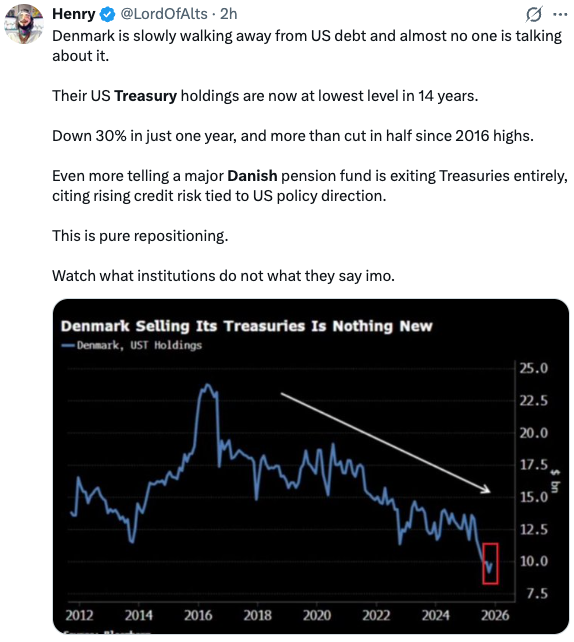
Denmark is selling U.S. Treasury notes. | Credit: Henry X profile
When Treasuries sell off, yields rise. Higher yields increase borrowing costs across the economy and often tighten global liquidity. Historically, periods of Treasury stress tend to ripple outward, affecting equities, emerging markets, and alternative assets, including crypto.
That’s why even modest moves in the Treasury market are closely monitored.
Akademiker Pension Divests Treasuries, Citing US Fiscal Risks
“It is not directly related to the ongoing rift between the US and Europe,” Schelde said, though he acknowledged that recent tensions did not make the decision harder.
Importantly, this is not a mass liquidation. The fund’s Treasury exposure is small relative to its total assets, and there is no evidence of coordinated selling among large European institutions. Still, the move highlights a growing unease around U.S. debt dynamics at a time when deficits are expanding and interest costs are rising.
At the World Economic Forum in Davos, U.S. Treasury Secretary Scott Bessent dismissed the idea that Europe is targeting U.S. debt, calling it a “completely false narrative.”
“I think everyone needs to take a deep breath. Do not listen to the media who are hysterical,” Bessent said, warning that large-scale divestment could destabilize markets.
In the meantime, Trump dialled back his Greenland push, ruling out military force and scrapping threatened tariffs after weeks of ally panic. Aides favoured a softer track. This should be a calm signal for Treasuries.
How US Treasury Market Stress Could Impact Bitcoin and Altcoins
Crypto does not exist in a vacuum. Its price action is deeply influenced by global liquidity, risk appetite, and financial stability.
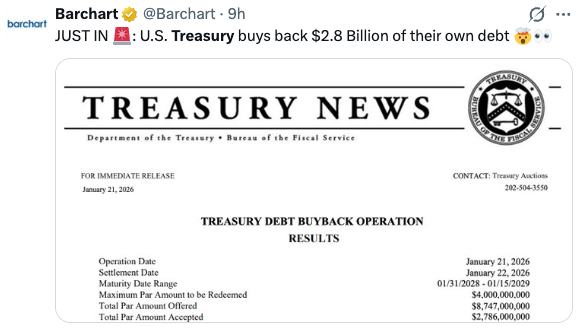
U.S. Treasury buys back notes. | Credit: Barchart X profile
Here’s how Treasury stress could impact crypto markets:
Liquidity tightening: If Treasuries sell off sharply, yields rise. Rising yields often pull capital toward government bonds and away from risk assets. That dynamic can reduce liquidity flowing into crypto markets.
Risk-off behavior: Treasury volatility tends to trigger broader “risk-off” sentiment. During risk-off phases, investors often sell volatile assets, including Bitcoin, ETH, and XRP, to reduce exposure.
Collateral effects: Treasuries are widely used as collateral in global markets. Falling Treasury prices can force deleveraging across hedge funds and trading desks, potentially leading to forced selling in correlated markets.
Bitcoin occupies a unique position. In mild or localized Treasury stress, Bitcoin often trades like a risk asset. But during deeper trust-based crises, where confidence in sovereign debt or fiat systems erodes, Bitcoin’s narrative as a non-sovereign asset can reassert itself.
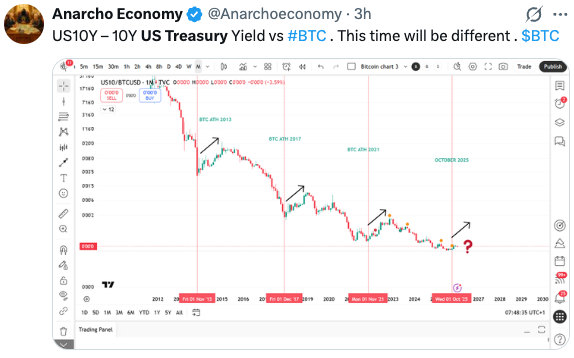
U.S. Treasury 10-year yield. | Credit: Anarcho Economy X profile
The distinction matters:
Short-term Treasury volatility turns bearish for crypto.
Structural loss of confidence in sovereign debt is usually bullish for Bitcoin.
So far, the Akademiker Pension decision looks more like a localized risk-management move than a systemic shift away from U.S. debt.
Why Ethereum and XRP Are More Vulnerable to Liquidity Shocks Than Bitcoin
Ethereum and XRP are generally more sensitive to liquidity conditions than Bitcoin.
If Treasury yields spike and liquidity tightens, ETH often underperforms Bitcoin in the short term.
XRP, meanwhile, tends to behave as a high-beta asset. It benefits from risk-on environments and institutional optimism but can fall sharply during macro-driven sell-offs.
In a scenario where Treasury markets experience sustained stress and global risk appetite declines, ETH and XRP would likely face sharper drawdowns than Bitcoin.
Is This the Start of a Broader Treasury Sell-Off?
At present, there is no evidence of a coordinated or large-scale exit from U.S. Treasuries by foreign institutions.
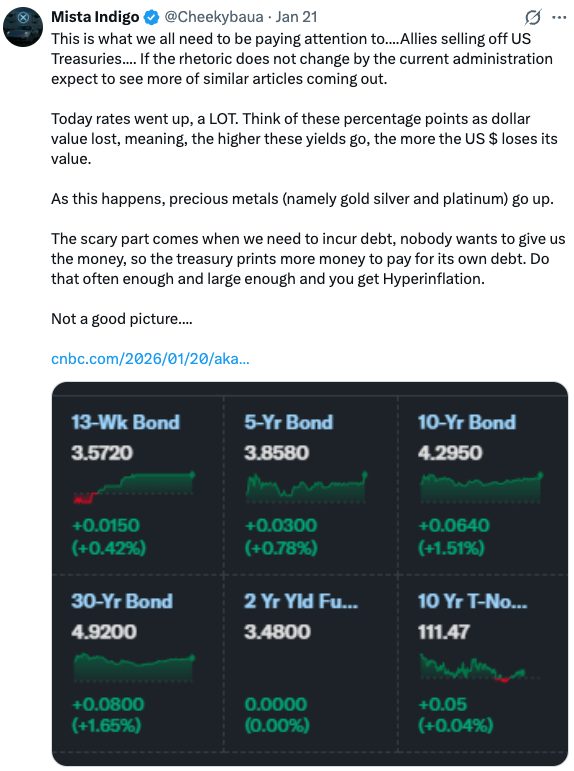
U.S. allies started selling Treasuries. | Credit: Mista Indigo X profile
Several factors limit the immediate downside risk:
If Treasury yields rise gradually and markets remain orderly, crypto may absorb the shock without major damage. But if yields spike suddenly and liquidity dries up, short-term downside risk increases.
Risk Awareness, Not Panic
The Akademiker Pension move is meaningful as a signal, not as a catalyst.
It highlights growing scrutiny of U.S. fiscal health but does not yet point to a structural collapse in Treasury demand. For now, crypto markets face heightened sensitivity, not imminent danger.
Bitcoin, Ethereum, and XRP could experience volatility if Treasury stress escalates, but a sharp, sustained drop would likely require broader financial contagion — something markets are not yet pricing in.
For investors, the takeaway is clear: stay alert, not alarmed. Treasury markets remain a key macro driver for crypto, and the next moves in bonds may matter as much as onchain metrics in the weeks ahead.
Why are U.S. Treasuries important for crypto markets?
U.S. Treasuries underpin global liquidity and serve as the primary risk-free asset. When Treasuries sell off and yields rise, liquidity often tightens across financial markets, which can pressure risk assets like cryptocurrencies.
Did Denmark’s Akademiker Pension fund trigger a broader Treasury sell-off?
No. The fund’s divestment involved roughly €85 million in U.S. bonds and appears to be an isolated risk management decision rather than part of a coordinated or systemic sell-off.
Does a Treasury sell-off automatically mean Bitcoin will fall?
Not automatically. In the short term, Treasury volatility can lead to risk-off behavior that pressures Bitcoin. However, in deeper confidence crises involving sovereign debt, Bitcoin has historically shown resilience as a non-sovereign asset.
Why are Ethereum and XRP more vulnerable than Bitcoin in this scenario?
Ethereum and XRP tend to be more sensitive to global liquidity conditions. During periods of tightening liquidity or rising yields, these assets often experience larger drawdowns than Bitcoin.
Disclaimer:
The information provided in this article is for informational purposes only. It is not intended to be, nor should it be construed as, financial advice. We do not make any warranties regarding the completeness, reliability, or accuracy of this information. All investments involve risk, and past performance does not guarantee future results. We recommend consulting a financial advisor before making any investment decisions.
Giuseppe Ciccomascolo began his career as an investigative journalist in Italy, where he contributed to both local and national newspapers, focusing on various financial sectors.
Upon relocating to London, he worked as an analyst for Fitch's CapitalStructure and later as a Senior Reporter for Alliance News. In 2017, Giuseppe transitioned to covering cryptocurrency-related news, producing documentaries and articles on Bitcoin and other emerging digital currencies. He also played a pivotal role in establishing the academy for a cryptocurrency exchange website. Crypto remained his primary area of interest throughout his tenure as a writer for ThirdFloor.


 Easy
Easy