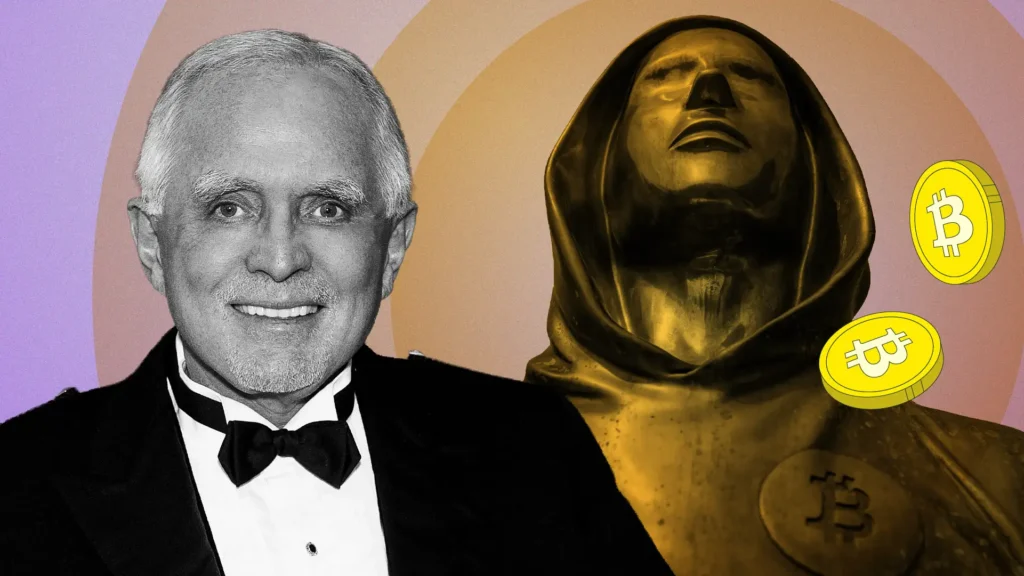
Speculation on Satoshi’s identity shows how anonymity supports Bitcoin’s neutrality, with any reveal risking volatility and legal uncertainty. | Credit: CCN.com
Share
Key Takeaways
Satoshi Nakamoto’s anonymity reinforces Bitcoin’s neutrality, founderlessness, and resistance to political or legal capture.
Even without selling, identifying the owner of early BTC could trigger supply-shock fears and reflexive sell-offs.
An identity reveal could cause sharp drawdowns and volatility without threatening the network’s long-term operation.
ETFs, custodians, and regulated capital are more sensitive to legal and reputational shocks than early retail-driven markets.
A short clip of the investor Dan Peña has been making the rounds again: he argues that if the world ever learned who was “really behind Bitcoin,” people would rush to sell, and Bitcoin could even go to zero. The claim sounds extreme, but it’s worth unpacking because it points at something real: Bitcoin’s price is partly a social contract, and Satoshi Nakamoto’s anonymity is one of the pillars holding that contract together.
This conversation has resurfaced amid a new wave of speculation triggered by the Epstein Files releases, where millions of pages disclosed under the Epstein Files Transparency Act have reignited online theories about elite networks, early crypto funding, and (in the wilder versions) the identity of Satoshi. The Department of Justice has confirmed the scale and timing of these disclosures.
However, there is no evidence in these released records that Jeffrey Epstein was Satoshi, a Bitcoin founder, or a core developer, despite the documents showing he had financial ties to parts of the early crypto ecosystem (donations, investments, email chains).
So why does Peña’s warning resonate anyway?
Because even if the identity reveal didn’t change Bitcoin’s code by a single line, it could change the market’s perception of Bitcoin’s legitimacy, neutrality, and survivability, especially in the short term.
Below is a clear, educational breakdown of the actual mechanisms through which “Satoshi being identified” could create a severe price shock, and why “to zero” is a stretch, but not a random fear.
Still can’t get over the time Dan Pena said
“If you knew who was behind Bitcoin, you would run as fast as you could to sell it” pic.twitter.com/Px0rsBwvoI
Dan Peña is an American businessman, motivational speaker, and self-styled high-performance coach best known as the “$50 Billion Man.”
He built his public reputation around:
Founding Great Western Resources, an energy company, in the 1980s
Teaching an aggressive deal-making framework he calls Quantum Leap Advantage (QLA)
Delivering blunt, confrontational commentary on markets, wealth, and risk
Peña is not a Bitcoin developer, economist, or cryptographer. His influence comes from psychology, capital markets experience, and media presence, not from technical authority in crypto.
When Peña says “Bitcoin could go to zero,” he’s speaking as a macro-minded risk commentator, not as someone evaluating Bitcoin’s code. His statements are best understood as stress-test rhetoric meant to highlight confidence risk, leverage, and narrative fragility rather than a literal price forecast.
That’s why his comments resonate: not because they’re precise, but because they point at how belief, legitimacy, and perception still move markets, especially in moments of uncertainty.
Bitcoin’s ‘Satoshi Myth’ Is Part of Its Monetary Premium
Bitcoin isn’t valuable only because it works. Plenty of systems “work.” Bitcoin also has a monetary premium: people treat it like a global, politically neutral asset with credible scarcity.
Satoshi’s anonymity reinforces three beliefs:
No founder control (no CEO, no central issuer, no “benevolent dictator” who can steer policy).
No personal profit motive (Satoshi mined early coins, but never cashed them publicly).
No jurisdictional anchor (harder to label Bitcoin “a product of country X” or “an organization”).
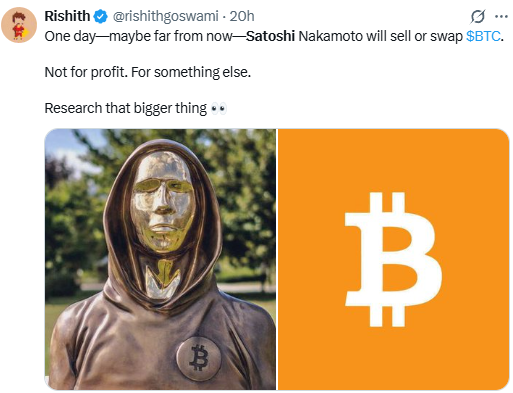
Will Satoshi Nakamoto start to trade Bitcoin? | Credit: Rishith Goswami X profile
If Satoshi is revealed, and the person or group looks politically exposed, ethically compromised, or legally vulnerable, Bitcoin’s neutrality narrative takes a hit. That doesn’t break the network, but it can reduce the monetary premium that sits on top of the technology.
Peña’s argument essentially compresses this into a single line: if the origin story turns ugly, confidence breaks.
Legal Risks of Identifying Satoshi Nakamoto
If Satoshi is identified as a real person (or a group), lawyers immediately ask: who can be sued, subpoenaed, sanctioned, or prosecuted?
Even if Satoshi has no current operational control, identification could trigger:
Civil lawsuits (investor suits, class actions, fraud allegations, whether strong or frivolous).
Government investigations (tax, sanctions, anti-money laundering narratives).
Discovery requests that drag early emails, drafts, and collaborators into public view.
Markets hate uncertainty, especially legal uncertainty. In risk-off moments, “headline risk” can cause violent repricing even when fundamentals are unchanged.
This matters more today because Bitcoin is now deeply integrated into regulated finance (ETFs, custodians, brokers). Institutions don’t like anything that threatens compliance posture.
Satoshi Nakamoto’s Bitcoin Holdings and Market Fear
A huge part of the anxiety is the stash associated with early mining, often estimated at around 1 million BTC (estimates vary; the key point is that it’s large). The market treats those coins like a dormant volcano.
If Satoshi is identified, traders immediately start gaming scenarios:
“Will they sell?”
“Were those coins stolen?”
“Could governments seize them?”
“Will wallets move?”
Even a small on-chain movement from a Satoshi-linked address could trigger reflexive selling because it changes expectations about future supply.
This is closely related to the “Satoshi is back” trope that flares up anytime old wallets move. The market has been trained to react to symbolism as much as flow.
Reputational Risk: If Satoshi Is “Tainted,” Bitcoin Gets Tainted (Fair or Not)
This is where current events have poured gasoline on the discussion.
As the Epstein Files disclosures rolled out, online narratives attempted to connect Epstein to Bitcoin’s origin. The more careful reporting emphasizes the opposite: the documents show proximity to parts of the early institutional ecosystem, but no technical fingerprints tying Epstein to Bitcoin’s creation.
Was Jeffrey Epsteing the creator of Bitcoin? | Credit: Ki Young Ju X profile
Still, reputational shocks can move markets even when the underlying claim is false, especially in crypto, where narratives often travel faster than verification.
If Satoshi were revealed and the identity came with a “toxic association” (criminality, intelligence links, market manipulation allegations), Bitcoin could suffer a temporary legitimacy crisis in mainstream capital markets. That doesn’t mean the protocol stops; it means the marginal buyer might step away until uncertainty clears.
Governance Panic: People Might Overestimate What Satoshi Can Do
Here’s a subtle but important point: many people don’t understand how Bitcoin governance works.
Even if Satoshi appeared tomorrow, they couldn’t unilaterally change the rules. Bitcoin’s consensus is enforced by nodes, miners, developers, exchanges, and users. The system is deliberately designed to make the “founder decree” ineffective.
But markets don’t always trade the truth; they trade what the crowd believes in the moment.
A Satoshi reveal could trigger fear that:
Satoshi can “flip a switch.”
Satoshi can “unlock” some hidden backdoor.
Satoshi can force protocol changes.
Those fears are mostly misunderstandings, but they can still cause liquidation cascades, particularly in leveraged derivatives markets. Peña’s “go to zero” framing is emotionally extreme, but the pathway he’s pointing at is real: panic and leverage can create discontinuous moves.
Is ‘Bitcoin to Zero’ a Realistic Scenario?
For Bitcoin to go to zero, you need more than scandal, you need a collapse in the asset’s ability to function as money-like collateral:
Sustained loss of global liquidity.
Mass exchange delistings.
Institutional exits.
A catastrophic technical failure.
A Satoshi reveal alone probably can’t do that. What it could do is trigger:
Could Bitcoin really go to zero if Satoshi Nakamoto is revealed?
A move to zero is extremely unlikely. For Bitcoin to collapse completely, there would need to be a systemic failure of the network, global liquidity, and market participation. A Satoshi reveal could trigger volatility or a sharp drawdown due to uncertainty and fear, but not a total collapse by itself.
Why does Satoshi’s anonymity matter so much?
Satoshi’s anonymity reinforces Bitcoin’s neutrality. It removes a central figure who could be pressured, regulated, sanctioned, or sued. This strengthens the perception that Bitcoin is not controlled by any person, company, or government, which supports its monetary credibility.
If Satoshi were identified, could they change Bitcoin’s code?
No. Bitcoin is governed by decentralized consensus. Even Satoshi could not unilaterally change the protocol. Any modification would require broad agreement among developers, node operators, miners, and users.
What about the “Satoshi coins”? Could they crash the market?
The fear exists because early wallets associated with Satoshi are believed to hold a large amount of BTC. If those coins moved, markets would react sharply. However, fear does not equal reality, those coins have remained untouched for over a decade, and ownership alone does not imply intent to sell.
Disclaimer:
The information provided in this article is for informational purposes only. It is not intended to be, nor should it be construed as, financial advice. We do not make any warranties regarding the completeness, reliability, or accuracy of this information. All investments involve risk, and past performance does not guarantee future results. We recommend consulting a financial advisor before making any investment decisions.
Giuseppe Ciccomascolo began his career as an investigative journalist in Italy, where he contributed to both local and national newspapers, focusing on various financial sectors.
Upon relocating to London, he worked as an analyst for Fitch's CapitalStructure and later as a Senior Reporter for Alliance News. In 2017, Giuseppe transitioned to covering cryptocurrency-related news, producing documentaries and articles on Bitcoin and other emerging digital currencies. He also played a pivotal role in establishing the academy for a cryptocurrency exchange website. Crypto remained his primary area of interest throughout his tenure as a writer for ThirdFloor.


 Easy
Easy