Blockchain networks and AI systems depend on physical infrastructure that relies on a narrow set of critical minerals. | Image credit: CCN/Veronica Cestari
Share
Key Takeaways
Trump’s tariff announcements trigger immediate risk-off behavior across global markets, and crypto, because it trades 24/7 and carries high leverage, often reacts faster and more sharply than equities.
Rare-earth minerals, data center hardware, AI chips, and energy systems are all critical to blockchain infrastructure, linking trade disputes directly to the long-term cost and scalability of crypto networks.
Executive orders, reserve proposals, and tariff threats can rapidly shift market expectations, injecting political volatility into an asset class already sensitive to liquidity conditions.
Past tariff cycles suggest that when negotiations begin or deadlines are delayed, markets frequently stabilize and recover as risk premiums compress and leverage gradually returns.
On Jan. 17, President Donald Trump announced that the United States would apply a 10% tariff on imports from eight European allies: Denmark, Norway, Sweden, France, Germany, the United Kingdom, the Netherlands, and Finland.
The tariffs would take effect on Feb. 1 and gradually increase to 25% by June 1, 2026, if no deal is reached on the US’s “Complete and Total purchase of Greenland”, signalling the U.S. response to opposition from these allies.
Some of the biggest consequences of the tariffs could directly affect economies and markets across specific areas, including net exports, imports, defense cooperation, and supply chains.
Technology and artificial intelligence (AI) stand among the sectors most integrated with transatlantic trade and global value chains.
The UK’s AI industry alone, the third-largest in the world after China and the U.S., is valued at close to $100 billion and is expected to grow rapidly, but it remains largely dependent on U.S. cooperation.
The impact on blockchain and crypto markets may include increased uncertainty, slower investment in technology infrastructure, and shifts in investor sentiment toward or away from risk assets like crypto.
Tensions affecting global tech supply chains, data centers, hardware imports, and regulatory cooperation could raise costs for crypto networks and services or alter demand for digital assets as a hedge against instability.
This article explains the implications of the tariff threat in the crypto landscape, the economic and technological risks involved, and how geopolitical pressure may shape crypto markets.
Greenland Crisis: Why the US-EU Alliance Faces a Strategic Breaking Point
The dispute over Greenland did not emerge in isolation. It sits within a broader moment of stress in the transatlantic relationship, where long-standing cooperation between Europe and the U.S. faces pressure.
Long-standing alliance under strain: European countries and the U.S. remain tightly aligned through the North Atlantic Treaty Organization (NATO), particularly since Russia’s invasion of Ukraine. Military aid to Ukraine, defense spending commitments, and intelligence cooperation underline this alliance.
NATO pressure: The “Operation Arctic Endurance”, a joint European military exercise in Greenland, triggered U.S. tariffs after the White House framed the deployment as provocative. European officials are now openly debating limits on U.S. access to NATO bases if Danish sovereignty is threatened.
Mixed signals from Washington: European governments remain aligned on Ukraine and Iran, while U.S. diplomacy appears divided, with Congress reassuring Denmark as the White House escalates pressure.
Technology rivalry becomes leverage: While allies, Europe and the U.S., increasingly compete in strategic technologies such as artificial intelligence, semiconductors, and digital infrastructure. Cooperation exists, but so do tensions over regulation, market access, and industrial policy. Within this context, Greenland’s rare-earth resources link territorial tensions to future high-tech supply chains.
These pressures converge most clearly in Greenland.
Rare Earth Control: Rare Minerals and the Future of Tech Supply Chains
Rare earth elements and other critical minerals are essential inputs for many advanced technologies. These materials underlie modern computing processors, energy storage, sensor systems, and components that power blockchain infrastructure, AI systems, and next-generation communication networks.
Greenland is a strategic place for these sources: it is the final frontier for specific minerals.
Why Rare Minerals Matter in Crypto
Blockchain networks and AI systems depend on physical infrastructure that relies on a narrow set of critical minerals. From computing hardware to energy storage, access to these materials shapes how crypto networks scale, operate, and remain secure.
Foundational to high-tech computing: Rare earths like neodymium, dysprosium, and terbium are central to powerful magnets, precision electronics, and high-efficiency components used in data centers, AI accelerators, and blockchain nodes.
Critical for AI hardware: AI model training and inference rely on GPUs, tensor processing units, and custom accelerators that use rare-earth materials to achieve high performance and efficiency. Supply constraints can raise hardware costs and slow roll-outs.
Energy and storage tech: Lithium, cobalt, and nickel are essential for batteries powering data-intensive operations and infrastructure. These materials help sustain long-running servers and mining operations in both the blockchain and AI sectors.
Defense and secure networking: Secure cryptographic systems and military communication networks use components based on rare-earth elements. Any disruption affects not just commercial tech but also national defense systems.
These dependencies expose a deeper issue. Global access to critical minerals remains highly concentrated, turning supply chains into strategic pressure points for technology markets.
Trump’s Tariff Playbook: How Policy Announcements Translate Into Market Moves
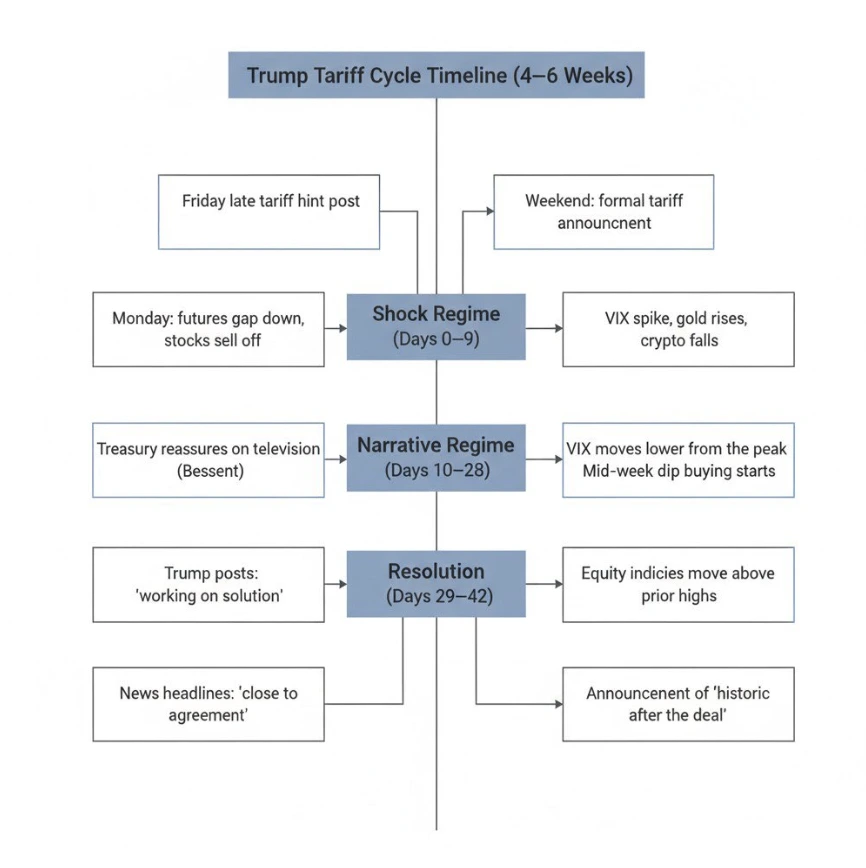
According to BullTheory, major tariff episodes under President Trump tend to follow a repeatable three-phase market cycle driven less by long-term economic fundamentals and more by market structure, timing, and negotiation dynamics. In this framework, tariffs function not only as trade tools but also as instruments of pressure that influence both counterparties and financial markets through carefully sequenced signaling.
Tariff announcements are often timed when markets are closed, allowing uncertainty to build. When trading resumes, selling is driven by automatic risk systems, not careful analysis. Volatility spikes, margin requirements rise, leveraged positions are forced to unwind, and liquidity drops. Stocks fall quickly, while crypto usually drops more due to 24/7 trading and high leverage. This phase reflects market mechanics reacting to uncertainty, not confirmed economic damage.
Phase 2: Narrative Regime (Days 10–28)
After forced selling slows, attention shifts to messaging. Officials emphasize negotiations and flexibility, and markets recognize that tariffs take time to implement. Volatility starts falling from peak levels, panic fades, and dip-buying begins. Prices become highly sensitive to headlines and tone rather than concrete policy changes. Markets stabilize as uncertainty feels more manageable, even though no final resolution has yet been reached.
Phase 3: Resolution Regime (Days 29–42)
This phase begins when tariffs are delayed, softened, or reframed as part of a broader agreement. Even partial clarity reduces uncertainty, allowing risk appetite to return. Liquidity improves, leverage rebuilds, and markets often recover losses or move higher. The rally reflects relief more than optimism about trade outcomes, as investors respond primarily to the end of policy uncertainty rather than long-term economic benefits.
Why the Pattern Matters
According to The Kobeissi Letter, after President Trump said he had a “very good phone call” with NATO’s Secretary General regarding Greenland and agreed to meet with “various parties” in Switzerland, this marks a Step #8 in his tariff playbook – the shift toward negotiations and diplomatic framing after the initial market shock.
BREAKING: President Trump says he had a "very good phone call" with the Secretary General of NATO regarding Greenland and he has agreed to a meeting with "various parties" in Switzerland.
In this framework, easing rhetoric and scheduled talks are signals that pressure tactics are transitioning into the resolution phase, where uncertainty begins to decline and markets start stabilizing.
Immediate Price Reaction in Crypto
Recent tariff threats from President Trump have triggered short-term sell-offs across risk assets, including crypto. Bitcoin has slipped into the low-$90,000s, falling about 2–3% in the initial reactions to the headlines, with other digital assets also trading lower amid heightened uncertainty.
Crypto markets have also experienced significant liquidations of leveraged positions as traders deleveraged amid rising geopolitical and macro risk, with reports estimating hundreds of millions wiped out from crypto positions in less than a day.
Risk-Off Sentiment Drives the Move
The tariff news has acted like a macro shock event for crypto, similar to past tariff scares. Traders and algorithms often treat unexpected geopolitical policy shifts as triggers to reduce exposure in volatile assets like Bitcoin and Ethereum, pushing them down even when the economic impact of the tariffs remains uncertain.
At the same time, traditional markets and safe-haven assets have diverged: gold and silver have surged to record levels as traders seek protection from uncertainty, illustrating how investors rotate out of risk assets in times of stress.
Patterns from Past Tariff Episodes
Historical events (e.g., tariff announcements in 2025) show that crypto often reacts faster and more violently than traditional markets because it trades 24/7 and has high leverage in futures markets. In those episodes, Bitcoin and other tokens saw sharp drops initially, followed by stabilization once policy direction was clarified or when the tariff threat was softened or delayed.
This suggests that the initial price moves reflect risk repricing rather than long-term valuation changes. If the tariff rhetoric eases or negotiations progress, crypto prices may recover as uncertainty declines.
How Supply Concentration Reshapes Crypto and AI Infrastructure
China dominates global refined rare-earth output, accounting for about 70% of total global rare-earth production. This concentration creates supply risk for the West and technology industries that rely on consistent access to these inputs.
Export controls and bottlenecks: Export restrictions or trade tensions can restrict the flow of key components, raising hardware costs or delaying new deployments of blockchain validation infrastructure or AI training clusters.
Processing gap: Even when critical minerals are mined outside China, most refining and processing take place in China, creating a chokepoint before they are turned into chips and components.
Node hardware costs: Blockchain networks rely on distributed nodes with computing hardware. Higher component costs dependent on rare earths (such as high-speed interconnects or storage arrays) increase the cost of running a node, potentially centralizing participation over time.
Mining and validation pressure: Proof-of-work (PoW) mining rigs and proof-of-stake (PoS) validator servers require advanced circuitry and cooling systems that use rare-earth elements. Higher hardware costs can reduce margins and slow network expansion.
AI-enabled crypto tools: Many blockchain and crypto analytics tools now incorporate machine learning and AI for risk modeling, trading signals, and smart contract security. If AI hardware costs rise due to constraints on rare earths, these capabilities become more expensive to build and scale.
Security at risk:Cryptographic security modules and secure enclave technologies often rely on advanced materials sourced from rare-earth supply chains. Disruptions in material flow could impact secure key storage, identity systems, and trusted execution environments.
National tech strategy: Governments are increasingly securitizing rare-earth supply chains, viewing them as foundational to technological leadership in both AI and crypto ecosystems.
As a natural consequence, projects may relocate or restructure infrastructure spending to hedge against supply risks, affecting where and how blockchain networks grow globally.
Greenland and the Arctic are regions with unique advantageous sources and strategic geographic locations.
As pressure builds on critical supply chains and compute infrastructure costs rise, the next section examines how these macro forces interact with market sentiment, liquidity events, and risk pricing in crypto markets.
Strategic competition over rare minerals does not stay confined to long-term policy or infrastructure planning. When trade tensions touch supply chains tied to advanced technology, markets react fast.
For crypto, these pressures raise risk across technology-linked assets, tighten liquidity, and push traders to reassess exposure.
As concerns about rare-earth supply, compute costs, and geopolitical fragmentation intensified, Bitcoin and the broader crypto market began pricing in greater uncertainty. That shift set the stage for the sharp sell-off that followed Trump’s Greenland-linked announcement.
A Geopolitical Shock Hits Bitcoin: The Greenland Candle
Following the announcement and President Donald Trump’s post on Truth Social later that day, Bitcoin reacted sharply across spot and derivatives markets.
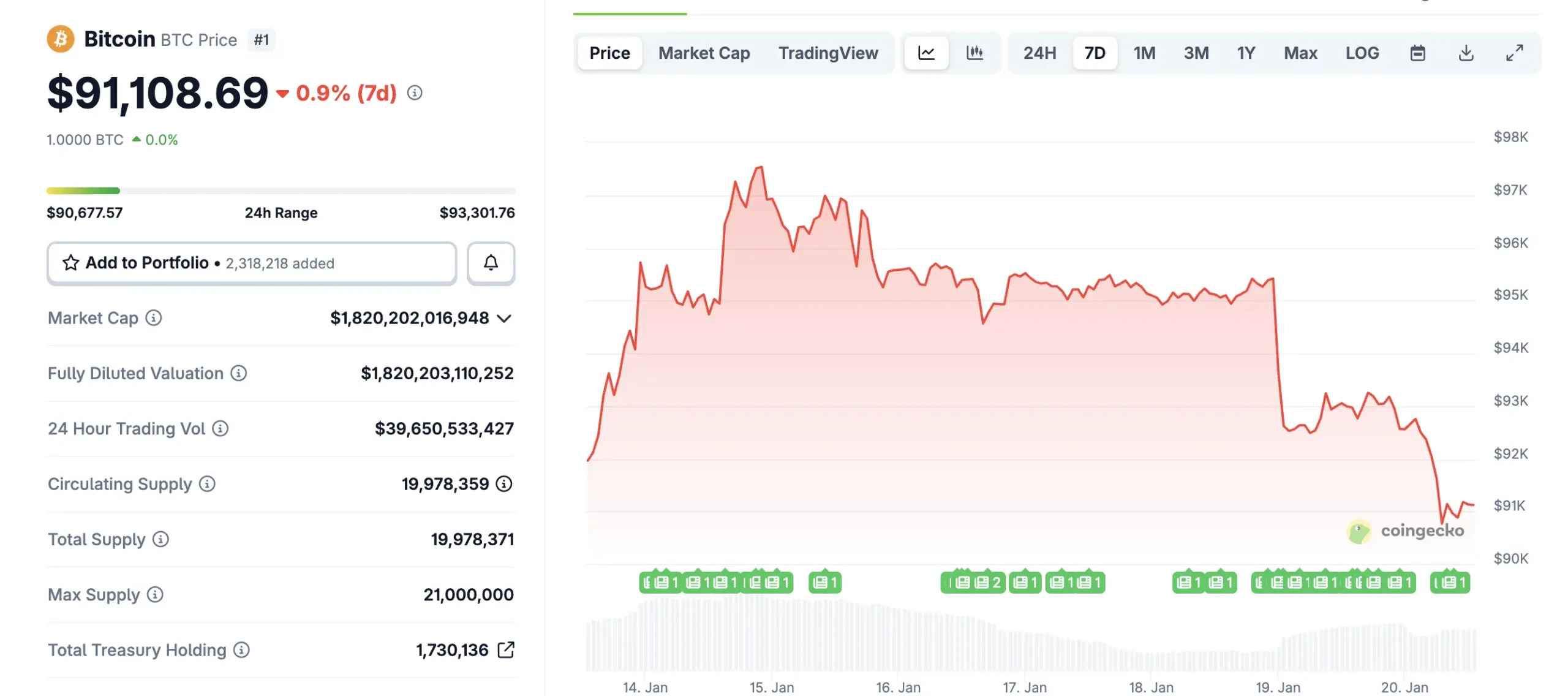
Price reaction: Bitcoin traded near local highs above $96,000 earlier in the week before selling pressure intensified. By Jan. 19–20, BTC dropped sharply toward $91,000, marking a roughly 5% decline from recent highs.
Delayed sell-off: The chart shows that the most aggressive downside move occurred after a period of consolidation, suggesting traders initially absorbed the news before leverage and risk exposure unwound.
Liquidity sweep: The sharp vertical drop into the $91,000 zone reflects a classic liquidity event, where stop-losses and leveraged positions accelerated downside momentum.
The move marked a clear shift from range-bound trading to risk-off behavior, setting the tone for broader weakness across crypto markets.
Trade Policy Uncertainty and Crypto Returns
Empirical research shows a measurable link between U.S. trade policy uncertainty and cryptocurrency price behavior, especially during extreme market conditions.
A 2025 study using a quantile Granger causality framework found that changes in crypto returns can predict shifts in trade policy uncertainty across different market states, while the effect of policy uncertainty on crypto returns is strongest in the tails of the return distribution, meaning during times of stress or extreme volatility.
This implies that during tariff shocks or geopolitical escalations, crypto markets don’t just react emotionally; their price movements are statistically tied to macro policy uncertainty dynamics, with pronounced impact when uncertainty is high.
Trump’s Policy Shifts and Blockchain Regulation Landscape
President Trump’s approach to crypto has been complex and multifaceted, producing both supportive and destabilizing effects on the blockchain ecosystem.
Early in his second term, Trump signed Executive Order 14178 (“Strengthening American Leadership in Digital Financial Technology”), revoking prior CBDC-focused orders and tasking a working group with proposing a federal digital asset framework.
The policy explicitly prohibited central bank digital currencies and created a framework to shape regulation for digital assets, aiming to clarify U.S. regulatory policy.
At the same time, proposals for a U.S. Strategic Bitcoin Reserve that would hold major tokens like BTC, ETH, ADA and XRP signaled potential long-term institutional engagement in digital assets.
This blend of regulatory openness and strategic state involvement has generated periods of optimism and fear in markets, with prices often rallying on policy clarity and selling off when politicalized uncertainty resurfaces.
Public figures in the crypto community have also responded to these shifts: for example, Cardano founder Charles Hoskinson criticized aspects of Trump’s crypto policy as “extractive,” arguing that political agendas, rather than clear regulatory frameworks, sometimes shape outcomes and create fragmentation rather than industry certainty.
Meanwhile, the administration’s broader digital asset strategy, informed by working groups and policy reports, aims to create a more structured regulatory framework, tax clarity, and inter-agency coordination, moving away from “regulation by enforcement” toward predictable rules of the road.
This duality, pro-innovation executive actions alongside high-profile political messaging and industry backlash, illustrates how Trump’s decisions have had both stabilizing and destabilizing effects on the crypto community.
Markets may rally on regulatory clarity but also swing when leadership rhetoric injects political risk into narratives, contributing to short-term volatility and long-term uncertainty.
Could future trade disputes trigger similar Bitcoin sell-offs?
Yes. As crypto integrates more deeply with global capital flows and technology supply chains, geopolitical shocks can trigger rapid risk-off repricing. During periods of high leverage, these events often lead to sharp, short-lived crashes.
Does control over rare earth minerals affect Bitcoin directly?
Rare earths do not change Bitcoin’s software protocol, but they shape the cost of computing power. These minerals remain essential for high-efficiency ASIC mining chips and data center hardware. If governments weaponize supply chains, higher hardware costs can reduce mining profitability and push activity toward regions with more secure access to critical materials.
Is Bitcoin still a safe haven or closer to a tech stock?
Recent data shows a split profile. In the 48 hours following the Greenland tariff news, Bitcoin fell alongside equity markets while gold moved higher. Over the long term, some investors still view Bitcoin as a hedge against currency debasement that can follow prolonged trade conflicts.
What geopolitical signals should crypto traders watch next?
Four signals matter most: changes in U.S. export controls on advanced chips, potential EU digital service taxes, military positioning in the Arctic, and shifts in diplomatic tone during major global forums such as the World Economic Forum.
Disclaimer:
The information provided in this article is for informational purposes only. It is not intended to be, nor should it be construed as, financial advice. We do not make any warranties regarding the completeness, reliability, or accuracy of this information. All investments involve risk, and past performance does not guarantee future results. We recommend consulting a financial advisor before making any investment decisions.
Dr. Lorena Nessi is an award-winning journalist and media technology expert with 15 years of experience in digital culture and communication. Based in Oxfordshire, UK, she combines academic insight with hands-on media practice.
She holds a PhD in Communication, Sociology, and Digital Cultures, and an MA in Globalization, Identity, and Technology.
Lorena has taught at Fairleigh Dickinson University, Nottingham Trent University, and the University of Oxford. She is a former producer for the BBC in London, with additional experience creating television content in Mexico and Japan.
Her research focuses on digital cultures, social media, technology, capitalism, and the societal impact of blockchain innovation.
She has written extensively on digital media and emerging technologies, with her work featured in both academic and media platforms. Her Web3 expertise explores how blockchain technologies shape culture, economics, and decentralized systems.
Outside of work, Lorena enjoys reading science fiction, playing strategic board games, traveling, and chasing adventures that get her heart racing. A perfect day ends with a relaxing spa and a good family meal.


 Easy
Easy