Johns Hopkins economist Steve Hanke calls Bitcoin ‘zero fundamental value,’ sparking debate on BTC price. | Credit: CCN.com
Share
Key Takeaways
Bitcoin’s price is not random; it’s shaped by macroeconomics, investor psychology, and more.
Fixed supply and halvings are major long-term drivers, reducing the issuance of new BTC.
Institutional adoption, including ETF inflows and corporate BTC accumulation, has become one of the most potent catalysts for bullish momentum.
Bitcoin’s price is ultimately the result of many interconnected forces.
Bitcoin is renowned for several key attributes: its decentralized structure, its digital scarcity, and its capacity to evoke both excitement and anxiety through sudden price fluctuations.
Whether you’re a long-term investor, a day trader, or simply someone curious about what moves the world’s largest cryptocurrency, understanding why Bitcoin rises and falls is essential.
Bitcoin doesn’t move randomly. Its price reacts to a combination of macroeconomic conditions, market psychology, technological developments, supply and demand mechanics, and global political events.
This guide breaks down 10 most important forces that shape Bitcoin’s price and explains how they interact to create the market we see today.
#
Force
Why It Matters for Bitcoin’s Price
1
Fixed Supply and Halvings
Reduces new BTC issuance over time, tightening supply and supporting long-term price growth.
2
Global Macroeconomics and Interest Rates
Liquidity, inflation, and central-bank policy directly affect risk appetite and demand for Bitcoin.
3
Institutional Adoption and ETF Flows
Large inflows and outflows increasingly drive market direction and price stability.
4
Regulation and Legal Clarity
Clear rules boost confidence and access; restrictive policies can trigger sell-offs.
5
Market Sentiment and Psychology
Fear, greed, narratives, and social media amplify price movements.
6
Exchange Liquidity and Leverage
Thin order books and high leverage can cause sharp rallies or sudden crashes.
7
Mining Economics and Hashrate
Miner profitability and network security influence supply pressure and sentiment.
8
Technology Upgrades and Infrastructure
Improvements to scalability, privacy, and usability strengthen long-term value.
9
Geopolitical and Financial Crises
Instability in traditional systems can accelerate Bitcoin adoption.
10
Network Adoption and On-Chain Activity
Real usage, transactions, and long-term holder behavior support sustainable price trends.
How Bitcoin’s Fixed Supply and Halvings Influence BTC Price
At its core, Bitcoin is governed by one of the simplest economic principles: supply and demand. But unlike traditional assets, Bitcoin has a hard-coded supply cap of 21 million coins.
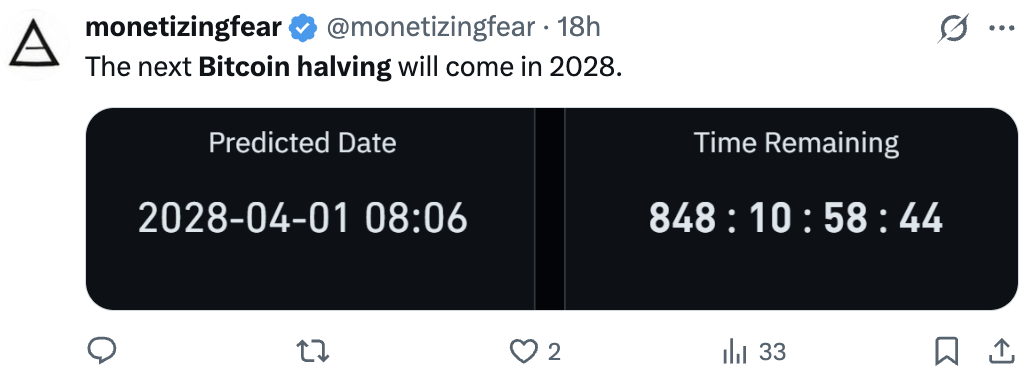
The next Bitcoin halving is scheduled in 2028. | Credit: Monetizingfear X profile
Key elements of Bitcoin’s supply structure include:
Halvings reduce new supply and historically trigger bull markets.
Lost coins permanently shrink the available supply.
Long-term holders remove BTC from exchanges, tightening liquidity.
When demand rises while supply stays fixed or declines, Bitcoin’s price moves higher. When demand weakens or large holders sell, the opposite happens.
How Global Macroeconomics and Interest Rates Move Bitcoin
Despite being billed as “digital gold,” Bitcoin is heavily influenced by big-picture economic trends.
BTC price vs. CPI. | Credit: SoSoValue
Key macro drivers include:
Interest rates: When they’re low, the USD weakens, and the Bitcoin strengthens; when they’re high, a stronger USD weakens BTC.
Inflation: Bitcoin often benefits when fiat currencies lose value.
Bitcoin increasingly trades like a macro asset, reacting to Federal Reserve policy, liquidity cycles, and global economic stability.
Institutional Demand and ETF Flows: The New Bitcoin Price Engine
Institutional participation has reshaped the Bitcoin market.
More institutional inflows mean higher demand, improved liquidity, and stronger price support. Large outflows, however, can quickly reverse momentum.
How Crypto Regulation Impacts Bitcoin Price Volatility
Regulatory developments are among the fastest-acting price drivers.
When governments and regulators introduce policies that support innovation and provide clearer rules for crypto markets, investor confidence tends to rise. These positive regulatory developments make it easier for institutions and individuals to buy, hold, and use Bitcoi, often pushing prices higher.
Examples of bullish regulation include:
ETF approvals: Allow traditional investors to gain exposure to Bitcoin through regulated financial products.
Tax clarity: Reduces uncertainty for investors and businesses, encouraging broader adoption.
Government support for digital assets: Signals long-term legitimacy and reduces perceived regulatory risk.
Negative regulatory actions can quickly create fear and uncertainty in the cryptocurrency market.
When governments impose restrictions or take legal action against major players, it can reduce liquidity, limit access, and cause sell-offs as traders prepare for tighter rules.
Examples of bearish regulation include:
Bans and restrictions: Limit how users can trade, mine, or transact in Bitcoin, hurting adoption.
Exchange lawsuits: Undermine confidence in major platforms and raise concerns about market stability.
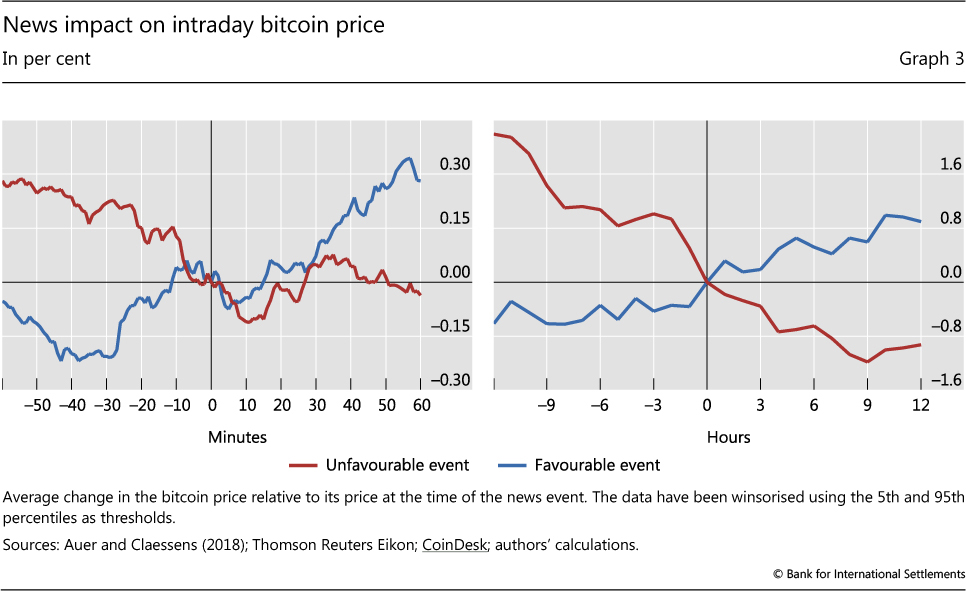
Crypto’s 24/7 news flow can create rapid shifts in sentiment, leading to big moves in either direction.
How Exchange Liquidity and Leverage Cause BTC Price Spikes
Bitcoin’s price often reacts sharply to changes in market liquidity and the amount of leverage traders are using.
In the crypto market, where 24/7 trading and high leverage are the norm, these dynamics can amplify even small price movements into explosive rallies or sudden crashes.
Key mechanics to understand:
Long squeezes push prices down quickly: When heavily leveraged long positions get liquidated during a drop, forced selling accelerates the decline, creating fast, cascading sell pressure.
Short squeezes create powerful upside spikes: If the price rises suddenly, overleveraged short positions are forced to buy back Bitcoin to cover, driving the price even higher in a rapid surge.
Liquidation clusters act as magnets for volatility: Large concentrations of stop-losses and liquidation levels, visible to market makers and algorithms, tend to get targeted, triggering abrupt moves when hit.
Exchange reserves reveal market intent: Rising reserves usually indicate more Bitcoin is being sent to exchanges, often a sign of upcoming selling. Falling reserves suggest accumulation and reduced selling pressure.
High leverage increases volatility in both directions: When traders use excessive leverage, even minor price moves can trigger large liquidation waves, intensifying both bullish breakouts and bearish crashes.
Mining Economics, Hashrate, and Their Effect on Bitcoin Price
Bitcoin’s mining ecosystem plays a crucial, though often indirect, role in shaping long-term price movements. Because miners secure the network and supply newly minted BTC, changes in mining conditions can affect supply dynamics, investor sentiment, and overall market stability.
Key mining metrics that matter:
Hashrate: A higher hashrate signals network strength and miner confidence. When more miners contribute computing power, the network becomes more secure. A rising hashrate typically reflects optimism within the mining sector and can support positive price sentiment.
Mining difficulty adjusts to maintain stable block production: The Bitcoin protocol automatically raises or lowers mining difficulty every two weeks, depending on hashrate. Higher difficulty means mining is more competitive and expensive, which can tighten miner margins and influence selling behavior.
Miner selling impacts market supply: Miners often sell a portion of their BTC to cover operational costs. When revenues fall due to price drops or increased difficulty, miners may sell more BTC, adding downward pressure to the market.
Halvings, energy disruptions, and miner capitulation cycles: Shape long-term trends. Events like block reward halvings reduce new BTC issuance, historically triggering bull markets. Conversely, energy price spikes or miner capitulation (when unprofitable miners shut down) can create temporary instability but often precede substantial recoveries.
How Bitcoin Upgrades and Technology Development Shape BTC Value
Bitcoin evolves slowly, but each upgrade and new layer of infrastructure strengthens the network, supporting long-term price growth. Better scalability, privacy, and usability attract more users and institutions, boosting overall demand.
Key technology developments to watch:
Taproot upgrade: Improves privacy and smart contract efficiency. It makes complex transactions more private and efficient, enhancing Bitcoin’s technical foundation.
Lightning Network adoption: Expands real-world payments. Faster, low-cost transactions increase Bitcoin’s utility as a payment system and drive broader usage.
Bitcoin layers and sidechains add new features: Solutions like Liquid and RSK bring faster settlement, tokenization, and advanced functionality to the Bitcoin ecosystem.
Infrastructure improvements strengthen investor confidence: As Bitcoin becomes more efficient and scalable, it becomes more appealing to institutions and long-term holders.
Geopolitical Risks and Why Global Crises Impact Bitcoin
Bitcoin often sees increased demand during times of geopolitical turmoil. When traditional financial systems become unstable, individuals and investors look for assets that offer independence from government control.
As a borderless, censorship-resistant currency, Bitcoin can serve as a financial haven during times of crisis.
Major geopolitical catalysts:
Bank failures: When confidence in traditional banking collapses, people increasingly turn to Bitcoin as an alternative store of value.
Currency devaluations: In countries facing rapid inflation or a weakening national currency, Bitcoin becomes a means to preserve purchasing power.
Capital controls: Restrictions on moving money across borders drive individuals toward Bitcoin’s open, permissionless system.
War or sanctions: Conflict and sanctions often push citizens or even governments to seek financial tools outside the traditional banking system.
In regions facing uncertainty, Bitcoin’s ability to operate independently of banks or government intervention becomes especially appealing, often boosting demand and influencing price trends.
Network Adoption Metrics: How Usage and Activity Drive BTC Price
The overall health and activity of the Bitcoin network offer some of the most reliable insights into its long-term price potential. Strong network usage reflects real demand, growing adoption, and increasing confidence, factors that typically support sustained price appreciation.
Key on-chain metrics to monitor:
Daily active addresses: More active users indicate higher real-world engagement and stronger network participation.
Transaction volume: Rising volume suggests increased demand for transferring value on the Bitcoin network.
Long-term holder supply: When long-term holders accumulate, it reduces available supply and signals bullish sentiment.
New wallet creation: Growth in new addresses often reflects expanding adoption and onboarding of new users.
As these on-chain metrics strengthen, they point to a healthier network—one that typically supports upward price momentum over time.
Bitcoin’s Price Is Driven by Many Powerful Forces
Bitcoin’s price is shaped by a complex blend of economic conditions, investor behavior, technological progress, liquidity dynamics, adoption trends, and geopolitical events.
Some factors, such as halvings or institutional inflows, shape long-term cycles, while others, like liquidations or news headlines, can move the market within minutes.
Understanding these forces can help investors make more informed decisions, navigate volatility more effectively, and better interpret the underlying signals behind Bitcoin’s price movements.
What are the main factors that influence Bitcoin’s price?
Several significant forces, including supply and demand dynamics, macroeconomic conditions, institutional investment, market sentiment, regulation, mining economics, geopolitical events, and on-chain network activity, shape Bitcoin’s price. These factors interact constantly, creating both long-term trends and short-term volatility.
How does Bitcoin’s fixed supply make its price go up?
Bitcoin has a maximum supply of 21 million coins, which cannot be changed. As more people buy and hold Bitcoin while new issuance slows (especially after halvings), supply becomes tighter. When demand increases faster than supply, the price tends to rise.
How do interest rates and inflation impact Bitcoin?
Low interest rates and high inflation typically boost Bitcoin because they weaken the U.S. dollar and reduce the appeal of traditional savings. High interest rates, on the other hand, often strengthen the dollar and reduce risk appetite, putting downward pressure on BTC.
Does Bitcoin trade more like a tech asset or a safe haven?
Bitcoin behaves like both, depending on the environment. In risk-on markets, it often moves with tech stocks. During inflation or geopolitical stress, demand can rise for Bitcoin as a store of value. Its behavior changes based on broader macroeconomic conditions.
Disclaimer:
The information provided in this article is for informational purposes only. It is not intended to be, nor should it be construed as, financial advice. We do not make any warranties regarding the completeness, reliability, or accuracy of this information. All investments involve risk, and past performance does not guarantee future results. We recommend consulting a financial advisor before making any investment decisions.
Giuseppe Ciccomascolo began his career as an investigative journalist in Italy, where he contributed to both local and national newspapers, focusing on various financial sectors.
Upon relocating to London, he worked as an analyst for Fitch's CapitalStructure and later as a Senior Reporter for Alliance News. In 2017, Giuseppe transitioned to covering cryptocurrency-related news, producing documentaries and articles on Bitcoin and other emerging digital currencies. He also played a pivotal role in establishing the academy for a cryptocurrency exchange website. Crypto remained his primary area of interest throughout his tenure as a writer for ThirdFloor.


 Easy
Easy