Their reasoning? Limited supply (21 million BTC), rising institutional demand, and Bitcoin’s potential role as “digital gold” in an uncertain financial world.
But if that day ever comes, who actually wins and loses? The answer is more complex than you might think.
Before diving into winners and losers, it’s worth unpacking what 1 BTC = $1 million would represent economically.
There will only ever be 21 million Bitcoin.
A $1 million price per coin would mean a total market value (market capitalization) of roughly $21 trillion.
That would make Bitcoin more valuable than all the gold in the world (currently around $20 trillion) and nearly the size of the U.S. economy. Such a scenario would make crypto investors rich and reshape global finance, politics, and power.
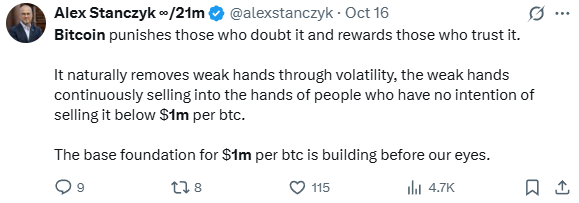
“Bitcoin punishes those who doubt it and rewards those who trust it,” says Alex Stanczyk. | Credit: @aexstanczyk X profile
Road to 1 BTC = $1 Million: What It Would Take
Reaching $1 million per Bitcoin would imply a market capitalization of roughly $19 trillion, assuming around 19 million BTC in circulation. That would make Bitcoin more valuable than gold’s current estimated market cap of about $15 trillion.
Several factors could drive such a rise:
Institutional adoption: Major corporations and financial institutions might increasingly hold Bitcoin as a strategic reserve asset, much like gold in the 20th century.
Fiat currency debasement: If global inflation persists or confidence in government-backed currencies declines, Bitcoin’s scarcity (hard-capped at 21 million coins) could make it a preferred store of value.
Technological integration: The rise of Bitcoin-based financial products, decentralized payment systems, and Lightning Network scalability improvements could expand everyday use.
But a $1 million Bitcoin wouldn’t just be a financial milestone, it would signal a massive realignment of global power and wealth.
Big Winners If Bitcoin Hits $1 Million
Long-Term Bitcoin Holders (“HODLers”)
The most obvious winners are the early adopters and those who have held Bitcoin throughout its volatile history.
Someone who bought one Bitcoin for $1,000 in 2013 would see that investment grow by 100,000% to $1 million per coin. Even small holdings could transform lives, $500 worth of Bitcoin today (at around $70,000 per coin) would be worth about $7,000 if Bitcoin reached that target.
This group includes:
Early miners who earned Bitcoin when it was almost worthless.
Long-term believers who ignored every crash.
Companies that have decided to use Bitcoin as a treasury asset.
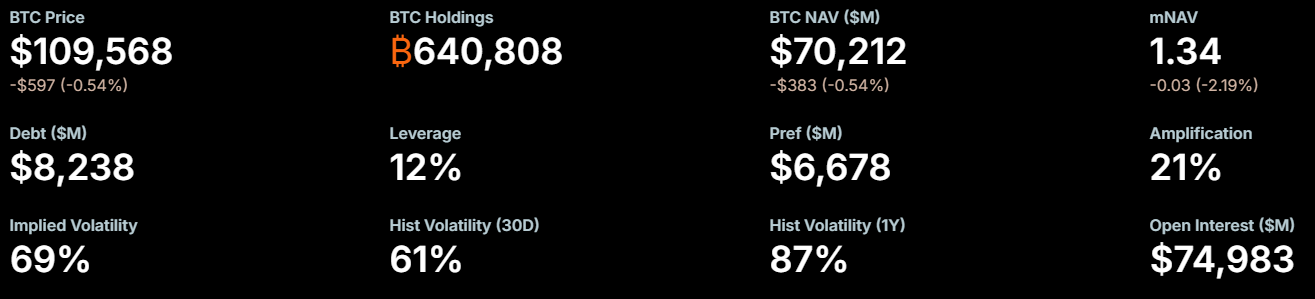
Among these, the most famous one is Michael Saylor’s Strategy (formerly known as MicroStrategy, trading under the ticker MSTR), which now holds over 640,000 BTC.
On the other side of the Pacific Ocean, Metaplanet mirrors Strategy’s bet on Bitcoin. The Japanese company holds 30,823 Bitcoin as of Oct. 30, 2025, worth $3.33 billion.
According to BitcoinTreasuries.net, in the ranking of the public companies holding most Bitcoin, Strategy is followed by MARA Holdings (Marathon Digital), which holds 53,250 BTC, and XXI (CEP) with 43,514 BTC.
Then sits Metaplanet. Other notable holders include Bitcoin Standard Treasury Company (30,021 BTC), Bullish (24,300 BTC), and Riot Platforms (19,287 BTC). Meanwhile, Trump Media & Technology Group appears on the list with 15,000 BTC, ahead of CleanSpark (13,011 BTC) and Coinbase Global (11,776 BTC).
Together, these companies represent a growing wave of corporate adoption, where public firms increasingly treat Bitcoin as a strategic asset and potential hedge against inflation.
Strategy is the largest Bitcoin holder among public companies. | Credit: Strategy
For them, $1 million Bitcoin wouldn’t just mean wealth but vindication after years of being called reckless or delusional.
Crypto Infrastructure Companies
Exchanges like Coinbase, wallet providers, and Bitcoin mining companies would experience enormous growth.
Transaction fees would surge in dollar value as the asset appreciates.
Assuming energy and regulatory conditions remain favorable, mining firms could become some of the most profitable companies on earth.
From custodians to fund managers, financial service providers would build an entire economy around Bitcoin’s trillion-dollar ecosystem.
Traditional institutions, such as Fidelity, BlackRock, and Goldman Sachs, which have already entered the Bitcoin ETF market or custody services, could become indirect winners as demand for Bitcoin-based financial products surges.
Developing Economies and Individuals Facing Inflation
In countries experiencing high inflation or weak currencies, such as Argentina, Turkey, or Nigeria, Bitcoin already serves as an alternative store of value and a practical tool for cross-border transactions.
If Bitcoin reached $1 million, it could:
Offer an inflation hedge for millions.
Give unbanked populations access to global digital finance.
Reduce dependence on unstable local currencies or restrictive capital controls.
At that point, Bitcoin’s role as a means of economic survival would evolve into one of wealth preservation, and for some, even wealth creation, reinforcing its position as a parallel financial system outside government control.
Governments and Institutions That Hold Bitcoin
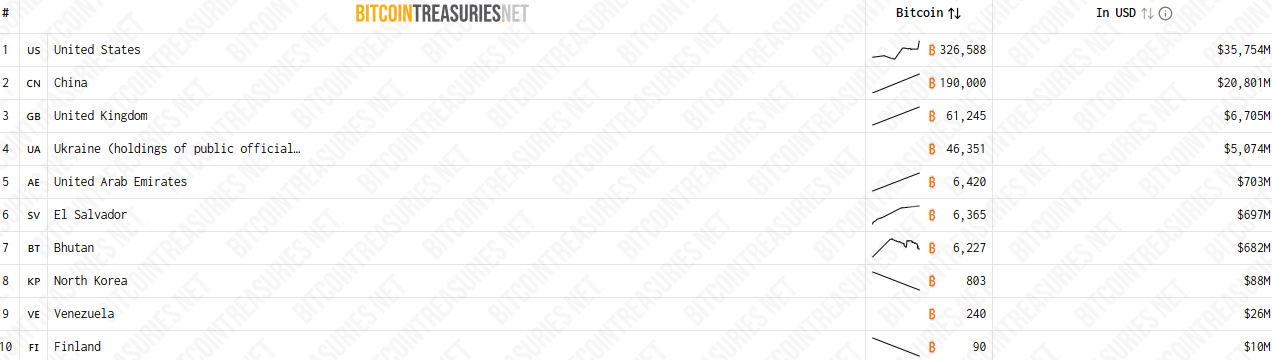
Some governments, like El Salvador, already hold Bitcoin in their national reserves. Others, including the U.S., have seized Bitcoin in criminal cases.
U.S. lead the ranking of governments holding Bitcoin. | Credit: BitcoinTreeasuries.net
At $1 million per coin, these holdings would represent massive windfalls. For instance:
El Salvador’s 6,365 BTC (as of 2025) would be worth $5.7 billion.
These gains could reshape national balance sheets and even influence monetary policy.
Early Builders and Developers
The engineers, entrepreneurs, and communities that helped Bitcoin evolve, often without direct compensation, would gain recognition and financial rewards. Many still hold small stashes of BTC from the early days, but they are now worth fortunes.
Their success would symbolize the triumph of open-source innovation, a rare case where decentralized development created one of the world’s most valuable assets.
Who Loses If Bitcoin Hits $1 Million
If Bitcoin’s rise sounds universally positive, think again. A world where one digital asset becomes worth more than most national currencies would create severe disruption; not everyone would benefit.
Central Banks and Fiat Currency Systems
A $1 million Bitcoin implies a collapse in confidence in traditional money systems. It would suggest that people no longer trust fiat currencies like the U.S. dollar, euro, or yen to hold their value.
Central banks, whose primary power lies in issuing and managing currency, would face a world in which a non-state currency outcompetes their own, something unprecedented in modern history.
Governments That Fail to Adapt Bitcoin
Countries that ban or overregulate Bitcoin might isolate themselves from global capital flows. Businesses and citizens could migrate their wealth digitally, evading local financial systems.
Governments could lose:
Tax revenue is affected as crypto transactions bypass traditional channels.
Capital control is especially prevalent in nations with strict limits on money movement.
Political leverage, as economic influence shifts toward decentralized finance.
In extreme cases, this could destabilize weaker economies that rely on controlling the money supply to maintain authority.
Banks and Financial Intermediaries
Bitcoin at $1 million would mean a massive shift toward self-custody and peer-to-peer finance. Traditional financial institutions could lose relevance if people trust digital wallets over banks.
JPMorgan’s CEO, Jamie Dimon, changed his view on Bitcoin. | Credit: @juniortgr X profile
Why? History shows that most retail buyers enter near the top. When Bitcoin crosses six figures, fear of missing out (FOMO) could drive a massive wave of late buying right before a correction.
Many might lose money trying to chase the rally instead of accumulating early.
As with every financial mania, latecomers often fund the exits for early adopters.
Bitcoin’s Energy Dilemma
Bitcoin’s network consumes large amounts of energy due to its proof-of-work (PoW) mining system. If prices skyrocket, miners would likely add more machines, potentially increasing global energy consumption.
While some miners use renewable energy, a sustained boom could still:
That said, newer mining technologies and carbon-neutral initiatives could help mitigate these effects, but only if the industry proactively evolves.
How a $1 Million Bitcoin Could Reshape the Global Financial Order
1 BTC = $1 million wouldn’t just create winners and losers but reshape the financial order. Some likely effects include:
Redefining wealth: Early Bitcoin owners could become the new elite class.
Changing corporate balance sheets: Firms might hold Bitcoin as a strategic reserve instead of cash.
New financial infrastructure: Global payment rails could move to blockchain, bypassing traditional banks.
Geopolitical shifts: Nations embracing Bitcoin could gain influence, while others risk economic isolation.
In many ways, it would be a global redistribution of wealth and power, from centralized institutions to decentralized networks, and from older generations of savers to a younger, tech-native class.
Could Bitcoin Really Reach $1 Million?
Theoretically, yes, but it depends on several assumptions:
Macroeconomic instability is driving people toward non-sovereign assets.
Regulatory acceptance, allowing institutions to hold and trade Bitcoin freely.
Skeptics, however, argue that Bitcoin’s volatility, energy use, and lack of intrinsic cash flow make a $1 million price unrealistic without massive inflation in fiat currencies.
Still, history shows that Bitcoin has defied skepticism before, rising from a few cents to tens of thousands of dollars in just over a decade.
Satoshi Nakamoto Could Become the First Trillionaire If Bitcoin Reaches $1 Million
If Bitcoin ever reaches $1 million per coin, its mysterious creator, Satoshi Nakamoto, could become the world’s first trillionaire. Believed to control about 1.09 million BTC mined in Bitcoin’s earliest days, Nakamoto’s holdings would be worth roughly $1.09 trillion at that price.
Yet none of these coins have ever moved, adding to the legend of the anonymous inventor who disappeared in 2011. Whether the keys are deliberately untouched, lost, or belong to a collective remains unknown.
This dormant fortune, nearly 5% of all Bitcoin, embodies both the promise and the paradox of the cryptocurrency revolution: a decentralized financial system whose greatest wealth rests with an invisible founder.
If Bitcoin fulfills its destiny as digital gold, Satoshi’s untouched stash will stand as the ultimate symbol of belief, restraint, and the immense power of being first in a system built on mathematics rather than trust.
Bitcoin at $1 Million: A New Era or the Same Inequality?
If Bitcoin ever reaches $1 million, it will be more than a financial milestone: it will mark a turning point in economic history.
Winners will include early adopters, crypto infrastructure players, and anyone positioned in the decentralized economy. Losers may be traditional financial systems, governments that resist change, and latecomers hoping for easy riches.
Ultimately, such a future would raise a profound question: Is Bitcoin’s rise a revolution against the old order, or the beginning of a new one just as unequal, only digital?
It’s possible, but far from guaranteed. Bitcoin’s fixed supply and rising institutional adoption could increase prices, especially if it’s increasingly seen as “digital gold.” However, significant challenges, including regulation, volatility, and competition from other assets, make such a price speculative, not sure.
How much would Bitcoin’s total value be at $1 million per coin?
With 21 million coins as the maximum supply, Bitcoin’s market capitalization would be about $21 trillion. That’s more than all the gold in the world, and it is close to the size of the U.S. economy, meaning Bitcoin would become one of the most significant financial assets ever.
Would inflation or economic crisis be required for Bitcoin to hit that level?
Possibly. A high price would probably require global inflation, currency debasement, or a major loss of trust in fiat money. In that scenario, Bitcoin might serve as a safe haven, similar to gold during crises.
Could late investors still make money if Bitcoin reaches $1 million?
Maybe, but risk would be high. If prices approach $1 million, many late buyers could face sharp corrections or high transaction fees. Historically, retail investors tend to enter near market peaks and struggle to hold through volatility.
Disclaimer:
The information provided in this article is for informational purposes only. It is not intended to be, nor should it be construed as, financial advice. We do not make any warranties regarding the completeness, reliability, or accuracy of this information. All investments involve risk, and past performance does not guarantee future results. We recommend consulting a financial advisor before making any investment decisions.
Giuseppe Ciccomascolo began his career as an investigative journalist in Italy, where he contributed to both local and national newspapers, focusing on various financial sectors.
Upon relocating to London, he worked as an analyst for Fitch's CapitalStructure and later as a Senior Reporter for Alliance News. In 2017, Giuseppe transitioned to covering cryptocurrency-related news, producing documentaries and articles on Bitcoin and other emerging digital currencies. He also played a pivotal role in establishing the academy for a cryptocurrency exchange website. Crypto remained his primary area of interest throughout his tenure as a writer for ThirdFloor.


 Easy
Easy