Home / News / Crypto / Ripple (XRP) / XRP’s Cross-Border Battle Heats Up as HSBC and Standard Chartered Go Live With Tokenized Deposits on SWIFT Ledger
XRP’s Old SWIFT Advantage Is Disappearing as Banks Move Tokenized Money Onchain
Share
Key Takeaways
HSBC and Standard Chartered completed the first live interbank cross-border transaction on SWIFT’s blockchain-based ledger on Aug. 19.
SWIFT is not using XRP, stablecoins, or a common blockchain currency. Each bank keeps its own tokenized deposits, while SWIFT coordinates, matches, and nets obligations before final settlement through existing banking systems.
XRP takes a different route, acting as a bridge asset between currencies on the public XRP Ledger. However, Ripple Payments now also supports RLUSD, USDC, USDT and fiat, meaning Ripple’s cross-border strategy is no longer dependent on XRP alone.
SWIFT has moved its blockchain payments project from testing into its first live interbank transaction, putting two of the world’s largest banks on a new 24/7 cross-border rail that competes with one of XRP’s longest-standing use cases.
HSBC and Standard Chartered announced on Aug. 19 that they had completed the first live cross-border transaction on SWIFT’s blockchain-based ledger, following the network’s July launch with 17 participating banks across six continents.
🚨 SWIFT, HSBC and Standard Chartered just completed the FIRST live cross-border tokenised deposit transaction on Swift’s blockchain ledger.
Bank money is starting to move onchain, 24/7, effectively copying the blockchain tech.
But calling the system an XRP-style blockchain payment network would be misleading.
The money moving between HSBC and Standard Chartered remained regulated bank money, and SWIFT did not introduce a cryptocurrency to bridge the two institutions.
Anton Lobintsev, co-founder of stablecoin infrastructure provider SquareFi, told CCN that SWIFT is concentrating on the part of cross-border banking it already controls.
“SWIFT is defending the one thing it owns: coordination between banks. So it’s not so much about becoming a blockchain or building a settlement chain, but rather an orchestration layer over deposits that stay on each bank’s own ledger. Day one, it’s a 24/7 liquidity overlay on top of correspondent banking; money moves before final settlement still clears through the old rails. That’s exactly why 17 tier-1 banks signed.”
How Tokenized Deposits Actually Settle on SWIFT’s Blockchain
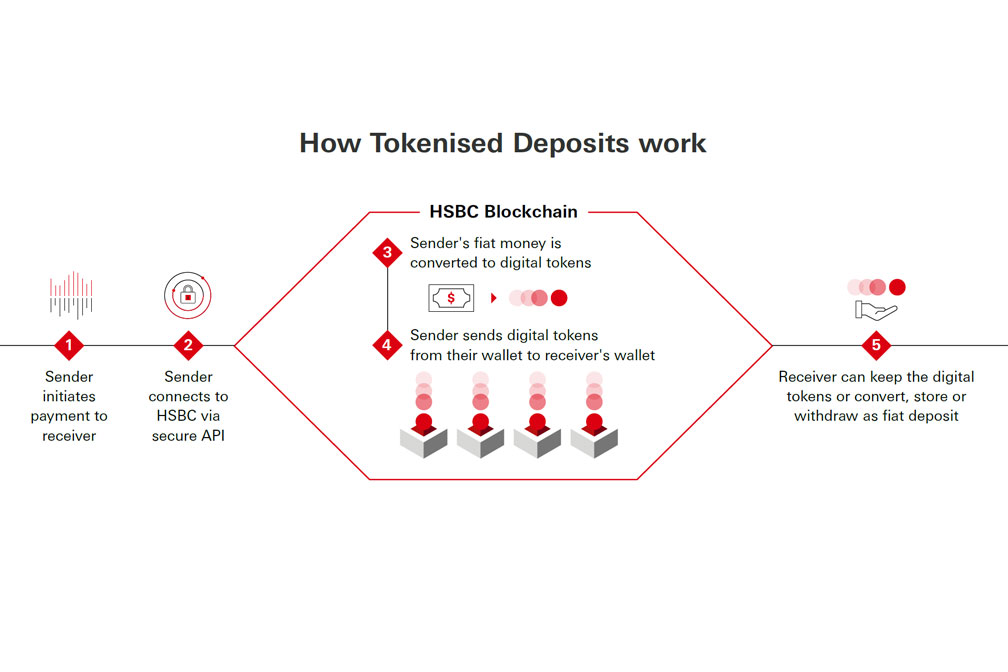
A tokenized deposit is essentially a digital representation of money already held at a commercial bank.
HSBC describes its Tokenized Deposit Service as converting deposits into digital tokens on a 1:1 basis, allowing customers to transfer those balances around the clock. Unlike a stablecoin such as USDT or RLUSD, the token remains a liability of the issuing bank.
HSBC’s service is already live across six markets, including the UK, US, Hong Kong, Singapore, Luxembourg, and the UAE, and supports currencies such as USD, GBP, EUR, HKD, and SGD.
In the HSBC-Standard Chartered transaction, payment messages moved through SWIFT’s new ledger. The resulting obligations were then recorded on HSBC’s Tokenized Deposit Service and Standard Chartered’s own tokenized-deposit infrastructure.
The new SWIFT setup allows banks issuing those tokens on separate systems to interact. Also, it is important to note that if HSBC tokenizes a corporate client’s $10 million deposit, the token still represents a claim against HSBC. It is not an independent asset like XRP and it is not a bearer stablecoin such as USDT or RLUSD.
However, Lobintsev said interoperability, rather than the creation of the tokens themselves, is where the larger challenge begins.
“SWIFT already proved the rails exist. The harder part of tokenisation was getting different banks’ tokenised deposits to interoperate, which they’re proving now. HSBC and Standard Chartered aren’t running on the same ledger; they’re keeping their tokenised deposits on their own infrastructure, while SWIFT’s ledger coordinates and nets the obligations between them.”
The process can be simplified as:
Bank deposit → tokenized deposit on the bank’s infrastructure → SWIFT coordinates and nets obligations → final settlement through existing banking rails.
That final step is important. SWIFT’s blockchain does not currently replace traditional interbank settlement infrastructure.
Instead, it provides participating banks with a shared coordination layer that operates around the clock.
Lobintsev added:
“That’s the whole thesis of an orchestration layer: it becomes valuable once you have multiple banks issuing deposit tokens on different systems that still need to interoperate. One live transaction between two tier-1 banks is small in volume, but it’s a meaningful proof point for the other 15 banks in the pilot as they move toward their own live transactions.”
XRP Solves the Same Problem Differently
XRP’s proposed role in cross-border payments sits at another part of the transaction.
A payment provider could convert the sender’s currency into XRP, transfer XRP across XRPL, and then sell it for the recipient’s local currency. Ripple says transactions on XRPL settle in roughly three to five seconds.
The flow is closer to (an example below):
USD → XRP → XRPL settlement → XRP → EUR.
XRP therefore provides both a transferable asset and a potential source of cross-currency liquidity. The idea is to reduce the need for payment companies to leave money sitting in pre-funded accounts across multiple countries.
SWIFT’s current model does not publicly show that same neutral bridge-asset mechanism. Its Aug. 19 announcement did not disclose the transaction’s amount, currencies, FX process, or how cross-currency liquidity would be sourced.
That makes claims that SWIFT has already “replaced XRP” premature.
According to Lobintsev, the two forms of tokenized money are likely to serve different parts of the market.
“Tokenized deposits and stablecoins are not competing for the same job. A tokenized deposit is a bank liability inside the regulated perimeter. A stablecoin is a bearer instrument built for reach and composability. Deposits win the institutional core with interbank, treasury, wholesale, and stablecoins win the corridors banks don’t serve, counterparties with no correspondent relationship, anything that has to compose with the open stack. At the end of the day, institutions will run both.”
This distinction also helps explain where RLUSD could compete.
A bank-to-bank transaction between HSBC and Standard Chartered may fit naturally into SWIFT’s tokenized-deposit model. A fintech paying a supplier in a market where it lacks a correspondent relationship could instead find it easier to move a stablecoin.
XRP adds another option when liquidity needs to move between different currencies rather than remaining dollar-denominated.
SWIFT has, however, moved directly into territory traditionally used to market blockchain payment networks: 24/7 transactions, faster liquidity movement, and fewer banking cut-off restrictions.
Its scale could be formidable. The July pilot includes Citi, BNY, BNP Paribas, DBS, UBS, Wells Fargo, HSBC, and Standard Chartered among 17 initial banks. SWIFT says its existing infrastructure already connects more than 200 markets.
There is another twist.
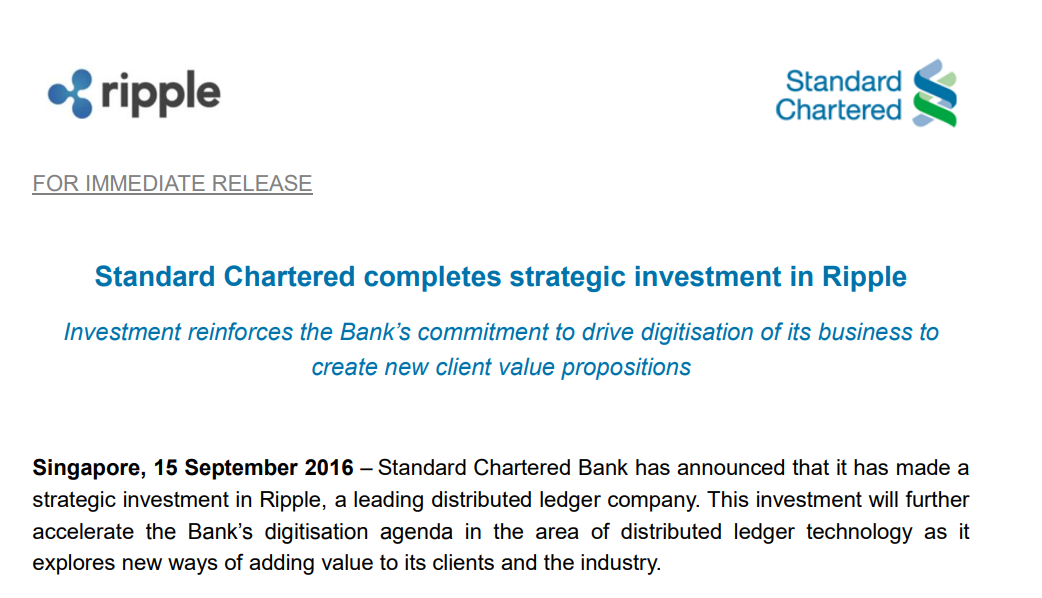
Standard Chartered has experience on both sides of this race. The bank invested in Ripple in 2016 and that same year completed a real-time cross-border payment pilot using Ripple technology in less than 10 seconds. It later participated in RippleNet payment trials.
Standard Charted made a strategic investment in Ripple in 2016. | Source: sc.com
Almost a decade later, it has now executed SWIFT’s first live blockchain-ledger transaction.
Ripple Isn’t Betting Only on XRP Either
The competition is also no longer simply SWIFT versus XRP.
Ripple’s current payments platform supports settlements in RLUSD, USDC, USDT, and fiat, and says the settlement layer is deliberately not dependent on a single token. Ripple still positions XRP as a bridge asset, but customers can use stablecoins instead.
The two strategies are moving toward the same objective from different directions.
SWIFT wants banks to make their existing deposits programmable and interoperable without leaving regulated banking infrastructure. Ripple offers a blockchain-first route in which XRP or stablecoins can move value across public blockchain rails before being converted into the required currency at the destination.
For XRP, the competitive question is no longer whether legacy banking can offer always-on blockchain payments. HSBC and Standard Chartered have now shown that it can.
The bigger question is whether SWIFT can make tokenized deposits interoperable across hundreds of banks and currencies while retaining its existing settlement architecture, or whether a bridge asset (crypto) such as XRP can still solve cross-currency liquidity more efficiently at scale.
Disclaimer:
The views, thoughts, and opinions expressed in the article belong solely to the author, and not necessarily to CCN, its management, employees, or affiliates. This content is for informational purposes only and should not be considered professional advice.
Dr. Guneet Kaur is a senior editor at CCN.com and a Science Fellow at Exponential Science. She is a fintech and blockchain expert with extensive experience in digital finance education, blockchain ecosystems, and cryptocurrency markets. She has worked with global media such as Cointelegraph, as well as education and blockchain platforms, to design and lead strategic content and learning initiatives. As an educator and assessor for top-tier executive programs, she bridges real-world fintech trends with academic insight.
Dr. Kaur is also a published researcher and peer reviewer across fintech and data science journals, including Financial Innovation Journal and International Journal of Big Data Intelligence and Applications. Her work spans data-driven analysis, Web3 innovation, and technical content development. With a strong foundation in both industry and academia, she translates complex financial technologies into practical applications, empowering learners, professionals, and institutions across the rapidly evolving digital finance landscape.