Is Ripple Building Repo Settlement on XRPL? GitHub Comment Reveals New Institutional Use Case
Share
Key Takeaways
A Ripple product manager has confirmed on GitHub that the company is “building repo settlement on XRPL,” with Ripple Custody named as the immediate customer for a proposed on-chain co-signing system.
The comment is not an isolated hint. Ripple previously said Hidden Road, now Ripple Prime, would use XRPL to streamline post-trade operations across the FX, swaps, and repo markets.
What remains unknown is equally important: Ripple has not disclosed the repo counterparties, the assets, the launch date, or whether XRP or RLUSD will be on either side of the repo trade.
Ripple appears to be working to bring one of traditional finance’s largest short-term funding markets onto the XRP Ledger, and the strongest evidence has surfaced not in a press release but in a technical discussion on GitHub.
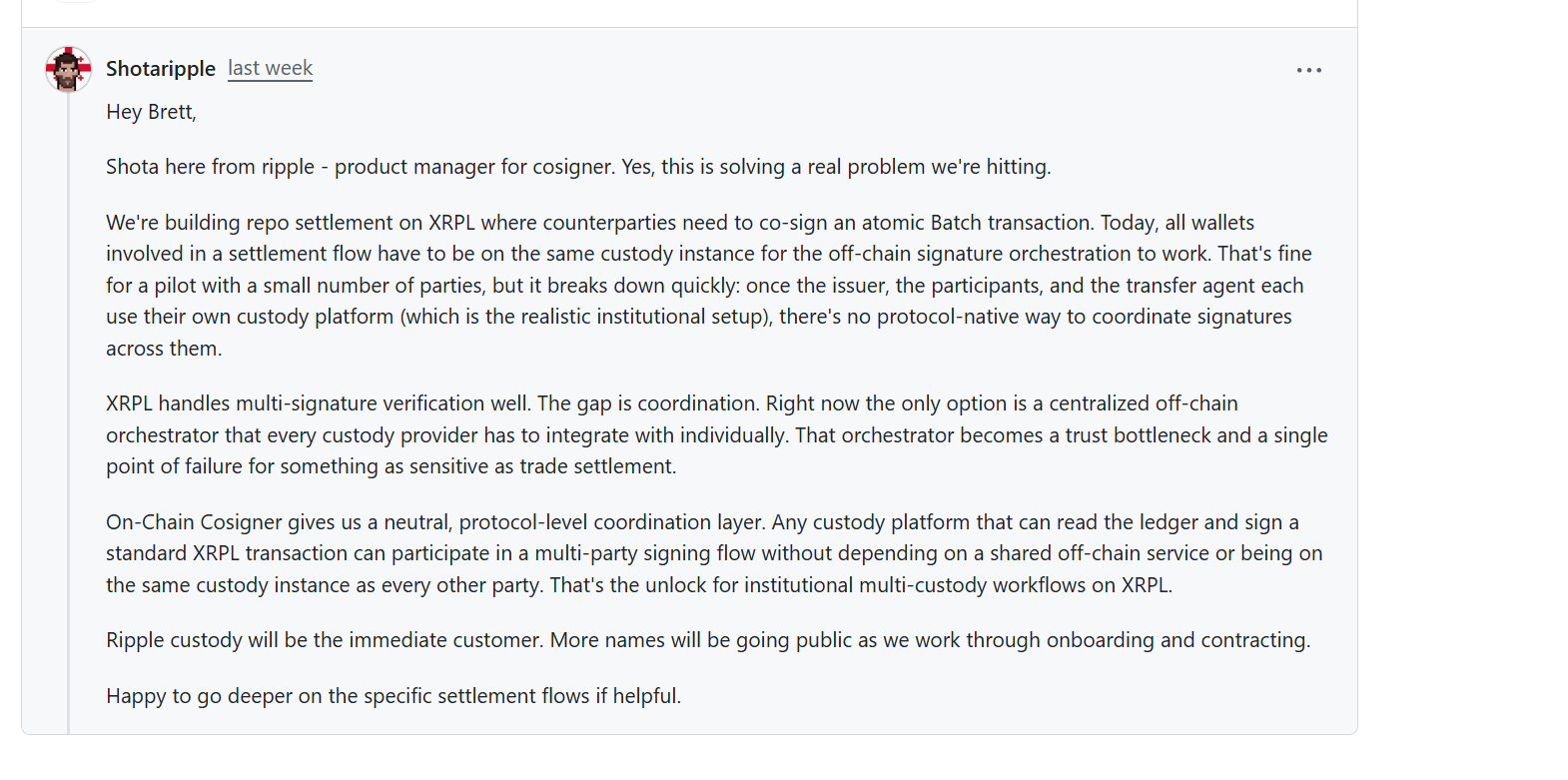
Responding to questions about a proposed XRPL feature called On-Chain Cosigner, a user named Shota, who identified himself as Ripple’s product manager for the feature, said the company was solving a problem it was already encountering.
“We’re building repo settlement on XRPL where counterparties need to co-sign an atomic Batch transaction,” he wrote on Aug. 12.
He added that Ripple Custody would be the immediate customer, while additional names would become public as Ripple works through onboarding and contracting.
GitHub comment from a Ripple developer detailing plans for XRPL-native repo settlement. | Source: GitHub
The comment quickly spread across the XRP community, with some posts on X calling it a new institutional use case for XRP.
And so it begins. Ripple is building repo settlement directly on $XRP Ledger.
Once you understand how big repo is, the XRP thesis gets insane.
The first part is supported by evidence and the second needs more caution.
Try Our Recommended Crypto Exchanges
Sponsored
Disclosure
We sometimes use affiliate links in our content, when clicking on those we might receive a commission at no extra cost to you. By using this website you agree to our terms and conditions and privacy policy.
A repurchase agreement, or repo, sounds more complicated than it is.
Imagine a bank or securities dealer needs $100 million overnight. It temporarily transfers securities, often government bonds, to another institution in exchange for cash, with a promise to buy them back the following day at a slightly higher price.
Economically, it behaves like a short-term secured loan. The securities serve as collateral, and the difference between the original and repurchase prices represents the interest earned by the cash lender. The New York Fed describes repo in much the same way: securities are exchanged for cash with an agreement to reverse the transaction later.
There can also be a haircut. A borrower seeking $100 million, for example, might have to provide $102 million of securities, giving the lender additional protection if the borrower defaults.
This is not a niche corner of finance. Federal Reserve researchers estimated the US repo market at around $12 trillion in 2025, highlighting its role in funding securities inventories and leveraged trading.
What Would XRPL Actually Do?
The clue sits in the words “atomic Batch transaction.”
Repo settlement involves assets moving in opposite directions. One party delivers cash while the other delivers securities. Institutions generally want to avoid a situation in which one party transfers its assets and then waits for the other party to perform.
XRPL’s XLS-56 Batch standard is designed to package several transactions together so they execute as a single unit. If one part cannot execute, the complete atomic batch fails rather than leaving only half of the transaction completed.
Applied to a repo, that could mean a tokenized security moves to one counterparty at the same moment the corresponding payment moves in the opposite direction.
The public GitHub proposal goes further. It specifically describes Batch as supporting “multi-account, atomic, multi-signed settlement” and gives end-of-day repo netting as an example.
The problem Ripple says it has encountered is getting multiple institutions to authorize that transaction.
Why Ripple Wants an ‘On-Chain Cosigner’
Institutional transactions rarely involve a single person controlling a single wallet.
The asset issuer may use one custodian, the buyer another, and a transfer agent a third. Each may have separate authorization policies and signing infrastructure.
According to Ripple’s Shota, XRPL can already verify multisignatures. The problem is coordinating those signatures when institutions are spread across separate custody systems.
Currently, a central off-chain coordinator may have to collect them. Ripple argues that this introduces another dependency into the settlement process.
The proposed On-Chain Cosigner would instead place the proposed transaction on XRPL and allow authorized parties to add their signatures directly on-chain. Once enough signatures are collected, the transaction can be submitted.
However, it remains a draft proposal, not a finished XRPL feature. The GitHub specification notes that implementation would require a new network amendment.
There are also objections. Developers behind X-Multi, an existing XRPL multisignature system, argued that offchain coordination already works and warned that moving proposals on-chain introduces different privacy and policy trade-offs.
This Repo Plan Did Not Start With One GitHub Comment
Other Ripple material supports the broader story.
In its Q1 2025 XRP Markets Report, Ripple said Hidden Road would eventually use XRPL to streamline parts of its post-trade operation, specifically naming “FX, swaps, and repo markets.” Ripple later completed its acquisition of Hidden Road, rebranding the business as Ripple Prime.
A current Ripple job posting provides additional evidence. It describes an “XRPL Collateral Mobility” initiative intended to move tokenized assets as on-chain collateral across repo, lending, prime brokerage, and trading.
The same role is tasked with promoting Ripple Capital Markets, an institutional product for bringing issuance, settlement, and post-trade workflows onto XRPL.
Taken together, these references show that repo settlement on XRPL is more than an XRP community theory.
But Does This Mean Repos Will Use XRP?
Not necessarily.
Nothing in the GitHub discussion says XRP will be the collateral, the asset being borrowed, or the settlement currency. Nor does it say Ripple’s RLUSD stablecoin will handle the cash leg.
XRP is used at the XRPL base layer for transaction fees and network reserve requirements, meaning greater institutional activity can create some XRP usage. Ripple also markets XRP as a bridge asset across other institutional workflows.
But saying Ripple is building repo settlement on XRPL is not the same as saying institutions will execute repos in XRP.
That part remains unconfirmed.
The more substantial development is elsewhere: Ripple appears to be trying to connect tokenized collateral, custody, prime brokerage, and settlement on the same blockchain infrastructure.
If counterparties now being onboarded eventually go public, the next question will not be whether Ripple is experimenting with repo settlement, but rather which assets and institutions will actually settle on XRPL.
Disclaimer:
The information provided in this article is for informational purposes only. It is not intended to be, nor should it be construed as, financial advice. We do not make any warranties regarding the completeness, reliability, or accuracy of this information. All investments involve risk, and past performance does not guarantee future results. We recommend consulting a financial advisor before making any investment decisions.
Dr. Guneet Kaur is a senior editor at CCN.com and a Science Fellow at Exponential Science. She is a fintech and blockchain expert with extensive experience in digital finance education, blockchain ecosystems, and cryptocurrency markets. She has worked with global media such as Cointelegraph, as well as education and blockchain platforms, to design and lead strategic content and learning initiatives. As an educator and assessor for top-tier executive programs, she bridges real-world fintech trends with academic insight.
Dr. Kaur is also a published researcher and peer reviewer across fintech and data science journals, including Financial Innovation Journal and International Journal of Big Data Intelligence and Applications. Her work spans data-driven analysis, Web3 innovation, and technical content development. With a strong foundation in both industry and academia, she translates complex financial technologies into practical applications, empowering learners, professionals, and institutions across the rapidly evolving digital finance landscape.