Why SWIFT's Blockchain Push Is a Win for Ripple but Not Yet for XRP
Share
Key Takeaways
Over 50 global banks have signed onto SWIFT’s new cross-border payments scheme, signaling strong institutional momentum.
The focus is on fixing real-world pain points as the framework targets faster settlement, transparent fees, full-value transfers, and improved payment tracking.
Networks like XRP and XLM offer near-instant settlement, lower costs, and fewer intermediaries.
Incremental upgrades to existing infrastructure may be more appealing than switching entirely to blockchain rails.
SWIFT connects 11,500 institutions across 200 countries and has dominated global payments for decades. Now it is asking those same institutions to help it survive what comes next.
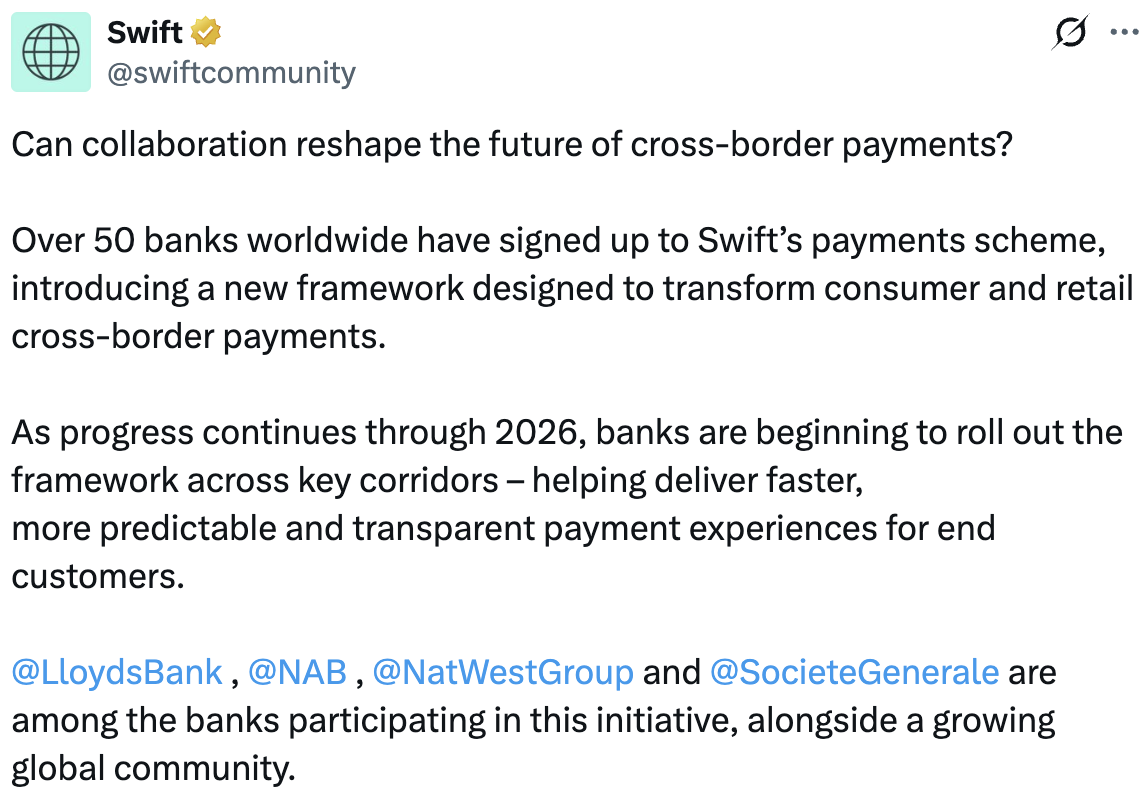
More than 50 banks, including Lloyds, NatWest, NAB and Société Générale, have signed onto a new cross-border payments framework that promises faster settlement, transparent fees and end-to-end tracking. By mid-2026, over 25 are expected to be actively processing payments through it.
The timing is not coincidental. XRP and XLM have spent years demonstrating that cross-border payments can settle in seconds, at near-zero cost, without intermediaries. SWIFT is now trying to close that gap without dismantling the system that made it indispensable.
How SWIFT’s New Cross-Border Payments Scheme Upgrades Legacy Banking Rails
For decades, SWIFT has served as the backbone of global banking, connecting more than 11,500 institutions across over 200 countries. Its scale is unmatched, but so are the criticisms.
Cross-border payments have historically been slow, opaque, and overly complex, often involving multiple intermediary banks.
The new payments scheme is designed to address these structural inefficiencies while preserving the trust and reach of the existing system.
Over 50 banks joined SWIFT’s new global payment scheme. | Credit: SWIFT X profile
At a high level, the framework promises:
Faster settlement, including near-instant processing where possible
By mid-2026, more than 25 banks are expected to actively process payments under the framework, spanning key markets such as India, China, the UK, the US, and Germany. Many of these are among the world’s largest remittance corridors, where even small improvements can have outsized economic impact.
What makes this initiative notable isn’t just the technology: it’s the coordination. Historically, cross-border payments have suffered from fragmentation. SWIFT is attempting to solve that through standardization at scale.
Why the ‘Last Mile’ Remains the Biggest Bottleneck in Cross-Border Payments
While SWIFT messaging itself is already fast, the biggest bottleneck has long been what happens after a payment reaches the destination bank. This so-called ‘last mile’ accounts for the majority of delays.
In fact, up to 80% of a transaction’s total time can be spent in this final stage, where domestic systems and banking processes take over.
SWIFT’s new framework focuses heavily on improving this segment. By introducing standardized expectations and better integration with domestic payment systems, the aim is to make the final leg of the transaction as efficient as the initial transmission.
For users, this translates into something simple but powerful: knowing exactly when money will arrive, and how much.
How SWIFT Aligns With G20 Goals for Faster, Cheaper Cross-Border Payments
SWIFT has already made measurable progress, with around 75% of transactions reaching destination banks within 10 minutes. But consistency remains uneven, particularly across emerging markets.
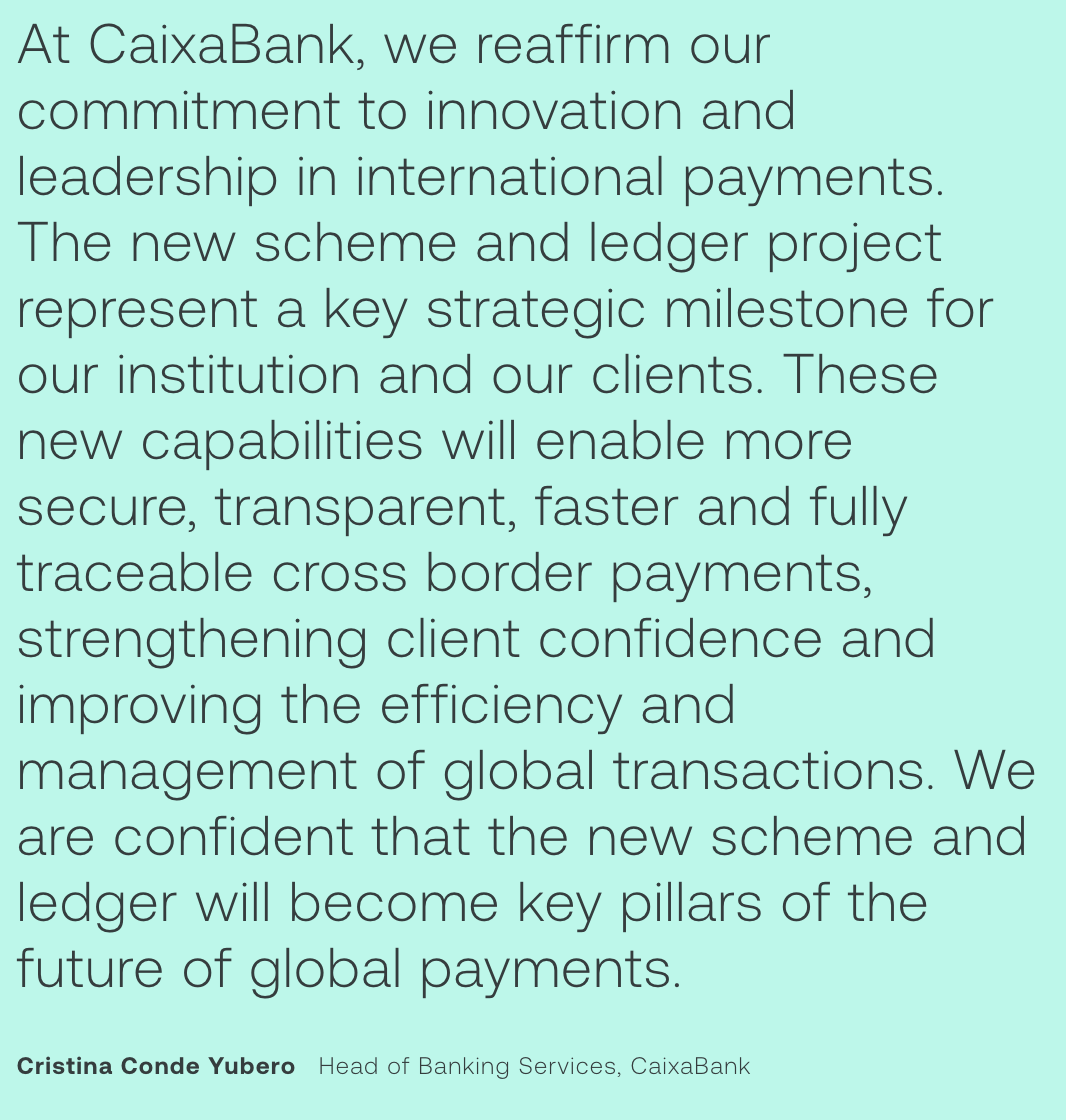
Bank managers hailed the new partnership. | Credit: CaixaBank’s Head of Banking Services
The new scheme is designed to close that gap, ensuring that improvements aren’t limited to select corridors but become the global standard.
SWIFT’s Blockchain Strategy: Can Traditional Finance Compete With Crypto Rails?
Perhaps surprisingly, SWIFT isn’t positioning itself against blockchain: it’s incorporating it.
Alongside the payments scheme, the organization is developing a blockchain-based shared ledger to support tokenized assets and enable 24/7 cross-border payments. This reflects a broader shift in strategy: rather than replacing its infrastructure, SWIFT is layering new capabilities on top of it.
Key elements of this approach include:
Support for tokenized value (including stablecoins and CBDCs)
Always-on transaction processing
Interoperability between traditional and digital asset systems
A focus on regulated, compliant environments
This ‘parallel track’ strategy allows SWIFT to innovate without disrupting the existing financial system, a critical consideration for global banks.
XRP vs XLM: How Blockchain Payment Networks Challenge SWIFT’s Dominance
While SWIFT upgrades its rails, blockchain-native networks like Ripple (XRP) and Stellar (XLM) have been building alternatives from the ground up.
These systems were designed specifically to solve the inefficiencies of cross-border payments, and they take a fundamentally different approach.
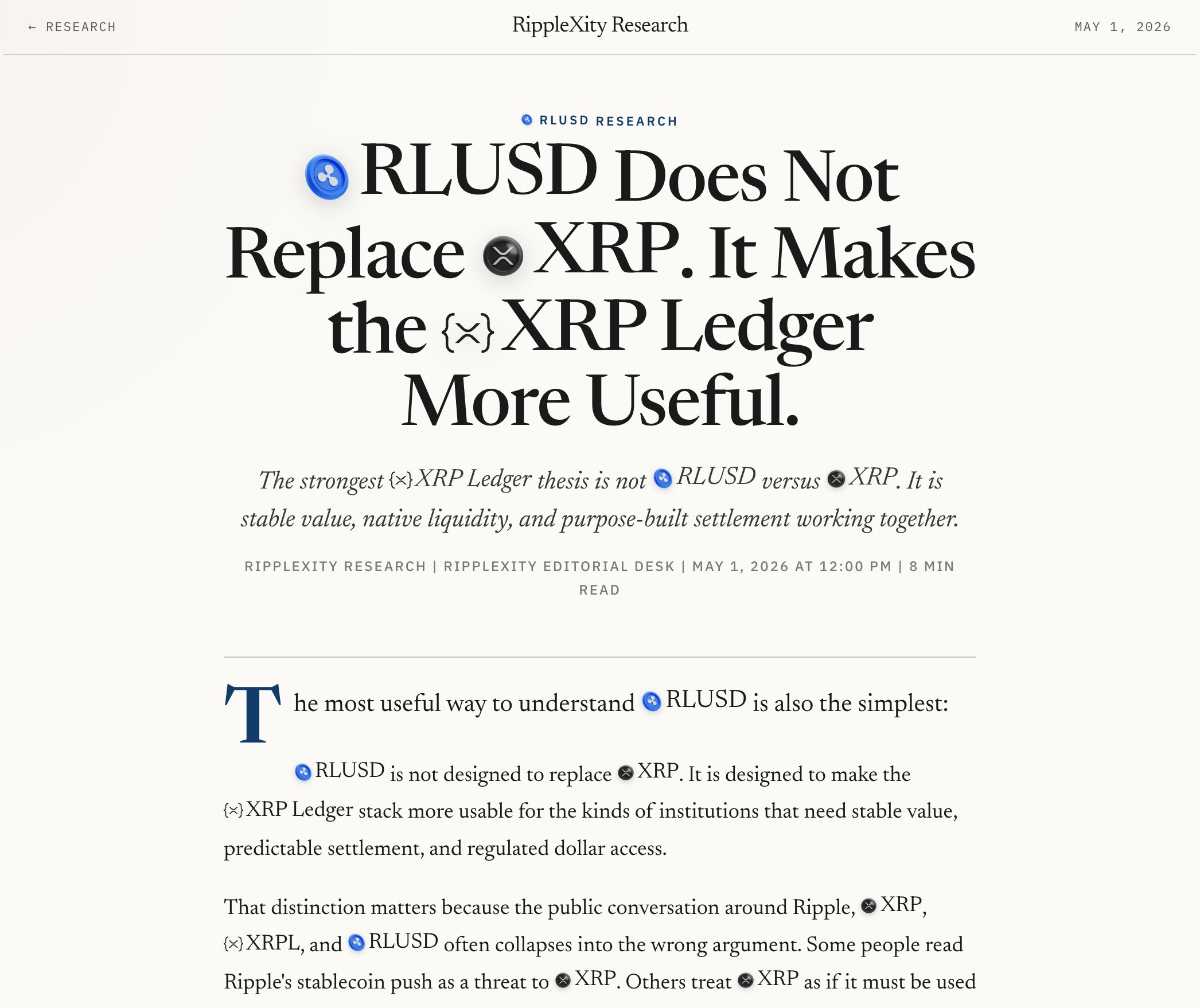
RLUSD doesn’t replace XRP. | Credit: RippleXity Research
Their core advantages include:
Settlement in seconds rather than minutes or hours
Minimal transaction fees
24/7 availability without banking constraints
Fewer intermediaries, reducing complexity
Native support for digital assets
Ripple, through XRP, focuses primarily on institutional use cases, offering liquidity solutions for banks and payment providers. Stellar, via XLM, leans more toward remittances and financial inclusion, particularly in underserved markets.
In purely technical terms, both networks outperform traditional systems. But technology alone doesn’t determine outcomes in finance.
SWIFT vs Blockchain Payments: Network Effects vs Technological Innovation
The real competition between SWIFT and blockchain networks comes down to a classic trade-off: network effects versus technological edge.
SWIFT’s strengths are deeply rooted:
A global network of over 11,500 institutions
Strong regulatory alignment
Decades of operational trust
Seamless integration into existing banking systems
By contrast, XRP and XLM offer:
Faster and cheaper transactions
Simpler payment architecture
Greater programmability
Reduced reliance on intermediaries
The challenge for blockchain networks is not proving they work, it’s convincing institutions to switch.
Banks are inherently conservative, and the cost of replacing core infrastructure is enormous. SWIFT’s strategy of incremental improvement may therefore be more appealing than wholesale disruption.
Cross-Border Payments Adoption Trends: Banks vs Blockchain Networks
Ultimately, the future of cross-border payments will be determined by adoption, not just capability.
SWIFT’s new scheme already has strong momentum, with dozens of major banks committed and more expected to follow. Its approach minimizes disruption while delivering tangible improvements, making it easier for institutions to buy in.
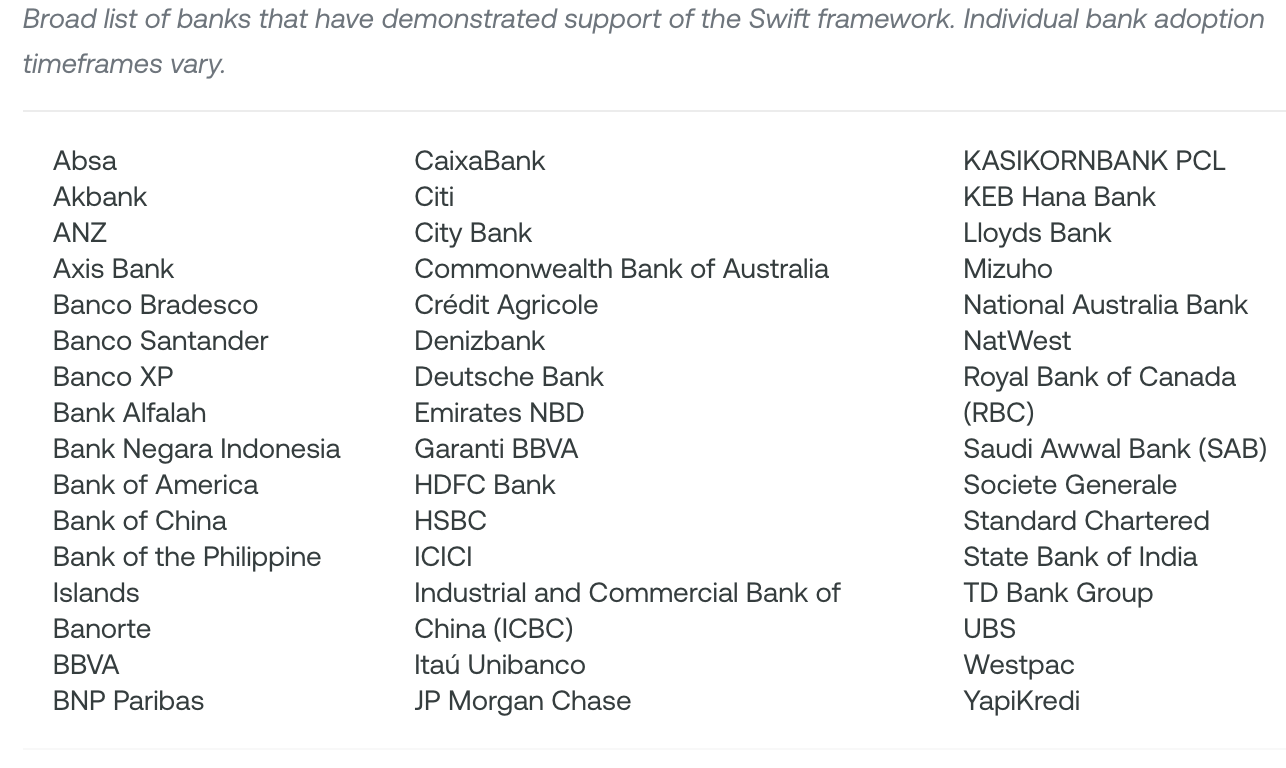
List of banks joining SWIFT payment scheme. | Credit: SWIFT
Blockchain networks, meanwhile, are gaining traction in specific niches:
While blockchain still offers near-instant settlement, SWIFT’s improvements are narrowing the gap. For many users, the difference between seconds and minutes may be less important than predictability and trust.
Cross-Border Payments Future: SWIFT, XRP, XLM or a Hybrid Model?
Rather than a clear winner, the future of cross-border payments is likely to involve convergence.
Blockchain networks engaging with regulators and banks
Growing interest in hybrid financial infrastructure
In such a scenario, SWIFT doesn’t need to “beat” XRP or XLM—it simply needs to evolve alongside them.
SWIFT’s new payments scheme represents a meaningful leap forward for traditional finance. By addressing long-standing inefficiencies and leveraging its vast network, it has positioned itself to remain a central player in global payments.
At the same time, XRP and XLM continue to push the boundaries of what’s technically possible, offering a glimpse into a more streamlined, decentralized future.
The balance of power comes down to:
SWIFT: Scale, trust, regulatory alignment
XRP/XLM: Speed, cost efficiency, innovation
In the end, the question isn’t which system is better, it’s which system the world chooses to use.
SWIFT does not need to be faster than XRP. It needs to be good enough that 11,500 institutions never feel the urgency to switch. Right now, it still looks reasonable. Whether it holds through 2027 is the only question that matters.
SWIFT’s new scheme is a standardized framework designed to improve international payments by making them faster, more transparent, and predictable. It focuses on retail transactions, including remittances and small business payments, and introduces features like upfront pricing, full-value transfers, and end-to-end tracking.
How many banks have joined SWIFT’s new payments initiative?
More than 50 banks globally have signed up to support the framework, with over 25 expected to actively process payments through it by mid-2026. Participants include major institutions such as HSBC, Citi, JPMorgan, Lloyds Bank, and Deutsche Bank.
How fast are SWIFT cross-border payments now?
SWIFT reports that around 75% of its transactions already reach the destination bank within 10 minutes. However, total settlement time can still vary due to delays in the ‘last mile,’ which the new framework aims to fix.
What is the ‘last mile’ problem in cross-border payments?
The “last mile” refers to the final stage of a transaction, when funds move from the receiving bank to the recipient’s account. This stage can account for up to 80% of delays due to local regulations, banking processes, and infrastructure limitations.
Disclaimer:
The information provided in this article is for informational purposes only. It is not intended to be, nor should it be construed as, financial advice. We do not make any warranties regarding the completeness, reliability, or accuracy of this information. All investments involve risk, and past performance does not guarantee future results. We recommend consulting a financial advisor before making any investment decisions.
Giuseppe Ciccomascolo began his career as an investigative journalist in Italy, where he contributed to both local and national newspapers, focusing on various financial sectors.
Upon relocating to London, he worked as an analyst for Fitch's CapitalStructure and later as a Senior Reporter for Alliance News. In 2017, Giuseppe transitioned to covering cryptocurrency-related news, producing documentaries and articles on Bitcoin and other emerging digital currencies. He also played a pivotal role in establishing the academy for a cryptocurrency exchange website. Crypto remained his primary area of interest throughout his tenure as a writer for ThirdFloor.


 Easy
Easy