XRP Ledger Powers $800M Energy Tokenization in Argentina — What It Means for XRP’s Bridge Asset Case
Share
Key Takeaways
YPF Luz and Justoken are bringing over $800 million in tokenized energy assets to XRPL.
The deal gives XRPL a real-world infrastructure use case in Argentina’s energy market.
Tokenizing energy contracts can help prove blockchain’s value in everyday business operations.
The project supports XRPL’s credibility, but it does not yet guarantee strong XRP demand.
Argentina has been known as one of crypto’s more practical test markets for some time. Citizens already use digital dollars to protect their savings and to move money, yet now one of the country’s biggest energy companies is using blockchain to sell and manage electricity contracts.
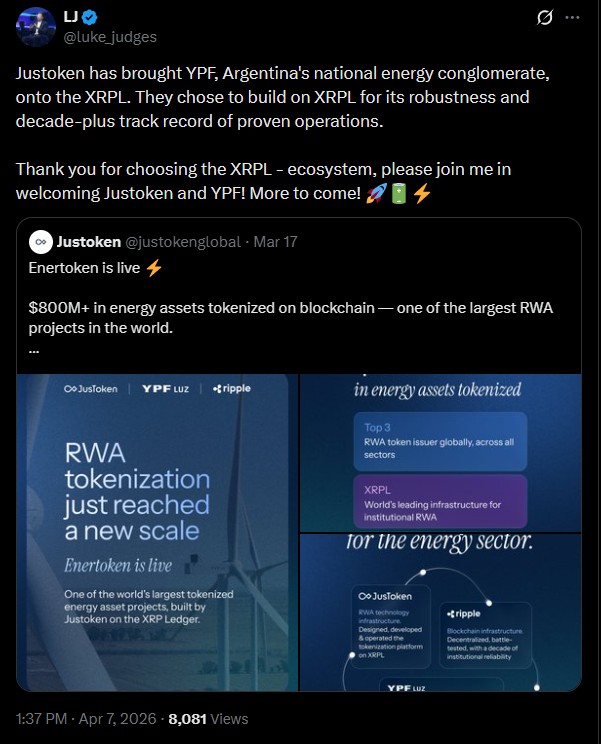
The partnership is between leading Argentine power generation company YPF Luz and RWA tokenization specialists Justoken, their new Enertoken platform is seeing a launch on the XRP Ledger with over $800 million in tokenized energy assets. This new system is meant to help companies and large power users handle cost simulation, contract execution, energy tracking, billing, and reporting all in one flow.
Why Electricity Contracts Are a Real-World Test for Tokenization
The scale of such a deal contributes to its notability. Justoken describes Enertoken as one of the world’s largest tokenized energy asset projects on the XRP Ledger (XRPL), and YPF Luz tied the launch to over $800 million in energy assets, spread across around 80 clients.
Next is the type of asset involved. Electricity contracts are necessary for businesses around the country to operate efficiently. They affect a company’s budgeting, operations, and long-term planning, and that importance is a strong test for tokenization, as the contracts are tied to repeat business activity instead of one-off trading. It might sound like a boring use case to some, but tokenizing dull business processes is just as much of a win for blockchain as any, making it far easier to take the tech seriously.
Source: @luke_judges on X
This isn’t to mention that in energy markets, small inefficiencies can pile up across billing, reconciliation, and reporting. A shared ledger can be useful because it gives all parties one immutable transaction history.
The deal also fits a wider XRPL trend, including the ledger’s growth in tokenized assets and XRP’s role in tokenized banking overall. Plus, in many countries, tokenization still feels like part of a far-off future. In Argentina, however, where people and businesses are forced to think more carefully about financial struggles like inflation, services that help them operate better by saving time and reducing friction are far more likely to see mass adoption.
How XRP Differs From XRPL
Of course, one must understand how to separate XRPL from XRP. XRPL is the blockchain, while XRP is the asset. XRP helps pay fees and can bridge currencies inside XRPL’s built-in exchange. Ripple’s On-Demand Liquidity product (ODL) also uses XRP as a bridge currency for real-time cross-border transfers.
The Argentina energy deal adds another serious, real-world asset to XRPL, putting more business activity on the ledger. It gives XRP another environment where it could become useful for routing value. These real-world use cases are as good a test as any, and energy contracts are more than one-time events. They create repetitive tasks where bridge assets have a better chance to prove they are useful.
Tokenization on XRPL Doesn’t Necessarily Drive XRP Demand
Investors looking to get involved should note the following. Tokenization on XRPL does not automatically create XRP demand. In some cases, the blockchain is mainly being used as a secure shared record system, a ledger!
RWA.xyz shows JMWH, the Justoken energy asset tied to the deal, as a “represented asset” worth $861 million with 12 holders. Each token represents one actual unit of electricity, measured as one megawatt-hour (MWh).
So imagine a company buys power through this system. The token acts like a digital claim ticket for said energy. Once the electricity is actually delivered and used, the token is destroyed as its job is done.
This use case suggests the tokens are being used more like business paperwork on a blockchain than like coins people freely buy and sell in an open market, like in many crypto cases.
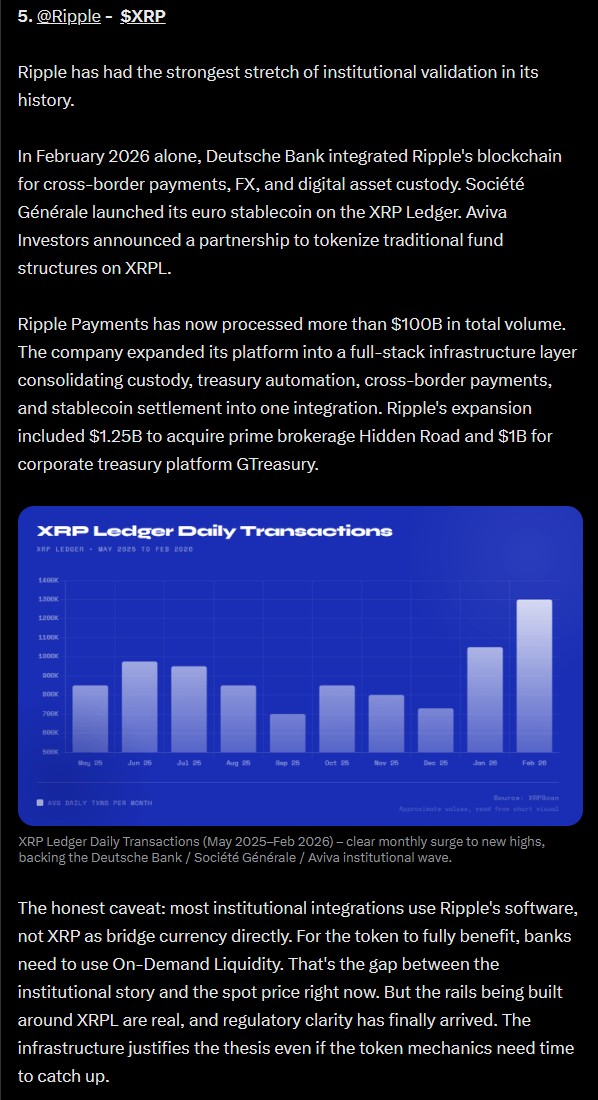
Source: @mominsaquib on X
So while the deal is good for XRPL because it shows the network can support real business activity, it does not automatically mean XRP will see heavy use. This is a reputational benefit more than it is an XRP price benefit. SWIFT’s tokenized deposit model is a similar example.
Both examples show that large financial systems are settling with tokenized deposits, stablecoins, and shared ledgers without needing to rely on a volatile bridge asset. Argentina’s tokenized energy contracts operating on XRPL will reinforce its structural power.
Tokenization’s use in energy is a great way to combat the common crypto complaint of “a product looking for a purpose.” Energy is a service businesses already need, and improving it is a viable step forward.
What exactly is being tokenized in the YPF Luz and Justoken deal?
The deal tokenizes energy-linked contracts on XRPL. Each token represents one megawatt-hour of electricity tied to a real business use case.
How could tokenized energy contracts affect businesses in Argentina?
They could make energy deals easier to track, bill, and manage. That may help businesses handle routine contract work with less friction.
Why does this project matter for XRP’s bridge asset use case?
It gives XRPL another real-world use case and shows the network can support business activity. Still, it does not automatically mean XRP will see heavy demand.
Could other energy companies follow the same model on XRPL?
Yes, because energy contracts are recurring and easy to measure. If this rollout works, it could give other firms a model for tokenizing similar agreements.
Disclaimer:
The information provided in this article is for informational purposes only. It is not intended to be, nor should it be construed as, financial advice. We do not make any warranties regarding the completeness, reliability, or accuracy of this information. All investments involve risk, and past performance does not guarantee future results. We recommend consulting a financial advisor before making any investment decisions.
Max Moeller is a Chicago‑based writer and video editor passionate about games, tech, and crypto. Whether it’s crafting clear, insightful articles or piecing together engaging video retrospectives, he’s driven by curiosity and takes pride in keeping things human. Since 2017, Max has been published in a variety of notable crypto magazines.


 Easy
Easy