Key Takeaways
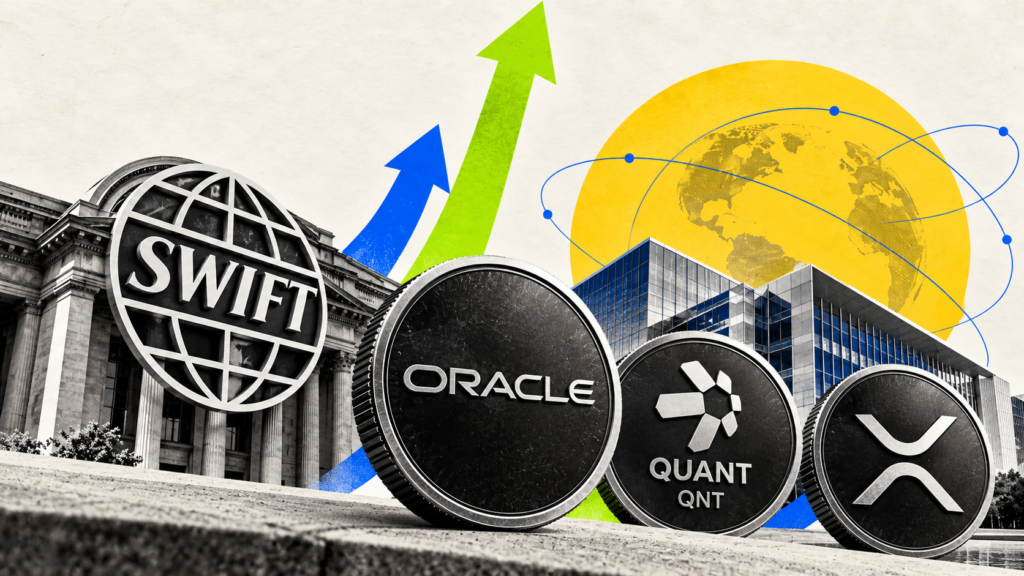
- Oracle integrated its Blockchain Platform, Digital Assets Data Nexus, and Banking Payments with SWIFT’s shared ledger.
- Quant’s Overledger operates as an interoperability layer that connects bank systems to blockchains, including Oracle’s infrastructure. The Oracle-Quant relationship was announced in March 2025.
- XRP is not part of SWIFT’s blockchain ledger architecture; its connection to SWIFT runs through a separate Thunes integration where XRP functions as an optional liquidity tool rather than a settlement asset inside the shared ledger itself.
Oracle announced on September 28 at Sibos in Miami the integration of three products with SWIFT’s blockchain shared ledger: Oracle Blockchain Platform, Oracle Digital Assets Data Nexus, and Oracle Banking Payments. The integration is not a pilot announcement. Oracle received SWIFT Compatible Application certification for payments earlier in 2026 and is now extending that relationship into the tokenized deposit layer.
The technical scope is specific.
Oracle Blockchain Platform and Oracle Digital Assets Data Nexus provide a pre-integrated foundation for connecting to SWIFT’s ledger, hosting SWIFT commitment contracts, and supporting event orchestration, while providing EVM-based blockchain infrastructure, custodial wallet capabilities, transaction signing, and smart contract functionality for tokenized deposit operations.
Oracle Banking Payments bridges onchain flows with existing ISO 20022 payment processing, enabling banks using Oracle’s core banking software to participate in SWIFT’s tokenized deposit network without replacing their existing payment infrastructure.
The practical result is that a bank running Oracle Banking Payments can now initiate a tokenized deposit transfer, have it coordinated through SWIFT’s ledger, and settle it with another institution in real time, all within the same operational lifecycle as a conventional ISO 20022 wire.
SWIFT’s 11,000-member network gains a production-grade enterprise technology vendor as an integration partner at Sibos, the annual industry gathering where the deals that shape the following year’s infrastructure roadmap are announced.
Where Quant Fits and Why the Oracle Connection Matters
Quant’s Overledger is not a blockchain but an interoperability layer that connects multiple blockchains and legacy financial systems through a single API, allowing banks to interact with different networks without building custom integrations for each. Its architectural pitch is that a bank does not need to choose a single blockchain; Overledger routes transactions across whichever network is most appropriate for a given use case.
Oracle’s collaboration with Quant, announced in March 2025, covers interoperability, digital assets, tokenized deposits, stablecoins, and programmable payments. That relationship places Overledger adjacent to Oracle’s financial services stack, meaning the same Oracle infrastructure that now connects to SWIFT’s ledger can, in principle, route through Overledger to interact with other blockchain networks.
The connection is not direct. Quant does not sit inside SWIFT’s ledger. But Oracle does, and Oracle and Quant have a documented technical relationship.
QNT trades at $240.29 (at the time of writing), up 25.70% to $234.50 in 24h, with institutional relationships spanning Oracle, SIA/Nexi, UK banks, Murex, and central-bank-related projects. The token’s value-capture thesis rests on whether banks and institutions using Overledger require QNT to access the network’s capabilities. That thesis has faced consistent scrutiny because customers may pay in fiat without needing QNT, which weakens the scarcity-driven narrative.
The Oracle-SWIFT integration does not resolve that question. It strengthens Overledger’s institutional surface area without confirming that QNT captures the commercial value that surface area generates.
XRP’s Position: The Side Door, Not the Main Entrance
SWIFT’s blockchain shared ledger deliberately avoids public-network assets like XRP. Yet XRP has been wired into SWIFT through a side door via a Thunes integration, giving banks access to XRP as one liquidity choice, but participation is not required.
The two access models highlight a central challenge for XRP’s institutional payments case. SWIFT’s ledger is a permissioned, bank-operated network designed around tokenized bank deposits. Its architecture is built to keep settlement within the existing banking system rather than routing through a public blockchain asset. XRP’s On-Demand Liquidity product uses the token to bridge currencies in seconds without pre-funded nostro accounts, which addresses a different problem than the one SWIFT’s ledger is solving. SWIFT is not disintermediating nostro accounts. It is digitizing them.
A payment can route from SWIFT through Thunes to Ripple’s ODL infrastructure, where XRP settles the leg. That routing exists. It works. But it is not a SWIFT endorsement of XRP as a settlement asset. It is a payment corridor that passes through SWIFT at one end and XRP at the other, with Thunes operating the bridge between the two systems independently of SWIFT’s architecture decisions.
Ripple is not cornered; it has built businesses in prime brokerage and corporate treasury management that SWIFT’s bank-to-bank ledger does not touch. But the bank settlement market just got more crowded.
IBM’s Digital Asset Haven, announced three days before Oracle’s Sibos integration, provides the same ISO 20022-to-tokenized-deposit bridge through Oracle’s competitor infrastructure, also without XRP.
Two major enterprise technology vendors have now connected to SWIFT’s ledger in the same week, and neither has named XRP as part of their architecture.
What the Oracle-SWIFT-Quant Triangle Actually Means
Three separate narratives are converging at Sibos in a way that the crypto community is interpreting as more connected than the underlying facts support.
Oracle integrating with SWIFT’s ledger is a real, specific, production-scope announcement. It tells us that enterprise technology vendors are competing aggressively to become the middleware layer between banks and SWIFT’s tokenized deposit infrastructure, and that Oracle is positioned to win a significant share of that market given its installed base in core banking.
Quant’s proximity to Oracle is real but commercially unverified at the revenue level. The Oracle collaboration covers the right categories, but pilot feasibility, not production revenue, remains unproven. The SWIFT-Oracle integration could pull Overledger into production-scale institutional use if banks that adopt Oracle’s SWIFT integration also use Overledger for cross-chain routing. That is a plausible outcome, not a confirmed one.
XRP’s relationship to SWIFT remains architecturally peripheral to what was announced today. Ripple’s relevant competitive response to the Oracle-SWIFT integration is not its ODL product but its institutional businesses, prime brokerage through Hidden Road and the XRP Ledger’s tokenized RWA infrastructure, which have grown from $150 million to $4 billion in assets over the past year. Those products compete in a different part of the market from SWIFT’s bank-to-bank settlement ledger.
The Oracle announcement matters. The QNT connection is relevant and plausible, but commercially unconfirmed. XRP is further removed, requiring a route into the infrastructure that SWIFT itself has not built.
Top Trending Crypto Articles
The information provided in this article is for informational purposes only. It is not intended to be, nor should it be construed as, financial advice. We do not make any warranties regarding the completeness, reliability, or accuracy of this information. All investments involve risk, and past performance does not guarantee future results. We recommend consulting a financial advisor before making any investment decisions.

Dr. Guneet Kaur is a senior editor at CCN.com and a Science Fellow at Exponential Science. She is a fintech and blockchain expert with extensive experience in digital finance education, blockchain ecosystems, and cryptocurrency markets. She has worked with global media such as Cointelegraph, as well as education and blockchain platforms, to design and lead strategic content and learning initiatives. As an educator and assessor for top-tier executive programs, she bridges real-world fintech trends with academic insight.
Dr. Kaur is also a published researcher and peer reviewer across fintech and data science journals, including Financial Innovation Journal and International Journal of Big Data Intelligence and Applications. Her work spans data-driven analysis, Web3 innovation, and technical content development. With a strong foundation in both industry and academia, she translates complex financial technologies into practical applications, empowering learners, professionals, and institutions across the rapidly evolving digital finance landscape.