Key Takeaways
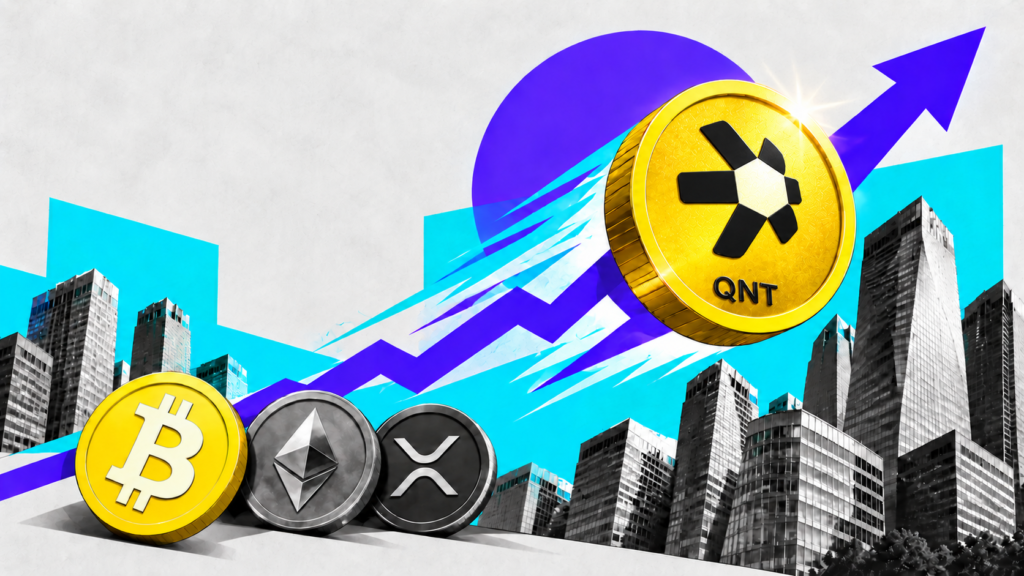
- Quant’s QNT has exploded from around $67 a week ago to above $280, dramatically outperforming Bitcoin, Ethereum and XRP.
- The immediate catalyst is The Clearing House selecting Quant to power key infrastructure for its U.S. tokenized-deposit network.
- Traders are now watching HBAR for a possible rotation, but claims that capital will automatically flow from QNT into HBAR, XLM, and XRP remain speculation.
Bitcoin may dominate the headlines whenever crypto turns higher, but this time the market’s biggest move is happening elsewhere.
Quant’s QNT surged from roughly $67 on Sept. 21 to around $285 on Sept. 27, briefly reaching $353 during Sunday trading. That represents a gain of more than 300% in roughly a week
The move accelerated after a major institutional announcement prompted traders to reconsider Quant’s role in traditional finance.
On Sept. 24, The Clearing House selected Quant to power its Onchain Money Initiative, a planned network that will allow financial institutions to clear and settle tokenized bank deposits.
Quant will provide the interoperability, orchestration, and transaction-management technology that connects the new network to existing payment infrastructure, including RTP and CHIPS. The Clearing House says its payment networks already clear and settle more than $2 trillion every day.
The network is expected to become available to participating institutions in the first half of 2027.
That is considerably more concrete than the partnership announcements that frequently drive short-lived altcoin rallies. Quant is being positioned inside infrastructure intended for actual bank settlement.
Why Did QNT Explode Now?
The Clearing House deal did not create Quant’s institutional story from scratch. Instead, it gave an existing narrative a much larger US anchor.
Quant previously worked as a technology vendor on Project Rosalind, an experiment led by the Bank for International Settlements and the Bank of England exploring APIs for potential central bank digital currency systems.
Earlier this year, Quant also partnered with Dentsu Soken to pursue tokenized deposits and programmable settlement infrastructure for Japanese financial institutions. The partnership builds on Quant’s participation in projects involving the Bank of England, the European Central Bank, and the UK banking sector.
Those older developments are now being rediscovered as QNT rallies.
Crypto commentator Greg Lunt argued that the market had overlooked Quant’s growing footprint across banking, payments, and interoperability, citing projects involving institutions ranging from central banks to enterprise technology providers.
But there is an important distinction.
The Clearing House has confirmed that Quant’s technology will power parts of its network. Its announcement does not state that participating banks must buy QNT, nor does it specify how much direct token demand the project could ultimately generate.
That makes the scale of QNT’s price reaction partly a bet on future value capture, rather than simply a reflection of demand already flowing through the token.
Is HBAR Next?
Some traders are already looking beyond QNT.
Crypto commentator Dr. Shawn described a potential rotation in which money moves first into QNT, followed by HBAR, XLM and eventually XRP, declaring that it is now “Hedera’s turn.”
There are early signs of traders testing that idea. QNT and HBAR were among the relative outperformers on Monday even as Bitcoin slipped toward $83,000 and much of the altcoin market gave back Friday’s gains.
But a sequence of QNT → HBAR → XLM → XRP is not an established market pattern, but a trader’s thesis.
What QNT’s rally does show is that the current market is aggressively rewarding a particular narrative: blockchain infrastructure becoming embedded in traditional financial systems.
For QNT, The Clearing House provided the catalyst.
The next question is whether traders will now search for the same story elsewhere — and whether HBAR becomes their next target.
fo
Top Trending Crypto Articles
The information provided in this article is for informational purposes only. It is not intended to be, nor should it be construed as, financial advice. We do not make any warranties regarding the completeness, reliability, or accuracy of this information. All investments involve risk, and past performance does not guarantee future results. We recommend consulting a financial advisor before making any investment decisions.

Dr. Guneet Kaur is a senior editor at CCN.com and a Science Fellow at Exponential Science. She is a fintech and blockchain expert with extensive experience in digital finance education, blockchain ecosystems, and cryptocurrency markets. She has worked with global media such as Cointelegraph, as well as education and blockchain platforms, to design and lead strategic content and learning initiatives. As an educator and assessor for top-tier executive programs, she bridges real-world fintech trends with academic insight.
Dr. Kaur is also a published researcher and peer reviewer across fintech and data science journals, including Financial Innovation Journal and International Journal of Big Data Intelligence and Applications. Her work spans data-driven analysis, Web3 innovation, and technical content development. With a strong foundation in both industry and academia, she translates complex financial technologies into practical applications, empowering learners, professionals, and institutions across the rapidly evolving digital finance landscape.