Ripple Prime Explained: XRP, RLUSD and the New Era of Brokerage
Share
Key Takeaways
Ripple’s acquisition strategy shows that institutional adoption depends on integrating blockchain into familiar financial structures, not replacing them.
RLUSD’s use as collateral demonstrates how stablecoins can move beyond payments into the core of financial market operations.
Ripple Prime’s platform-based model directly challenges SWIFT’s network-based evolution, highlighting two distinct paths to the same goal, digitally native global finance.
Institutional-grade compliance, custodianship, and transparency are the keys to transforming blockchain from a speculative technology into trusted financial infrastructure.
The digital asset industry is rapidly evolving from retail speculation toward institutional-grade finance. One of the most significant recent developments in this shift is Ripple’s acquisition of Hidden Road, now rebranded as Ripple Prime.
The move positions Ripple as the first crypto company to own and operate a global, multi-asset prime broker, providing traditional and digital asset market access under one roof.
Ripple Prime sits at the intersection of blockchain innovation, traditional financial infrastructure, and institutional adoption. It aims to merge the liquidity and efficiency of digital assets like XRP and stablecoins such as RLUSD with the proven frameworks of prime brokerage, custody, and settlement used across global capital markets.
What Is Ripple Prime: A New Model for Prime Brokerage
Traditionally, a prime broker acts as an intermediary between hedge funds or trading firms and the broader financial markets. It provides services like trade execution, clearing, settlement, financing, custody, and risk management.
Ripple Prime modernizes this model by expanding it to include digital assets, foreign exchange, derivatives, and fixed income on one integrated platform.
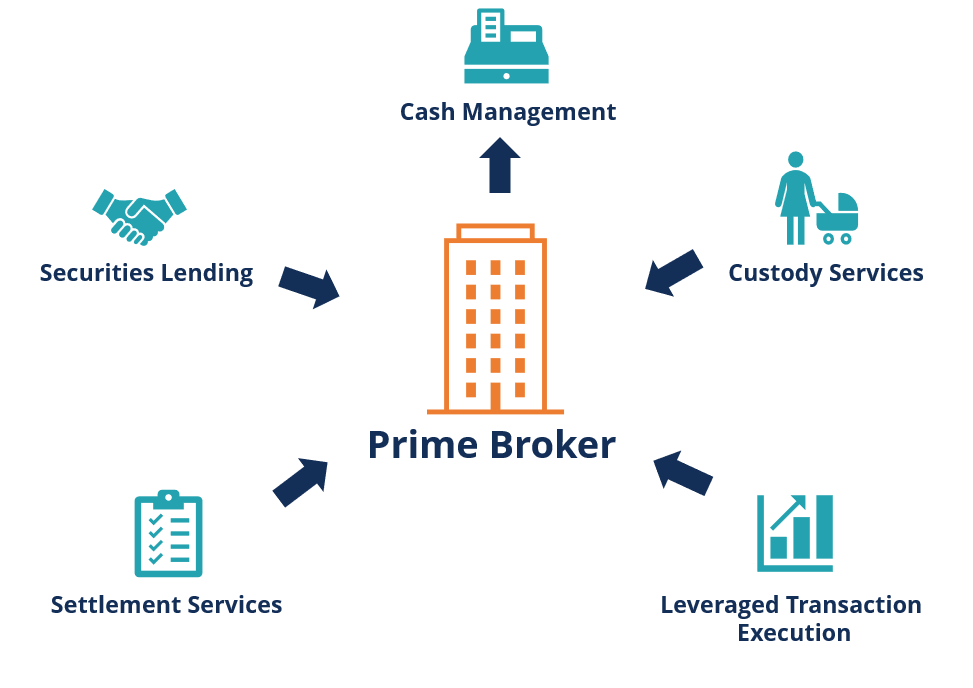
A prime broker is a one-stop intermediary for funds and market makers. Instead of juggling many exchanges, lenders, and custodians, clients use one desk that:
gives market access across venues and asset classes,
aggregates collateral and risk (e.g., cross-margining across positions).
Services provided by prime brokers. | Source: Corporate Finance Institute
What distinguishes Ripple Prime from its peers is its digital-first architecture. The firm combines Ripple’s blockchain infrastructure, spanning payments, stablecoins, and custody, with the market access and operational controls of a traditional prime broker. This synthesis creates a bridge between traditional finance (TradFi) and crypto finance (DeFi), allowing institutions to move capital efficiently across both worlds.
Ripple Prime offers institutional clients a single relationship for multi-asset access, financing, and clearing. This means firms can trade and manage risk across asset classes, while optimizing capital and collateral use through integrated technology.
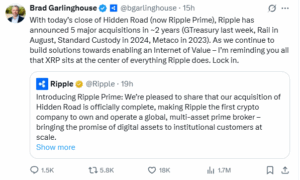
Ripple’s CEO, Brad Garlinghouse, noted on X, “As we continue to build solutions towards enabling an Internet of Value, I’m reminding you all that XRP sits at the center of everything Ripple does. Lock in.”
Ripple became the first crypto company to own and operate a global, multi-asset prime broker | Source: @bgarlinghouse on X.
How Ripple Prime Integrates XRP and RLUSD into Prime Brokerage
Ripple’s long-term strategy has been to use XRP, the native digital asset of the XRP Ledger, as a bridge currency for cross-border settlements and liquidity management. With Ripple Prime, XRP extends its utility beyond payments, becoming a component of a multi-asset brokerage system.
1. XRP as a Settlement and Liquidity Asset
Within Ripple Prime, XRP serves as a highly liquid digital asset that can be traded, settled, or held across multiple venues. Because of its fast settlement time and low transaction cost, XRP can support intra-day liquidity, helping institutions reduce pre-funding needs and free up capital. This function mirrors the use of cash or short-term treasury instruments in traditional brokerage systems.
By incorporating XRP into the prime broker’s workflow, Ripple enables institutions to bridge liquidity across asset classes and jurisdictions, without relying solely on fiat rails. This creates a hybrid environment where blockchain-based and traditional instruments can coexist.
2. RLUSD as a Collateral and Settlement Medium
Ripple’s stablecoin, RLUSD, also plays an important role. RLUSD is a U.S. dollar–pegged digital asset backed by reserves held with The Bank of New York Mellon (BNY Mellon), one of the world’s most trusted custodians.
In mid-2025, RLUSD received an ‘A’ rating from Bluechip, an independent stablecoin rating agency, for its strong governance and asset backing.
Institutions using Ripple Prime can hold balances in RLUSD, use it as collateral for derivatives and margin products, or settle transactions directly.
This is a critical innovation: it allows digital asset markets to maintain the stability of a fiat-equivalent instrument, while benefiting from blockchain’s efficiency and programmability.
The use of RLUSD also supports cross-margining, a process where collateral posted for one product can offset risk in another. For instance, a client holding RLUSD against FX positions could potentially reduce margin requirements on digital asset trades, improving capital efficiency across their portfolio.
3. Unified Digital Collateral Management
Ripple Prime aims to simplify how institutions manage collateral by integrating digital and traditional assets within one infrastructure. Traditionally, collateral is fragmented, different banks and brokers hold separate positions, creating operational inefficiency.
Ripple Prime uses RLUSD and XRP to provide a single, blockchain-compatible collateral layer, reducing the need for manual transfers or reconciliations.
This unified system offers several benefits:
Transparency: On-chain settlement records provide real-time visibility into collateral balances.
Efficiency: Faster transfers and instant settlement reduce counterparty and operational risk.
Interoperability: Ripple’s blockchain infrastructure allows RLUSD and XRP to function across different markets and systems.
This model not only makes collateral management more agile but also demonstrates how stablecoins can serve as institutional-grade instruments rather than speculative assets.
Example: How a Transaction Could Work in Ripple Prime
Ripple explains that Ripple Prime is designed as a one-stop institutional desk, a place where clients can trade, finance, and clear across FX, digital assets, derivatives, and fixed income using digital collateral such as RLUSD and liquidity assets like XRP.
The following illustrative example shows how such a transaction might unfold within Ripple Prime’s framework.
1. Institutional Onboarding and RLUSD Funding
A regulated hedge fund or market maker joins Ripple Prime.
It completes compliance and onboarding checks under Ripple’s institutional KYC/KYB process.
The firm deposits USD and converts part of it into RLUSD, Ripple’s fully backed, USD-denominated stablecoin held in reserves at BNY Mellon, its primary custodian.
The RLUSD balance becomes the fund’s primary collateral inside Ripple Prime, available to support trading and financing activities.
Ripple itself notes that “Ripple Prime will significantly enhance the utility and reach of Ripple’s stablecoin RLUSD,” with derivatives clients already opting to hold their balances in RLUSD.
2. Executing a Trade Using XRP
The fund decides to take a position in XRP to facilitate market-making or cross-exchange liquidity.
Through Ripple Prime’s trading interface, it purchases XRP against RLUSD.
The trade is executed within Ripple Prime’s network of liquidity venues and cleared through the platform’s prime brokerage structure.
Ripple emphasizes that its foundational digital-asset infrastructure across payments and XRP complements Prime’s multi-asset services, making XRP a built-in liquidity and settlement asset.
3. Collateral and Financing Management
After the trade, the fund’s RLUSD holdings act as collateral for margin and financing needs.
Ripple Prime’s system automatically assesses exposure and allocates RLUSD toward open positions, enabling cross-margining across asset classes.
Because RLUSD is blockchain-based, margin adjustments occur instantly and transparently, reducing operational friction.
This workflow mirrors traditional prime brokerage functions but uses digital assets for speed and cost efficiency.
4. Settlement and Post-Trade Reporting
Once the fund closes its position or the trade matures:
Proceeds are automatically netted and paid out in RLUSD or XRP, depending on the client’s preference.
Settlement occurs on-chain within seconds, rather than over the two-day (T+2) window common in traditional markets.
Ripple Prime’s integrated reporting tools record each transaction, linking blockchain confirmations with institutional reporting standards and audit trails.
This step embodies Ripple’s goal of combining on-chain transparency with institutional-grade compliance.
5. Optional Cross-Border Liquidity Transfer
If the fund wishes to move profits internationally, it can use XRP as a bridge asset.
XRP can be exchanged for local fiat through Ripple’s network of payment partners, reducing the need for multiple correspondent banks.
Alternatively, the fund can hold RLUSD for future collateral use or convert it back to USD via regulated channels.
This final step shows how Ripple Prime connects Ripple Payments, RLUSD, and the XRP Ledger into a unified liquidity ecosystem.
Ripple’s Acquisition Strategy: Building an Institutional Infrastructure
Ripple’s recent acquisitions reflect a deliberate strategy to construct an end-to-end digital asset ecosystem for institutions. Each acquisition adds a functional layer that complements Ripple Prime and strengthens its global infrastructure.
Ripple’s key acquisitions since 2023 include:
Metaco (May 2023): A leader in institutional digital-asset custody technology, now serving as Ripple’s foundation for secure, compliant custody solutions.
Standard Custody and Trust (June 2024): A regulated trust company providing licensed custody and settlement services, reinforcing Ripple’s compliance posture.
Rail (August 2025): A stablecoin-powered payments platform that simplifies cross-border treasury and back-office operations.
GTreasury (October 2025): A treasury management system provider enabling corporate clients to integrate digital assets and stablecoins into liquidity workflows.
Hidden Road (October 2025): The acquisition that established Ripple as a fully-fledged global prime broker.
Together, these acquisitions form a vertically integrated ecosystem—custody → brokerage → treasury → payments → settlement—designed for banks, asset managers, and corporates exploring blockchain-based financial operations.
Does Ripple Prime Challenge SWIFT’s “Linea” Move?
As Ripple builds out Ripple Prime, it inevitably invites comparison with SWIFT, the dominant global network for interbank messaging and settlement. SWIFT has been developing its own blockchain initiatives, including tokenization pilots with leading banks and partnerships with Consensys and Chainlink to explore interoperability between traditional finance and blockchain networks.
Reports in 2025 suggest that SWIFT has been experimenting with Consensys’s Linea, an Ethereum layer-2 network, to prototype shared ledgers for real-time asset transfers and tokenized settlements. The goal is to upgrade SWIFT’s messaging standard into a more interactive digital settlement layer.
While both Ripple and SWIFT pursue modernization, their approaches differ fundamentally:
SWIFT’s modelisnetwork-centric: It focuses on connecting existing banks and financial institutions through standardized messaging that can interact with various blockchains.
Ripple’s modelisplatform-centric: With Ripple Prime, it directly provides trading, financing, and settlement infrastructure where digital and traditional assets are already interoperable.
Ripple Prime thus competes not by replicating SWIFT, but by offering a fully integrated alternative. In SWIFT’s model, blockchain remains an external system connected through messaging. In Ripple Prime’s model, blockchain is the system itself, embedded into the core of trading, financing, and collateral workflows.
For institutions, this means a potential shift from relying on interbank intermediaries to operating within a unified prime-broker platform where assets, risk, and collateral move seamlessly.
Ripple Prime as a Catalyst for Financial Evolution
Ripple Prime marks a turning point for digital finance. By integrating XRP and RLUSD into a multi-asset brokerage system, Ripple has extended blockchain utility from payments to capital markets.
Through thoughtful acquisitions and regulated partnerships, it has built an institutional ecosystem that rivals traditional financial infrastructure while operating at blockchain speed.
In doing so, Ripple is not merely digitizing finance, it is redefining how assets, collateral, and liquidity interact in a global, multi-asset system.
For educators, analysts, and industry practitioners alike, Ripple Prime offers a glimpse into the next phase of financial evolution: a world where digital assets are not an alternative to traditional finance, but its natural extension.
How is Ripple Prime different from a traditional prime broker?
Ripple Prime expands prime brokerage into digital assets, offering trading, custody, and financing for both traditional and crypto markets on one blockchain-enabled platform.
What roles do XRP and RLUSD play in Ripple Prime?
XRP provides fast, liquid settlement for global transfers, while RLUSD serves as a stable, compliant digital collateral and settlement asset for institutional clients.
How does Ripple Prime improve capital efficiency?
By allowing on-chain settlement and cross-margining with RLUSD, Ripple Prime lets institutions use collateral more efficiently and reduce redundant funding requirements.
How does Ripple Prime challenge SWIFT’s modernization efforts?
With Linea, SWIFT will connect banks through blockchain-compatible messaging, while Ripple Prime integrates blockchain directly into trading and settlement, offering a fully operational alternative to legacy systems.
Disclaimer:
The information provided in this article is for informational purposes only. It is not intended to be, nor should it be construed as, financial advice. We do not make any warranties regarding the completeness, reliability, or accuracy of this information. All investments involve risk, and past performance does not guarantee future results. We recommend consulting a financial advisor before making any investment decisions.
Onkar Singh has three years of experience as a digital finance content creator. Throughout his career, he has collaborated with various DeFi projects and crypto media outlets. In his leisure time, he enjoys fitness activities at the gym and watching movies across different genres. Balancing his professional and personal interests, Onkar continues to contribute to the digital finance landscape while pursuing his hobbies.


 Easy
Easy