ChatGPT, Gemini, Claude and Grok predict how Bitcoin, Ethereum and XRP could react if the CLARITY Act passes or fails. | Credit: CCN.com
Share
Key Takeaways
Four leading AI models expect the passage of the CLARITY Act to be broadly bullish for the crypto market.
XRP has the greatest potential percentage upside, but also the highest downside risk if the bill fails.
Bitcoin is expected to benefit less directly because it already has a stronger regulatory and institutional footing.
Four leading artificial intelligence models agree that passage of the US CLARITY Act would support cryptocurrency markets, but they differ sharply over how high Bitcoin, Ethereum, and XRP could climb.
ChatGPT, Gemini, Claude, and Grok were asked to assess how the three assets might react if the digital-asset market structure bill becomes law or fails to advance.
Their shared conclusion was that XRP has the greatest sensitivity to the legislation, Ethereum has the strongest fundamental opportunity, and Bitcoin remains the most defensive asset if negotiations collapse.
The projections are scenario estimates, not reliable price forecasts. Interest rates, liquidity, and investor sentiment could outweigh any regulatory catalyst.
Try Our Recommended Crypto Exchanges
Sponsored
Disclosure
We sometimes use affiliate links in our content, when clicking on those we might receive a commission at no extra cost to you. By using this website you agree to our terms and conditions and privacy policy.
XRP Emerges as the Highest-Risk, Highest-Reward Asset
All four models identified XRP as the token most likely to deliver the largest percentage gain after passage.
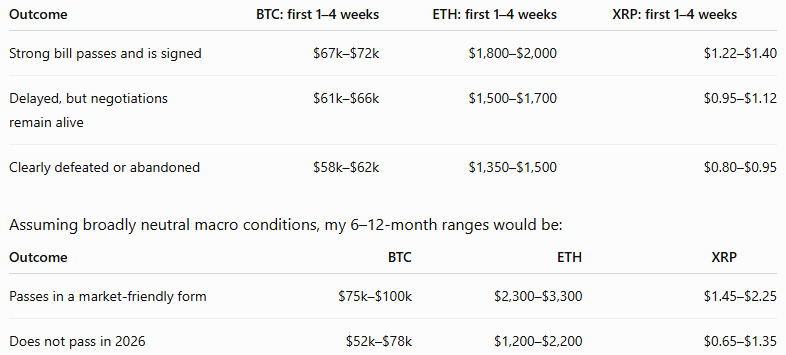
ChatGPT estimated that XRP could reach $1.22 to $1.40 within four weeks of a strong bill becoming law, followed by a six- to 12-month range of $1.45 to $2.25. Under outright defeat, it projected an initial decline to $0.80-$0.95.
ChatGPT’s view on the three cryptocurrencies. | Credit: ChatGPR
Gemini offered the most bullish short-term outlook, placing XRP between $2.20 and $3 following passage. It argued that statutory clarity could remove XRP’s longstanding US regulatory discount and encourage institutional settlement activity.
Grok agreed with the XRP-first ranking but avoided a firm target, emphasizing that legal certainty could support ETF inflows and conservative institutional participation.
Claude was more cautious, arguing that Ripple’s earlier courtroom progress means some regulatory optimism may already be reflected in XRP.
The models broadly agreed that non-passage would affect XRP the most because its institutional narrative remains closely tied to durable-commodity treatment.
Ethereum Could Win on Staking and DeFi
Ethereum ranked as the strongest fundamental beneficiary across the responses. The models argued that clearer boundaries between securities and digital commodities could reduce uncertainty surrounding staking, decentralized finance, and tokenization.
ChatGPT projected an immediate ETH price range of $1,800 to $2,000 after passage, with a six- to 12-month target of $2,300 to $3,300 under neutral macroeconomic conditions.
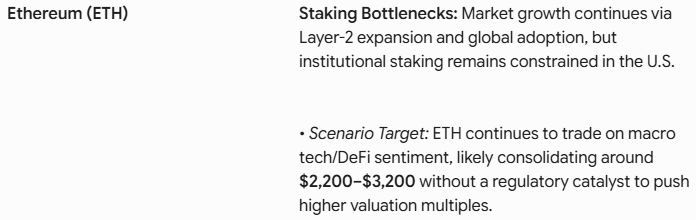
Ethereum is seen consolidating around $2,200-2,300. | Credit: Gemini
Gemini presented a much more aggressive scenario, suggesting that renewed DeFi inflows and greater access to institutional staking could eventually push ETH toward $4,500 to $6,000.
Claude and Grok declined to provide precise levels but agreed that Ethereum would benefit more structurally than Bitcoin.
Both highlighted its role as infrastructure for programmable finance, making clear market rules more consequential for ETH than for a primarily monetary asset.
If the bill fails, the models expect Ethereum to remain tied to broader technology, DeFi, and liquidity cycles, with US institutional staking developing more slowly.
Bitcoin Looks Most Resilient
Bitcoin ranked last for relative upside but first for downside protection.
ChatGPT placed BTC between $67,000 and $72,000 during the first four weeks after passage, potentially rising to $75,000-$100,000 over six to 12 months. Under outright legislative defeat, it projected an initial range of $58,000 to $62,000.
Grok considers BTC the most resilient to any CLARITY Act outcome. | Credit: Grok
Gemini’s bullish scenario reached $90,000 to $120,000, although it acknowledged that Bitcoin already enjoys comparatively strong commodity treatment, access to spot ETFs, and established custody channels.
Claude and Grok argued that BTC’s response would primarily reflect broader relief across crypto rather than a significant change to its regulatory position. If the CLARITY Act fails, capital leaving more legally sensitive altcoins could even strengthen Bitcoin dominance.
Legislative Outcome Remains Uncertain
The Senate Banking Committee advanced the CLARITY Act in May, and Senator Cynthia Lummis released updated merged text in July. However, the measure still faces a full Senate vote, possible amendments, and reconciliation with the House.
The models assigned varying probabilities to enactment. ChatGPT estimated a 35% to 40% chance of passage in 2026, while Claude cited prediction-market odds ranging from the high 20s to upper 30s.
LATEST: 📊 Kevin O'Leary says Bitcoin's price will "go nowhere" if the CLARITY Act doesn't pass: "Unless the bill passes, it's stuck here." pic.twitter.com/wAdvDlr3OR
Despite their different targets, the four models produced the same overall ranking: passage favors XRP first, Ethereum second, and Bitcoin third in relative terms. Failure reverses the defensive order, leaving Bitcoin strongest and XRP most exposed.
Their largest point of agreement was also the most important caveat: the CLARITY Act can reduce regulatory risk, but it cannot override the global liquidity cycle.
Disclaimer:
The information provided in this article is for informational purposes only. It is not intended to be, nor should it be construed as, financial advice. We do not make any warranties regarding the completeness, reliability, or accuracy of this information. All investments involve risk, and past performance does not guarantee future results. We recommend consulting a financial advisor before making any investment decisions.
Giuseppe Ciccomascolo began his career as an investigative journalist in Italy, where he contributed to both local and national newspapers, focusing on various financial sectors.
Upon relocating to London, he worked as an analyst for Fitch's CapitalStructure and later as a Senior Reporter for Alliance News. In 2017, Giuseppe transitioned to covering cryptocurrency-related news, producing documentaries and articles on Bitcoin and other emerging digital currencies. He also played a pivotal role in establishing the academy for a cryptocurrency exchange website. Crypto remained his primary area of interest throughout his tenure as a writer for ThirdFloor.