Ripple’s MiCA license unlocks 30 EEA markets as the CLARITY Act could strengthen institutional XRP adoption and its path toward $10. | Credit: CCN.com
Share
Key Takeaways
Polymarket traders put the probability of the CLARITY Act becoming law in 2026 at 27%, near the market’s lowest level.
A separate market gave the Senate only a 28% chance of holding a recorded vote on the legislation before its August recess.
XRP would need to rise approximately 363% from $1.08 to reach $5, a target Motley Fool contributor William Ebiefung believes could be achieved by 2030.
XRP’s prospects of reaching $5 have returned to focus as confidence in the passage of a landmark US crypto bill falls toward a major low.
Polymarket traders now see only a 27% chance that the CLARITY Act will become law before the end of 2026.
A separate contract gives the Senate a 28% chance of holding any recorded vote connected to the bill before lawmakers leave Washington for their August recess.
Motley Fool contributor William Ebiefung recently argued that the crypto could reach $5 by 2030 as institutional access expands and Ripple pushes further into traditional finance.
However, with XRP trading at approximately $1.08, reaching that target would require a gain of around 363%.
Try Our Recommended Crypto Exchanges
Sponsored
Disclosure
We sometimes use affiliate links in our content, when clicking on those we might receive a commission at no extra cost to you. By using this website you agree to our terms and conditions and privacy policy.
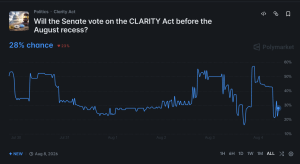
The probability of the CLARITY Act becoming law in 2026 has fallen to 27% on Polymarket.
The contract, which has generated more than $3.8 million in trading volume, will resolve positively only if H.R.3633 passes both chambers of Congress and is signed into law by Dec. 31.
Its odds briefly approached 80% in February but have trended substantially lower as negotiations became increasingly difficult.
Polymarket traders are not convinced the CLARITY Act will pass. | Source: Polymarket.
The 27% figure is therefore close to the lowest level reached since the market opened in January.
However, a second Polymarket contract provides a more immediate indication of whether senators will act before leaving Washington.
That market gave the Senate a 28% chance of holding a recorded vote connected to the legislation by 11:59 p.m. ET on Aug. 7.
Senate Faces Three-Day CLARITY Act Window
The falling odds come as senators enter the final three scheduled session days before their summer break.
The CLARITY Act was absent from Monday’s floor schedule. However, Senate Majority Leader John Thune was reported on Tuesday as saying he still expected the chamber to take up the legislation this week.
No firm time for a vote had been announced at the time of writing.
The Senate’s published calendar places the chamber in a state work period from Aug. 10 until Sept. 11, meaning senators are expected to return to Washington on Sept. 14.
Missing the immediate window would not kill the bill, but it would push the fight deeper into a midterm election year, when lawmakers will face competing political priorities.
Senator Cynthia Lummis subsequently released an updated 616-page version combining work undertaken by the Banking and Agriculture committees.
“The coming weeks are likely the last real chance we will have for years to get this right,” Lummis said on July 22.
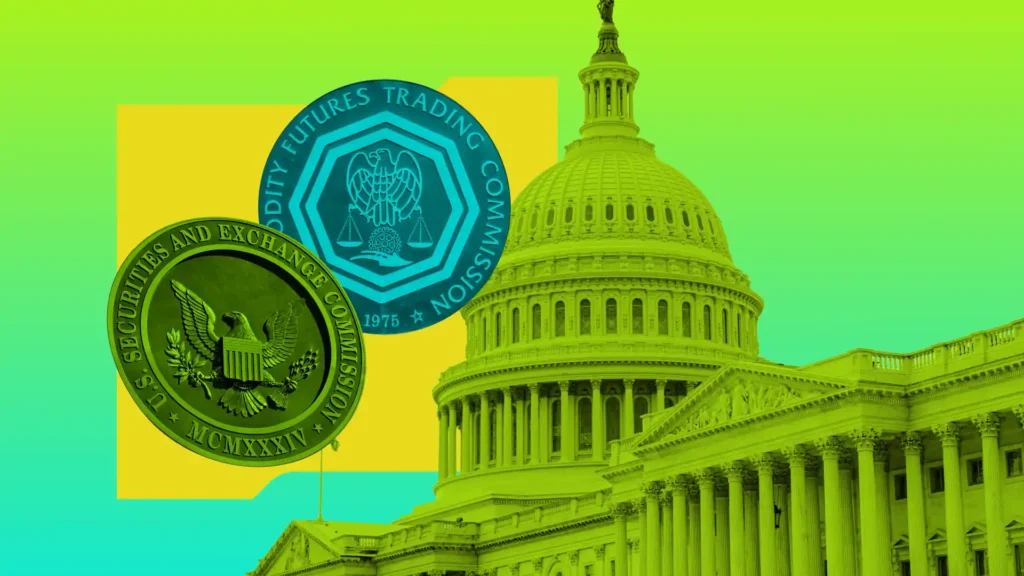
The bill would divide responsibility for different digital assets and market participants between the Securities and Exchange Commission and the Commodity Futures Trading Commission.
However, disagreements remain over political-ethics restrictions, stablecoin rewards, decentralized finance, developer liability, and anti-money-laundering requirements.
White House and Crypto Industry Increase CLARITY Act Pressure
The White House and several major crypto companies have continued pressing senators to complete negotiations before the recess.
Coinbase Chief Policy Officer Faryar Shirzad recently amplified comments from former Defense Secretary Mark Esper, who framed the CLARITY Act as a national security issue.
Esper argued that establishing a federal digital asset framework was important to maintaining US leadership in technologies likely to shape economic competition.
Former Barclays CEO Bob Diamond has also backed the transition toward regulated blockchain markets.
Speaking during a CNBC interview, Diamond said blockchain could support continuous trading, near-instant settlement, and significantly lower costs than conventional financial infrastructure.
“The infrastructure winners are Circle and Hyperliquid,” he said.
Diamond’s comments are notable for XRP investors because they demonstrate that regulatory clarity would not necessarily benefit every crypto equally.
Stablecoin issuers, exchanges,s and trading infrastructure providers may capture much of the immediate value created by clearer rules.
Diamond reportedly placed the probability of the CLARITY Act passing in 2026 at between 50% and 75%, making him considerably more optimistic than Polymarket traders.
Could XRP Price Reach $5 by 2030?
Despite the deteriorating CLARITY Act odds, Motley Fool contributor William Ebiefung believes XRP could reach $5 by 2030.
In his June analysis, Ebiefung wrote that there were “compelling reasons to be optimistic about XRP’s future.”
XRP was trading at $1.34 when the prediction was published.
From that level, reaching $5 required a 273% increase, equivalent to a compound annual growth rate of approximately 39% over four years.
The calculation has since become more demanding.
At an XRP price of $1.08, a move to $5 would represent an increase of approximately 363%, or a 4.6-fold return.
The target would also put XRP around 41% above its 2025 cycle high of $3.55.
Ebiefung based his optimism partly on XRP’s historical market cycles, pointing to major peaks in 2018, 2021, and 2025.
If a similar pattern continues, another major rally could emerge before 2030.
He also argued that improving macroeconomic conditions, lower interest rates, and easier institutional access through spot XRP exchange-traded funds could support the next cycle.
“The next XRP rally could significantly exceed previous highs,” Ebiefung wrote.
XRP Price to $5? AI Models Weigh In
CCN turned to ChatGPT, Gemini, and Claude to assess whether an XRP rally is possible.
ChatGPT
OpenAI’s ChatGPT assessed $5 as possible by 2030, although it placed the target in a bullish scenario rather than its central forecast.
“XRP has previously demonstrated that it can deliver gains of this magnitude, but repeating them will require institutional adoption to translate into sustained token demand,” it said.
Its outlook:
Bearish: $0.50–$1.25
Base case: $1.75–$3.50
Bullish: $5–$8
“The CLARITY Act could improve the broader regulatory environment, but its passage would not create a direct or automatic valuation mechanism for XRP.”
The model said reaching $5 would probably require several conditions to align, including stronger crypto liquidity, meaningful XRP ETF inflows, growth in XRP-denominated activity, and another broad market cycle.
It added that failure to pass the CLARITY Act in August would not preclude a $5 price by 2030, as Congress could revisit the legislation later.
However, a prolonged regulatory delay, combined with weak evidence of XRP’s utility, would make the target considerably less likely.
“Given crypto’s historical volatility, this is mathematically feasible, but it relies on several crucial market mechanics working in tandem,” it said.
Gemini argued that comprehensive US market-structure legislation could reduce institutional uncertainty around XRP, even if the CLARITY Act fails to pass during the current congressional window.
However, it emphasized that Ripple’s institutional expansion should not be taken as evidence of automatic demand for XRP.
Financial companies can use Ripple’s software, private payment infrastructure, and RLUSD without holding substantial amounts of XRP. Reaching $5 would therefore require significant growth in transactions that directly use XRP as a bridge asset.
Its outlook:
Bearish: $0.40–$1.20
Base case: $3–$6
Bullish: $8–$15+
“Yes, $5.00 by December 31, 2030, is a realistic base-to-bullish target,” it said.
Claude
Anthropic’s Claude offered a more cautious assessment, placing $5 at the lower end of its bullish scenario rather than within its central forecast.
“$5 by 2030 sits at the low end of the bullish case, not the base case,” it said.
Claude argued that the immediate CLARITY Act deadline may be less important to XRP’s 2030 valuation than the longer regulatory direction.
Even if the legislation misses its current window, Congress could return to the crypto market structure in 2027.
Meanwhile, five US spot XRP ETFs have already created institutional access without the CLARITY Act becoming law.
However, Claude identified the separation between Ripple’s corporate growth and demand for XRP as the most important issue.
Its outlook:
Bearish: $0.50–$1.50
Base case: $1.50–$3.50
Bullish: $4–$7
Claude’s bearish case assumes the CLARITY Act remains stalled or is significantly weakened, XRP ETF inflows disappoint, and competing payment networks reduce the token’s relevance.
Reaching $5 would require the conditions in Claude’s bullish scenario.
That would include effective market-structure legislation, substantial ETF and institutional demand, another broad crypto bull marke,t and meaningful growth in payment corridors that directly use XRP as a bridge asset.
Disclaimer:
The information provided in this article is for informational purposes only. It is not intended to be, nor should it be construed as, financial advice. We do not make any warranties regarding the completeness, reliability, or accuracy of this information. All investments involve risk, and past performance does not guarantee future results. We recommend consulting a financial advisor before making any investment decisions.
Kurt Robson is a London-based reporter at CCN, specialising in the fast-moving worlds of crypto and emerging technology. He began his career covering local news in Cornwall after graduating from Falmouth University with First Class Honours in Journalism. There, he cut his teeth on everything from council meetings to missing swans.
He quickly rose through the ranks to become a frontline journalist at several of the UK’s leading national newspapers. Over the years, he has interviewed musicians and celebrities, reported from courtrooms and crime scenes, and secured multiple front-page exclusives.
Following the upheaval of the COVID-19 pandemic, Kurt shifted his focus to technology journalism—just ahead of the AI boom. With a natural curiosity and a trained eye for emerging trends, he has found a new rhythm in reporting on innovation.
At CCN, Kurt's work focuses on the cutting edge of crypto, blockchain, AI, and the evolving digital world. Drawing on his background in people-first reporting and his deep interest in disruptive tech, Kurt delivers stories that are insightful, entertaining, and human-centric.