Bitcoin Down 25% in 2026: Has BTC Finally Bottomed or Is Another Crash Coming?
Share
Key Takeaways
BTC is forming support near $60,000 without confirming a reversal.
Low exchange supply is constructive; derivatives concentration and leverage remain destabilizing.
The probability split is 60% stabilization versus 40% for another decline toward $50,000–$58,000.
As of Aug. 4, 2026, Bitcoin trades near $63,586 (at the time of writing), down a calculated 27.3% year to date and 33.0% in the first half.
The market appears to be bottoming rather than fully bottomed: low exchange supply and accumulation around $60,000–$70,000 support a floor, while realized losses, weak participation, and leverage preserve downside risk.
The assessment assigns a 60% probability of stabilization above $58,000–$60,000 next quarter and a 40% probability of a decline toward $50,000–$58,000.
According to Glassnode, stronger onchain activity, resilient long-term holders, and continued spot Bitcoin ETF inflows are providing underlying support, but overall market conviction remains muted.
BTC spot demand remains weak, and derivatives stay defensive. | Source: @glassnode on X
The combination suggests investors are waiting for a stronger catalyst before committing to a sustained directional move.
Try Our Recommended Crypto Exchanges
Sponsored
Disclosure
We sometimes use affiliate links in our content, when clicking on those we might receive a commission at no extra cost to you. By using this website you agree to our terms and conditions and privacy policy.
Bitcoin (BTC) began 2026 near $87,440, closed June around $58,559 and remains almost 50% below its October 2025 record near $126,200. Provider differences reflect timing and rounding.
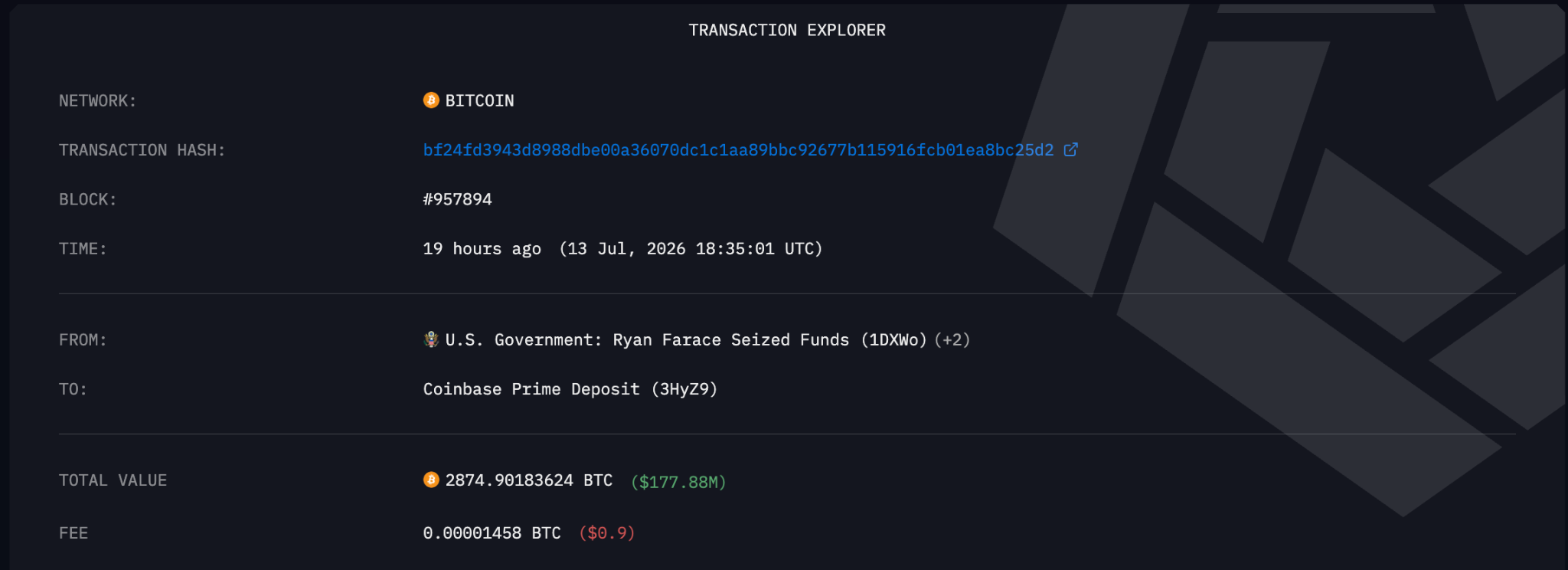
The United States Government transferred approximately $280 million worth of seized BTC and ETH to Coinbase Prime on 13th July. | Source: Arkham
Onchain Data Suggest Support, Not Confirmation
Santiment placed exchange-held BTC at 5.6% of supply in May, the lowest ratio since 2018, while wallets holding 1,000–10,000 BTC controlled 21.3%.
Glassnode’s July 21 realized-cap components totaled approximately $1.06 trillion; against a roughly $1.27 trillion market capitalization, a cross-date estimate places MVRV near 1.2—cheap relative to cycle peaks, but above the sub-1 capitulation zone.
A July Glassnode-based assessment put short-term-holder MVRV at 0.90 and the 30-day realized profit/loss ratio at 0.53, indicating that newer buyers remained underwater and realized losses dominated.
Participation remains soft: a February Glassnode-based reading put active addresses near 536,000 on an eight-day average, 31% below August 2025. Conversely, about 844,000 BTC accumulated between $60,000 and $70,000 by April, reinforcing that range as support.
While the market appears to be deep into a late bear phase, the composite indicator has not yet reached the deep-blue levels that have historically coincided with major cycle bottoms, suggesting investors should look for additional confirming signals before calling a definitive market floor.
The Bitcoin Cycle Position Heatmap. | Source: @n3ocortex on X
Liquidity, Macro Conditions, and Analyst Views
June turnover reached $4.74 trillion, but derivatives supplied 84.5% as order-book depth thinned across nearly every venue. A two-day liquidation wave erased roughly $3 billion and reduced aggregate crypto open interest by 8.5%, underscoring how quickly liquidity can disappear.
Analyst views remain divided. Pantera said BTC traded 42% below its long-term trend; ARK estimated ETFs and digital-asset treasuries held more than 12% of supply at end-2025.
Fidelity’s Jurrien Timmer called roughly $58,000 an accumulation zone but saw no immediate catalyst. Bloomberg Intelligence’s Mike McGlone said BTC must regain $75,000, while Standard Chartered warned $50,000 could precede recovery.
LATEST: 📊 Bloomberg Intelligence’s Mike McGlone says Bitcoin could fall to $10,000 in 2026, calling $75,000 the key level BTC must reclaim to invalidate the forecast. pic.twitter.com/XffVpiZeq9
JPMorgan estimated mining production cost at $78,000, creating treasury-sale risk below it. Banca d’Italia found that Tether and Circle represented more than 80% of stablecoin capitalization.
What Comes Next for Bitcoin Price
A durable bottom would require a sustained reclaim of $72,000–$75,000, renewed realized-cap growth, and calmer leverage. Low exchange supply and dense cost-basis support make a collapse below $50,000 less likely than volatile stabilization, but thin liquidity could magnify other rates, ETF-flow or treasury-selling shock.
The probability split remains 60% for stabilization above $58,000–$60,000 and 40% for another decline toward $50,000–$58,000.
Disclaimer:
The information provided in this article is for informational purposes only. It is not intended to be, nor should it be construed as, financial advice. We do not make any warranties regarding the completeness, reliability, or accuracy of this information. All investments involve risk, and past performance does not guarantee future results. We recommend consulting a financial advisor before making any investment decisions.
Dr. Guneet Kaur is a senior editor at CCN.com and a Science Fellow at Exponential Science. She is a fintech and blockchain expert with extensive experience in digital finance education, blockchain ecosystems, and cryptocurrency markets. She has worked with global media such as Cointelegraph, as well as education and blockchain platforms, to design and lead strategic content and learning initiatives. As an educator and assessor for top-tier executive programs, she bridges real-world fintech trends with academic insight.
Dr. Kaur is also a published researcher and peer reviewer across fintech and data science journals, including Financial Innovation Journal and International Journal of Big Data Intelligence and Applications. Her work spans data-driven analysis, Web3 innovation, and technical content development. With a strong foundation in both industry and academia, she translates complex financial technologies into practical applications, empowering learners, professionals, and institutions across the rapidly evolving digital finance landscape.