Saylor Reveals Why Strategy Sold Bitcoin Near $60K Despite Its Buy and Hold Strategy
Share
Key Takeaways
ChatGPT, Gemini, Claude, and Grok concluded that Strategy would likely survive a Bitcoin drop to $50,000.
Even at $50K BTC, Strategy’s approximately 843,775 Bitcoin would still be worth about $42.2 billion, comfortably exceeding its roughly $6.75 billion in debt.
Strategy’s financing relies mainly on long-term convertible notes and preferred securities rather than Bitcoin-backed margin loans.
Bitcoin has fallen more than 70% during previous bear markets, making downside scenarios a recurring topic for investors in Michael Saylor’s Strategy (MSTR).
While the company has transformed itself into the world’s largest corporate Bitcoin holder, critics continue to question whether its highly leveraged treasury strategy could withstand another prolonged downturn.
To test that thesis, we asked four leading artificial intelligence models, OpenAI’s ChatGPT, Google’s Gemini, Anthropic’s Claude, and xAI’s Grok, whether Strategy could survive if Bitcoin dropped to $50,000.
The analysis used the company’s current metrics, including approximately 843,775 BTC, valued at around $54.4 billion at current prices; $6.75 billion in debt; roughly $15.5 billion in preferred securities; and $2.55 billion in cash reserves.
Although each model approached the question differently, all four reached the same conclusion: a fall to $50,000 would severely pressure Strategy’s business model, but it would not likely threaten the company’s survival.
Try Our Recommended Crypto Exchanges
Sponsored
Disclosure
We sometimes use affiliate links in our content, when clicking on those we might receive a commission at no extra cost to you. By using this website you agree to our terms and conditions and privacy policy.
All Four AI Models Agree: $50K Bitcoin Is Painful, Not Fatal
The clearest point of consensus was that a $50,000 Bitcoin price would significantly reduce Strategy’s treasury value but would leave the company with assets well above its outstanding debt.
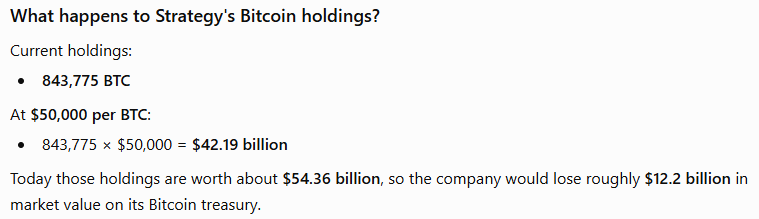
At $50,000 per Bitcoin, Strategy’s holdings would be worth approximately $42.2 billion, down roughly $12 billion from current levels.
Even after that decline, every AI model noted that Bitcoin holdings alone would still cover the company’s roughly $6.75 billion of debt many times over.
ChatGPT emphasized that the biggest misconception surrounding Strategy is the assumption that lower Bitcoin prices automatically trigger bankruptcy.
Bitcoin’s eventual drop to $50,000 is painful but Strategy will survive. | Credit: ChatGPT
Instead, it argued that Strategy’s balance sheet remains relatively conservative from a leverage perspective. The company would still own more than $42 billion in Bitcoin while maintaining around $2.5 billion in cash, leaving debt coverage at more than six times outstanding borrowings.
Gemini reached a similar conclusion, pointing to Strategy’s low net leverage and describing the capital structure as resilient enough to withstand a prolonged drawdown without triggering forced asset sales.
Grok also concluded that bankruptcy would remain unlikely because the company’s liabilities would still represent only a fraction of total assets, even after Bitcoin fell to $50,000.
Claude described the scenario as a “serious stress test” rather than an existential crisis.
The Real Risk Isn’t Bitcoin — It Is Losing Access to Capital Markets
While all four models dismissed immediate solvency concerns, they agreed that the greatest threat to Strategy would come from a very different source: its ability to continue raising capital.
Strategy’s Bitcoin accumulation strategy relies heavily on issuing new equity, convertible notes, and preferred securities to purchase additional Bitcoin. That model works best when investors are willing to assign a premium valuation to the company’s shares.
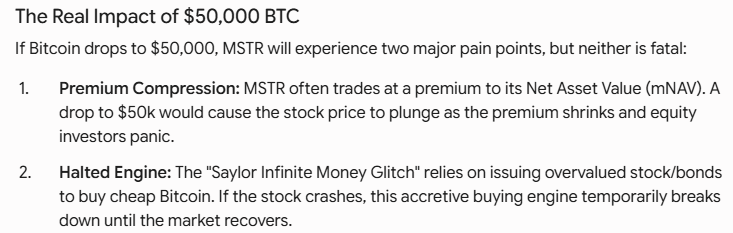
ChatGPT argued that a $50,000 Bitcoin price would likely compress Strategy’s stock valuation, making future equity issuance significantly more dilutive while reducing investor demand for convertible debt.
If MSTR crashes, this accretive buying engine temporarily breaks down until the market recovers. | Credit: Gemini
Gemini described this as the “halted engine” scenario, where the mechanism that allows Strategy to continuously acquire Bitcoin temporarily stops functioning because issuing new shares no longer creates value for existing shareholders.
Claude echoed that concern, noting that if the company’s multiple falls to or below its net asset value (mNAV), issuing equity to buy additional Bitcoin becomes far less attractive.
Rather than balance-sheet insolvency, the models identified capital market access as the company’s primary vulnerability during an extended bear market.
Why Forced Liquidation Remains Unlikely
One of the strongest areas of agreement involved the structure of Strategy’s debt.
Unlike leveraged crypto traders who borrow directly against Bitcoin collateral, Strategy primarily finances itself through long-term convertible senior notes and preferred equity.
Because these obligations generally lack daily collateral requirements, a falling Bitcoin price does not automatically trigger margin calls or forced liquidations.
Gemini stressed that most of Strategy’s debt matures years into the future and consists of unsecured corporate obligations rather than Bitcoin-backed loans.
A drop to $50,000 would hurt returns and test conviction, but bankruptcy is highly unlikely. | Credit: Grok
Grok similarly noted that creditors cannot simply seize Bitcoin holdings because prices decline.
ChatGPT also pointed to Strategy’s approximately $2.55 billion cash reserve, which provides an additional liquidity cushion during market downturns.
Claude highlighted the company’s recently announced liquidity plan, including several billion dollars in available reserves designed to cover dividend obligations and debt servicing over multiple years.
Together, these factors led every model to conclude that a Bitcoin decline alone would not force Strategy to liquidate its treasury.
Dividend Obligations and Refinancing Could Become Bigger Challenges
Although none of the AI models predicted bankruptcy at $50,000 Bitcoin, several warned that prolonged weakness could gradually increase financial pressure.
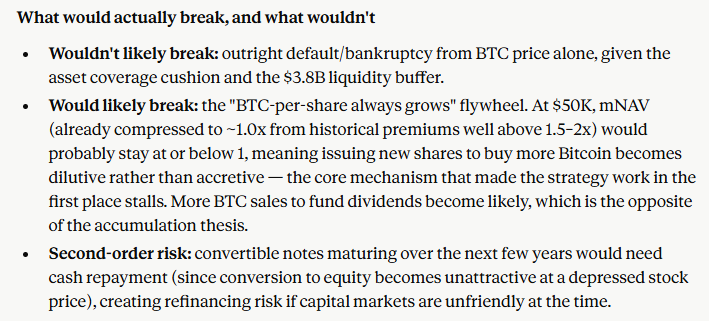
Claude focused on preferred dividend obligations, arguing that Bitcoin itself produces no cash flow. If market conditions remain depressed for an extended period, Strategy would increasingly depend on cash reserves, selective Bitcoin sales, or new financing to meet those commitments.
One of the biggest issues may be profit distribution to shareholders. | Credit: Claude
Grok also pointed to refinancing risk as future convertible notes mature. If capital markets remain weak and Strategy’s stock trades at a significant discount to historical premiums, refinancing debt could become more expensive.
ChatGPT identified a similar risk, suggesting that higher funding costs combined with lower investor confidence could gradually erode the company’s ability to continue expanding its Bitcoin holdings.
Several models also noted that Strategy has already demonstrated a willingness to sell relatively small amounts of Bitcoin when necessary to support corporate obligations, suggesting management retains flexibility rather than adhering to an absolute “never sell” philosophy.
Consensus: Strategy Survives, But Its Growth Machine Slows
Despite highlighting different risks, all four AI models ultimately reached nearly identical conclusions.
A Bitcoin decline to $50,000 would likely trigger substantial unrealized losses, pressure Strategy’s stock price, reduce its financing flexibility, and slow future Bitcoin accumulation.
However, none of the models viewed the scenario as sufficient to trigger bankruptcy or widespread forced liquidation.
Instead, the stress would primarily shift from the balance sheet to the capital markets.
As long as Strategy maintains liquidity, successfully refinances debt, and preserves investor confidence, its corporate Bitcoin strategy appears capable of surviving a $50,000 Bitcoin environment.
The bigger question, according to every AI model, is not whether Strategy survives, but whether Michael Saylor’s aggressive Bitcoin acquisition machine can continue operating at full speed if the premium that fuels it disappears.
Disclaimer:
The information provided in this article is for informational purposes only. It is not intended to be, nor should it be construed as, financial advice. We do not make any warranties regarding the completeness, reliability, or accuracy of this information. All investments involve risk, and past performance does not guarantee future results. We recommend consulting a financial advisor before making any investment decisions.
Giuseppe Ciccomascolo began his career as an investigative journalist in Italy, where he contributed to both local and national newspapers, focusing on various financial sectors.
Upon relocating to London, he worked as an analyst for Fitch's CapitalStructure and later as a Senior Reporter for Alliance News. In 2017, Giuseppe transitioned to covering cryptocurrency-related news, producing documentaries and articles on Bitcoin and other emerging digital currencies. He also played a pivotal role in establishing the academy for a cryptocurrency exchange website. Crypto remained his primary area of interest throughout his tenure as a writer for ThirdFloor.