Helium legal chief says the CLARITY Act could protect DePIN tokens from shifting SEC enforcement and give crypto startups durable rules. | Credit: CCN.com
Share
Key Takeaways
The CLARITY Act faces a 20-day deadline as Senate divisions threaten progress on crypto regulation.
A collapse could pressure BTC, ETH, and XRP, with XRP facing the highest volatility risk.
Analysts say agency guidance may still provide clarity on crypto even if legislation fails.
The Senate returns Monday with roughly 20 working days before its August recess, a window Republicans and Democrats alike are treating as the last realistic shot at passing the CLARITY Act before politics reshuffles the entire fight.
A new draft could land as soon as next week, but Democrats have not signed on as the clock runs down.
Try Our Recommended Crypto Exchanges
Sponsored
Disclosure
We sometimes use affiliate links in our content, when clicking on those we might receive a commission at no extra cost to you. By using this website you agree to our terms and conditions and privacy policy.
Senator Cynthia Lummis has spent the past week framing the standoff as a test of national competitiveness rather than a partisan skirmish.
“Every month without clear digital asset rules is a month another country writes them for us,” she wrote, adding that the delay “is not a risk. It’s already happening.”
In a sharper post on July 8, Lummis called this “likely our last chance to get real legislation for digital assets on the books before 2030,” warning that failure means the US spends the next decade catching up to jurisdictions that move first.
Senator Elizabeth Warren’s objection cuts in the opposite direction. She wrote that the bill “as currently drafted… is a ticket to sanctions evasion,” a direct challenge to provisions Lummis has pointed to as evidence the bill actually tightens enforcement, including Section 303, which enables new crypto sanctions on Iran, and Section 305, which lets exchanges intercept illicit funds before they reach North Korea. Lummis’s reply to Warren captured the standoff in one line: both sides want bad actors held accountable, she argued, but “the difference is I’m working on solutions, you’re shouting into the void hoping the status quo fixes itself.”
We both want bad actors held accountable. The difference is I’m working on solutions, you’re shouting into the void hoping the status quo fixes itself.
— Senator Cynthia Lummis (@SenLummis) July 9, 2026
Could Crypto Still Win Without the CLARITY ACT?
Not everyone treats failure as catastrophic.
Galaxy’s head of research, Alex Thorn, said that even if the CLARITY Act collapses, the crypto industry will still capture “most of what it wants” through agency guidance over the next two and a half years, a reminder that regulators can deliver meaningful clarity without a statute, even if that clarity carries less permanence and can be unwound by the next administration.
LATEST: 🇺🇸 Galaxy head of research Alex Thorn says even if the CLARITY Act fails, the crypto industry will still get "most of what it wants" from agency guidance over the next 2.5 years. pic.twitter.com/9gAL8LEZjJ
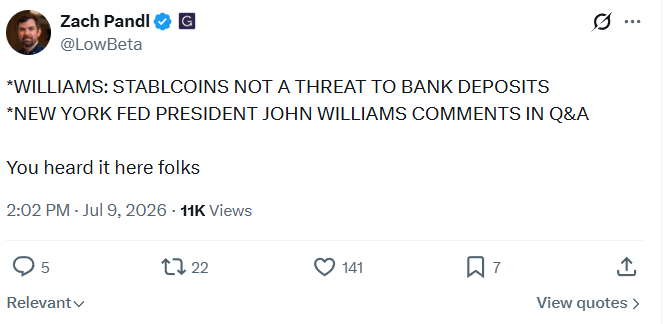
Fed’s Williams states stablecoins are mainly for payments and don’t threaten bank deposits. | Source: @LowBeta on X.
Trader Billy Boone pushed back sharply on X, noting the irony that stablecoins are “backed by the same treasuries banks used to hold,” a structural observation that undercuts the idea that stablecoin growth and bank deposit stability are unrelated.
The exchange lands squarely inside the CLARITY Act debate, since the bill’s market-structure provisions interact directly with how stablecoin issuers and deposit-taking banks compete for the same underlying collateral.
ChatGPT Predicts BTC, ETH, XRP Reaction if CLARITY Act Collapses
ChatGPT was asked to game out a full CLARITY Act collapse against crypto prices at the time of writing (BTC $64,165, ETH $1,781, XRP $1.10), and its read draws a clear line between short-term shock and long-term thesis damage.
Its overall stance: a collapse would likely trigger a short-term crypto shock but probably not a 2022-style crash on its own, with the reaction size varying sharply by asset.
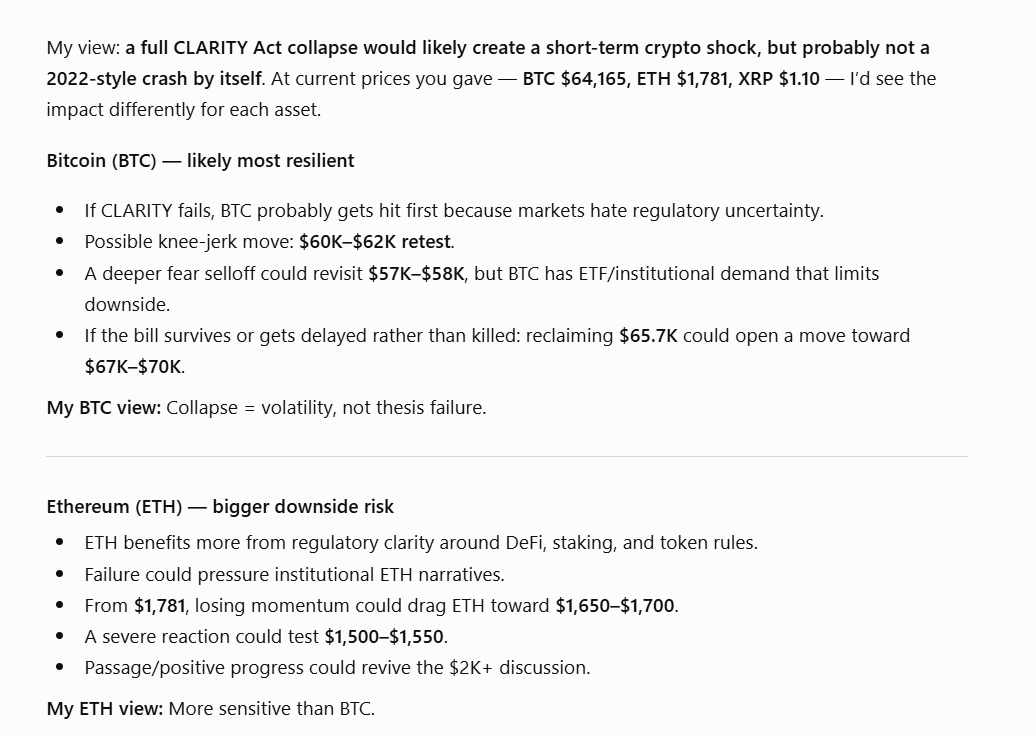
On Bitcoin, the model rated it the most resilient of the three. Its reasoning: BTC is likely to get hit first in any regulatory-uncertainty selloff, with a knee-jerk move toward the $60,000 to $62,000 range as the likely initial reaction.
A deeper, fear-driven selloff could revisit $57,000 to $58,000, but Bitcoin’s ETF and institutional demand base were cited as factors limiting how far that drawdown extends. On the upside, if the bill survives or is simply delayed rather than killed outright, reclaiming $65,700 could open the door to $67,000 to $70,000.
Its summary judgment: “Collapse = volatility, not thesis failure.”
If CLARITY fails, BTC is likely to take the hit first, while TH benefits more from regulatory clarity. | Source: ChatGPT
On Ethereum, the model flagged more downside sensitivity. Its logic is that ETH’s institutional narrative leans more on regulatory clarity around DeFi, staking, and token classification than Bitcoin’s does, making a CLARITY failure a more direct hit on the thesis than just a liquidity shock.
From $1,781, a momentum-losing scenario could drag ETH toward $1,650 to $1,700, with a more severe reaction testing $1,500 to $1,550. It also noted that passage, or even just visible progress, could revive discussion of a $2,000-plus target.
Its verdict: ETH is “more sensitive than BTC” to the bill’s outcome either way.
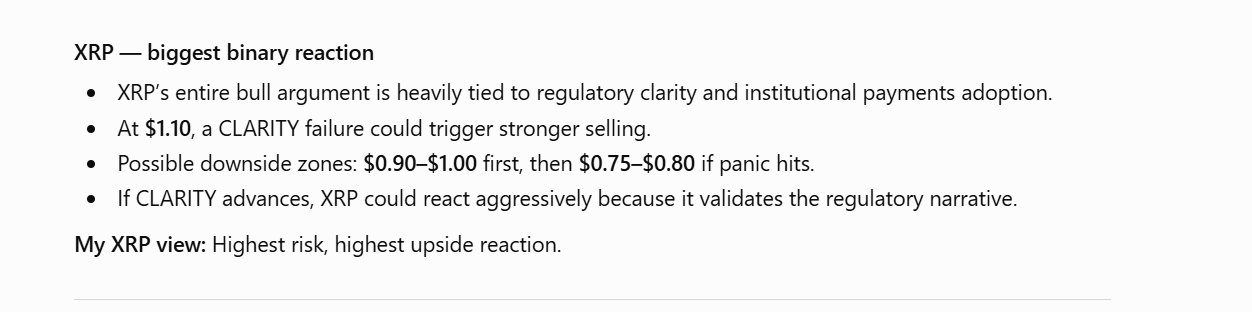
On XRP, ChatGPT called it the biggest binary reaction of the three, arguing that XRP’s entire bull case is more closely tied to regulatory clarity and institutional payments adoption than either BTC’s or ETH’s.
From $1.10, it modeled a CLARITY failure triggering stronger relative selling than the other two assets, with downside zones at $0.90 to $1.00 initially, extending to $0.75 to $0.80 if panic selling took hold. But the asymmetry was framed as cutting both ways: if CLARITY advances, XRP could react more aggressively to the upside precisely because passage would validate the regulatory narrative the token has been pricing in for years.
Its summary: “Highest risk, highest upside reaction.”
What happens to XRP price if CLARITY Act fails?. | Source: ChatGPT
Please note that these are scenario ranges from a language model working off the price inputs it was given, not forecasts grounded in order-book depth or options positioning.
But the relative ranking, XRP as the most binary, ETH as more exposed than BTC, and Bitcoin as the asset most insulated by its institutional base, tracks with how analysts have been arguing the same trade using harder data, including the ETF flow and onchain metrics already covered elsewhere in this piece.
What Happens to Bitcoin, Ethereum, and XRP if the CLARITY Act Deadline Fails?
If the bill misses its August window, the political variables compound quickly. A shift in Congress after the midterms would likely force Democrats to demand a substantially revised text, pushing negotiation into an entirely new Congress and resetting years of committee work.
Bitcoin’s reaction to earlier legislative progress offers the only real price data available: BTC traded near $81,000 when the bill cleared the Senate Banking Committee in May, a smaller procedural step than final passage.
XRP carries the most direct exposure of the three assets, since the bill would convert its existing commodity classification from an agency ruling into permanent statute, a distinction Lummis‘s own team has argued matters precisely because a law can’t be reversed the way an interpretive ruling can.
For Bitcoin, Ethereum, and XRP, the next 20 days settle less about price levels than about durability, whether the industry gets a fallback through agency guidance that resembles the real thing, or spends years relitigating what should have been decided this summer.
Disclaimer:
The information provided in this article is for informational purposes only. It is not intended to be, nor should it be construed as, financial advice. We do not make any warranties regarding the completeness, reliability, or accuracy of this information. All investments involve risk, and past performance does not guarantee future results. We recommend consulting a financial advisor before making any investment decisions.
Dr. Guneet Kaur is a senior editor at CCN.com and a Science Fellow at Exponential Science. She is a fintech and blockchain expert with extensive experience in digital finance education, blockchain ecosystems, and cryptocurrency markets. She has worked with global media such as Cointelegraph, as well as education and blockchain platforms, to design and lead strategic content and learning initiatives. As an educator and assessor for top-tier executive programs, she bridges real-world fintech trends with academic insight.
Dr. Kaur is also a published researcher and peer reviewer across fintech and data science journals, including Financial Innovation Journal and International Journal of Big Data Intelligence and Applications. Her work spans data-driven analysis, Web3 innovation, and technical content development. With a strong foundation in both industry and academia, she translates complex financial technologies into practical applications, empowering learners, professionals, and institutions across the rapidly evolving digital finance landscape.