Is XRP Price Undervalued Relative to Ripple’s $40B Valuation and XRPL Utility?
Share
Key Takeaways
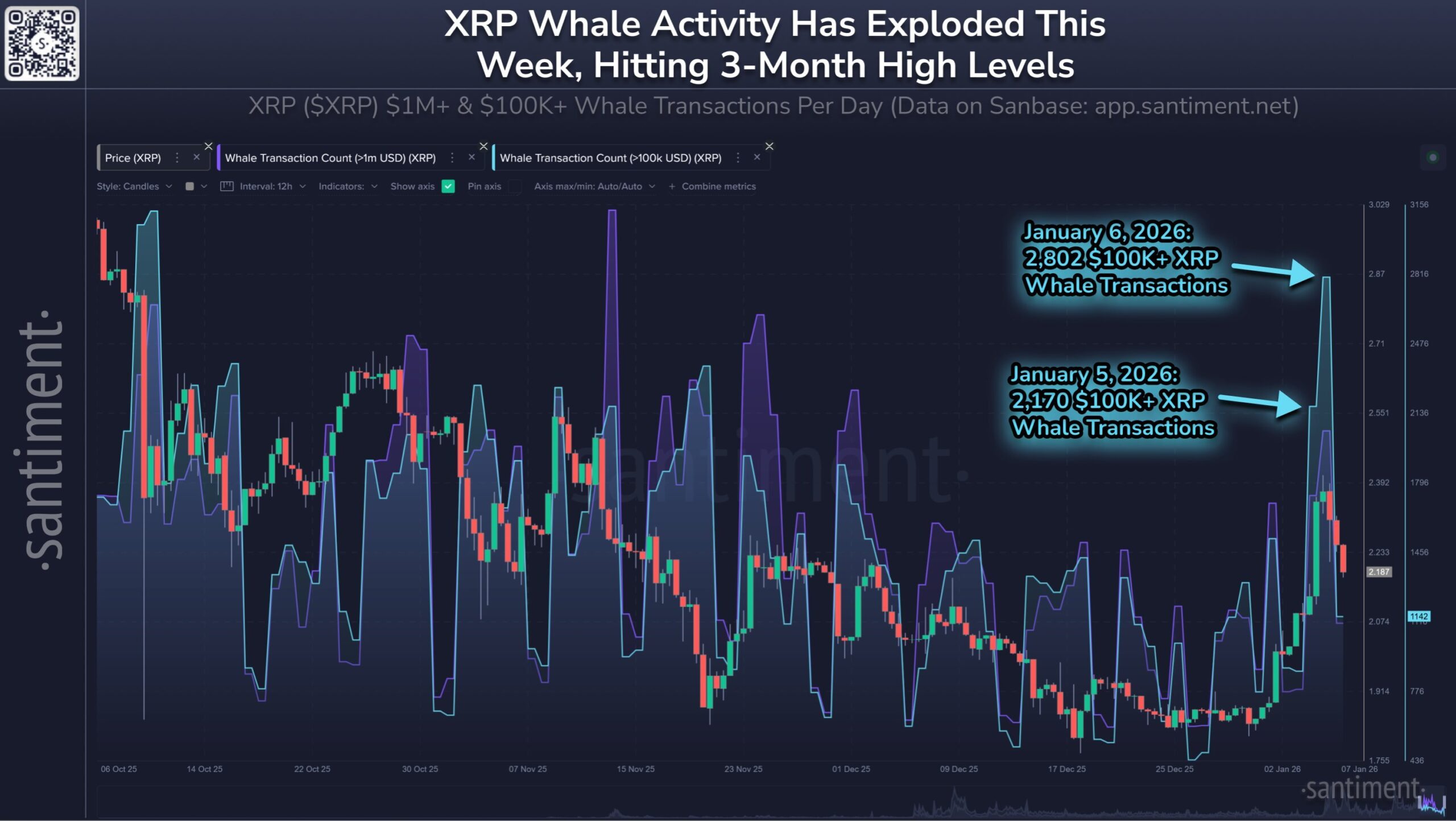
XRPL whale transactions surged to a three-month high, jumping from 2,170 to 2,802 large-value transfers in just 24 hours.
Spikes in whale activity typically signal rising market conviction and often precede periods of increased XRP price volatility.
Whale transactions do not automatically indicate buying or selling, but rather reflect large holders repositioning their capital rather than remaining inactive.
Historically, elevated whale activity on XRPL has clustered around market inflection points, not during stable trends.
The XRP Ledger (XRPL) is flashing a signal that market participants rarely ignore: whale activity is rising sharply.
On Monday, Jan. 5, the network recorded approximately 2,170 large transactions, defined as transfers valued at $100,000 or more. Just one day later, that figure jumped to 2,802, marking the highest level of whale transactions in three months.
Whale activity does not automatically mean prices will rise or fall. But historically, spikes in large-value transfers tend to coincide with periods of heightened volatility, shifts in market structure, or changes in investor behavior. Understanding what these transactions represent, and what they do not, is critical for interpreting XRP’s near-term price dynamics.
This article breaks down what whale transactions are, why they matter on XRPL specifically, and how similar patterns have played out in past XRP market cycles.
What Are XRP Ledger Whale Transactions and Why Do They Matter?
In on-chain analysis, a “whale transaction” typically refers to a single transfer exceeding a predefined value threshold, often $100,000 or more. On XRPL, these transactions are tracked because they represent activity by large holders, institutions, exchanges, or market makers.
XRP whale activity. | Credit: Santiment
Importantly, whale transactions do not necessarily reflect buying or selling. They can include:
Transfers between wallets owned by the same entity.
Exchange inflows or outflows.
Custodial rebalancing.
Liquidity provisioning.
Institutional settlement activity.
What makes whale data worthwhile is not the intent behind any single transaction, but the aggregate trend. When large-value transfers spike sharply, it often signals that capital is repositioning, not sitting idle.
Why Rising XRPL Whale Activity Is Important for XRP Price Analysis
XRP’s market structure differs from many other large-cap cryptocurrencies. A meaningful share of XRP’s circulating supply is concentrated among:
As a result, large movements on XRPL tend to be more informative than on chains with extremely fragmented ownership. When whales move XRP, it can significantly impact liquidity conditions, particularly during periods of thinner order books or heightened leverage.
XRPL is also widely used for payments, settlement, and cross-border liquidity, which means whale activity may reflect real economic usage rather than purely speculative repositioning. Distinguishing between these possibilities is key.
XRPL Whale Transactions Hit a 3-Month High: What Changed?
The jump from 2,170 to 2,802 whale transactions in 24 hours represents a significant acceleration, not a gradual increase. Such sharp moves typically coincide with one or more of the following conditions:
Regulatory or macro uncertainty prompting repositioning.
Anticipation of liquidity events (ETFs, legislation, or listings).
Increased arbitrage or market-making activity.
In XRP’s case, the surge comes amid a period of heightened narrative sensitivity, where institutional flows, regulatory developments, and ETF speculation are closely watched.
Historically, XRP tends to exhibit compressed volatility before significant directional moves. Spikes in whale activity often precede the release of that pressure.
How Whale Transactions Historically Impact XRP Price Volatility
Looking back at prior XRP cycles, elevated whale activity has tended to cluster around inflection points, not trend continuations.
Examples include:
Pre-rally accumulation phases, where large holders quietly reposition ahead of breakouts.
Distribution phases, where whales move assets toward exchanges during euphoric price action.
Liquidity reshuffling, especially ahead of macro events or regulatory decisions.
In each case, the key takeaway is the same: volatility tends to follow, even if direction remains uncertain.
It is also common for prices to move after whale activity peaks, not during it. On-chain data often leads price by days or weeks, especially when sentiment remains conflicted.
Exchange Inflows vs Wallet Transfers: How to Read XRP Whale Data Correctly
Exchange inflows (large transfers into centralized exchanges) often signal potential selling pressure.
Exchange outflows may indicate accumulation or long-term holding.
Wallet-to-wallet transfers can indicate internal treasury movements or adjustments made by the custodian.
Without granular address labeling, raw whale counts must be interpreted cautiously. However, when whale transaction spikes coincide with declining exchange balances, the signal often skews more bullish. Conversely, rising exchange inflows during whale spikes can increase downside risk.
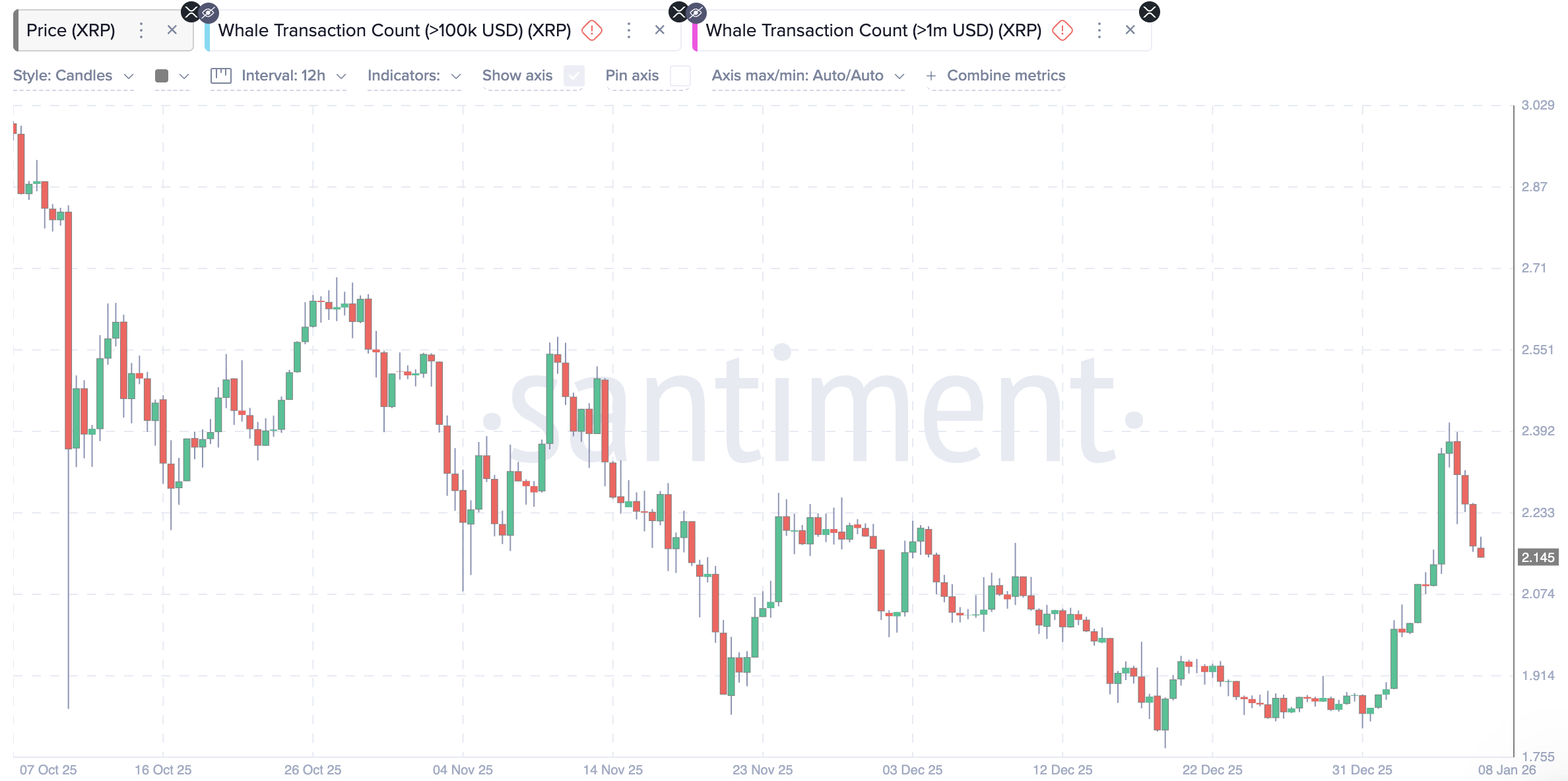
XRP whale activity since 2023. | Credit: CryptoQuant
For XRP traders, tracking both whale activity and exchange reserve trends together provides a clearer picture than either metric alone.
Why XRP Whale Activity Can Increase Without Immediate Price Moves
A common misconception is that large transfers should instantly move price. In reality, markets often absorb these flows silently.
In highly liquid markets, whales often move first, while the price responds later once positioning becomes unbalanced.
This dynamic is especially relevant for XRP, where derivatives volume frequently exceeds spot volume, and leverage can delay visible reactions.
What Rising Whale Transactions Signal About XRP Market Sentiment
A sustained increase in whale transactions usually reflects growing conviction, not indifference.
That conviction can be bullish or bearish, but it implies:
Large players believe something is changing.
Capital is being repositioned rather than sidelined.
Volatility expectations are rising.
Periods of low whale activity often coincide with market apathy. The current spike suggests the opposite: attention is returning.
XRP Price Outlook: Scenarios After a Spike in Whale Transactions
Based on historical behavior, elevated XRPL whale activity typically resolves into one of three outcomes:
Volatility expansion with directional breakout: If whale accumulation aligns with improving fundamentals or regulatory clarity, price may break higher as liquidity thins.
Sharp rejection after distribution: If whale activity reflects positioning for sales into strength, price may experience abrupt pullbacks once selling emerges.
Extended range with violent swings: If whales are repositioning across derivatives and spot markets simultaneously, price may remain range-bound but volatile.
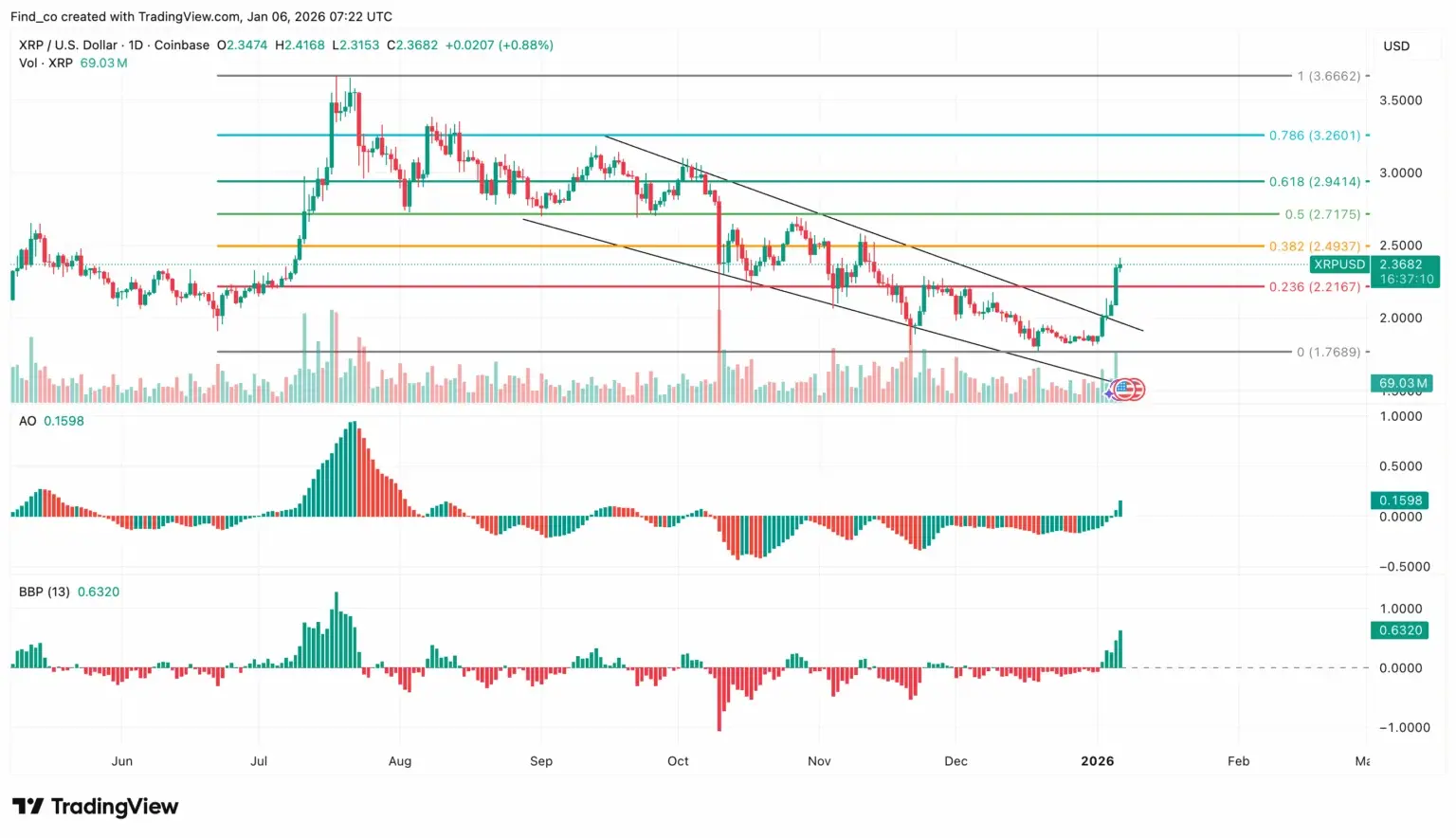
XRP techincal analysis. | Credit: TradingView.com
Which scenario plays out depends less on the whale activity itself and more on external catalysts.
What XRP Traders and Long-Term Holders Should Watch Next
For long-term holders, whale transaction spikes are not signals to panic or chase. They are contextual indicators that conditions are shifting.
For traders, elevated whale activity typically implies:
Ignoring these signals often leads to being caught offside when volatility returns.
Is Rising Whale Activity a Sign XRPL Network Usage Is Accelerating?
Beyond price implications, rising whale activity suggests renewed engagement with the XRPL ecosystem itself. Whether driven by payments, institutional flows, or speculative positioning, increased large-value transfers indicate that XRP is not dormant.
In previous cycles, similar upticks in XRPL activity preceded periods where XRP re-entered broader market conversations after an extended period of consolidation.
The jump to 2,802 whale transactions, the highest in three months, does not indicate a clear direction. It does predict movement.
Markets rarely stay quiet after large holders start moving capital at this scale. Whether the outcome favors bulls or bears will depend on liquidity, macro conditions, and regulatory developments. But one conclusion is hard to escape: XRP’s low-volatility phase may be ending.
For investors and traders alike, this is not a signal to react emotionally, but rather a call to pay attention.
Whale transactions are large XRP transfers, typically valued at $100,000 or more, recorded on the XRP Ledger. They usually involve institutional players, exchanges, market makers, or large individual holders.
Why did XRPL whale transactions spike to a 3-month high?
The spike to 2,802 whale transactions suggests large holders are repositioning capital. This often happens ahead of volatility events, such as regulatory developments, liquidity shifts, or anticipated price moves.
Does rising whale activity mean XRP price will go up?
Not necessarily. Increased whale activity signals higher volatility, not guaranteed price direction. Prices can rise, fall, or remain range-bound depending on whether whales are accumulating, distributing, or reallocating assets.
Are whale transactions the same as buying or selling XRP?
No. Whale transactions include wallet-to-wallet transfers, exchange inflows or outflows, custodial rebalancing, and OTC settlements. Only some whale movements result in direct buying or selling on exchanges.
Disclaimer:
The information provided in this article is for informational purposes only. It is not intended to be, nor should it be construed as, financial advice. We do not make any warranties regarding the completeness, reliability, or accuracy of this information. All investments involve risk, and past performance does not guarantee future results. We recommend consulting a financial advisor before making any investment decisions.
Giuseppe Ciccomascolo began his career as an investigative journalist in Italy, where he contributed to both local and national newspapers, focusing on various financial sectors.
Upon relocating to London, he worked as an analyst for Fitch's CapitalStructure and later as a Senior Reporter for Alliance News. In 2017, Giuseppe transitioned to covering cryptocurrency-related news, producing documentaries and articles on Bitcoin and other emerging digital currencies. He also played a pivotal role in establishing the academy for a cryptocurrency exchange website. Crypto remained his primary area of interest throughout his tenure as a writer for ThirdFloor.


 Easy
Easy