Ripple Moves 300,000,000 XRP ($652M) to 'Unknown Wallet' as Price Eyes $2.50 — Here’s Where It Really Went
Share
Key Takeaways
The 300M XRP transfer stayed within Ripple-controlled wallets, not exchanges.
The move fits Ripple’s regular monthly escrow and treasury pattern.
Large internal XRP transfers don’t automatically impact price.
XRP’s rise in early 2026 was driven by broader market momentum, not this transfer alone.
On January 5, 2026, crypto trackers spotted an enormous XRP “whale” transfer: 300 million XRP (worth about $652 million) moving from a known Ripple wallet to an unidentified address.
Such mammoth on-chain moves naturally spark buzz among investors, who scour these transactions for clues about Ripple’s intentions and potential market impact. Is this a routine treasury shuffle or a prelude to something bigger?
This deep-dive breaks down what happened, where the XRP went, why Ripple might be moving such a sum, and whether history shows any link between these transfers and XRP’s price moves.
What Happened: The 300M XRP Transfer at a Glance
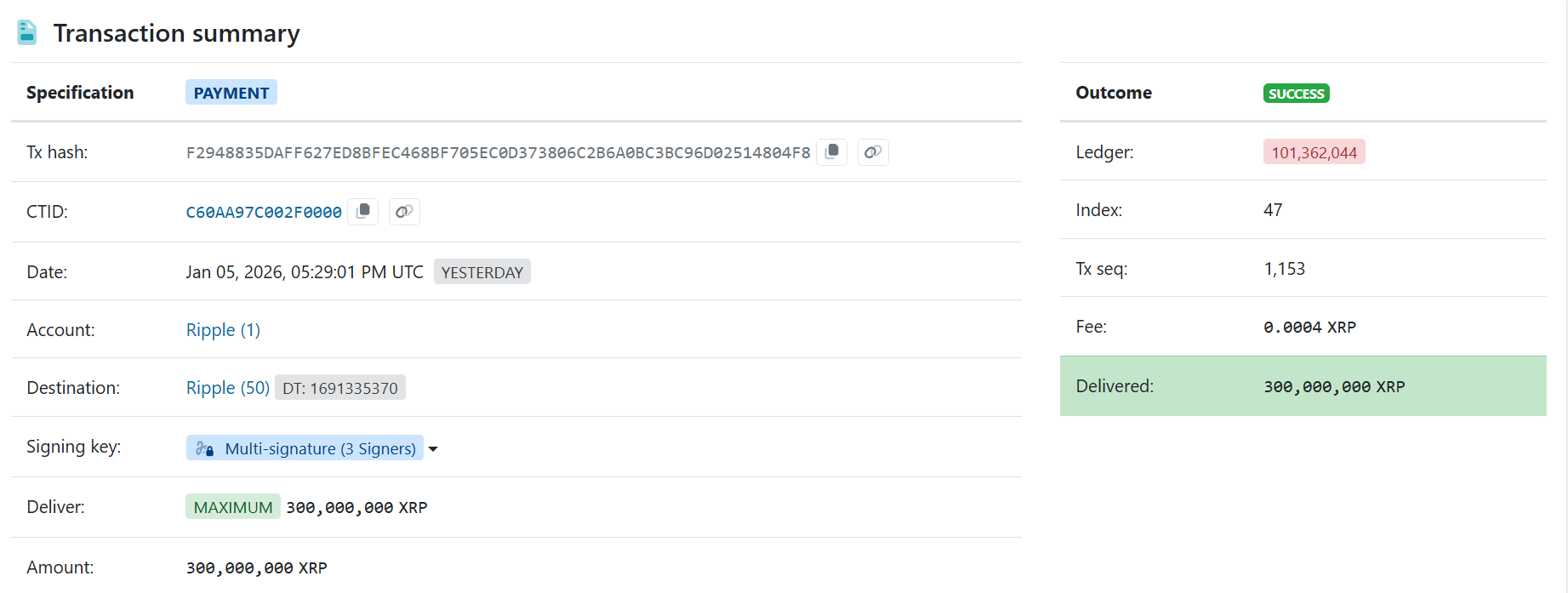
To understand the significance, let’s first recap the raw details of this transaction. On Monday, Jan. 5, 2026, Ripple shifted a huge trove of XRP in a single ledger transaction:
Time: 17:29:01 UTC on Jan. 5, 2026 (late Monday afternoon)
Amount: 300,000,000 XRP
Approx. USD Value: $652.6 million at the time (XRP was about $2.18 each)
Sender: A Ripple-associated wallet (address rBg2FuZ…x1o91m), labeled “Ripple” on blockchain explorers. This suggests the source was under Ripple’s control (likely a corporate treasury or escrow-related account).
Receiver: An “unknown wallet” (address rJqiMb94…La8nE) with no public tag. In Whale Alert’s system, “unknown” just means the address isn’t recognized as belonging to a known exchange or entity. It does not imply anything nefarious – simply that the wallet’s owner is not publicly identified.
Network: XRP Ledger (XRPL), known for fast settlement. The fee was a mere 0.0004 XRP (fractions of a penny) and the transfer likely finalized within seconds on XRPL’s ledger.
Transaction Hash:F2948835DAFF627ED8BFEC468BF705EC0D373806C2B6A0BC3BC96D02514804F8 – a unique ID one can use to verify the transaction on an XRP Ledger explorer.
So Ripple shifted a $652 million chunk of XRP from one company-controlled account to another address that isn’t openly labeled. Notably, this move happened amid a broader crypto market upswing in early 2026 – XRP was already climbing (up 6% that day) alongside Bitcoin and Ethereum.
It’s a reminder that large on-chain transfers by major holders (“whales”) draw attention, but they don’t always mean what casual observers might think. Next, this article explores where those tokens actually went and why “unknown wallet” doesn’t necessarily mean “mystery outsider.”
Where Did the XRP Go? Understanding the “Unknown Wallet”
At first glance, seeing 300,000,000 XRP go to an “unknown wallet” can raise eyebrows. However, in blockchain parlance “unknown” simply means untagged, not that it’s completely mysterious. In fact, on XRP Ledger explorers like XRPScan, the receiving address (rJqiMb94hyz41SBTNr2AyPNW8AzELa8nE) is identified as “Ripple (50)”, indicating it’s recognized as one of Ripple’s many internal wallets.
The receiving XRP address is identified as “Ripple (50). | Source: XRPScan
In other words, the funds likely didn’t leave Ripple’s sphere of control at all, they were just moved from one Ripple-managed account to another. (Whale Alert’s database hadn’t labeled that address, hence calling it “unknown,” but XRPScan’s data shows it’s Ripple-affiliated.
This kind of internal transfer is not without precedent. For example, in April 2025, Ripple similarly sent 200 million XRP to an address that Whale Alert called “unknown,” but analysts later confirmed both the sender and receiver were Ripple-owned wallets.
The receiving wallet in that case had been created by Ripple and only interacted with other Ripple addresses, clearly an internal treasury maneuver, not a third-party receiving funds.
In this January 2026 event, the same pattern likely holds: Ripple shuffled XRP to another company wallet, possibly for accounting or operational reasons, rather than sending it to an exchange or outside entity.
Can You Track What Happens Next With This XRP Wallet?
Yes – XRP’s ledger is public, so one can monitor that receiving address to see if it moves funds elsewhere.
Key things analysts look for include:
Exchange deposits: Does the “unknown” wallet later send large chunks of XRP to known exchange addresses (like Binance, Bitstamp, etc.)? If yes, that could indicate Ripple is distributing or selling those tokens on the market. In this case, as of the transfer time, the XRP remained in a non-exchange wallet (no immediate influx to exchanges was observed). Blockchain sleuths will be watching if any of that 300M eventually flows into exchange hot wallets.
Dispersal to multiple wallets: Ripple could split the 300M into smaller amounts and send to various other addresses (for instance, to liquidity partners or institutional clients). A pattern of many outgoing transactions might suggest distribution to Ripple’s customers or operational use across different corridors.
Dormancy: If the 300M XRP stays put in that new wallet for an extended period, it implies a custodial move, perhaps Ripple simply parked the funds in cold storage or a new treasury wallet. In the April 2025 example, the 200M XRP remained untouched at the receiving address for some time, indicating no immediate use; it was likely just a strategic reserve.
Connections to known Ripple activities: Sometimes, internal wallets are used for specific programs. For instance, Ripple’s On-Demand Liquidity (ODL) platform (also recently rebranded as Ripple Payments) utilizes XRP for cross-border flows. If the funds start moving to ODL-related exchange accounts or known partner addresses, that could reveal a liquidity provisioning purpose.
Why Would Ripple Move 300M XRP? Possible Explanations
Large transfers like this naturally prompt the question: what is Ripple up to? Since Ripple hasn’t publicly commented on this specific transaction, one can only outline plausible explanations based on past behavior and available data (without jumping to unwarranted conclusions).
Here are several hypotheses, emphasizing that these are not confirmed facts but informed guesses:
Routine Escrow Release & Treasury Management
This is the most likely scenario. Ripple famously holds a significant portion of XRP in time-locked escrow contracts, releasing 1 billion XRP at the start of each month as part of a pre-set schedule.
Typically, Ripple does not flood the market with all of it, historically about 70%–80% gets returned to escrow, and the remainder (200–300 million XRP) is retained for Ripple’s own use. January 2026 was no exception: on Jan. 1, Ripple unlocked 1 billion XRP and later re-escrowed 700 million (70%) back into lock-up.
The 300 million XRP left would be earmarked for the company’s operational needs in the coming period. Moving 300M on Jan. 5 aligns perfectly with this pattern, it likely represents the portion Ripple kept from the monthly unlock.
In other words, Ripple might be shifting its monthly “budget” of XRP into a wallet for use, while the rest is safely locked up again. This treasury rebalancing is standard practice and provides Ripple with XRP to fund various activities until the next release.
Operational Liquidity Provisioning (ODL and Payments)
Ripple uses XRP to facilitate cross-border payments through its On-Demand Liquidity (ODL) service (recently rebranded under Ripple Payments). It’s possible the 300M XRP is intended to provide liquidity to Ripple’s payment partners or market-making operations.
For instance, Ripple might deploy some of these tokens to exchanges or payment corridors to ensure there’s sufficient XRP liquidity for international transactions. In the past, funds reserved by Ripple have been used to finance ODL transactions and supply exchanges where needed.
If this hypothesis is true, you might later see portions of the 300M flowing to specific ODL exchange accounts (e.g. Bitso, Coins.ph, etc., which have been ODL hubs). Notably, around the same time as a prior large transfer, 29 million XRP was sent to the Bitso exchange in Mexico, hinting at liquidity needs. For now, the entire 300M remains in Ripple’s wallet, but it could be gradually distributed for this purpose.
Security or Wallet Rotation
It could be as mundane as internal security practice. Crypto companies periodically rotate funds to new wallets as a safety measure (for example, if keys are updated or to compartmentalize holdings). Ripple might have moved 300M to spread out its holdings across addresses, reducing single-point risk.
The label “Ripple (50)” suggests Ripple has dozens of such wallets. Moving funds could be akin to moving money from a checking account to a savings account, an internal shift to manage risk or administrative convenience.
If this is the case, you’d expect the funds to mostly sit idle (which you might have seen so far in some past internal transfers. There’s no direct evidence this was a security rotation, but it’s a plausible benign explanation.
Does a Whale Transfer Like This Drive XRP’s Price Higher?
When news of a $650M token move hits, many traders wonder: Is this bullish or bearish for XRP? The truth is, by itself this transfer doesn’t inherently push XRP’s price up or down in the short term. What matters is what happens to the XRP after the transfer (and how the market perceives it).
Let’s break down the possible interpretations:
Bullish case (positive sentiment):
Viewed as a sign of ongoing operational activity rather than selling.
Could reflect Ripple allocating XRP for payments, liquidity, or institutional use.
No immediate transfer to exchanges suggests no instant sell pressure.
Effective circulating supply remains unchanged in the short term.
XRP was already in an uptrend in early 2026, reclaiming the $2.20 level and targeting $2.50.
XRP rose roughly 6% on the day of the transfer, indicating the market was not spooked.
Supporters may see this as “business as usual” during a broader crypto market rally.
Bearish case (negative sentiment)
Large transfers often trigger concern about future XRP sales.
If Ripple later deploys or sells part of the 300M XRP, supply could increase.
Past escrow-related distributions have sometimes coincided with short-term sell pressure.
Late-2025 data showed whale selling (including Ripple-linked wallets) creating resistance near $2.
If funds eventually move to exchange wallets, it could weigh on price.
Misinterpretation of “unknown wallet” can fuel short-term fear or uncertainty.
In this instance, no immediate price drop occurred, reducing near-term bearish impact.
No confirmed exchange inflows at the time of the transfer.
Internal treasury movements historically have minimal immediate price impact.
Short-term XRP price action is typically driven more by:
Broader crypto market trends
Bitcoin price direction
Macro and regulatory developments
Similar 250M XRP transfers in 2025 showed little to no short-term market reaction.
Price effects tend to appear only if XRP later enters exchange liquidity.
In early 2026’s case, XRP’s continued rise after Jan. 5 was probably driven by macro bullish momentum (the whole crypto market was climbing) and perhaps renewed investor confidence in XRP’s prospects, rather than by the 300M transfer itself. It’s more correlation than causation that XRP was up when this whale alert hit, the price was already trending up, and this transfer didn’t derail that trend.
Historical evidence backs this up. Ripple frequently moves sizable amounts (tens to hundreds of millions of XRP), and these alone have not guaranteed any pump or crash.
For example, Ripple’s January 2025 allocation was around 300M XRP as well, and even though that represented higher-than-average monthly sales, the market absorbed it without issue and XRP performed well amid strong demand.
Conversely, in a September 2024 instance, a 100M XRP transfer by Ripple coincided with a modest price dip (2% in 24 hours), but that was during a broader market downturn, it’s hard to pin the blame solely on the transfer. In each case, context was key.
What to Watch Next: Notable Signals for XRP Holders
While one can’t predict the future, but can certainly monitor certain signals in the coming days and weeks to gauge the implications of this 300M XRP move.
Bear markets can amplify selling pressure, even without Ripple activity.
It’s worth reiterating, none of these observations guarantee a particular price outcome. Crypto markets are complex. By understanding the mechanics (escrow releases, Ripple’s treasury habits, and how supply flows), you’re better equipped to cut through the noise.
What does it mean when XRP is sent to an “unknown wallet”?
An “unknown wallet” simply means the address is not publicly tagged in tracking databases like Whale Alert. It does not imply illegal activity. In this case, XRP Ledger explorers identify the receiving address as a Ripple-associated wallet, suggesting the funds remained under Ripple’s control.
Did Ripple sell the 300 million XRP after this transfer?
As of the transfer, there was no evidence that the 300M XRP was sent to exchange wallets. The tokens moved between Ripple-linked accounts, meaning they did not immediately enter market circulation or increase selling pressure.
Is this 300M XRP transfer part of Ripple’s escrow process?
Yes, it aligns with Ripple’s long-standing escrow schedule. Ripple unlocks 1 billion XRP monthly and typically re-locks 70–80%, retaining the remainder (often 200–300M XRP) for operational use. The January 2026 transfer fits this historical pattern.
Do large Ripple XRP transfers usually affect XRP’s price?
Historically, similar large transfers have not consistently caused price pumps or crashes. Price impact depends on whether XRP reaches exchanges and on broader market conditions. Internal treasury movements alone have shown minimal short-term effect on XRP’s price.
Disclaimer:
The information provided in this article is for informational purposes only. It is not intended to be, nor should it be construed as, financial advice. We do not make any warranties regarding the completeness, reliability, or accuracy of this information. All investments involve risk, and past performance does not guarantee future results. We recommend consulting a financial advisor before making any investment decisions.
Onkar Singh has three years of experience as a digital finance content creator. Throughout his career, he has collaborated with various DeFi projects and crypto media outlets. In his leisure time, he enjoys fitness activities at the gym and watching movies across different genres. Balancing his professional and personal interests, Onkar continues to contribute to the digital finance landscape while pursuing his hobbies.


 Easy
Easy