Bitcoin, Ethereum and XRP face a US CPI test as ETF outflows weaken demand and crowded XRP longs raise liquidation risks. | Credit: CCN.com
Share
Key Takeaways
XRP has emerged as 2026’s top-performing major cryptocurrency, outperforming both Bitcoin and Ethereum in recent weeks.
CNBC’s designation of XRP as the “hottest crypto trade” has intensified mainstream attention.
The resolution of Ripple’s U.S. regulatory case in 2025 removed a major overhang, unlocking institutional demand and broader market access.
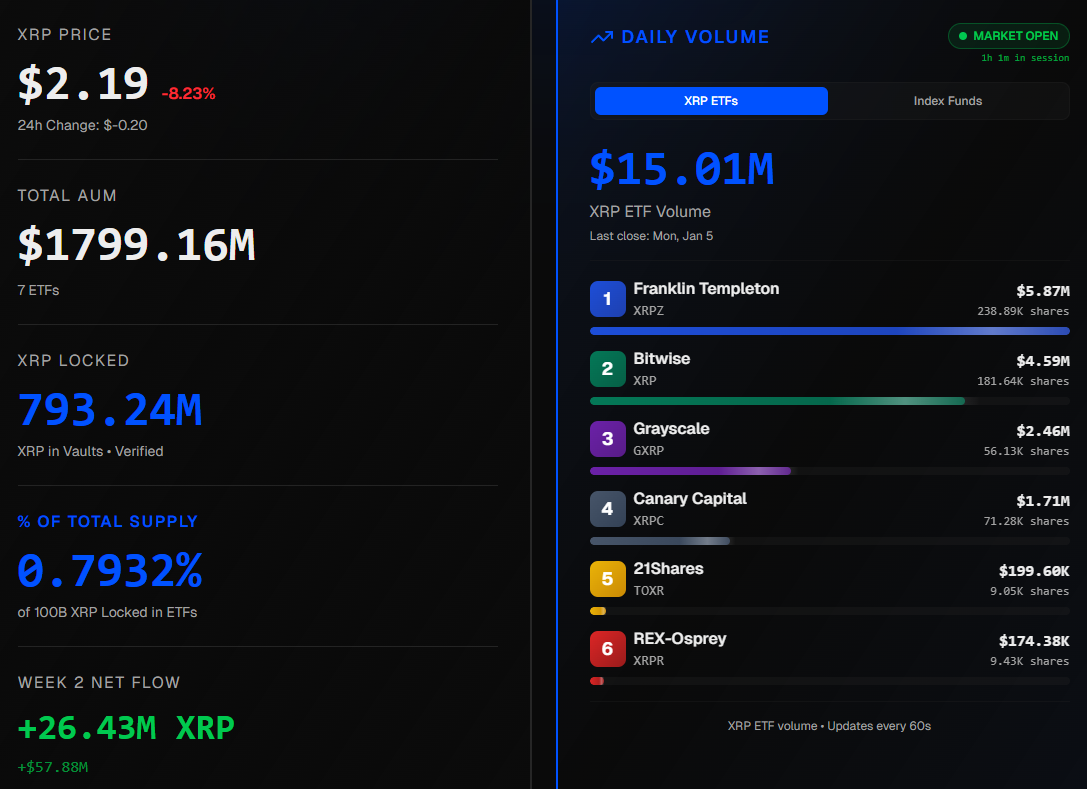
Strong inflows into U.S.-listed spot XRP ETFs signal growing institutional confidence, with total net assets now approaching $1.4 billion.
CNBC’s labeling of XRP as the “hottest crypto trade” of 2026 has amplified attention on a token many investors had written off after years of underperformance and legal uncertainty.
XRP has not only rallied sharply but also outperformed both Bitcoin (BTC) and Ethereum (ETH), reclaiming its position as one of the most closely watched assets in the cryptocurrency market.
While some traders see this resurgence as long-overdue validation of XRP’s utility-driven narrative, others warn that mainstream enthusiasm can sometimes mark the later stages of a rally.
To understand why XRP has suddenly leapt ahead of crypto’s two most significant assets, it’s necessary to examine the mix of regulatory resolution, market structure, institutional inflows, and speculative momentum driving its 2026 breakout.
Why CNBC Is Calling XRP the Hottest Crypto Trade of 2026
The token overtook BNB to become the third-largest cryptocurrency by market cap.
XRP continued to attract capital despite broader market consolidation.
At a time when many large-cap assets have struggled to generate momentum, XRP has emerged as what commentators described as a “quiet outperformer,” steadily climbing while others stalled.
XRP Legal Victory Over US Regulators Fuels Renewed Investor Confidence
One of the key drivers behind XRP’s resurgence is the resolution of Ripple Labs’ long-standing legal battle with U.S. regulators. For years, the lawsuit limited institutional involvement and weighed heavily on market sentiment.
U.S.-based funds and institutions regained the ability to hold XRP.
Exchange support expanded following legal certainty.
Investor confidence improved across both spot and derivatives markets.
Many traders also note that XRP trades remain less crowded than Bitcoin and Ethereum, meaning new capital inflows can move the price more aggressively.
XRP ETF Inflows Surge as Institutional Demand Accelerates
Perhaps the strongest validation of XRP’s renewed relevance has come from exchange-traded funds. U.S.-listed spot XRP ETFs recently recorded their most significant daily inflows since launch, signaling growing institutional demand.
Approximately $43 million in inflows over one week.
Total net assets are rising to roughly $1.37 billion.
Since debuting in November, XRP ETFs have attracted steady subscriptions, with cumulative inflows now exceeding $1.18 billion. Unlike retail-driven rallies, ETF participation often reflects longer-term positioning, adding durability to XRP’s momentum.
XRP Price Performance Outpaces Bitcoin and Ethereum in 2026
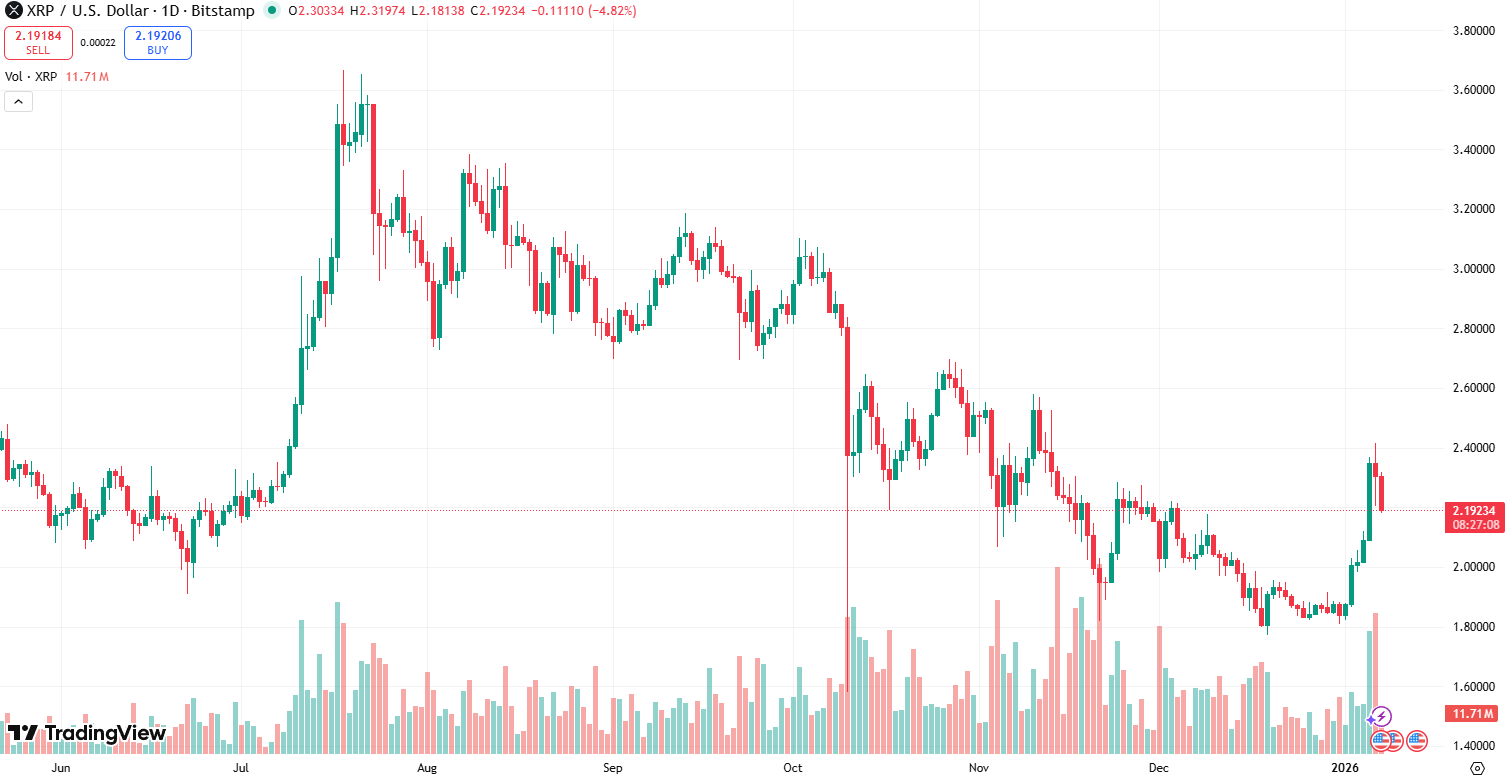
At the time of reporting, XRP was trading between $2.18 and $2.36, following a sharp weekly rally. The token rose nearly 26% over seven days, logging double-digit intraday gains at several points.
XRP price performance. | Credit: Giuseppe Fabio Ciccomascolo
According to CCN analyst Victor Olanrewaju, several technical signals support a bullish outlook:
XRP broke decisively above resistance near $2.22.
The Awesome Oscillator flipped positive for the first time since October.
Bull Bear Power surged to its strongest level since late July.
If momentum holds, analysts see potential upside targets at $2.49 and $2.94, with more optimistic scenarios extending toward $3.26.
XRP Price Predictions Resurface as Analysts Target $33, $50, and Beyond
XRP’s intense price action has revived long-term bullish projections that had faded earlier in the year. Sistine Research recently reiterated its view that XRP is following a market structure similar to its 2017 breakout, albeit on a much larger scale.
Their analysis outlines:
A base-case target range of $33 to $50.
An extended upside scenario of $77 to $100.
Technical support from long-term consolidation patterns.
These projections have sparked debate, with critics questioning whether such valuations are realistic given the market cap implications. At the same time, supporters argue that XRP’s utility and regulatory clarity justify a higher valuation ceiling.
XRP Supply, Escrow, and Ownership Structure Explained
As XRP climbs, attention has again turned to its supply model and ownership structure. Ripple Labs created all 100 billion XRP tokens at inception and retains a significant portion under an escrow system designed to ensure predictable supply releases.
Key points often highlighted by analysts include:
Approximately 45 billion XRP remain in escrow.
Approximately 1 billion XRP are held outside escrow.
In December 2025, Ripple transferred 250 million XRP, worth over $520 million at the time, from escrow to an unidentified address. While the move initially raised concerns, on-chain data showed no immediate transfer to exchanges, easing fears of sudden selling pressure.
XRP Market Sentiment Divided as Traders Debate Sustainability of the Rally
Reaction across social media has been sharply mixed. Some traders remain cautious, recalling XRP’s dramatic rise and fall during the 2017-2018 cycle.
Skeptical voices argue that:
Mainstream media enthusiasm can mark market tops.
Long-term bank adoption may take longer than expected.
Others believe the current rally is fundamentally different, driven by institutional inflows and legal clarity rather than hype alone.
XRP Outlook for 2026: Upside Potential Versus Downside Risks
Despite the bullish momentum, analysts consistently warn that XRP remains a volatile asset.
The weakening demand could invalidate the current setup, potentially pulling prices back toward the $1.77 level.
Still, as 2026 unfolds, XRP has successfully rewritten its narrative.
By resolving its legal challenges, attracting institutional capital, and outperforming both Bitcoin and Ethereum in the short term, XRP has positioned itself at the center of the crypto conversation, earning its title as 2026’s hottest crypto trade, at least for now.
Why is XRP being called the “hottest crypto trade” of 2026?
XRP earned that label after significantly outperforming Bitcoin and Ethereum in recent weeks. CNBC highlighted XRP’s strong price momentum, rising trading volumes, and growing institutional interest, particularly through U.S.-listed spot ETFs.
How has XRP outperformed Bitcoin and Ethereum?
XRP has posted double-digit weekly gains while Bitcoin and Ethereum have largely traded sideways. Its smaller market size, renewed investor interest, and strong inflows have allowed price movements to be more pronounced compared to larger assets.
Are institutional investors buying XRP?
Yes. Spot XRP ETFs listed in the U.S. have seen record inflows in recent weeks, with total net assets rising to around $1.37 billion. These products suggest growing demand from institutional and long-term investors rather than purely speculative traders.
What are analysts’ price targets for XRP?
Short-term technical analysts see potential upside toward the $2.49–$3.26 range if momentum holds. Longer-term projections from some research firms extend much higher, though these aggressive targets remain controversial and speculative.
Disclaimer:
The information provided in this article is for informational purposes only. It is not intended to be, nor should it be construed as, financial advice. We do not make any warranties regarding the completeness, reliability, or accuracy of this information. All investments involve risk, and past performance does not guarantee future results. We recommend consulting a financial advisor before making any investment decisions.
Giuseppe Ciccomascolo began his career as an investigative journalist in Italy, where he contributed to both local and national newspapers, focusing on various financial sectors.
Upon relocating to London, he worked as an analyst for Fitch's CapitalStructure and later as a Senior Reporter for Alliance News. In 2017, Giuseppe transitioned to covering cryptocurrency-related news, producing documentaries and articles on Bitcoin and other emerging digital currencies. He also played a pivotal role in establishing the academy for a cryptocurrency exchange website. Crypto remained his primary area of interest throughout his tenure as a writer for ThirdFloor.


 Easy
Easy