Policy shocks and thin liquidity lead to rapid liquidations and auto-deleveraging.
Human-driven crime dominated 2025, including Lazarus heists and WhatsApp “investment groups.”
Political memecoins are based on sentiment, not strategy or utility.
Protect yourself by using verified platforms and self-custody solutions.
Crypto’s 2025 bull run had villains littered all throughout the space. Policy announcements turning into liquidations, political memecoins crashing hard, or pig-butchering scams taking advantage of the everyday trader.
This piece names the worst offenders and, more importantly, shows you how to stay ahead of such sinfulness.
Try Our Recommended Crypto Exchanges
Sponsored
Disclosure
We sometimes use affiliate links in our content, when clicking on those we might receive a commission at no extra cost to you. By using this website you agree to our terms and conditions and privacy policy.
When volatility explodes and insurance funds can’t keep up, some derivatives-offering platforms switch on auto-deleveraging (ADL). This trims some profitable positions to plug holes from bankrupt liquidations.
On October 10th, President Trump’s tariff-on-China announcement helped vaporize roughly $19 billion in crypto derivatives bets. ADL and other liquidation methods amplified the move, wiping out longs and cutting the gains off of shorts who thought they were safe.
Why it’s villainous:ADL can feel like a punishment for traders who manage their risk. If you’re high on the ADL queue during extreme volatility, your bet may be forcibly trimmed to stabilize the exchange you’re on.
How to fight it:Be careful when using leverage. Also, understand each platform’s ADL policy and insurance fund disclosures.
2. North Korea’s Lazarus Group
In February 2025, the Federal Bureau of Investigation (FBI) attributed the $1.5 billion Bybit theft to the Democratic People’s Republic of Korea (DPRK), or more specifically, the Lazarus Group, a sect of hackers the DPRK utilizes to steal cryptocurrencies, take down companies, and more. The group utilized decentralized exchange (DEX) swaps and coin mixing, amongst other money laundering methods, to get away with it.
Why it’s villainous: Intrusions on large exchanges like Bybit do not instill confidence in their safety systems. Are your funds really safe to hold on Coinbase if the Lazarus Group can break into Sony, Bybit, and other “secure” systems?
How to fight it: Keep your funds secure in a hardware wallet, instill withdrawal allow-lists, and only use an exchange to trade assets, not to hold them.
3. U.S. Tariff Updates and Trade War
Aside from the ADL issue, Trump’s new round of tariff threats against China is a clear case of how policy can affect price. Market sentiment can thrive or falter based on news, and in this case, contributed to crypto’s worst single-day leverage purge.
Why it’s villainous: Policy shock turns into market shock, resulting in liquidations, thinner order books, and eventually, ADL.
How to fight it: You can only protect yourself so much from surprise news, but be wary of major policy dates and size your trading positions assuming that liquidity can evaporate at any time.
Nearly every crypto market crashed after Trump’s tariff announcement. | Source: @KobeissiLetter on X
4. Pig-Butchering Scams
A “pig-butchering” scam can consist of romance, friendship, or even investment advice in an attempt to steal your funds. Basically, someone online contacts you to convince you they’re a friend or a potential romantic partner. Then, they ask you to send money to help them out of a “dire situation.”
In October 2025, the United States Department of Justice (DOJ) revealed an indictment naming Chen Zhi, the chairman of Cambodia’s Prince Holding Group, as a perpetrator of pig-butchering.
The DOJ accused Zhi of stealing billions in crypto not only from the United States but from victims around the world.
Why it’s villainous: These scams weaponize social engineering and human trafficking to convince you to let your guard down, steal your crypto, and disappear with no way to recover it.
How to fight it: Never send money to anyone you don’t know in real life. Vigorously background check any social media accounts that try to message you, and utilize exchanges with strict anti-money-laundering (AML) and know-your-customer (KYC) policies.
5. The Gotbit Wash Trading Machine
Market-making crosses into market manipulation when you fake trading volume. In October 2024, Gotbit founder Aleksei Andriunin was arrested in Portugal for inflating token volumes via wash trades and was extradited to the United States on February 25, 2025.
From there, he pleaded guilty in March and received a sentence in June for the activity.
Why it’s villainous: Faked trading volumes distort prices and asset listing decisions, affecting the entire market.
How to fight it: Always do your own research. Don’t trade volume spikes without knowing the reason.
6. $LIBRA Memecoin Scandal
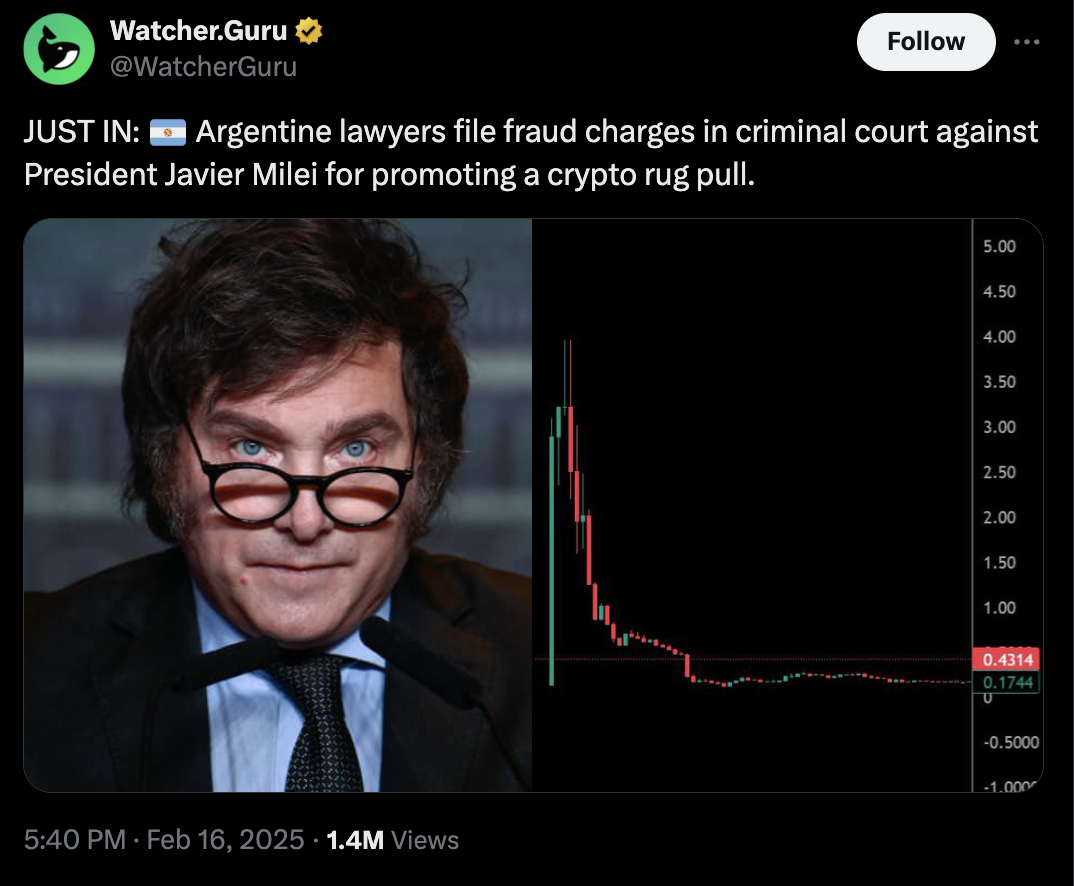
A Valentine’s weekend scandal occurred when Argentina’s President, Javier Milei, was promoting posts about the launch of $LIBRA on Solana. He stated that “the world wants to invest in Argentina,” implying that investing $LIBRA will benefit the country.
The token’s price crashed shortly afterward, with Milei deleting his posts and issuing an apology and claiming he had “no connection” to the project. As of October 2025, the Argentine government ordered a search of Milei’s phone while two of his advisors related to the token launch were taken into custody.
Why it’s villainous: Politicians promoting a token blurs the line between governance and potential scam. It can inflate a project’s value, and sometimes they don’t even know what they’re talking about.
How to fight it: If a token’s pitch hinges more on political promotion than its utility, it’s probably not the best investment. Do your own research, check the project’s liquidity values, and understand how it’s being marketed.
Milei’s $LIBRA promotion did not go over well. | Source: @WatcherGuru on X
7. Zhimin (Yahi) Qian £5B Bitcoin Overhang
The United Kingdom courts advanced a case tied to Zhimin (Yahi) Qian, a Chinese investment fraud that turned its victims’ funds into a massive stash of stolen Bitcoin, into 2025. Depending on the case’s outcome, that stash of more than £5B hangs over the market. If a court forces liquidation, a £5B shift will introduce Bitcoin price pressure and spook investors.
Why it’s villainous: Giant criminal hoards inject fear into the market as investors wait for an outcome. A surprise liquidation can ruin an ill-prepared trader.
How to fight it: Track court cases like token unlocks, and don’t invest more than you can afford to lose during potential case closure windows.
8. Rajib Dutta and the “Investment Group” Web
Indian police tracked a woman’s scam complaint to a Chinese investment scheme. Shikha Gupta complained to the police about the fraud, which was traced to Rajib Dutta of Kolkata. The seizure of Dutta’s phone unveiled conversations with Chinese scam coordinators. Essentially, Dutta made up one node of a wider, cross-border scheme. One that anyone could have fallen for.
Why it’s villainous: Mid-tier scams don’t make headlines like Lazarus does, but their smaller scale helps bad actors stay under the radar.
How to fight it: Treat peer-to-peer trades with a degree of caution, especially when such conversations are organized via WhatsApp.
9. Tegan Marie Pohoikura Gilmore
In 2019, Australian resident Tegan Maria Pohoikura Gilmore was tied to an alleged crypto investment scheme that Queensland authorities say hit more than 100 Australians for around $3 million AUD. She first faced charges of fraud and money laundering, but the issue is resurfacing in 2025.
She’s facing up to 20 years in prison as proceedings continue.
Why it’s villainous: A years-old scheme resurfaces to remind investors that scammers are everywhere.
How to fight it: Trade only on licensed platforms. Don’t get involved in third-party platforms or peer-to-peer trades.
10. Wash Trading and Token Manipulation
From a meta perspective, wash trading and token manipulation are annual villains in the crypto space. Wash trading manufactures demand by buying and selling the same asset to mess with trading volume, messing with top tokens, and providing a false window into what’s trending.
Why it’s villainous: Market manipulation messes with token discovery and can be paired with token spoofing or even pump-and-dumps.
How to fight it: Only trade with proven tokens and treat unusually high trading volume bursts as suspect until you uncover the reason.
Old Scams, New Challenges: How to Stay Secure in the Crypto Market
The 2025 market faced a variety of problems, old and new. For all of its surprise headlines, constant problems like wash trading and investment fraud consistently plague the crypto industry.
Your antidote is to do your own research. Pay attention to market news, trade with proven tokens, and never send money to random people online.
Compare CEX volume to on-chain analytics. Check how many market makers are active in a market, and compare order book depth to a market’s 24-hour volume.
Do politically charged coins ever make sense to trade?
Only if you accept that they’re pure sentiment trades. If an asset’s core value proposition is a politician’s tweet, don’t be surprised if it’s a scam.
What are red flags for pig-butchering DMs?
Unsolicited “mentors,” rushed urgency, and requests to move off-platform are prime red flags when it comes to pig-butchering.
What does “the order book is thin” mean?
It means that there aren’t many resting bids or asks near the asset’s price. In this case, even smaller orders can cause big moves, threatening liquidations and ADL risk.
Disclaimer:
The information provided in this article is for informational purposes only. It is not intended to be, nor should it be construed as, financial advice. We do not make any warranties regarding the completeness, reliability, or accuracy of this information. All investments involve risk, and past performance does not guarantee future results. We recommend consulting a financial advisor before making any investment decisions.
Max Moeller is a Chicago‑based writer and video editor passionate about games, tech, and crypto. Whether it’s crafting clear, insightful articles or piecing together engaging video retrospectives, he’s driven by curiosity and takes pride in keeping things human. Since 2017, Max has been published in a variety of notable crypto magazines.


 Easy
Easy