Track the latest stablecoins hitting the market. | Credit: Pixabay.
Share
Key Takeaways
Stablecoin launches are accelerating, with new fiat-pegged, yield-bearing, and synthetic models expanding across multiple blockchains.
Projects like suiUSDe and USDi highlight the trend of issuers targeting new networks such as Sui, Polygon, Base, and Solana to capture liquidity.
Stablecoins backed by U.S. Treasuries are gaining traction as bridges between traditional finance and DeFi.
Despite new entrants, Ethereum continues to lead in stablecoin inflows, adding nearly $500M in 24 hours, reinforcing its position as the core hub of DeFi liquidity.
Stablecoins remain one of the most active areas in crypto innovation, bridging traditional finance and blockchain by providing digital assets pegged to stable values like the U.S. dollar.
New stablecoin projects and integrations come to market each week, reflecting the sector’s rapid growth and the competition to become the trusted “digital dollar” of choice.
This article highlights the latest stablecoin launches this week, along with a quick look at key players driving innovation in the space.
New Trending Crypto Wallet Offers
Sponsored
Disclosure
We sometimes use affiliate links in our content, when clicking on those we might receive a commission at no extra cost to you. By using this website you agree to our terms and conditions and privacy policy.
suiUSDe is a new stablecoin launched by Ethena Labs on the Sui blockchain. It’s part of Ethena’s strategy to expand its synthetic dollar ecosystem, which already includes USDe (its core synthetic stablecoin on Ethereum).
Unlike traditional fiat-backed stablecoins (USDC or USDT), Ethena’s stablecoins are crypto-native: backed by a mix of staked ETH and perpetual futures positions. This structure uses hedging strategies to maintain the dollar peg without needing bank reserves or Treasuries.
Launched on the Sui blockchain during the first week of October.
Pegged to the U.S. dollar and designed to expand Ethena’s synthetic dollar ecosystem.
Aims to enhance cross-chain liquidity and DeFi adoption on Sui.
Launched in March 2024, BUIDL invests in short-term U.S. government securities and cash equivalents. By tokenizing the fund, investors can hold shares on-chain, turning a traditional instrument into a blockchain-based asset.
Through USDi, Sui users gain access to U.S. money market stability with the speed of the Sui blockchain.
Barnett said the initiative “will add another powerful mechanism to drive liquidity, utility, and long-term value across the Sui blockchain, while positioning SUIG as one of the first publicly traded gateways to the global stablecoin economy.”
The move underscores the growing overlap between traditional finance and blockchain-based stable assets.
Ethena CEO, Guy Young, added that Sui’s “performance and composability made it a clear choice for bringing these powerful, new-age stablecoin products beyond the EVM.”
Mountain Protocol’s yield-bearing USDL stablecoin launched support on Polygon.
USDi is backed by real-world assets, including U.S. treasury bonds, and other inflation hedging assets.
USDi is audited by a third party to ensure that real-world assets back the coin.
Key Players to Watch in the Stablecoin Space
Beyond weekly launches, a handful of issuers continue to shape the direction of the stablecoin market. These organizations drive adoption, set standards for compliance, and experiment with new models that bridge traditional finance and crypto.
The following names remain central to the stablecoin space:
Circle (USDC, EURC): Circle completed its IPO in 2025 under ticker CRCL, raising $1.1B and securing a public market valuation and is still the largest regulated issuer, expanding across multiple blockchains.
Ondo Finance (USDY): Bridging traditional finance and DeFi with tokenized Treasury-backed products.
Mountain Protocol (USDL): Innovating with yield-bearing stablecoins built for institutional adoption.
Institutions & Traditional Finance Entrants
Beyond crypto native issuers, traditional financial firms and banks are increasingly entering the space. For example:
Fiserv is introducing FIUSD and collaborating with Mastercard to embed stablecoin functionality in payments infrastructure.
Large banks in Europe have formed a consortium to launch a euro-denominated stablecoin, signaling growing institutional adoption.
Tech and payment firms, such as Stripe, and Revolut, have expressed intentions or experiments to integrate or issue stablecoins.
Infrastructure & Payments Enablers
Not all key players issue tokens, some facilitate adoption through infrastructure:
Rain is a fintech company enabling Visa cards and wallet integrations backed by stablecoins.
Exchanges and wallet platforms (e.g. Coinbase) play essential roles as on-ramps, liquidity venues, and custodial bridges between stablecoins and fiat.
Securitize (Tokenization & RWA Infrastructure)
Securitize is not a “stablecoin issuer” in the traditional sense, but it powers the tokenization rails and fungible infrastructure that bridge real-world assets and crypto.
Key roles & updates:
BUIDL: Securitize is the tokenization provider / transfer agent behind BlackRock’s BUIDL, the tokenized money market fund now accepted as collateral on exchanges like Crypto.com and Deribit.
Off-ramps: It launched off-ramp mechanisms to convert BUIDL and other tokenized fund shares into RLUSD, integrating more tightly into stablecoin-linked flows.
New stablecoin integrations: On the Sui blockchain, USDi is planned to be backed 1:1 by BUIDL (tokenized by Securitize). This aligns tokenized funds and stablecoins directly.
Market footprint: Securitize claims to manage a large share of tokenized assets and issues many of the top tokenized funds in the RWA space.
Why it matters: As stablecoins increasingly tap into tokenized real-world asset (RWA) backing and money market instruments, the infrastructure providers (like Securitize) become critical nodes, not just issuers. Their compliance, security, and connectivity choices will influence which stablecoins are viable at scale.
Ethereum Dominates Daily Stablecoin Inflows
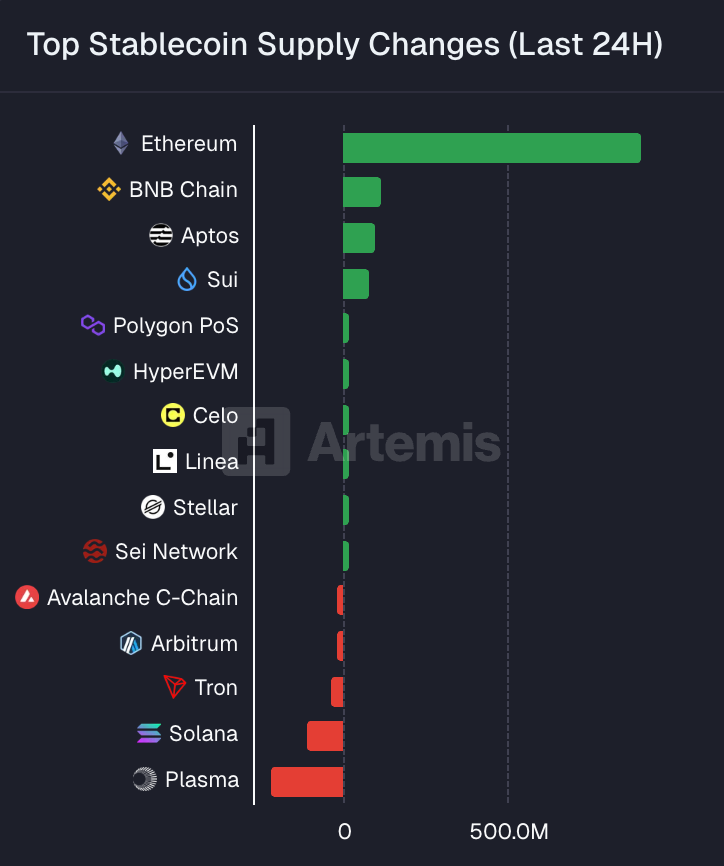
In the past 24 hours, Ethereum has emerged as the leader in stablecoin inflows, capturing nearly $500 million in net supply growth. This surge places it far ahead of competing blockchains, reinforcing Ethereum’s role as the primary hub for stablecoin liquidity and DeFi activity.
Other chains such as BNB Chain, Aptos, and Sui also recorded moderate inflows. This suggests ongoing diversification of stablecoin adoption across newer ecosystems.
In the past 24 hours, Ethereum has emerged as the leader in stablecoin inflows. | Credit: Artemis
On the other hand, networks including Solana, Tron, and Plasma experienced notable outflows, pointing to a short-term rotation of liquidity back into Ethereum-based markets.
This trend underscores Ethereum’s continued dominance as the settlement layer of choice for institutional and retail stablecoin flows and highlights the shifting balance of liquidity across layer-1 and layer-2 ecosystems.
Stablecoin launches continue accelerating, reflecting the race to capture liquidity, compliance, and institutional trust. While some projects focus on traditional fiat-pegged stability, others explore yield-bearing models or synthetic designs. As more blockchains compete for DeFi dominance, stablecoins become a cornerstone of liquidity and adoption.
Whether you’re a trader, DeFi builder, or institutional participant, following new weekly launches provides a pulse on where capital and innovation are flowing.
Because blockchains and DeFi protocols compete to attract liquidity, stablecoins are critical as the “money” layer for each ecosystem.
Are all stablecoins pegged to the US dollar?
No. While USD-backed stablecoins dominate, euro, yen, and gold-backed stablecoins are also emerging.
How can I track upcoming stablecoin launches?
Follow project announcements, DeFi dashboards, and weekly roundups like this one for real-time updates.
Are stablecoins safe?
It depends on the model. Fiat-backed stablecoins depend on reserves and regulation, while synthetic or algorithmic designs carry higher risks.
Disclaimer:
The information provided in this article is for informational purposes only. It is not intended to be, nor should it be construed as, financial advice. We do not make any warranties regarding the completeness, reliability, or accuracy of this information. All investments involve risk, and past performance does not guarantee future results. We recommend consulting a financial advisor before making any investment decisions.
Giuseppe Ciccomascolo began his career as an investigative journalist in Italy, where he contributed to both local and national newspapers, focusing on various financial sectors.
Upon relocating to London, he worked as an analyst for Fitch's CapitalStructure and later as a Senior Reporter for Alliance News. In 2017, Giuseppe transitioned to covering cryptocurrency-related news, producing documentaries and articles on Bitcoin and other emerging digital currencies. He also played a pivotal role in establishing the academy for a cryptocurrency exchange website. Crypto remained his primary area of interest throughout his tenure as a writer for ThirdFloor.


 Easy
Easy