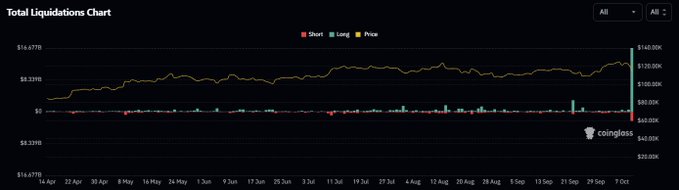
The sell-off, which began on Friday after Trump vowed to impose a 100% tariff on Chinese imports, cascaded across exchanges worldwide, triggering what data tracker CoinGlass called “the largest liquidation event in crypto history.”
More than 1.6 million traders saw their positions evaporate as Bitcoin, Ethereum and dozens of altcoins plunged double digits. This $19 billion liquidation bloodbath, roughly nine times larger than any previous single-day crypto wipeout, underscores how rapidly geopolitical shocks can unravel highly-leveraged crypto markets.
Trump’s tariff announcement sent a shockwave through all risk assets. Bitcoin, which had just hit an all-time high above $125,000 earlier in the week, crashed over 12% to as low as $104,000 during the worst of the rout.
By Saturday, BTC had stabilized around $112K. Ethereum fell even harder, tumbling from $4,300 to under $3,600 intraday. Scores of smaller coins experienced flash-crashes, with some like Solana (SOL) plunging over 40% and memecoins like Dogecoin (DOGE) briefly down 50% before partial recoveries.
Solana flash crashed to $142 on MEXC. | Source: @Treecimo
As panic spread, crypto exchanges were swamped by an onslaught of automated sell orders, forcing mass liquidations of long positions and a historic deleveraging across the board.
How Different Crypto Exchanges Were Impacted During the $19B Liquidation Event
Not all trading venues were hit equally.
Try Our Recommended Crypto Exchanges
Sponsored
Disclosure
We sometimes use affiliate links in our content, when clicking on those we might receive a commission at no extra cost to you. By using this website you agree to our terms and conditions and privacy policy.
In a remarkable turn, an upstart decentralized perpetuals exchange, Hyperliquid, emerged as the epicenter of the purge, absorbing roughly half of all liquidations.
The main culprit of this appears to be a combination of excessive leverage and risk. | Source: @KobeissiLetter on X.
This suggests many large traders on Hyperliquid were caught over-leveraged on bullish bets. In fact, the single largest liquidation order of the day occurred on Hyperliquid, an ETH/USDT position worth approximately $204 million that was automatically closed, exemplifying the scale at which whale traders were wiped out.
The largest liquidation event in crypto history. | Source: @coinglass_com on X
Binance
By contrast, Binance, the world’s largest centralized exchange, saw a lower share of the carnage (about $2.4 billion in liquidations).
Notably, Binance’s liquidations were more evenly split between long and short positions ($1.41 billion longs vs. $0.98 billion shorts), a relatively high short-liquidation ratio likely influenced by the peculiar behavior of certain synthetic tokens on the platform.
With just HALF the volume of Bybit, Binance liquidated three times as many short positions. | Source: @LeviRietveld on X.
During the chaos, several leveraged tokens on Binance depegged violently – for example, an ETF-like token BNSOL plunged from $300 to $35, and stablecoin USDE dropped 35% below $1 before rebounding.
These swings caused short-position traders in those markets to get squeezed as prices whipsawed, contributing to Binance’s near-$1B in short liquidations.
Binance acknowledged “system disruptions” amid the volume surge and later announced it will compensate users for losses caused by technical failures (though not for market losses).
Other Exchanges and Platforms
Among other major venues, Bybit was severely impacted, tallying about $4.63 billion in liquidations, overwhelmingly long positions ($4.3B). OKX saw roughly $1.2 billion liquidated (90%+ longs), according to CoinGlass, while Huobi/HTX and smaller exchanges like Gate.io each faced a few hundred million in forced liquidations.
In total, over a dozen exchanges experienced at least eight figures in liquidations as margin positions were hunted down.
Decentralized exchanges were not spared either, the on-chain perps platform dYdX reportedly had tens of millions in positions unwound, though nowhere near Hyperliquid’s scale.
Deribit hit an all-time high of $22.8 billion in 24-hour trading volume, as institutions scrambled to hedge or speculate. Massive BTC put option clusters at $110K and $100K acted as psychological and technical support zones.
CME Bitcoin futures also surged in volume but traded briefly at a discount, signaling panic-driven selling by U.S. institutions.
Binance Margin Flaw and Mispriced Collateral: Did a Single Design Error Triggered the $19B+ Crypto Crash?
Dr. Martin Hiesboeck, Head of Research at Uphold, described the October 10–11 sell-off as “a targeted attack” exploiting a flaw in Binance’s Unified Account margin system.
According to him, Binance allowed traders to use assets like USDE, wBETH, and BnSOL as collateral, but these were valued using Binance’s own volatile spot prices rather than their underlying redemption values.
When the market dropped, these assets depegged sharply,“USDE to $0.65,” triggering a cascading margin collapse that wiped out positions across the platform. The exploit reportedly occurred in the short window between Binance announcing a fix and deploying it, leading to estimated losses of $500 million to $1 billion.
@trevor_flipper, analyst at Delphi Digital, noted that the deeper issue wasn’t just volatility or congestion but pricing reliability. “The reference/pricing/quotes many desks and DEXs lean on became unreliable, exactly when everyone needed it most,” he wrote. Because Binance anchors most of crypto’s price feeds, its mispriced wrapped assets and stalled APIs propagated errors across exchanges. Market makers, unable to trust their collateral marks, pulled liquidity, widening spreads and deepening the crash.
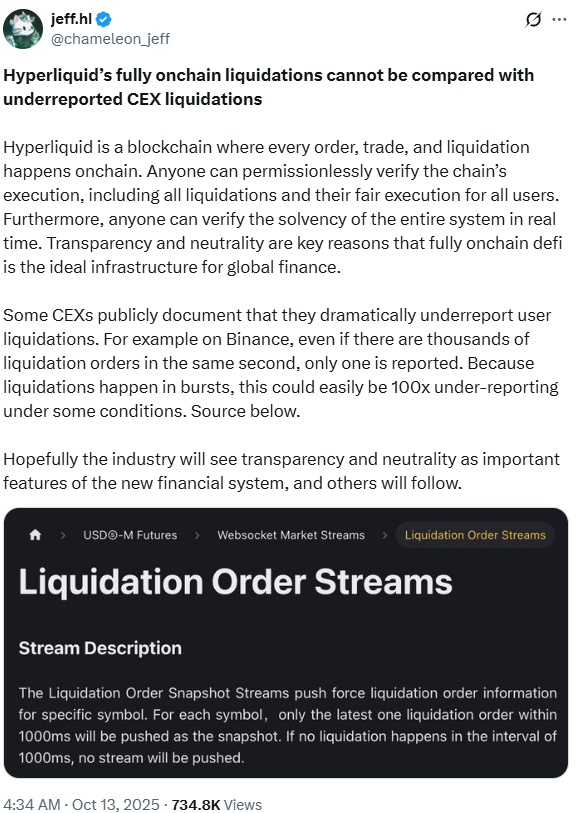
Adding fuel to the debate, Hyperliquid ($HYPE) founder Jeff accused centralized exchanges of underreporting liquidations by up to 100x, claiming “thousands can occur in a second, but only one is shown publicly.”
Hyperliquid’s fully onchain liquidations cannot be compared with underreported CEX liquidations. | Source: @chameleon_jeff on X.
Binance co-founder CZ fired back, defending the exchange’s resilience:
“While others tried to ignore, hide, shift blame, or attack competitors, the key @BNBChain ecosystem players (Binance, Venus, and more) took hundreds of millions out of their own pockets to PROTECT USERS. Different value systems.”
Binance: Different value systems. | Source: @cz_binance on X
The clash underscores deep divisions in crypto’s post-crash narrative, between those blaming Binance’s risk systems and those praising its response to protect user funds.
Why Did Hyperliquid Lead the Losses During the $19B Crypto Liquidation?
One major reason Hyperliquid ended up leading the losses was its popularity among high-roller traders using extreme leverage. As the sell-off hit, Hyperliquid’s open interest collapsed, and the number of traders with active positions on the platform plunged from about 50,000 to 20,000, indicating that roughly 60% of its users were wiped out or closed out during the event.
Further illustrating the scale of destruction, Conor Grogan (@jconorgrogan) shared sobering data on trader losses from Hyperliquid’s collapse. According to his analysis, 1,010 traders lost over $100,000 in a single day, while 206 traders were down more than $1 million each.
Conor Grogan shared sobering data on trader losses from Hyperliquid’s collapse. | Source: @jconorgrogan on X.
Most devastatingly, 358 accounts were completely wiped out, left with near-zero balances. Grogan noted that one trader lost their entire $19 million balance, underscoring how quickly fortunes can evaporate as liquidation engines fire across the decentralized exchange.
As Grogan’s findings suggest, behind the $19B headline loss was not just a systemic market failure, but a devastating personal toll on traders who were overexposed when the market turned.
Whales, Retail Traders and Institutions – Who Was Worst Affected?
The pain was widespread, affecting everyone from small retail speculators to heavyweight “whales.” In one tragic turn, a well-known crypto trader was found dead in his Lamborghini, an apparent suicide linked to the catastrophic losses suffered during the crash.
Overall, more than 1.6 million trading accounts were liquidated within 24 hours, marking the single largest wipeout in crypto history.
Retail Traders
Retail investors collectively bore the brunt of the collapse simply due to their overwhelming participation. As Bitcoin and other cryptocurrencies hit new all-time highs earlier in the week, countless individual traders piled into highly leveraged long positions on platforms like Binance, Bybit and OKX. When the market turned sharply, these positions were swiftly wiped out.
Liquidations occurred at an estimated 7:1 ratio of longs to shorts, amplifying the speed and severity of the cascade once prices reversed
A clear imbalance of longs/shorts. | Source: @seth_fin on X.
Whales and Institutional Players
Large-scale traders and institutional players suffered the biggest dollar losses. Bitcoin and Ethereum accounted for the majority of liquidations by value, indicating that some massive positions went under in a matter of minutes.
At least one major trading fund is believed to have been wiped out by margin calls.
Market observers described it as “one of the messiest events ever seen,” hinting that more revelations about major losses may surface soon.
A newly created account on Hyperliquid shorted BTC and ETH 30 minutes before the crash, using 12x leverage and 91 ETH. | Source: @FabianoSolana on X.
Short Sellers
Even short sellers, initially positioned on the winning side, were not immune from the chaos. Many captured profits during Bitcoin’s drop from $122K to $105K, including one whale who reportedly made nearly $200 million by shorting BTC and ETH ahead of the crash. However, the volatility that followed forced several shorts to close prematurely as prices rebounded or liquidity vanished.
In extreme cases, traders who sold high and tried to “buy the dip” were liquidated twice in succession, illustrating how treacherous the market became during the liquidation storm.
The event proved that in crypto, both overconfidence and perfect timing can be equally fatal.
24 Hours of Chaos: How the Crypto Liquidation Cascade Unfolded
What made this liquidation event so historic was not just its size, but its speed. The chain reaction played out over roughly one trading day, with a few critical flashpoints:
Trump’s tariff bomb (friday morning): Around 9:30 a.m. ET on Oct. 10, the initial post about “massive” new China tariffs hit the wires. Global markets immediately lurched risk-off, U.S. equities fell sharply and Bitcoin sank below $120K within hours. This first leg down set the stage by shaking market confidence and pushing highly leveraged long positions toward the brink.
Cascade ignites (midday–afternoon): By mid-afternoon New York time, a second post confirmed the 100% China tariff starting Nov. 1. This “tape bomb” escalated fears of a full-blown trade war. Crypto markets, already wobbling, went into free-fall. Prices plunged alongside stocks, accelerating as stop-losses triggered and liquidity thinned. Bitcoin toppled through key support at $110K and $105K in minutes, ultimately wicking as low as $102K on some futures exchanges. Ethereum cracked $3.5K, down over 15% on the day. According to CoinGlass, more than $7 billion of positions were force-sold in under one hour during the heaviest wave on Friday, a record purge concentrated in a blink of time.
Forced selling and flash crashes (evening): As liquidations accelerated, automated sell-offs triggered a self-reinforcing crash, hitting altcoins hardest. On Binance, thinly traded tokens like Cosmos (ATOM) and Enjin (ENJ) briefly plunged to near zero as margin collateral was dumped en masse. Analysts explained that because many traders had used altcoins as leverage collateral, forced selling cascaded across markets, creating a domino effect of price collapses. These extreme lows, they added, were liquidation-driven anomalies rather than true market valuations.
The surge of sell orders overwhelmed major exchanges, causing outages and trading failures across platforms. Binance froze for many users, with failed stop-loss orders worsening losses and its futures insurance fund deploying $188 million to cover bad debts in a single day. Coinbase also suffered brief outages, while Robinhood temporarily halted crypto trading.
In contrast, DeFi platforms performed seamlessly, Uniswap processed a record $10B in daily volume, and Aave auto-liquidated $180M in loans without human intervention, showcasing the resilience of decentralized systems.
By late Friday, the sell-off had bottomed out. Bitcoin stabilized between $105K–$110K, aided by heavy options activity around key strike prices, and rebounded to ~$112K by Saturday.
Although the total crypto market cap fell about 10% ($400 billion) in 24 hours, signs of recovery emerged, even as altcoins remained 15–25% below their weekly highs.
Overall, the liquidation cascade unfolded rapidly, within 8 hours, Bitcoin lost over 12% of its value and billions in margin positions were forcibly closed. Market depth vanished during the worst of it; one observer noted “I gotta say I have never seen anything like this in my entire-longer than a decade-investing career.”
As the dust settled, comparisons were made to past crypto “black swan” days (the March 2020 COVID crash, the May 2021 deleveraging, the FTX collapse of 2022), but at $19+ billion, this liquidation wave blew past those episodes by an order of magnitude.
Crypto Market Outlook: From Historic Crash and Contagion Risks to Possible Reset
As the dust settles from the historic $19 billion liquidation, the crypto industry is grappling with both the immediate risks and long-term implications of the event. Analysts and traders are weighing whether the sell-off marks the start of broader contagion or a much-needed purge of speculative excess.
While uncertainty persists, early signs suggest that the market’s core infrastructure and long-term investor base remain intact, even strengthened, by the forced reset.
Key highlights of the post-liquidation fallout:
Counterparty risk looms: The top concern among investors is whether the mass liquidation left any brokers, funds, or lenders insolvent. So far, no major firm has disclosed severe losses, but smaller exchanges and lending platforms may still face hidden exposure as bad debt surfaces over time.
Potential contagion watch: Traders are monitoring for domino effects across the ecosystem. Analysts warn that it could take days or weeks before the full extent of counterparty risks becomes visible.
Healthy market reset: Many view the crash as a “brutal but healthy cleanse” that flushed out excessive leverage and speculation. With over-leveraged players wiped out, market stability and sustainability could improve moving forward.
Spot holders and bargain buyers: Long-term investors not using leverage were largely unscathed, and some even benefited by buying the dip. Analysts note that these sharp liquidations often precede strong rebounds, as happened after major crashes in 2020 and 2022.
Lingering geopolitical risks: The U.S.–China tariff tensions that sparked the meltdown remain unresolved, meaning further macroeconomic shocks could reignite volatility. Trump’s hardline trade stance has ushered in a new era of macro uncertainty for risk assets like crypto.
Exchange risk controls under scrutiny: The crash exposed structural weaknesses in trading platforms, particularly where cross-margin positions and altcoin collateral amplified the cascade. Experts expect regulatory scrutiny and internal reforms to improve liquidation systems and prevent future “flash zeros.”
A hard lesson in leverage: The event underscored crypto’s extreme volatility and the dangers of excessive margin trading. As Dom Kwok, co-founder of EasyA, summarized, “when markets go up, it’s tempting to use leverage to enhance your gains. but leverage will get you stopped out of positions and blow up your account fast, as soon as the market goes against you.”
Crypto has now added over +$550 billion in market cap since the 5:30 PM ET bottom on Friday. | Source: @TKL_Adam on X
In essence, the $19 billion liquidation served as both a warning and a reset. It reminded traders that even in bull markets, geopolitical shocks and over-leverage can erase fortunes overnight.
Yet, with weaker hands flushed out and market structure under review, many see this as the necessary groundwork for the next, more stable phase of crypto’s long-term growth.
The $19 billion liquidation stands as a defining moment for the crypto industry, a brutal reminder of how swiftly global politics and market leverage can collide.
Triggered by Trump’s 100% China tariff threat, the event exposed systemic weaknesses in exchanges and risk management but also revealed the resilience of decentralized systems.
While millions of traders were wiped out, long-term holders and institutions are already rebuilding confidence. With excessive leverage flushed from the market and key support holding, this crisis could mark not the end of the bull run, but the beginning of a healthier, more sustainable phase for digital assets.
Which exchanges were hit hardest by the $19B liquidation?
Hyperliquid led with over $10.2 billion in liquidations, followed by Bybit ($4.6 billion) and Binance ($2.4 billion). Centralized exchanges struggled with outages, while decentralized platforms remained stable.
Why did the liquidation event happen so fast?
Trump’s 100% China tariff threat triggered panic selling and margin calls across over-leveraged markets. Automated liquidations and thin liquidity caused prices to collapse within hours.
Were retail or institutional traders affected the most?
Retail traders took the majority of liquidations by volume, but whales and institutional funds suffered the largest dollar losses, especially on Bitcoin and Ethereum leveraged positions.
What’s next for the crypto market after this crash?
Analysts expect short-term volatility but see this as a healthy reset. With leverage flushed out and fundamentals intact, crypto may stabilize and potentially rebound in the weeks ahead.
Disclaimer:
The information provided in this article is for informational purposes only. It is not intended to be, nor should it be construed as, financial advice. We do not make any warranties regarding the completeness, reliability, or accuracy of this information. All investments involve risk, and past performance does not guarantee future results. We recommend consulting a financial advisor before making any investment decisions.
Onkar Singh has three years of experience as a digital finance content creator. Throughout his career, he has collaborated with various DeFi projects and crypto media outlets. In his leisure time, he enjoys fitness activities at the gym and watching movies across different genres. Balancing his professional and personal interests, Onkar continues to contribute to the digital finance landscape while pursuing his hobbies.


 Easy
Easy