SWIFT Completes Multi-Bank Tokenized Bond Settlement Trial Using Stablecoins and ISO 20022 — What Does This Mean for XRP and XLM?
Share
Key Takeaways
Linea is ConsenSys’ zkEVM layer-2 network built to scale Ethereum while maintaining full EVM equivalence.
Zero-knowledge proofs (zk-SNARKs) allow Linea to process transactions off-chain and finalize them on Ethereum quickly.
Users benefit from faster and cheaper transactions with finality in minutes instead of the week-long delays seen on optimistic rollups.
SWIFT and major global banks are testing Linea for cross-border payments, validating its potential beyond DeFi.
Ethereum’s growth has been explosive, but its scalability bottleneck has made layer-2 networks the real engines of mass adoption.
From Optimism and Arbitrum driving liquidity in DeFi, to zkSync and Starknet pushing the boundaries of zero-knowledge cryptography, the Ethereum L2 ecosystem is quickly becoming the backbone of Web3.
Among these contenders, Linea, a zkEVM rollup developed by ConsenSys, has emerged as a leading solution, attracting interest from everyday crypto users as well as major institutions such as SWIFT, which is piloting new infrastructure on the network.
But Linea’s significance goes far beyond one institution: it represents how Ethereum can scale to support both decentralized finance and traditional banking systems on the same rails.
This article breaks down what Linea is, how it works, and how it compares to other L2s like Arbitrum, Optimism, zkSync, and Starknet.
Try Our Recommended Crypto Exchanges
Sponsored
Disclosure
We sometimes use affiliate links in our content, when clicking on those we might receive a commission at no extra cost to you. By using this website you agree to our terms and conditions and privacy policy.
Linea is a zkEVM Layer-2 blockchain built on Ethereum by ConsenSys, co-founded by Joseph Lubin. Announced in early 2023 and launched on mainnet that July, it was initially called “ConsenSys zkEVM.”
Linea is a zkEVM rollup, meaning it handles transactions away from Ethereum’s main chain to save space and reduce costs. It is jointly developed by Ethereum’s open-source community, including Consensys, ENS, and Status.
Once a batch of transactions is processed, Linea creates a special cryptographic proof (called a zk-SNARK) that gets sent back to Ethereum. This proof confirms all the transactions are valid, so Ethereum can finalize them quickly and securely without needing to re-check every single step.
This way, Ethereum verifies entire batches of transactions at once, giving Linea two major advantages:
Full Ethereum compatibility: Linea is EVM-equivalent, meaning Solidity smart contracts can run on Linea without any changes. Ethereum dApps like Uniswap or Aave can deploy out-of-the-box, supported by familiar developer tools like MetaMask, Truffle, and Hardhat.
Zero-knowledge security and speed: Validity proofs confirm transactions as soon as they’re verified on Ethereum, avoiding the week-long withdrawal delays seen in optimistic rollups like Arbitrum and Optimism. Users enjoy near-instant settlement and stronger security guarantees.
Under the Hood
Linea is currently a “Type 2” zkEVM, equivalent at the bytecode level with minor differences in gas handling. This makes it highly compatible with existing apps while still being much faster and cheaper.
The team aims to upgrade to a “Type 1” zkEVM by 2026, which would make Linea identical to Ethereum’s execution environment while scaling up to 5,000+ TPS. A Type 1 zkEVM is a perfect copy of Ethereum, it works exactly the same as Ethereum layer-1, down to the smallest detail. That makes it the most compatible, but also the hardest to scale efficiently.
Even in its early phase, Linea’s testnet processed 47 million transactions in just 3 months. Upon launch, it offered fees up to 15× lower than Ethereum layer-1, and an Alpha v2 upgrade in 2025 cut gas costs by another 66%.
Today, users typically pay pennies in gas, and thanks to account abstraction, they can even pay fees in stablecoins like USDC instead of ETH. This makes Ethereum apps more accessible to mainstream users.
How Linea Works
At its core, Linea is a zkEVM rollup, which means it takes the heavy lifting off Ethereum’s main chain without breaking compatibility. Here’s the process in plain terms:
Execution off-chain: Transactions are first carried out on Linea’s network instead of directly on Ethereum. This allows for faster processing and lower fees.
Batching: Once enough transactions are collected, Linea packages them together into a single batch.
Proof generation: A compact cryptographic proof, called a zk-SNARK, is produced. This proof doesn’t reveal every detail but mathematically guarantees that the entire batch is valid.
Verification on Ethereum: The proof is sent to Ethereum, where it’s quickly verified by a smart contract. If the proof is correct, all the bundled transactions are finalized on Ethereum in one go.
This model gives Linea three main benefits:
Cheaper transactions because the cost of submitting one proof is shared by many users.
Faster finality since Ethereum only needs to check the proof, not each transaction individually.
Ethereum-level security because final settlement still happens on the main chain.
Sequencing on Linea: How It Works
Like all rollups, Linea relies on a sequencer, a system that orders transactions before they’re bundled into proofs and sent to Ethereum. Right now, Linea’s sequencer is operated by ConsenSys, which helps guarantee speed and uptime but raises questions about decentralization.
Because Linea is a zk-rollup, the sequencer can’t finalize anything on its own, it still needs the zero-knowledge proof to be verified on Ethereum. This means even if the sequencer acted maliciously (e.g., censoring transactions), users would eventually be able to force their transactions on-chain through Ethereum contracts.
Decentralization and trust minimization roadmap. | Credit: Linea
Phase 0 (Complete): Mainnet Alpha launch with EVM equivalence, creation of the Security Council (multi-sig Safe), and public release of node software for independent verification.
Phase 1 (Current): Open-sourcing of Linea’s software stack and implementation of full EVM opcode and precompile coverage in the zkEVM, with audits and bug bounties to improve security.
Phase 2 (Next): Diversification of the Security Council to reduce centralization and introduction of censorship-resistant withdrawals so users can always exit independently.
Phase 3 & 4 (Future):Decentralization of sequencers and provers, community-driven governance, and eventual adoption of a multi-prover system with limited governance powers to ensure resilience and trust minimization.
The tradeoff: today, Linea’s centralized sequencer gives users very low latency and a smoother UX. But long-term, the team has stated plans to decentralize sequencing, allowing multiple parties (potentially stakers or token holders) to participate. This shift would reduce censorship risk and align with Ethereum’s ethos of neutrality.
Why Linea Matters for DeFi and Finance
Linea isn’t just another Ethereum scaling experiment, it’s becoming a key piece of infrastructure for both crypto-native users and traditional institutions.
Crypto-Native Adoption
Linea has been quick to attract DeFi protocols. Within its first year, over 100 projects deployed or announced launches on Linea, including giants like Uniswap, Aave, and Curve.
With gas costs reduced to pennies and withdrawals confirmed in minutes, everyday users can finally interact with DeFi more frequently, even with small amounts. T
By late 2025, its total value locked (TVL) had climbed to around $2.3 billion, placing it among the top Ethereum rollups.
MetaMask has launched a $30 million reward program in LINEA tokens to incentivize users, making Linea a default choice for millions of MetaMask users looking for cheaper, faster transactions.
Institutional Interest
On the TradFi side, Linea’s biggest breakthrough is its partnership with SWIFT. In September 2025, SWIFT revealed a prototype for a 24/7 interbank payments platform built on Linea.
Major banks including Bank of America, Citi, JPMorgan, and TD Bank joined the trial, testing Linea for cross-border settlement.
The pilot is early-stage, but it’s a strong validation of Linea’s reliability and enterprise-grade potential. If successful, it could position Linea as part of the plumbing for global payments infrastructure, a level of integration few blockchain networks have achieved.
This experiment reflects a broader theme: Linea is positioning itself as the meeting point of DeFi innovation and institutional finance. It’s a chain where DAOs can launch new apps while banks test stablecoin settlements, all secured by Ethereum.
Linea vs Other Ethereum Layer-2s
How does Linea compare to the other major L2s shaping Ethereum’s future?
Features
Linea (ConsenSys)
Arbitrum One
Optimism (OP Mainnet)
zkSync Era
Starknet
Type of rollup
ZK-rollup (zkEVM)
Optimistic Rollup
Optimistic Rollup
ZK-rollup (zkEVM)
ZK-rollup (STARK-based)
EVM compatibility
Full – EVM equivalent
Yes – EVM-compatible
Yes – EVM-compatible
Yes – via zkEVM
No – uses Cairo (non-EVM)
Finality (withdrawals)
Fast – zk-proofs finalize in minutes
Slow – 7 day fraud window
Slow – 7 day fraud window
Fast – zk-proofs, minutes
Fast – STARK proofs, minutes
Typical gas fees
Very low (15× cheaper than L1)
Very low (fractions of L1)
Very low (fractions of L1)
Very low (similar to Linea)
Low, but higher until mature
Throughput (TPS)
Hundreds today; scalable to 5,000+
Dozens to hundreds
Dozens to hundreds
Hundreds (theoretical)
High potential, in development
Arbitrum and Optimism: Leaders in adoption, with massive liquidity and user bases. Both rely on optimistic rollups, meaning users face week-long withdrawal delays.
zkSync Era: A close competitor to Linea, also offering zkEVM compatibility and fast finality. It has a strong community and open-source ethos.
Starknet: A different approach, using Cairo and STARKs for scalability. Promising for performance, but slower adoption due to non-EVM architecture.
All of these solutions slash Ethereum’s fees from dollars to cents. The difference lies in compatibility, speed of withdrawals, and institutional positioning, where Linea is starting to stand out.
Linea’s Dual-Burn Mechanism: Aligning Layer-2 Economics with Ethereum
Linea introduced a dual-burn mechanism designed to align its layer-2 economics with Ethereum’s. Under this model, 20% of net transaction fees (paid in ETH) are burned directly, permanently reducing Ethereum’s circulating supply.
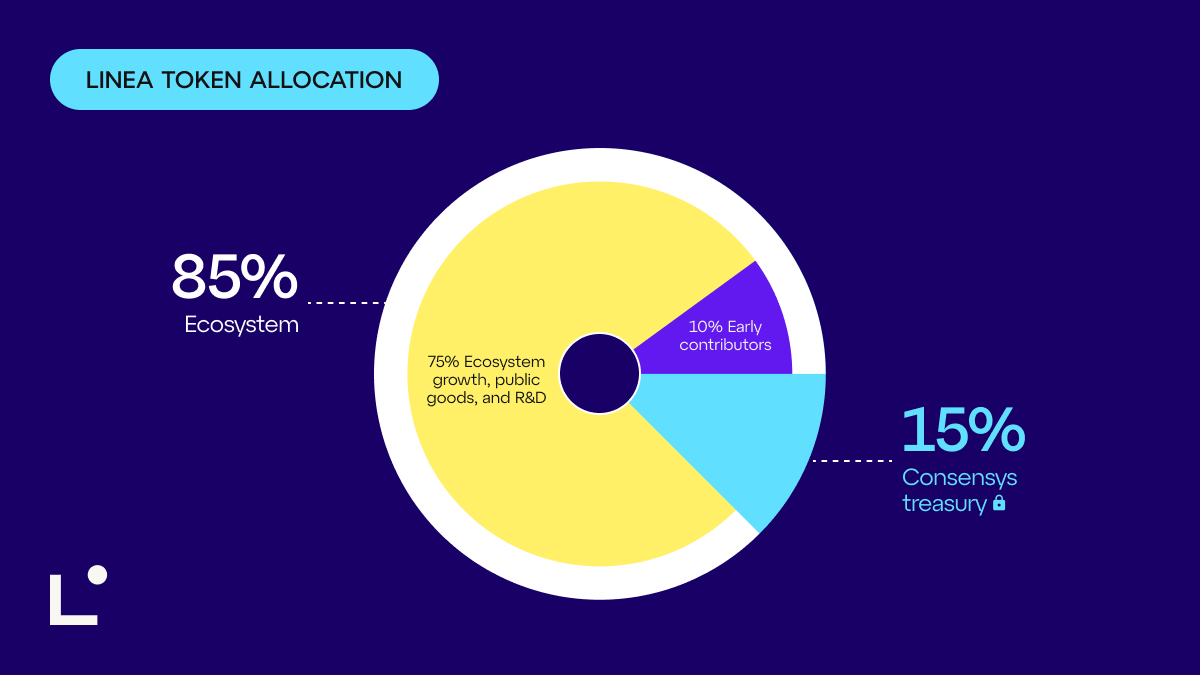
$Linea Tokenomics. Source: docs.linea.build
The remaining 80% of fees are used to buy back and burn LINEA tokens, creating a deflationary effect for both ecosystems. This approach links network activity to token scarcity—more usage drives more burning.
By redistributing value to Ethereum while enhancing LINEA’s long-term sustainability, the mechanism strengthens Linea’s position as an Ethereum-aligned layer-2 focused on efficiency, transparency, and community-driven economic growth.
SWIFT and Linea: Why It Matters
When people hear “SWIFT,” they usually think of the backbone of global banking, a network that moves trillions of dollars daily across more than 200 countries. For decades, it has been the messaging layer that makes international transfers possible.
The fact that SWIFT is now testing Linea is more than just a headline; it’s a signal that traditional finance is taking Ethereum layer-2 technology seriously.
By experimenting with Linea, SWIFT is exploring whether settlements between banks can be faster, cheaper, and more transparent without losing the security and compliance banks demand.
Linea’s use of zero-knowledge proofs is key here: sensitive financial data can remain private while the underlying transactions are still verified and secured by Ethereum.
The pilot involves major global banks and focuses on cross-border payments, one of the most costly and time-consuming areas in finance today. If successful, this could evolve into a system where institutional money flows through the same rails that power DeFi protocols, bridging two worlds that until recently were completely separate.
For Linea, being chosen for this kind of experiment is validation at the highest level. It shows that the network isn’t just another Ethereum L2 chasing retail adoption, it has the credibility and infrastructure to attract some of the most risk-averse players in finance.
Linea has quickly evolved from “just another L2” to a serious player connecting crypto-native ecosystems and global finance. Its zkEVM architecture ensures Ethereum-level compatibility with the added benefits of lower fees, faster settlement, and enterprise-ready infrastructure.
On one side, Linea is thriving as a hub for DeFi apps, attracting billions in liquidity and everyday MetaMask users. On the other hand, it’s being tested by SWIFT and major banks, proving its potential to underpin cross-border payments.
Competition is fierce; Arbitrum and Optimism have liquidity dominance, while zkSync and Starknet push technical boundaries. Yet Linea’s unique blend of ConsenSys backing, zkEVM tech, and institutional pilots gives it a powerful edge.
As Ethereum scaling matures, Linea is positioning itself as a default choice for both DeFi builders and TradFi giants. If it succeeds, it won’t just be scaling Ethereum, it could help redefine how money moves around the world.
How is Linea different from other Ethereum Layer-2s like Arbitrum and Optimism?
Linea uses zero-knowledge proofs (zk-SNARKs) instead of optimistic fraud proofs. This means transactions on Linea are finalized faster (minutes, not days), while still enjoying Ethereum’s security. Arbitrum and Optimism rely on a one-week challenge period for withdrawals, which Linea avoids.
Does Linea require a new token for gas fees?
No. Gas fees on Linea are paid in ETH, not in a separate native token. This strengthens Ethereum’s economic model and makes it easier for users and developers, since they don’t need to manage another asset just to interact with dApps.
What kinds of projects are already building on Linea?
Linea has attracted hundreds of integrations across DeFi, NFTs, and infrastructure, including major names like Uniswap, Aave, and Curve. It’s also supported by MetaMask’s $30 million rewards program, which is driving user adoption. Traditional players like Status Network have also adopted Linea for ETH-native yield products.
Is Linea suitable for beginners or only advanced developers?
Linea is designed for both. Developers can deploy existing Ethereum smart contracts without changes, while everyday users benefit from low fees and the ability to pay gas in stablecoins thanks to account abstraction.
Disclaimer:
The information provided in this article is for informational purposes only. It is not intended to be, nor should it be construed as, financial advice. We do not make any warranties regarding the completeness, reliability, or accuracy of this information. All investments involve risk, and past performance does not guarantee future results. We recommend consulting a financial advisor before making any investment decisions.
Giuseppe Ciccomascolo began his career as an investigative journalist in Italy, where he contributed to both local and national newspapers, focusing on various financial sectors.
Upon relocating to London, he worked as an analyst for Fitch's CapitalStructure and later as a Senior Reporter for Alliance News. In 2017, Giuseppe transitioned to covering cryptocurrency-related news, producing documentaries and articles on Bitcoin and other emerging digital currencies. He also played a pivotal role in establishing the academy for a cryptocurrency exchange website. Crypto remained his primary area of interest throughout his tenure as a writer for ThirdFloor.


 Easy
Easy