Auto-Deleveraging Explained: The Hidden Mechanism Behind Crypto’s $19B+ Meltdown.
Share
Key Takeaways
Auto-deleveraging (ADL) is an exchange’s last resort, activating only if an insurance fund can’t cover liquidation losses.
Queues help organize the most profitable/high-leverage positions that get trimmed first.
ADL is triggered by shortfalls, or slippage past a bankruptcy price.
You can lower ADL risk by utilizing less leverage, managing your ADL bar, avoiding crowded trades, and monitoring market depth.
The crypto market’s record-breaking crash on Friday, Oct. 10, appears to be the mark of Donald Trump’s tariff on China announcement.
The President’s 100% tariff threat triggered liquidation of more than $19 billion worth in leveraged crypto markets, while NASDAQ dropped 3.6% and the S&P 500 dropped 2.7%.
A bloodbath for traditional and decentralized assets, no doubt.
But as headlines focus on liquidations, many ignore the deeper reasoning behind such a crash: auto-deleveraging (ADL).
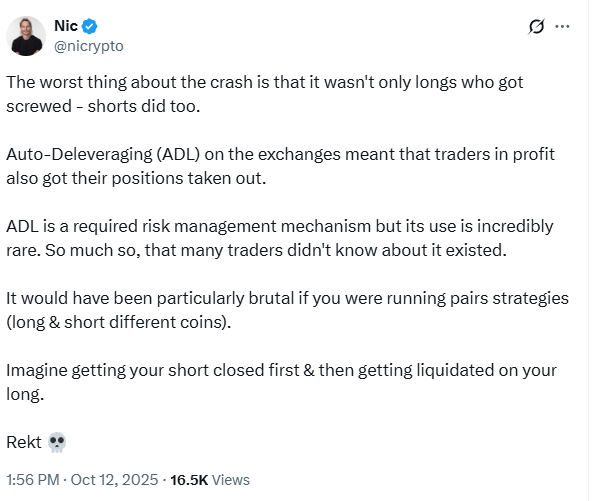
Auto-Deleveraging (ADL) on the exchanges meant that traders in profit also got their positions taken out. | Source: @nicrypto on X
Try Our Recommended Crypto Exchanges
Sponsored
Disclosure
We sometimes use affiliate links in our content, when clicking on those we might receive a commission at no extra cost to you. By using this website you agree to our terms and conditions and privacy policy.
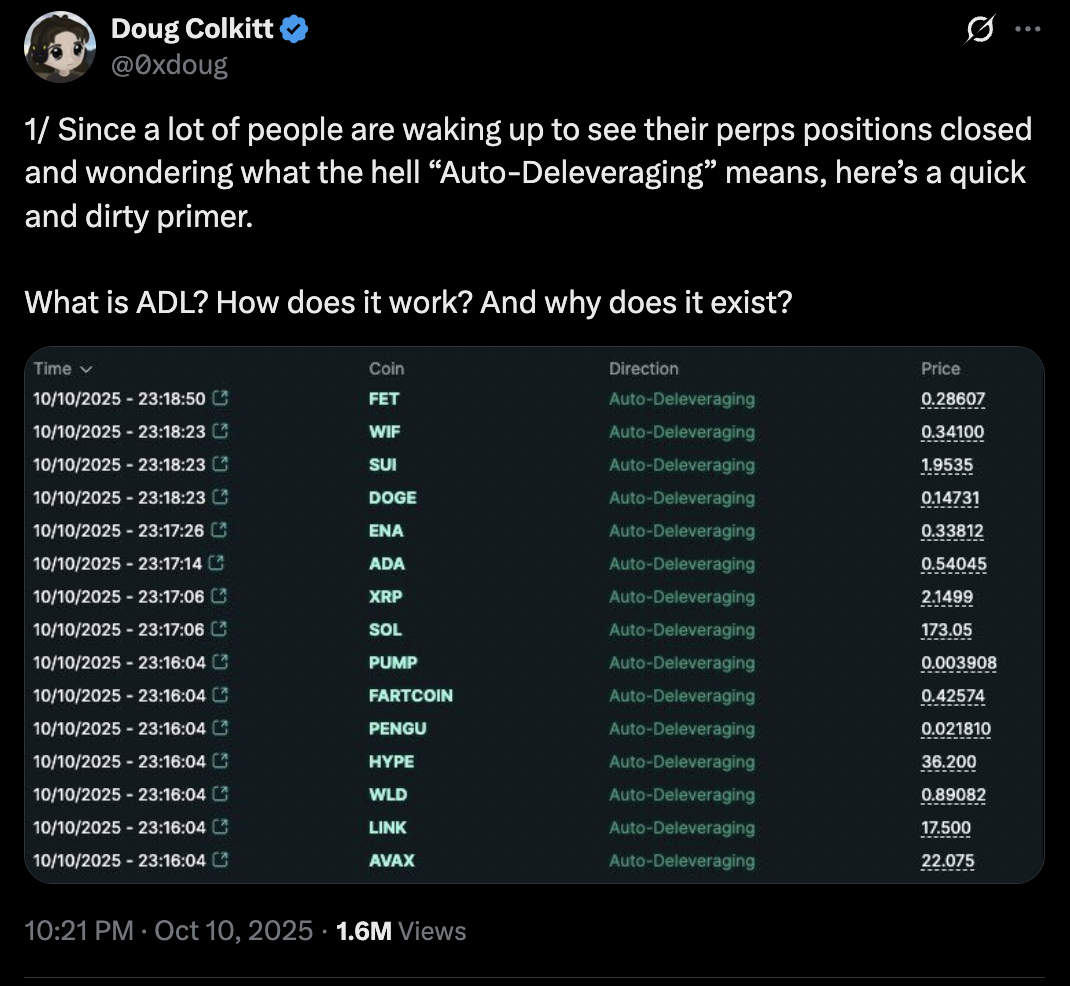
Auto-deleveraging or ADL is an exchange’s last resort. It occurs if liquidations leave a loss that a platform’s insurance cannot cover, and automatically reduces an opposite-side profitable position to cover the hole. It’s the final step in an exchange’s “risk waterfall.”
A de-leveraging explained. Source: 0xdoug on X
Remember that perpetual markets aren’t holding an asset, they’re tracking its spot price as traders bet on its movements. This means that a Bitcoin (BTC) perpetual market is mostly made up of a ton of cash, rather than investors buying and holding Bitcoin. An exchange needs risk management, such as insurance or ADL, to keep the platform solvent.
Here’s an example:
Imagine you’re long 1 BTC at $110,000
Your bankruptcy price, the point where your margin is wiped out, is $109,000
A market crash hits. The exchange tries to close your position around $109,000, but liquidity is thin. It ends up selling your Bitcoin at $108,000 instead.
That $1,000 difference? It’s a loss the system has to cover.
Insurance payout: The exchange’s insurance pays it, at all is done.
ADL: If the insurance can’t pay it, ADL comes into play. The system will pick profitable/high-leverage shorts and reduce their positions to offset the $1,000, plugging the hole, if you will.
Basically, ADL means the system automatically reduces or closes profitable traders’ positions on the other side (like high-leverage shorts) to cover that $1,000 gap.
So while Trump’s announcement helped initiate liquidations, causing crypto volatility, a system like ADL kept the snowball rolling, removing even more money from the market.
Do Exchanges Need Auto-Deleveraging as a Last Resort Tool
Two simple ideas explain the need for ADL as an exchange’s last resort:
Bankruptcy price: Every leveraged position has a point where margin is gone. If forced exits fill at worse than that level, the account goes negative, creating a deficit.
Insurance fund: Exchanges keep an insurance fund to cover deficits, insuring the winner still gets paid. But that fund is finite. Extreme days like October 10 can overwhelm an insurance fund. ADL exists for that edge case.
Think of it like seatbelts and airbags. The liquidation engine is the seatbelt, the insurance fund is an airbag. ADL is the emergency crew that shows up if both weren’t enough.
How Exchanges Choose Who Gets Auto-Deleveraged
Exchanges don’t randomly pick who gets auto-deleveraged or “ADL’d.” They use a ranking, often called an ADL queue, built around two ideas:
Profitability: Positions with higher unrealized PnL are closer to the front.
Leverage: Positions using higher effective leverage move up the queue.
Big, high-leverage winners on the opposite side of a liquidation are most likely to be cut first. Many exchanges show an ADL indicator next to each position (five little bars/lights). The more bars lit, the higher in the queue if an ADL triggers.
Just know that you’ll experience the following if tapped:
Position reduction: The system will attempt to partially reduce your position, not fully close it. The amount will vary based on the platform.
Profit and loss (PnL) realization: Naturally, your PnL will be realized on that reduced slice.
Possible market re-entry: The rest of your open orders may get cancelled to reduce the risk of ADL re-exposure. You’ll usually receive an email notice, and can immediately re-enter if you wish.
If you’re in a winning position, getting ADL’d may feel like being “punished’ for winning too much. Like having to pay more in taxes as you make more money. But in reality, you’re keeping the platform operational.
When a market loser can’t pull its weight to keep an exchange solvent, it’s forced to tap your winning position. Otherwise, the balance is off, and the platform can fall.
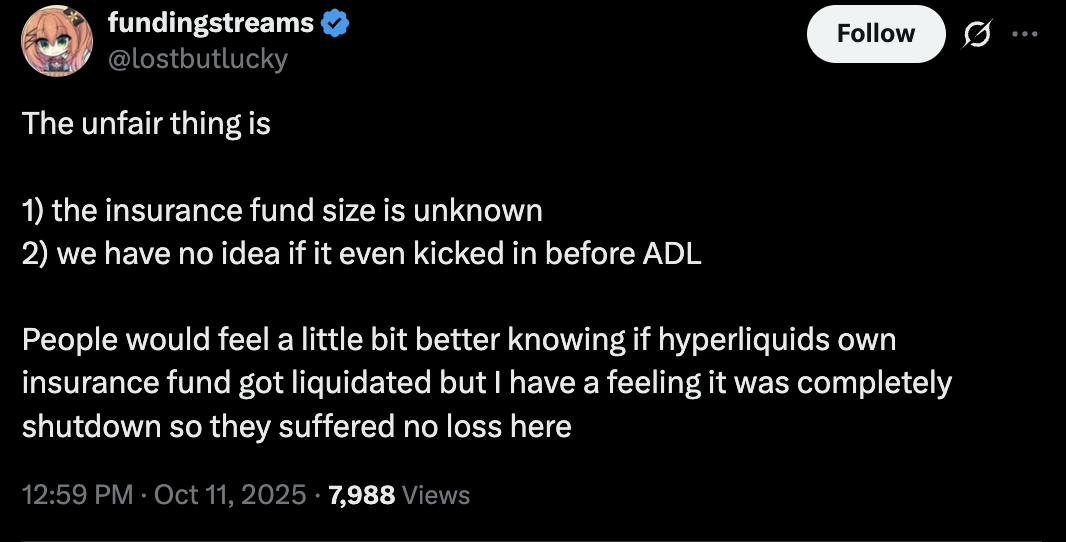
Just keep in mind that insurance funds can vary by platform, such as in the case of Hyperliquid on Oct. 10:
Some traders on Hyperliquid experienced ADL. | Source: @lostbutlucky on X
How to Lower Your Auto-Deleveraging Risk
While you can’t turn ADL off, you can intentionally lower your queue position:
Use less leverage: Add margin or reduce your leverage.
Watch your ADL bar: If your indicator is nearly full, you’re at high risk of getting ADL’d. Trim or hedge your investment.
Avoid crowded trades: If everyone is shorting while market longs are blowing up, insurance funds are more likely to run thin. In this case, shorts can get ADL’d. Spread your risk to help avoid this.
Mind market depth: If market depth looks low and spreads are high, volatility may follow. Volatility can lead to ADL.
Liquidations may have started the October 10th cascade, but when fills slip past bankruptcy and the insurance fund runs thin, ADL keeps the market standing by trimming the highest-ranked winners on either side.
This reasoning is why big selloffs can snowball even after the first wave of liquidations. If you trade perpetuals, treat ADL like a fire-safety system. It’s rarely used, but on historic days it matters.
Keep leverage modest, watch your ADL indicator, avoid crowded trades, and always check market depth against the trading chart.
What triggers Auto-Deleveraging (ADL) in crypto markets?
ADL is triggered when liquidations occur below a trader’s bankruptcy price and the exchange’s insurance fund can’t cover the resulting shortfall. It’s essentially a failsafe that activates only when normal liquidation and insurance mechanisms are exhausted.
Why do profitable traders sometimes get auto-deleveraged?
Because ADL reduces risk platform-wide, not just for losing trades. When a losing trader’s position creates a deficit, the system trims the most profitable and high-leverage positions on the opposite side to balance the books. It’s not a penalty, it’s a stability safeguard.
How can I tell if my position is at risk of being ADL’d?
Most exchanges display an ADL indicator bar beside each open position. The more bars lit, the higher your ranking in the ADL queue, meaning greater risk. High leverage, high unrealized profit, and crowded positions all increase your ADL likelihood.
How can I reduce my risk of auto-deleveraging?
Use lower leverage, maintain extra margin, and avoid one-sided or “crowded” trades. Keep an eye on your ADL indicator and the market’s depth; when liquidity thins out and spreads widen, the chance of ADL events increases sharply.
Disclaimer:
The information provided in this article is for informational purposes only. It is not intended to be, nor should it be construed as, financial advice. We do not make any warranties regarding the completeness, reliability, or accuracy of this information. All investments involve risk, and past performance does not guarantee future results. We recommend consulting a financial advisor before making any investment decisions.
Max Moeller is a Chicago‑based writer and video editor passionate about games, tech, and crypto. Whether it’s crafting clear, insightful articles or piecing together engaging video retrospectives, he’s driven by curiosity and takes pride in keeping things human. Since 2017, Max has been published in a variety of notable crypto magazines.


 Easy
Easy