Bitcoin fell after the Federal Reserve kept rates unchanged but revealed a hawkish outlook, with policymakers signaling possible future hikes amid slowing US growth and persistent inflation concerns.| Credit: CCN.com
Share
Key Takeaways
Bitcoin reacts strongly to Fed rate expectations as markets often price in anticipated rate hikes or cuts before announcements.
Indicators like Average True Range (ATR) and volume spikes can reveal institutional positioning.
Monitoring the U.S. dollar index can provide early indications of potential Bitcoin price movements.
Momentum and overbought/oversold conditions offer actionable insights for timing entries or exits around Fed announcements.
Bitcoin has matured from a niche digital asset into a major player in global financial markets. With its growing correlation to macroeconomic factors, traders are increasingly paying attention to central bank decisions, especially the U.S. Federal Reserve’s interest rate announcements.
These events can trigger significant volatility, presenting both opportunities and risks for Bitcoin traders. Understanding the market signals that precede and follow these announcements can help you navigate this high-stakes trading environment.
In this guide, we’ll explore seven key market signals you need to watch when trading Bitcoin around Fed rate decisions, providing insights to make more informed decisions and manage risk effectively.
Try Our Recommended Crypto Exchanges
Sponsored
Disclosure
We sometimes use affiliate links in our content, when clicking on those we might receive a commission at no extra cost to you. By using this website you agree to our terms and conditions and privacy policy.
1. How Bitcoin Reacts to Fed Interest Rate Expectations and Futures Pricing
Before the Fed officially announces a rate change, markets often react to expectations of a change. The pricing of interest rate futures and the yield curve can provide crucial insights into market sentiment.
Traders closely monitor instruments like the federal funds futures to gauge whether the market anticipates a rate hike, a rate cut, or a hold.
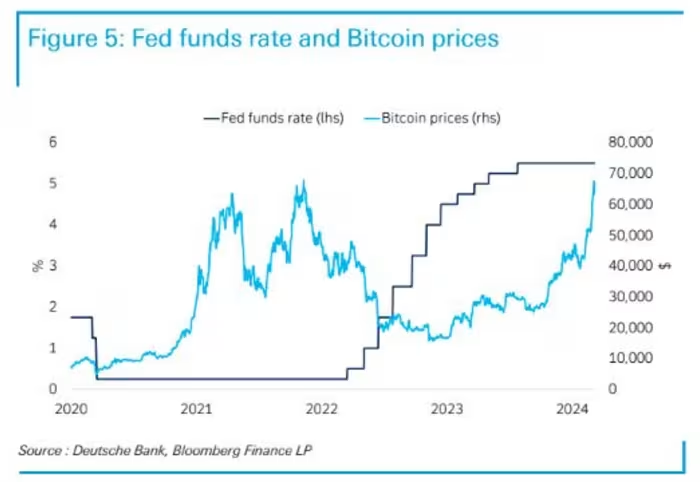
Fed funds rate and Bitcoin prices. | Credit: MarketWatch
A rate hike typically strengthens the U.S. dollar and can put downward pressure on Bitcoin, as investors may shift funds toward traditional assets, such as U.S. Treasury securities. Conversely, a rate cut or dovish commentary often fuels risk appetite, which can lift Bitcoin prices.
A key strategy may be to compare current Bitcoin trends with shifts in futures pricing. If futures suggest a 75% chance of a rate hike and Bitcoin remains bullish, it could indicate a divergence, potentially an early signal of market overreaction.
2. Pre-Fed Announcement Volatility: How to Spot Bitcoin Market Swings
Volatility often spikes in the hours leading up to Fed announcements. Traders anticipate sharp moves as the market positions itself, making this a critical period for careful observation.
Indicators to watch:
Average True Range (ATR): Measures daily volatility. A rising ATR in the 24 hours before the announcement signals potential big swings.
Volume spikes: Significant increases in trading volume can indicate that institutional players are entering positions ahead of the Fed news.
Many traders adopt a “wait-and-see” approach right before the announcement, avoiding large directional bets. Alternatively, using smaller position sizes or options strategies can allow participation while limiting exposure.
3. Tracking Dollar Strength (DXY) to Predict Bitcoin Price Moves
The U.S. dollar index (DXY) is a widely followed measure of the greenback’s strength relative to a basket of foreign currencies. Bitcoin often exhibits an inverse correlation with the dollar, meaning that a stronger dollar can pressure BTC, while a weaker dollar tends to support it.
How it works:
A rate hike tends to boost the dollar as yields rise, potentially causing Bitcoin to dip.
Conversely, a dovish Fed or rate cut can weaken the dollar, creating a favorable environment for BTC.
Monitor DXY trends in real-time. If the dollar rallies ahead of the Fed announcement, traders may consider short-term hedges or tighter stop-loss levels for long Bitcoin positions.
4. Using RSI and Momentum Indicators to Trade Bitcoin Around Fed News
Technical indicators remain valuable even amid macroeconomic events. The Relative Strength Index (RSI) measures whether an asset is overbought or oversold, providing clues about potential reversals or continuations.
How to apply RSI around Fed events:
An RSI above 70 indicates Bitcoin is overbought and may be vulnerable to a sharp pullback if the Fed surprises with a hawkish stance.
An RSI below 30 suggests oversold conditions, possibly creating buying opportunities if the Fed is dovish.
5. Bitcoin Futures and Options Liquidity: Key Signals for Fed Events
Institutional traders increasingly influence Bitcoin through futures and options markets. Watching open interest and funding rates on platforms like CME or Binance can provide early signals of positioning ahead of Fed announcements.
Key metrics to monitor:
Funding rates: Persistently high long funding rates indicate bullish sentiment but can make BTC vulnerable to a sudden unwind if the Fed surprises the market.
Open interest changes: Large accumulations of futures contracts indicate that institutional players are anticipating significant price movements.
Traders can adjust position sizes or implement strategies, such as straddles, in the options market to profit from volatility without taking a specific directional bet.
6. Bitcoin Correlation With Stocks and Risk Assets During Fed Announcements
Bitcoin is increasingly behaving like a risk asset, moving in tandem with equities and commodities, especially during macroeconomic events. Tracking these correlations can provide additional context.
Examples:
S&P 500 correlation: A dovish Fed announcement often lifts equities and Bitcoin simultaneously, while a hawkish stance can depress both.
Gold:Gold and Bitcoin sometimes act as alternative stores of value. The divergence between gold and BTC can indicate a unique positioning in the cryptocurrency market.
Consider monitoring multiple asset classes. If Bitcoin diverges from equities during a Fed event, it may signal an early trading opportunity or risk of a sharp correction.
7. Analyzing Fed Statements and Economic Guidance to Trade Bitcoin Smarter
While the rate decision itself is necessary, the Fed’s post-announcement statement and press conference can have even greater influence. Traders focus on nuanced language: words like “gradual,” “hawkish,” or “data-dependent” can drive significant volatility.
Why tone matters:
The Fed often aims to manage expectations. A rate hike paired with dovish language may have a muted impact on the price of Bitcoin.
Conversely, even a small rate change combined with aggressive language about future hikes can trigger strong moves.
Listen closely to the Fed Chair’s press conference. Avoid entering positions solely based on the numerical rate change. Instead, interpret the guidance and market expectations to anticipate the next wave of Bitcoin volatility.
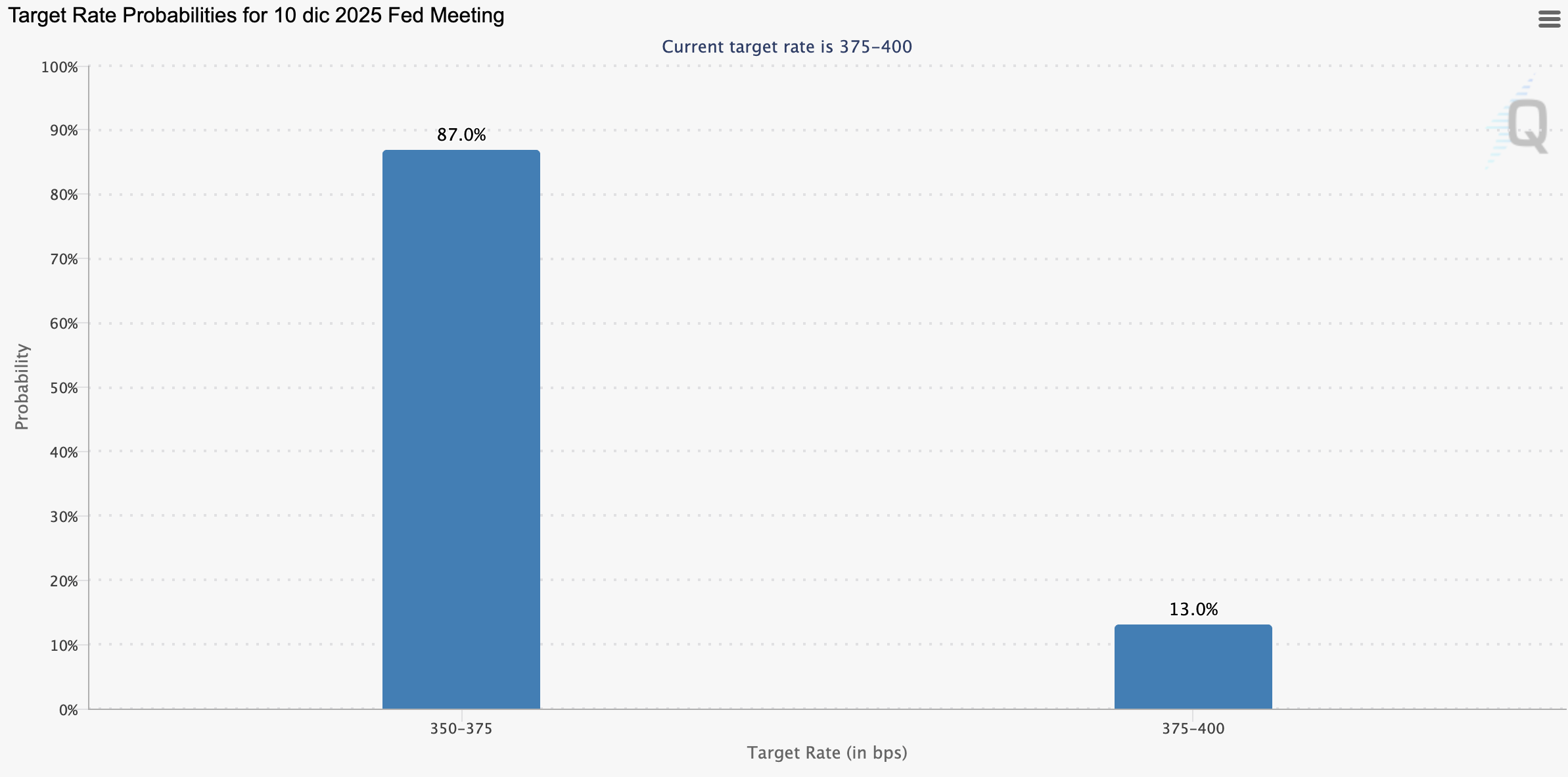
This upcoming decision follows a series of financial data points, including weaker-than-expected private payrolls, that have increased expectations that the Fed may shift to a more dovish stance.
Markets expect Fed to cut rates by 25 basis points on Dec. 10. | Credit: FedWatch
If the Fed delivers the anticipated cut, the U.S. dollar is likely to weaken, as lower interest rates reduce demand for dollar-denominated assets.
At the same time, Bitcoin and other risk assets could see a boost, as easing monetary policy often encourages investors to seek higher returns in assets perceived as higher risk.
Historical trends indicate that Bitcoin, although volatile, tends to react positively to interest rate cuts, particularly when accompanied by dovish guidance from the Fed.
Practical Trading Tips Around Fed Announcements
Combining these seven market signals can help traders navigate Fed-related volatility with greater confidence. Here are some practical tips:
Use smaller position sizes: Volatility spikes can lead to rapid losses; smaller trades help manage risk.
Set stop-loss orders: Protect against unexpected swings, particularly during post-announcement surges.
Consider options strategies: Straddles and strangles can profit from volatility without requiring a directional prediction.
Stay informed: Follow reputable economic news sources and monitor Fed communications in real-time.
Avoid emotional trading: Market reactions can be exaggerated; stick to a disciplined plan.
Trading Bitcoin around Fed interest rate announcements requires a combination of macroeconomic awareness, technical analysis, and risk management.
By focusing on the seven key signals outlined, interest rate expectations, pre-announcement volatility, dollar strength, momentum indicators, futures and options liquidity, correlations with other assets, and the tone of Fed guidance, traders can make more informed decisions and better navigate the inherent uncertainty.
Remember, while opportunities exist, these events can also produce rapid and unpredictable price swings. Educated, cautious, and disciplined trading is essential. By observing market signals and adjusting your strategy in response to the context of Fed announcements, you can enhance your chances of capturing gains while minimizing downside risk.
Bitcoin trading around macroeconomic events is as much an art as it is a science. With preparation, attention to detail, and a clear understanding of these seven market signals, you’ll be better equipped to approach these high-volatility moments with confidence.
How do Fed interest rate announcements affect Bitcoin prices?
Fed rate announcements influence macroeconomic conditions, particularly the U.S. dollar and risk sentiment. A rate hike can strengthen the dollar and put downward pressure on Bitcoin, while a rate cut or dovish guidance often boosts risk assets, including BTC.
Can Bitcoin be predicted before a Fed announcement?
While precise predictions are impossible, traders can monitor market signals like futures pricing, volatility indicators, and funding rates to gauge how Bitcoin might react to an upcoming Fed decision.
What are the best technical indicators for trading Bitcoin during Fed events?
Key indicators include the Relative Strength Index (RSI) to assess overbought or oversold conditions, MACD for momentum, Bollinger Bands for volatility, and the Average True Range (ATR) to measure expected price swings.
Why should I track the U.S. dollar index (DXY) when trading Bitcoin?
Bitcoin often moves inversely to the U.S. dollar. Monitoring DXY helps traders anticipate BTC reactions to Fed announcements, as a stronger dollar may depress Bitcoin and a weaker dollar may support it.
Disclaimer:
The information provided in this article is for informational purposes only. It is not intended to be, nor should it be construed as, financial advice. We do not make any warranties regarding the completeness, reliability, or accuracy of this information. All investments involve risk, and past performance does not guarantee future results. We recommend consulting a financial advisor before making any investment decisions.
Giuseppe Ciccomascolo began his career as an investigative journalist in Italy, where he contributed to both local and national newspapers, focusing on various financial sectors.
Upon relocating to London, he worked as an analyst for Fitch's CapitalStructure and later as a Senior Reporter for Alliance News. In 2017, Giuseppe transitioned to covering cryptocurrency-related news, producing documentaries and articles on Bitcoin and other emerging digital currencies. He also played a pivotal role in establishing the academy for a cryptocurrency exchange website. Crypto remained his primary area of interest throughout his tenure as a writer for ThirdFloor.


 Easy
Easy