Hassett’s Fed Momentum Moves Markets as Traders Price In Faster Rate Cuts
Share
Key Takeaways
Hassett’s rise in the Fed chair race drives clear reactions across bonds, currencies, and equities.
Markets show strong expectations for lower borrowing costs under a growth-focused approach.
Traders price in faster easing as yields fall, the dollar weakens, and rate-sensitive assets climb.
A leadership shift at the Fed creates new uncertainty for inflation, policy direction, and global flows.
Christmas is approaching and clarity is one of the best gifts for markets during a volatile year.
The race to lead the Federal Reserve has intensified. However, Kevin Hassett, the Director of the White House National Economic Council (NEC), is emerging as the clear frontrunner to replace Jerome Powell, whose term ends in May 2026.
Markets already react to the possibility of a major shift in U.S. monetary policy, with treasury yields moving lower, the dollar losing strength, and rate-sensitive stocks gaining momentum.
Investors watch closely because a change at the Fed could reshape the path of interest rates, inflation, and global capital flows.
This article explains what Hassett’s nomination means for the economy, markets, and policy outlook.
Kevin Hassett: The Dovish Economist Poised To Reshape the Fed
Over the past weeks, both betting markets and key financial media have sharply increased the odds of Hassett’s nomination.
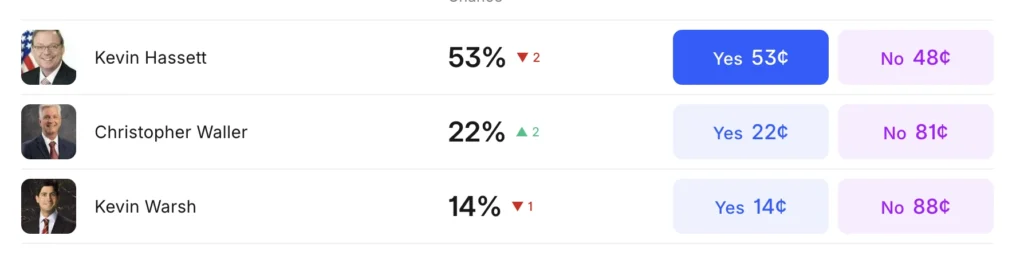
In the prediction exchange, Kalshi’s probability rose to around 54–56 percent, placing him well ahead of other contenders such as Christopher Waller, Kevin Warsh, Michelle Bowman and Rick Rieder.
Who will Trump nominate as Fed Chair? | Source: Kalshi
The main reason is his widely known leaning, which means he supports lower interest rates and easier financial conditions. Hassett publicly argued recently that the Fed has been “a little bit late to the game” on rate cuts.
His positioning aligns with what Donald Trump has repeatedly demanded: lower rates to boost economic growth, reduce borrowing costs, and ease pressure on households and businesses.
Despite his political ties, some in the financial world consider him a “credible economist.” For example, analysts at Citi described his profile as consistent with a pro-growth agenda that could ease financial conditions nationwide.
What Hassett’s Stance Signals for Policy
A leadership shift at the Federal Reserve would influence how credit moves through the economy. Kevin Hassett’s record suggests a more growth-focused and accommodative approach, which differs from the recent focus on inflation control. Markets already respond to this possibility, as reported by Reuters.
Hassett has criticized the current policy stance and supports quicker reductions in interest rates. His approach favors early easing to support growth and lower borrowing costs.
However, Hassett’s close relationship with the administration has raised questions about whether monetary decisions would remain insulated from political goals.
The next question is how markets interpret these signals and how investors position themselves ahead of potential leadership changes.
Bitcoin Price May Rise as Rate-Cut Bets Grow and Dollar Weakens
Financial markets reacted fast to Kevin Hassett’s rise as the leading candidate for the Federal Reserve chair. Traders shifted across bonds, currencies, and equities as they factored in a more dovish policy path.
Bitcoin responds fast to interest rate expectations because traders use liquidity to move in and out of risk assets. Hassett’s rise increases expectations for cheaper borrowing costs, which supports a stronger appetite for digital assets. This approach could boost the appeal of Bitcoin (BTC) during periods of easier financial conditions.
Treasury yields dip: The 10-year US Treasury yield fell below 4% as traders bet on aggressive rate cuts under a dovish Fed approach led by Hassett.
Dollar weakens: The USD index dropped 0.8% as markets responded to expectations of softer inflation pressure management and lower rates.
Equities rally: Rate-sensitive stocks and S&P 500 futures rose 1 to 2% as sentiment shifted toward more favorable financial conditions.
Rate cut odds surge: Market-implied odds for a December rate cut jumped to roughly 80% as Hassett’s frontrunner status strengthened.
Markets moved in the same direction because traders expect Hassett to support lower borrowing costs and faster policy easing.
This shift in positioning flows directly into crypto trading activity.
Crypto markets watch the Federal Reserve closely because lower rates reduce stress on leveraged traders and exchanges. Cheaper credit increases activity across spot and derivatives markets.
Falling yields, a weaker dollar, and the strength of risk assets suggest that investors view a Hassett-led Fed as a clear pivot toward cheaper capital and more liquidity.
A weaker dollar creates more room for assets like Bitcoin to gain momentum. Crypto often moves in the opposite direction of the dollar when global markets search for alternative stores of value. Stronger expectations for rate cuts increase the flow of capital into crypto as traders position for higher volatility and faster market cycles.
The scale and speed of the reaction show how strongly the market anticipates a shift in policy, setting the stage for a volatile path if political signals or incoming data challenge the current expectations.
Why do traders link Hassett’s policy stance with faster liquidity growth?
Traders expect Hassett to support easier credit conditions, which increases liquidity across financial markets.
Does a Fed leadership change influence crypto volatility?
Influential Fed voices guide risk appetite, so a leadership shift raises volatility in assets like Bitcoin.
Could Hassett’s relationship with the White House influence market confidence?
Close ties create questions about independence, which influences how investors price long-term risk.
Why do prediction markets matter for financial forecasting?
Prediction markets track real money expectations, which signal how traders position ahead of policy events.
Disclaimer:
The information provided in this article is for informational purposes only. It is not intended to be, nor should it be construed as, financial advice. We do not make any warranties regarding the completeness, reliability, or accuracy of this information. All investments involve risk, and past performance does not guarantee future results. We recommend consulting a financial advisor before making any investment decisions.
Dr. Lorena Nessi is an award-winning journalist and media technology expert with 15 years of experience in digital culture and communication. Based in Oxfordshire, UK, she combines academic insight with hands-on media practice.
She holds a PhD in Communication, Sociology, and Digital Cultures, and an MA in Globalization, Identity, and Technology.
Lorena has taught at Fairleigh Dickinson University, Nottingham Trent University, and the University of Oxford. She is a former producer for the BBC in London, with additional experience creating television content in Mexico and Japan.
Her research focuses on digital cultures, social media, technology, capitalism, and the societal impact of blockchain innovation.
She has written extensively on digital media and emerging technologies, with her work featured in both academic and media platforms. Her Web3 expertise explores how blockchain technologies shape culture, economics, and decentralized systems.
Outside of work, Lorena enjoys reading science fiction, playing strategic board games, traveling, and chasing adventures that get her heart racing. A perfect day ends with a relaxing spa and a good family meal.


 Easy
Easy