A look at the 2025 Christmas rally and if Bitcoin can outperform gold, highlighting seasonal trends, macro pressures, and investor sentiment. | Credit: Veronica Cestari/CCN.com
Share
Key Takeaways
The 2025 Christmas rally is shaping up to be unusually competitive, with Bitcoin struggling to reclaim $100,000.
Bitcoin’s typical Santa rally faces headwinds, including a recent death cross, liquidity shocks, and macro uncertainty.
Gold enters December with steady momentum, supported by central bank buying, geopolitical stress, and strong seasonal jewelry demand.
Macro forces will decide the winner, with risk-on conditions favoring Bitcoin and risk-off environments boosting gold.
As the holiday season approaches, investors across global markets are once again preparing for the year-end surge known as the Christmas rally, or, in crypto parlance, the Santa Claus rally.
This recurring pattern, marked by rising asset prices during the final weeks of December and the first days of January, has become a closely monitored event among Bitcoin traders.
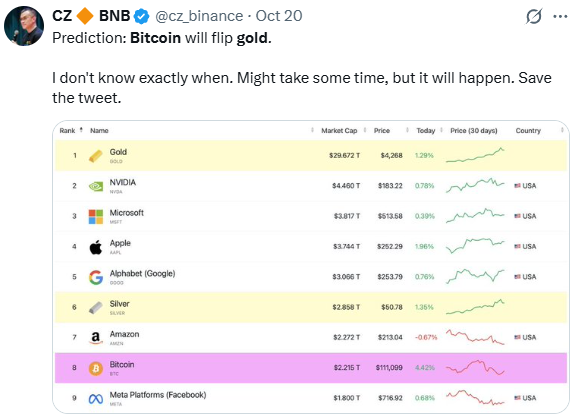
But this year, there’s a twist: can Bitcoin outperform gold, the world’s oldest store of value, during the 2025 holiday season?
Amid death-cross warnings, macroeconomic uncertainty, and shifting market sentiment, both assets are entering December with wildly different setups. With Bitcoin struggling to reclaim the $100,000 level and gold inching back toward record highs, the race for year-end dominance has rarely been this competitive.
Let’s break down the forces shaping the 2025 Christmas rally, examine how Bitcoin and gold behave under seasonal and macroeconomic pressures, and explore which asset may emerge as the holiday season’s star performer.
Try Our Recommended Crypto Exchanges
Sponsored
Disclosure
We sometimes use affiliate links in our content, when clicking on those we might receive a commission at no extra cost to you. By using this website you agree to our terms and conditions and privacy policy.
Why Investors Expect a Bitcoin Santa Rally in 2025
A Santa rally in Bitcoin refers to the historical tendency for BTC to rise between Christmas and New Year’s. Data from Coinglass shows that Bitcoin has finished six of the past eight Decembers in the green, with gains ranging from 8% to 46%.
There are several drivers behind this pattern:
Reduced liquidity on exchanges during the holidays.
Portfolio rebalancing as institutions close their books.
Year-end tax positioning for both retail traders and funds.
Seasonal risk appetite, especially when macro sentiment improves.
Crypto-native optimism, which historically spikes in Q4.
And yet, this year’s setup is complicated.
Bitcoin recently flashed its fourth death cross, where the 50-day moving average drops below the 200-day, a traditionally bearish signal. October’s dramatic liquidation, triggered in part by Trump’s comments on 100% tariffs on Chinese imports, wiped billions from the market.
CZ said he’s sure Bitcoin will outshine gold. | Credit: CZ X profile
CryptoQuant warned that losing the 365-day moving average at $102,000 opens the door to potential downside toward $72,000 if recovery stalls.
Still, analysts remain cautiously optimistic. Some believe anticipated U.S. rate cuts and ongoing institutional accumulation could create the ideal environment for a year-end rebound.
Bitcoin vs. Gold: Holiday Season Performance Breakdown
Bitcoin and gold are often lumped together as “stores of value,” but their markets, and seasonal behaviors, are profoundly different. Below is a clear comparison that fits naturally within the narrative:
Bitcoin vs. Gold: Key Differences Heading Into December
Category
Bitcoin
Gold
Primary Buyers
Retail investors, tech-oriented traders, institutions via ETFs
Central banks, sovereign wealth funds, jewelers, institutional allocators
Seasonal Behavior
Strong year-end rallies; high volatility
Gradual December uptick; low volatility
Liquidity Dynamics
Extremely sensitive to ETF flows and exchange liquidity
Deep, stable liquidity; less prone to sharp swings
Perceived Risk
High — price can swing 5–10% in hours
Low — safe haven during stress
Storage Concerns
Dependent on private key security
Requires vaulting, insurance, transport
Macro Sensitivity
Highly responsive to interest rates, dollar strength, liquidity cycles
Driven by geopolitical stress, inflation, and central bank buying
This table helps illustrate why the Christmas rally plays out differently for each asset and why predicting a winner for 2025 is unusually complicated.
Gold’s Seasonal Strength: Why December Is Historically Bullish
Gold has served as a store of value for centuries, and its seasonal pattern reflects deep-rooted global demand trends. Although gold rarely surges in December, it typically enjoys steady upward pressure thanks to:
Jewelry demand in China and India.
Central bank reserve accumulation.
Year-end institutional rebalancing.
This year, gold has already seen dramatic moves. After hitting record highs above $4,380 per ounce, the yellow metal pulled back, then began recovering as U.S. budget concerns mounted and shutdown fears eased. Now trading above $4,100 per ounce, gold sits only 7% below all-time highs.
These conditions historically strengthen gold’s appeal, especially during slow holiday trading.
Bitcoin as Digital Gold: High Upside, High Volatility
Bitcoin’s story since 2022 is nothing short of remarkable. Rising from $16,000 in late 2022 to a peak above $125,000 in October 2025, BTC has cemented itself as a legitimate long-term store of value for millions.
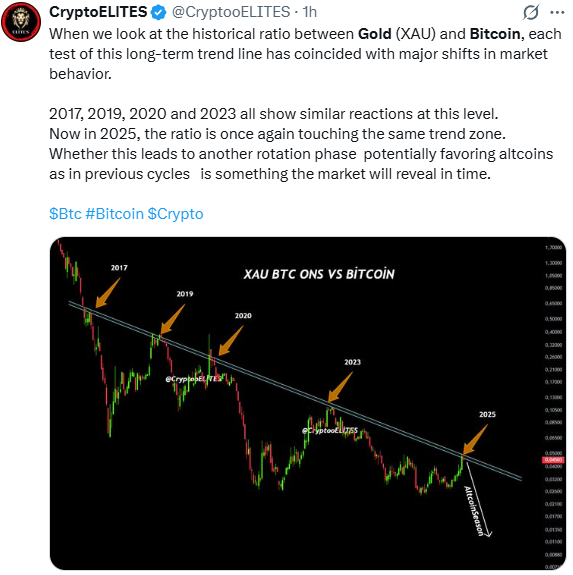
Bitcoin-to-gold ratio similar to 2017, 2019, 2020, and 2023 levels. | Credit: CryptoELITES X profile
We’re observing a shift from panic selling to strategic accumulation by long-term holders.
Still, volatility cuts both ways. A deterioration in macro conditions or another liquidity shock could derail any year-end momentum.
Macro Forces Driving the 2025 Christmas Rally
The Federal Reserve’s role cannot be overstated. After cutting interest rates by 25 bps in both September and October 2025, borrowing costs now sit at their lowest since 2022. Lower rates generally:
Weaken the U.S. dollar.
Strengthen alternative assets.
Boost market liquidity.
Inflation has risen slightly to 3.0%, keeping both gold and Bitcoin attractive as hedges.
This divergence matters. Gold buyers are slow, predictable, and macro-driven. Bitcoin buyers are fast, opportunistic, and sentiment-driven — creating explosive upside potential but also deeper downside risk.
Case Studies: When Bitcoin Outperforms Gold
Looking at recent history helps investors understand how each asset responds to macroeconomic shifts.
Case Study 1: Bitcoin Outperformed (2020)
During the pandemic, trillions in global liquidity flooded markets.
Lesson: In tightening cycles and stress, gold protects capital more reliably.
These lessons frame the big question for 2025: What type of macro environment will December bring?
Can Bitcoin Beat Gold This Christmas? Key Factors to Watch
The answer depends on three variables:
Liquidity Conditions: If year-end liquidity improves, through Fed dovishness, ETF inflows, or reduced selling, Bitcoin could stage a powerful Santa rally.
Investor Sentiment: When optimism is high, Bitcoin tends to benefit, attracting risk-on investors looking for upside. When fear dominates, gold becomes the preferred safe haven, drawing capital seeking stability. In periods of mixed or uncertain sentiment, both assets can rise — but gold usually does so more steadily, reflecting its long-established role as a defensive hedge.
Holiday Market Structure: Holiday periods amplify volatility. Bitcoin thrives in such environments; gold simply stabilizes.
Final Verdict: Which Asset Will Lead the 2025 Holiday Rally?
A Christmas or Santa Claus rally refers to the tendency for markets, including stocks, Bitcoin, and sometimes gold — to rise during the final week of December and the first few trading days of January.
Does Bitcoin usually participate in a Santa rally?
Yes. Historical data shows Bitcoin has finished six of the last eight Decembers in the green, often posting significant gains thanks to seasonal optimism, low liquidity, and year-end portfolio rebalancing.
Why are investors debating Bitcoin vs. gold this holiday season?
Both assets are entering December with strong but very different setups: Bitcoin has shown volatility and bearish signals, while gold is nearing record highs. Investors want to know which “store of value” will win the 2025 holiday rally.
What macroeconomic factors matter most this year?
The Federal Reserve’s recent rate cuts, rising inflation, and a weaker dollar are key drivers. Liquidity conditions are critical: more liquidity typically favors Bitcoin, while uncertainty boosts gold.
Disclaimer:
The information provided in this article is for informational purposes only. It is not intended to be, nor should it be construed as, financial advice. We do not make any warranties regarding the completeness, reliability, or accuracy of this information. All investments involve risk, and past performance does not guarantee future results. We recommend consulting a financial advisor before making any investment decisions.
Giuseppe Ciccomascolo began his career as an investigative journalist in Italy, where he contributed to both local and national newspapers, focusing on various financial sectors.
Upon relocating to London, he worked as an analyst for Fitch's CapitalStructure and later as a Senior Reporter for Alliance News. In 2017, Giuseppe transitioned to covering cryptocurrency-related news, producing documentaries and articles on Bitcoin and other emerging digital currencies. He also played a pivotal role in establishing the academy for a cryptocurrency exchange website. Crypto remained his primary area of interest throughout his tenure as a writer for ThirdFloor.


 Easy
Easy