Japan’s Bond Yields Hit Record High — What It Means for the Bitcoin Price
Share
Key Takeaways
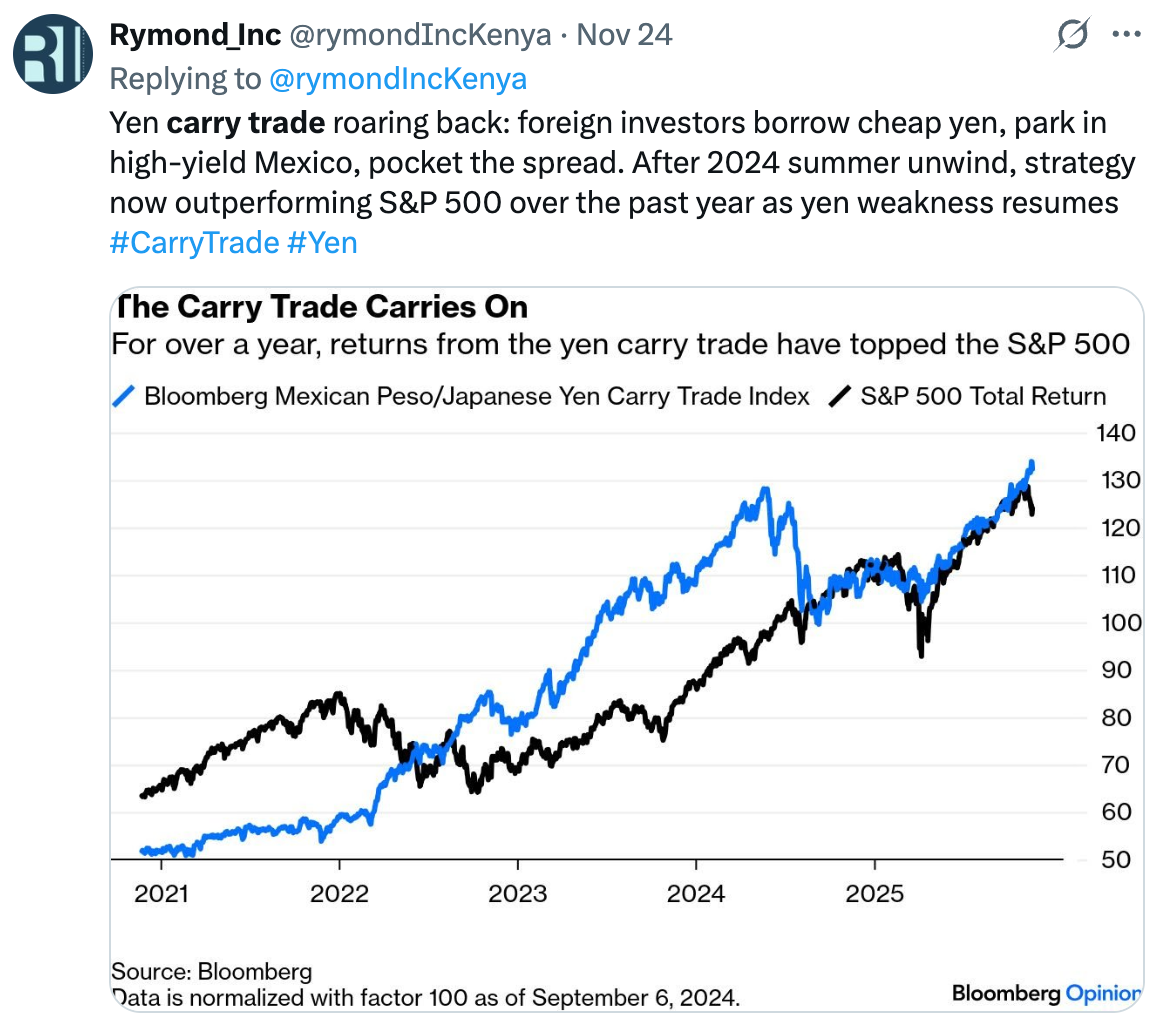
The Japanese carry trade has been a primary driver of global liquidity for decades.
Robert Kiyosaki said his investment stance in gold, silver, Bitcoin, Ethereum, and now energy reflects his preference for assets outside central-bank control.
The author of Rich Dad frames energy investments, especially in oil and natural gas, as long-term beneficiaries of AI-driven demand.
While some concerns are grounded in fundamental economic dynamics, his predictions often lean toward dramatic, worst-case interpretations.
When Robert Kiyosaki, the outspoken author of Rich Dad Poor Dad, issues warnings about financial collapse, the world tends to listen, not necessarily because he is always right, but because he has a unique ability to distill complex macroeconomic ideas into a simple, investor-friendly worldview.
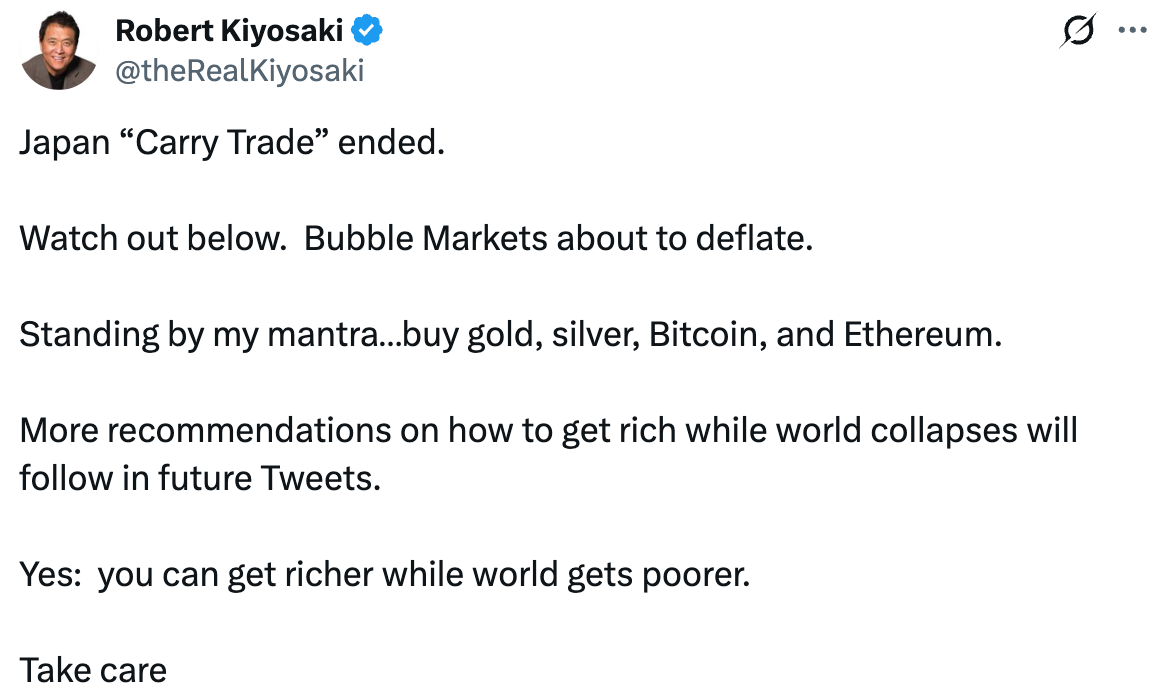
His recent tweets have set off a wave of discussion: “Japan ‘Carry Trade’ ended. Watch out below. Bubble markets about to deflate. Standing by my mantra: buy gold, silver, Bitcoin, and Ethereum… Yes: you can get richer while the world gets poorer.”
Kiyosaki is now positioning his familiar message, hard assets, crypto, and strategic investing, within a new macroeconomic narrative: the end of a decades-long global liquidity engine. Whether one accepts his conclusions or not, understanding the underlying economic concepts is valuable.
This article breaks down Kiyosaki’s claims, the mechanics behind them, and what average investors can learn from his perspective, without taking any prediction as guaranteed.
Japanese Carry Trade: Why Kiyosaki Warns Its End Could Crash Global Markets
A strengthening yen amplifies the unwind as dollar-based investors lose currency value.
Kiyosaki refers to this as the “pin” that can deflate global bubbles. He argues that the unwind has already begun, marking the potential start of:
Falling real estate prices.
Stock market volatility.
Bond market stress.
Rising unemployment.
Whether or not this becomes the “biggest crash in history,” as he claims, the structural logic of the carry-trade unwind is real economics, not speculation.
Kiyosaki’s Economic Framework: Why He Predicts an Upcoming Global Market Crash
Kiyosaki’s general worldview includes several long-standing themes:
A. Debt-Driven Economies Are Fragile
Governments, especially the U.S., carry unprecedented levels of:
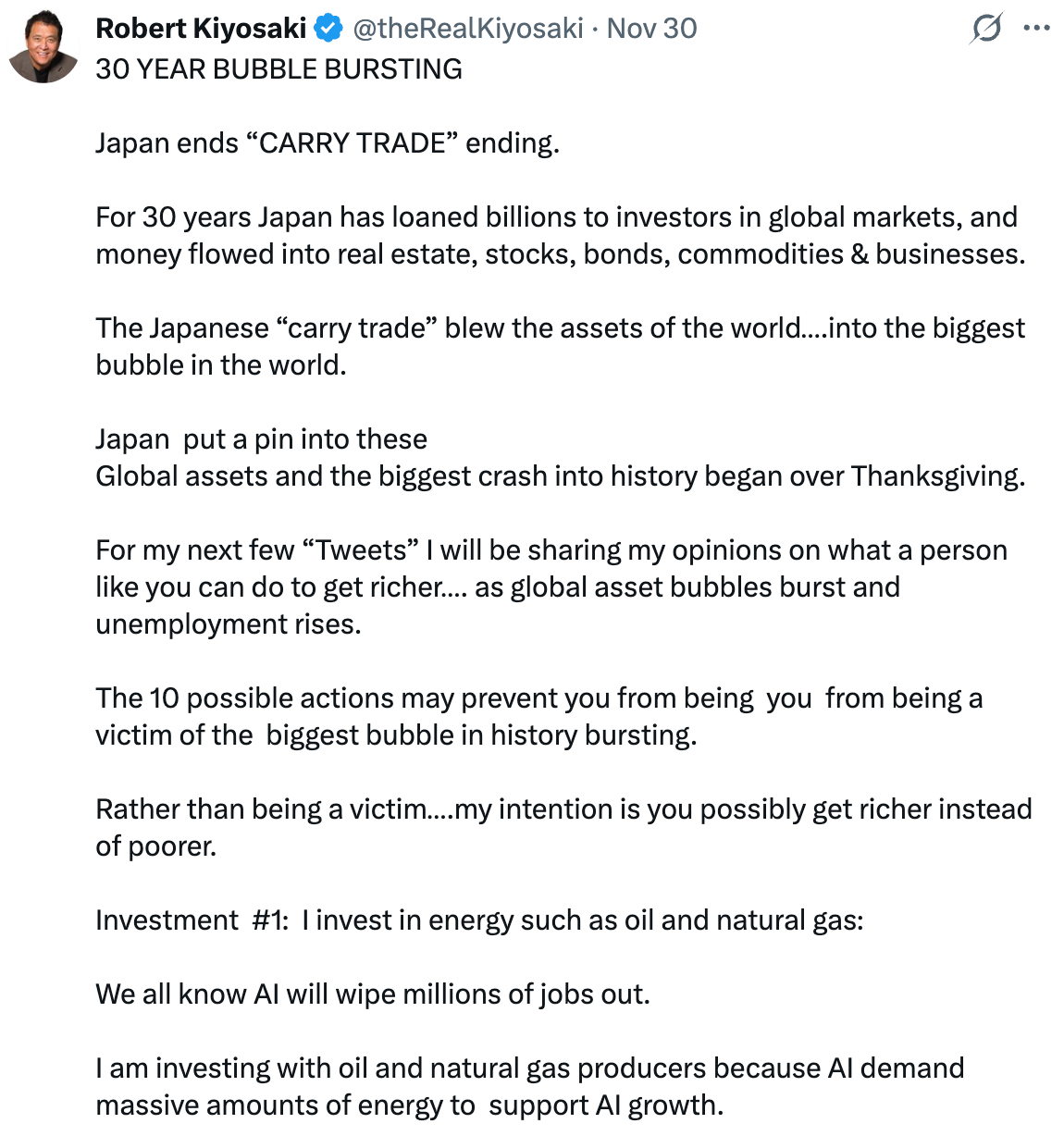
“I invest in energy such as oil and natural gas… AI will wipe millions of jobs out. AI demands massive amounts of energy.”
Why Energy?
Kiyosaki links two macro forces:
AI Adoption to exploding energy demand: Training frontier models requires enormous electricity consumption, far exceeding most people’s assumptions.
Energy producers to cash flow in any economy: Even during recessions, energy demand rarely collapses; AI, data centers, global logistics, and manufacturing rely on it.
His Investing Pathways
Rich Dad author mentions:
Private equity energy deals.
Oil and gas producers.
Energy ETFs.
Traditional stock positions.
Cashflow-style investments that prioritize passive income.
This aligns with his long-held principle: to seek assets that generate cash flow regardless of market cycles.
“You Can Get Richer While the World Gets Poorer” — The Philosophy Behind the Claim
This controversial line is central to Kiyosaki’s message. He argues that economic downturns do not affect everyone equally.
A. Downturns Reallocate Wealth
Historically, crises:
Lower asset prices.
Increase volatility.
Shake out over-leveraged investors.
Create buying opportunities for those with liquidity.
Those who prepare, not panic, often capture long-term gains.
B. Jobs and Real Estate Are Interlinked
Kiyosaki warns: “The real estate market depends upon jobs.” If unemployment rises globally:
Homebuyers disappear.
Mortgage defaults rise.
Property prices fall.
Over-leveraged homeowners get squeezed.
Investors with cash or liquidity, however, may find bargain opportunities in real estate during the downturn.
C. Financial Education Is the Differentiator
Kiyosaki’s core philosophy states:
The rich invest early and consistently.
The poor rely on wage income.
The middle class assumes job stability and home equity will protect them.
Crashes disproportionately affect those who depend on a single income source.
This is why he continues to emphasize “getting financially educated” as the ultimate hedge.
What Robert Kiyosaki Gets Right and Where Investors Should Be Cautious
Kiyosaki’s analysis blends accurate macroeconomic observations with bold predictions. A critical reading helps separate insight from interpretation.
Where His Warnings Have Merit
Before dismissing Robert Kiyosaki’s latest wave of warnings as alarmist, it’s essential to recognize that several of his underlying points rest on real, measurable economic pressures.
Kiyosaki says a 30-year long bubble is bursting. | Credit: Robert Kiyosaki X profile
The factors he highlights are not fringe theories; they are grounded in observable macroeconomic dynamics that economists and financial institutions have been monitoring for years. Among them:
The carry-trade unwind is a legitimate global risk.
Global markets are heavily debt-driven.
Asset valuations in multiple sectors remain historically elevated.
Precious metals hedge inflationary risk.
Crypto has become an institutional-grade asset class.
AI will increase global energy demand.
These are defensible positions supported by fundamental economic dynamics.
Where Readers Should Be Cautious
While Kiyosaki’s concerns draw from real economic pressures, his delivery often amplifies the drama. This is part of his style: attention-grabbing, narrative-driven, and unapologetically contrarian.
But it also means readers should temper his most extreme claims with a healthy dose of skepticism and independent judgment. Several points warrant particular caution:
Kiyosaki often frames events in hyper-dramatic terms.
Predicting “the biggest crash in history” is inherently speculative.
Asset recommendations may not fit every investor’s risk tolerance.
Crypto and commodities can be highly volatile.
Timing markets based on macro predictions is tough.
An educated investor uses his perspective as one input, not gospel.
How Investors Should Interpret Kiyosaki’s Crash Warnings Responsibly
Kiyosaki’s core message is not fear: it’s preparation. His themes can be distilled into several actionable principles:
Diversify into tangible assets: Whether one chooses metals, crypto, or energy, the principle is diversification.
Hold assets that are independent of central bank policy: This includes physical metals, decentralized crypto, and certain types of energy income.
Prioritize cash flow: Crisis-resistant portfolios focus on income, not speculation.
Don’t rely on job security alone: Kiyosaki’s warnings about AI-driven unemployment highlight the need for multiple income streams.
Stay financially educated: Economic literacy, not panic, determines who seizes opportunity during downturns.
Preparing Your Portfolio for Economic Uncertainty
Robert Kiyosaki’s warnings about the end of the Japanese carry trade, global bubble deflation, and the rise of alternative assets reflect a larger truth: the global financial landscape is entering a period of transition and uncertainty.
You don’t need to accept every one of his predictions to appreciate the broader message.
Whether the future holds a historic crash or a milder recalibration, his commentary provides a lens through which to examine global debt, currency risk, asset valuations, inflation, technological disruption, and the importance of financial independence.
The world may or may not be on the brink of the “biggest crash in history,” but the principle remains timeless: economic downturns reward the prepared, not the fearful.
Why is Robert Kiyosaki warning about a global meltdown now?
Kiyosaki’s warnings stem from what he sees as the end of the Japanese yen carry trade—a decades-long source of cheap global liquidity. He believes this unwind could trigger falling asset prices, rising unemployment, and widespread financial stress. While he has issued warnings before, he ties this specific prediction to major shifts in global interest rates, debt levels, and inflation trends.
What exactly is the Japanese carry trade?
The carry trade occurs when investors borrow low-interest Japanese yen and invest those funds in higher-yielding global assets, such as stocks, real estate, and commodities. This flow of borrowed money has helped inflate asset values worldwide. If Japan raises rates or tightens monetary conditions, those positions may unwind, forcing investors to sell assets and repay yen loans, creating downward pressure on markets.
Why does he support Bitcoin and Ethereum?
Kiyosaki sees cryptocurrencies as digital versions of hard money, especially Bitcoin, with its fixed supply. He predicts that trust in traditional financial systems will deteriorate and believes decentralized assets can act as a hedge. Ethereum, in his view, provides both scarcity and practical utility within a growing digital ecosystem.
How does AI relate to his investment strategy?
Kiyosaki argues that artificial intelligence will sharply increase global energy consumption due to data-center and computing demands. For this reason, he invests in oil and natural gas producers, believing they will benefit from rising long-term demand, even if the broader economy weakens.
Disclaimer:
The information provided in this article is for informational purposes only. It is not intended to be, nor should it be construed as, financial advice. We do not make any warranties regarding the completeness, reliability, or accuracy of this information. All investments involve risk, and past performance does not guarantee future results. We recommend consulting a financial advisor before making any investment decisions.
Giuseppe Ciccomascolo began his career as an investigative journalist in Italy, where he contributed to both local and national newspapers, focusing on various financial sectors.
Upon relocating to London, he worked as an analyst for Fitch's CapitalStructure and later as a Senior Reporter for Alliance News. In 2017, Giuseppe transitioned to covering cryptocurrency-related news, producing documentaries and articles on Bitcoin and other emerging digital currencies. He also played a pivotal role in establishing the academy for a cryptocurrency exchange website. Crypto remained his primary area of interest throughout his tenure as a writer for ThirdFloor.


 Easy
Easy