Veteran analysts warn Bitcoin could face major downside, with $10,000 risk scenarios and historical charts signaling up to 80% cycle declines. | Credit: CCN.com
Share
Key Takeaways
Robert Kiyosaki sold $2.25 million worth of Bitcoin, originally bought at $6,000, but reaffirmed his long-term belief in BTC’s future.
He’s reinvesting the proceeds into two surgery centers and a billboard business, aiming to generate around $27,500 in monthly, tax-free income by next year.
BTC’s brief dip into the $80,000s reflected broader volatility, not his individual trade.
Kiyosaki’s move aligns with his core “Rich Dad” principle: turn gains into productive, cash-flowing assets.
Robert Kiyosaki, author of Rich Dad Poor Dad and one of Bitcoin’s most vocal advocates, has surprised the crypto community by revealing that he recently sold about $2.25 million worth of Bitcoin – coins he says he first bought around $6,000 each years ago.
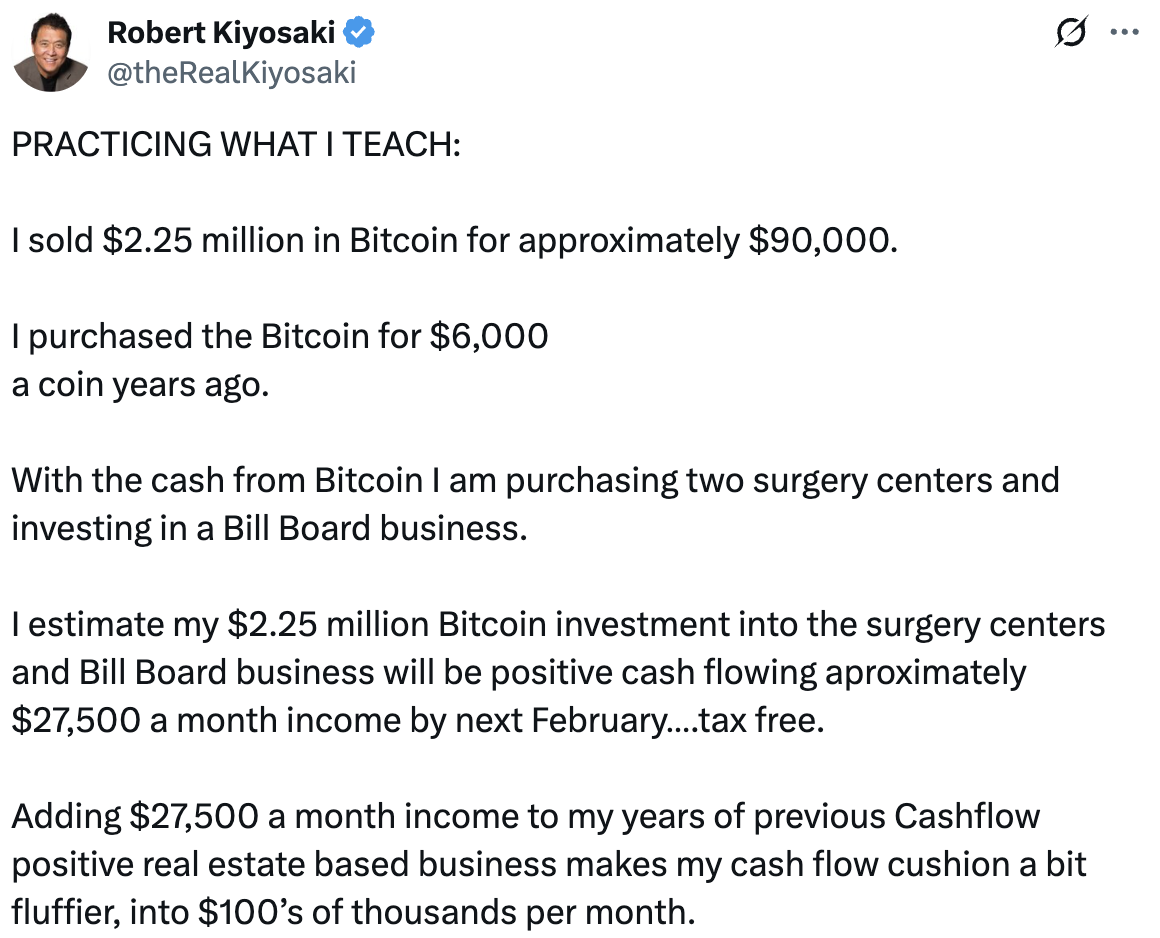
In a post on X titled “PRACTICING WHAT I TEACH,” Kiyosaki explained that he originally bought the coins for $6,000 each and is now rotating those profits into two surgery centers and a billboard business.
PRACTICING WHAT I TEACH:
I sold $2.25 million in Bitcoin for approximately $90,000.
I purchased the Bitcoin for $6,000 a coin years ago.
With the cash from Bitcoin I am purchasing two surgery centers and investing in a Bill Board business.
“With the cash from Bitcoin I am purchasing two surgery centers and investing in a billboard business,” he wrote.
“I estimate my $2.25 million Bitcoin investment into the surgery centers and billboard business will be positive cash flowing approximately $27,500 a month income by next February… tax free.”
Kiyosaki emphasized that his approach aligns with the wealth principles he’s preached for decades, building cash-flowing assets rather than depending solely on capital appreciation.
“I am still very bullish and optimistic on Bitcoin and will begin acquiring more with my positive cash flow,” he said. “This has been my ‘get rich plan’ since I began playing Monopoly with my Rich Dad for over 65 years.”
Kiyosaki’s Wealth Philosophy in Action
The move is consistent with Kiyosaki’s long-standing message: use profitable assets to acquire income-producing investments that create financial freedom. He noted that adding $27,500 per month in new cash flow boosts his total real-estate-based income “into the hundreds of thousands per month.”
He also reflected on criticism of his transparency in revealing the Bitcoin sale:
“I was advised against posting my Bitcoin liquidation and acquisition of real estate. You may know why I was advised against being transparent – too many sickos out there. Yet in a world of ‘fake money’ and ‘fake teachers,’ I thought it best you know I practice what I teach.”
Robert Kiyosaki announced his Bitcoin sale. | Credit: Robert Kiyosaki X profile
Ending his post, Kiyosaki turned the message back on his audience:
“I am not saying my plan should be your plan. Warren Buffett has his plan. Donald Trump has his plan. What is your get-rich plan?”
Kiyosak’s Journey From Bitcoin Bull to Strategic Seller
Kiyosaki’s sale comes after years of publicly championing Bitcoin as protection against “fake money” and failing government debt management.
His decision to sell a portion near $90,000, while pledging to buy again with new business income, illustrates a disciplined approach rather than a shift in belief. Analysts say it reflects a “cash flow first, speculation second” mentality that many long-term investors are beginning to adopt.
A Brief History of Kiyosaki’s Bitcoin Journey
Kiyosaki’s relationship with Bitcoin has been both vocal and volatile.
2020–2021: Publicly endorsed Bitcoin as “people’s money,” calling it a hedge against government spending and inflation.
2022: Predicted Bitcoin could fall as low as $11,000 before a major rebound; continued to “buy the dip.”
2023: Forecasted BTC at $120,000 by 2024 and $500,000 by 2025, urging followers to accumulate regardless of short-term volatility.
2024: Announced a goal to own 100 BTC, citing distrust in fiat currencies and traditional banking.
2025: Executes a partial sale near $90K but maintains a long-term target of $1 million per BTC by 2030.
Q: Why do I say buy, gold, silver&Bitcoin? A: Because I do not trust the Fed, Treasury, or Wall Street. Game of $ rigged in their favor. Gold, silver, Bitcoin are outside their control. As Fed prints trillions in Fake $ Gold, Silver& Bitcoin become harder, stronger, more real.
His messaging has consistently centered around distrust of fiat systems, belief in hard assets (gold, silver, Bitcoin), and a focus on cash flow over capital gains.
Different Perspectives on Bitcoin Investment
Kiyosaki’s transparency has sparked wide discussion across the crypto community. Many argued it contradicts the “HODL forever” ethos that many long-term Bitcoin believers uphold.
Market commentators remain divided on what comes next:
Arthur Hayes, co-founder of BitMEX, still projects Bitcoin could reach $250,000 in 2025, describing the cycle as liquidity-driven.
Michael Saylor continues to hold through Strategy’s treasury strategy, reiterating his “never sell” position.
Not everyone viewed Kiyosaki’s sale favorably. Author and investor Ricardo Celini criticized the decision on X, writing that selling “the most asymmetric asset on Earth to buy billboards and surgery centers” is akin to “swapping a rocket ship for a rental car because the radio sounded nice.” Celini argued that true wealth comes from concentrated ownership of high-upside assets, not reallocating into lower-growth ventures.
Selling the most asymmetric asset on Earth to buy billboards and surgery centers⁉️
My book has a whole chapter on this: don’t trim your flowers to water the weeds. 
Turning $2.25M of monster-grade upside into $27.5k a month is basically the financial equivalent of swapping a… pic.twitter.com/we2wG9DV83
Earlier this month, Robert Kiyosaki made headlines for predicting a major financial crash, saying he was buying gold “aggressively” as a hedge against what he described as government mismanagement. He forecasted that gold could reach $27,000 and Bitcoin could climb to $250,000 by 2026.
Robert Kiyosaki Predicts Financial Crash, Reveals Bold Targets for Gold and $BTC
– Robert Kiyosaki warns of an imminent crash, buying gold aggressively
– Gold to hit $27,000, Bitcoin $250,000 by 2026, predicts Kiyosaki
Kiyosaki blamed the U.S. Treasury and Federal Reserve, accusing them of “breaking money laws” and destabilizing the global economy. His warning reflected his long-standing distrust of fiat systems and his belief that hard assets like gold, silver, and Bitcoin remain the best protection against systemic collapse.
Still, for many observers, Kiyosaki’s ‘sell’ move reflects a different kind of conviction, one rooted in the Rich Dad philosophy of turning gains into productive, income-generating assets. His sale appears less a change of belief and more a continuation of his long-term approach: using asset cycles strategically to build durable, compounding wealth.
From HODL to Cash Flow: What Kiyosaki’s Bitcoin Move Really Means
Robert Kiyosaki’s recent Bitcoin sale isn’t just market news, it’s a financial lesson in action.
His move shows that wealth building isn’t only about catching the next crypto rally; it’s about turning volatile gains into steady cash flow.
Most crypto investors focus on price – buy low, sell high. Kiyosaki focuses on flow – taking profits from appreciating assets and converting them into income-producing investments. That’s the essence of his “Rich Dad” philosophy: make your money work for you, not the other way around.
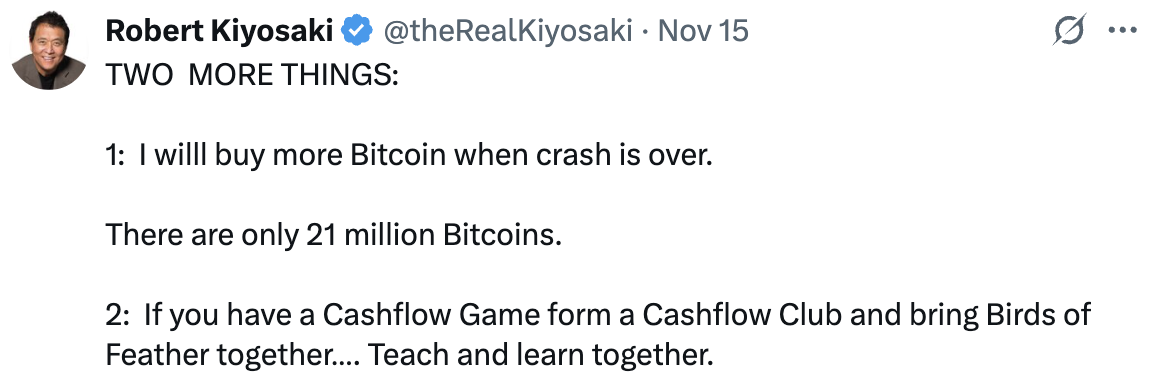
Kiyosaki said he’s buying BTC when the crash is over. | Credit: Robert Kiyosaki X profile
For readers, the takeaway is simple but powerful:
Take profits with purpose. Selling doesn’t mean losing faith, it means freeing capital to grow elsewhere.
Diversify across asset types. Real-world businesses or real estate can generate income even when crypto markets cool.
Think in cash flow, not just price charts. The ultimate goal isn’t owning volatile assets, it’s owning assets that pay you.
In a world chasing quick wins, Kiyosaki’s Bitcoin trade is a reminder that the smartest investors play the long game, one cash-flowing move at a time.
Will Kiyosaki’s Sale Impact Bitcoin’s Price?
Robert Kiyosaki’s announcement that he sold about $2.25 million worth of Bitcoin at roughly $90,000 per coin came as BTC briefly dipped into the $80,000 range amid broader market volatility.
While the timing of his post drew attention, analysts agree the sale itself was too small to move Bitcoin’s $1.8 trillion market significantly. The pullback reflected wider profit-taking and macro pressure rather than one investor’s decision.
However, Kiyosaki’s sale carried psychological weight, as one of Bitcoin’s most vocal advocates chose to lock in profits while remaining bullish.
His message, converting gains into income-generating assets and planning to buy back with cash flow, underscored a maturing investor mindset rather than any loss of faith in Bitcoin’s long-term potential.
Should You HODL or Take Profits on Your Bitcoin?
Kiyosaki’s move naturally raises a common question among investors: Should you hold your Bitcoin forever, or take profits along the way?
The honest answer depends on your goals, time horizon, and tolerance for volatility.
For many long-term holders, Bitcoin represents a store of value, a hedge against inflation and fiat currency risks. Selling too early can mean missing potential upside, especially if you believe in Bitcoin’s decade-long growth trajectory.
On the other hand, seasoned investors, including Kiyosaki, remind us that taking profits isn’t weakness, it’s strategy. Locking in gains can provide liquidity to diversify, reduce risk, or, as Kiyosaki demonstrated, invest in assets that generate steady income.
A balanced approach might look like this:
Keep a core Bitcoin position for long-term conviction.
Take profits incrementally during strength, not panic.
Reinvest proceeds into cash-flowing or stable assets to sustain your portfolio through downturns.
In essence, whether you choose to HODL or sell, the goal should remain the same – build lasting financial independence, not just temporary gains. Kiyosaki’s example shows that even the most committed Bitcoin believers can manage risk while staying true to their vision.
Why did Robert Kiyosaki sell his Bitcoin holdings?
Robert Kiyosaki said he sold about $2.25 million worth of Bitcoin, originally purchased at $6,000 each, to reinvest in income-generating businesses such as two surgery centers and a billboard company. He emphasized that the move aligns with his “Rich Dad” philosophy of converting profits into cash flow, not speculation.
Did Robert Kiyosaki lose faith in Bitcoin?
No. Kiyosaki remains bullish on Bitcoin’s long-term potential. He described the sale as a strategic rotation rather than an exit, stating that he plans to use new business income to buy more Bitcoin in the future.
Did Kiyosaki’s sale affect Bitcoin’s price?
Analysts say the sale was too small to move the market directly. Bitcoin’s brief dip into the $80,000 range occurred during broader market volatility, not solely because of his transaction.
What does Kiyosaki’s move mean for everyday investors?
His sale demonstrates that taking profits doesn’t equal abandoning conviction. It shows how investors can use gains to build diversified income streams while maintaining a long-term belief in Bitcoin’s growth story.
Disclaimer:
The information provided in this article is for informational purposes only. It is not intended to be, nor should it be construed as, financial advice. We do not make any warranties regarding the completeness, reliability, or accuracy of this information. All investments involve risk, and past performance does not guarantee future results. We recommend consulting a financial advisor before making any investment decisions.
Giuseppe Ciccomascolo began his career as an investigative journalist in Italy, where he contributed to both local and national newspapers, focusing on various financial sectors.
Upon relocating to London, he worked as an analyst for Fitch's CapitalStructure and later as a Senior Reporter for Alliance News. In 2017, Giuseppe transitioned to covering cryptocurrency-related news, producing documentaries and articles on Bitcoin and other emerging digital currencies. He also played a pivotal role in establishing the academy for a cryptocurrency exchange website. Crypto remained his primary area of interest throughout his tenure as a writer for ThirdFloor.


 Easy
Easy