Vitalik Buterin Warns 20% Quantum Risk by 2030 — Are Bitcoin and Ethereum Truly in Danger?
Share
Key Takeaways
Vitalik Buterin warns there is a 20% chance that quantum computers capable of breaking modern cryptography could emerge before 2030.
Even though current quantum machines cannot threaten Bitcoin or Ethereum today, ECDSA would be vulnerable once powerful quantum hardware appears.
Nick Szabo views quantum risk as eventually inevitable but believes legal and governance threats pose more immediate dangers.
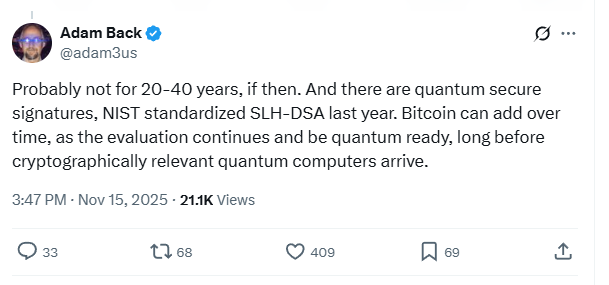
Adam Back argues the quantum threat is decades away, urging steady research rather than rushed or disruptive protocol changes.
In late August 2025, Vitalik Buterin did something unusual for a crypto founder: he put a number on a fear that usually lives in vague terms.
In public comments that were widely picked up by crypto and tech outlets, he said there is “about a 20% chance” that quantum computers capable of breaking today’s cryptography could arrive before 2030, citing forecasts from the prediction platform Metaculus. According to those same forecasts, the median expectation for such “Q-day” capabilities is around 2040.
In other words:
2040 is the most likely rough timeframe.
But there’s a one-in-five chance the danger arrives a full decade earlier.
That is the line Vitalik drew in the sand. He wasn’t claiming quantum computers exist today in any practical, crypto-breaking sense. He wasn’t predicting doom as a certainty. Instead, he was saying:
“The quantum threat is no longer just distant science fiction. It is a quantifiable near-term risk, and that’s enough reason to start preparing now.”
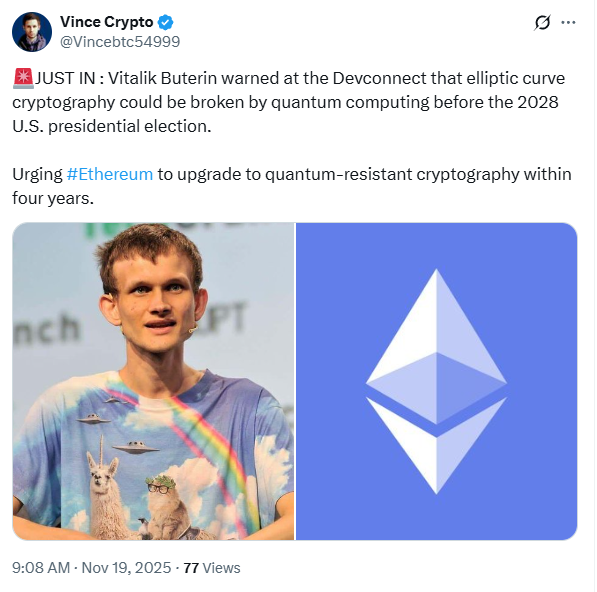
A few months later, at Devconnect in Buenos Aires in November 2025, he returned to the theme. In a talk that was mostly about Ethereum “ossifying” its base layer, he closed with a warning: future quantum computers could break elliptic-curve cryptography, and he urged the community to move Ethereum onto quantum-resistant foundations within a few years, even framing the risk in terms of the 2028 U.S. election as a visible milestone on the horizon.
Vitalik Buterin Warns 20% Quantum Risk by 2030. | Source: @Vincebtc54999 on X
So the 20% by 2030 number comes from his August 2025 public comments referencing Metaculus, and the “we need to move within four years” urgency shows up again at Devconnect Buenos Aires.
Why Quantum Matters for Bitcoin and Ethereum
Bitcoin and Ethereum rely on elliptic-curve cryptography, specifically ECDSA over the secp256k1 curve, to secure private keys and validate transactions. Today, this system is essentially unbreakable using classical computers.
Quantum computers, however, introduce a different paradigm. A sufficiently advanced machine running Shor’s algorithm could calculate private keys from public keys, breaking the fundamental assumption that only the private-key holder can authorize transactions.
The consequences of such a breakthrough would be severe:
Attackers could forge signatures and steal funds.
Anyone who has ever exposed a public key on-chain would be vulnerable.
Entire chains could see unprecedented chaos as old security assumptions collapse.
There are important nuances, though:
Not all coins are equally exposed.
On Bitcoin, coins tied to public keys directly visible on-chain, such as early outputs or reused addresses, would be the first targets.
On Ethereum, any account that has ever sent a transaction has already revealed its public key.
The threat is not immediate. Today’s quantum computers are far too small, fragile, and error-prone. Breaking real-world ECDSA likely requires millions of stable, error-corrected qubits, a scale far beyond current technology.
Quantum-resistant cryptography already exists. Standardized post-quantum algorithms, including lattice-based and hash-based signature schemes, are available today. They can be incorporated into future versions of Bitcoin and Ethereum.
Vitalik Buterin’s Key Quantum Warnings Explained
Vitalik Buterin’s comments on quantum computing weren’t meant to spark panic, they were meant to create clarity. His message centered on a few critical points that highlight why the industry must treat quantum readiness as a strategic priority, not a distant theoretical exercise.
Buterin made it clear that no current quantum computer can break Bitcoin, Ethereum, or any major cryptographic system today. The hardware is still far too limited, noisy, and small-scale to threaten real-world cryptography.
His central claim is that there’s a non-negligible probability, roughly one in five, that quantum-capable machines arrive before 2030, far earlier than most industry participants assume.
He also admitted that unlike traditional software, which can be upgraded quickly and quietly, blockchains require global consensus, careful migration, and long testing cycles. Because of this slow upgrade process, Buterin argues the industry must begin adopting post-quantum cryptography (PQC) well before quantum attacks become practical.
This is why Ethereum’s long-term roadmap, particularly the phase dubbed “The Splurge”, includes building an ecosystem that can operate securely in a post-quantum world.
Nick Szabo’s View on the Quantum Threat: An Eventual Risk Overshadowed by More Urgent Dangers
Nick Szabo’s position is often mischaracterized as “the opposite” of Vitalik’s, but that’s not quite right. Szabo does not dismiss quantum risk. Instead, he frames the issue within a much longer time horizon and places greater emphasis on non-quantum threats facing Bitcoin today.
Szabo on Quantum and Long-Term Vulnerability
In conversations about long-term cryptographic risk, often brought up in the context of Satoshi’s early coins, Szabo has acknowledged that eventually, whether through quantum computing or other breakthroughs, someone may be able to break the encryption protecting those early outputs. This is effectively an admission that modern cryptography is not eternal.
What he does not do is assign a specific probability or timeline. Unlike Vitalik, who explicitly mentions “20% by 2030,” Szabo treats quantum as an inevitable endgame rather than a near-term crisis.
“Fly in Amber” and Bitcoin’s Time-Hardened Security
Szabo is famous for his analogy describing a Bitcoin transaction as a fly trapped in amber, the more blocks that accumulate around it, the harder it becomes to dislodge. Applied to quantum concerns, this metaphor highlights his view that Bitcoin’s security strengthens over time, and that deeply buried history is extraordinarily difficult to unwind even in the presence of powerful adversaries.
Immediate Threats: Legal and Governance Attack Surfaces
More recently, Szabo has spent far more time emphasizing legal, social, and governance threats:
He argues that cryptocurrencies are “trust-minimized,” not perfectly trustless, because they operate within real-world legal systems.
He sees network-level centralization and institutional capture as more pressing risks than hypothetical quantum timelines.
Nick Szabo warns Bitcoin is not safe from legal pressure. | Source: @NickSzabo4 on X.
For Szabo, quantum is a real but distant threat, whereas law and governance are the risks already shaping crypto today.
Adam Back’s Take on Quantum Computing and Bitcoin: Long Runway, No Need to Panic
Adam Back, CEO of Blockstream and one of the original cypherpunks, offers the clearest counterbalance to Vitalik’s urgency. His stance is straightforward:
Claims that quantum computers could break Bitcoin in the near term are, in his view, overhyped.
Quantum is not an immediate threat to Bitcoin, per Adam Back. | Source: @adam3us on X.
Hardware Reality Check
Back emphasizes the enormous gap between today’s quantum machines and the theoretical “cryptographically relevant” quantum computer that would be needed to break ECDSA or SHA-256. The machines currently built are noisy, low-qubit prototypes, while a real threat would require thousands to millions of error-corrected qubits.
From his perspective, this gap represents decades of breathing room.
PQC Exists and Bitcoin Can Upgrade
Back frequently points out that standardized post-quantum signature schemes already exist. If and when the threat becomes more concrete, Bitcoin can adopt these through soft forks or, if necessary, a hard fork.
In his framing, Bitcoin is not painted into a corner. It can evolve safely, deliberately, and without panic.
Concern for Exposed Early Coins
Back does acknowledge one specific vulnerability: early Bitcoin outputs, especially those linked to Satoshi, have exposed public keys and would be prime targets in a future quantum era. But he frames this as a practical operational issue that will be addressed when the time is right, not a current existential threat.
Viewpoints on quantum threat
Core view
Timing outlook
Main concern
Recommended approach
Vitalik Buterin: The Tail-Risk Planner
Quantum threat is real enough to plan for now
20% chance by 2030; median around 2040
Early-arrival quantum shock breaking ECDSA
Begin integrating post-quantum cryptography into Ethereum’s roadmap today
Nick Szabo: The Long-View Realist
Cryptography will eventually be broken
Eventual, long-term inevitability
Legal, governance, and institutional attack surfaces
Harden systemic resilience; treat quantum as a future certainty, not an immediate crisis
Adam Back: The Runway Optimist
Quantum threat is real but distant
20–40+ years away; current forecasts overstated
Overreaction causing unnecessary or risky protocol changes
Steady research; adopt PQC when the threat is clearer, not prematurely
Are Bitcoin and Ethereum Truly in Danger Before 2030?
Today? No.
There is no evidence that any existing quantum computer can break ECDSA or compromise Bitcoin or Ethereum’s core security.
Long-term? Yes, if they fail to evolve.
All three thinkers ultimately agree on foundational points:
Modern cryptography will not last forever.
Bitcoin and Ethereum must eventually transition to quantum-resistant schemes.
Where they differ is when the industry should act:
To Vitalik, delaying preparation is reckless given the tail-risk of early breakthroughs.
To Szabo, quantum is real but overshadowed by more imminent political and governance threats.
To Back, the technology is too far away to worry about urgently, and Bitcoin has decades to prepare safely.
The balanced take is:
Bitcoin and Ethereum are not doomed, but their longevity depends on planning for a world where quantum computing is real.
Vitalik’s 20% estimate is not a prophecy, it is a call to avoid complacency. If these networks are meant to endure for generations, they must be engineered for the technological landscape of the future, not just the present.
Is Bitcoin or Ethereum at immediate risk from quantum computers?
No. Today’s quantum computers are far too small and unstable to break ECDSA, the core cryptography behind Bitcoin and Ethereum. The threat is long-term, not present-day.
Why is Vitalik Buterin pushing for early preparation if the threat isn’t imminent?
Vitalik argues that upgrading a global blockchain takes years, not months. Because migration to post-quantum cryptography is complex and high-stakes, he believes preparation must begin before quantum computers become capable.
Why does Nick Szabo downplay quantum compared to Vitalik?
Szabo doesn’t dismiss quantum; he simply believes legal, governance, and institutional threats are more urgent. In his view, governments and centralized chokepoints are already shaping crypto’s security landscape – long before quantum becomes practical.
Could Bitcoin and Ethereum upgrade to quantum-resistant cryptography when needed?
Yes. Both chains can adopt post-quantum signature schemes through upgrades. Ethereum’s roadmap already includes this direction, while Bitcoin can implement PQC via soft forks or hard forks when the threat becomes clearer.
Disclaimer:
The information provided in this article is for informational purposes only. It is not intended to be, nor should it be construed as, financial advice. We do not make any warranties regarding the completeness, reliability, or accuracy of this information. All investments involve risk, and past performance does not guarantee future results. We recommend consulting a financial advisor before making any investment decisions.
Onkar Singh has three years of experience as a digital finance content creator. Throughout his career, he has collaborated with various DeFi projects and crypto media outlets. In his leisure time, he enjoys fitness activities at the gym and watching movies across different genres. Balancing his professional and personal interests, Onkar continues to contribute to the digital finance landscape while pursuing his hobbies.


 Easy
Easy