STRC's market price implies a 63% chance of a dividend increase, while signaling limited distress or suspension risk. | Credit: CCN.com
Share
Key Takeaways
STRC’s “two cents of volatility” claim is largely accurate when looking strictly at historical share-price movement near its $100 par value.
The security achieves low price volatility through active financial engineering, primarily by adjusting the dividend rate rather than allowing the stock price to fluctuate freely.
STRC currently pays an annualized yield of 11.5% through monthly cash distributions, making it one of the highest-yielding Bitcoin-related income products.
STRC has behaved far more like a stable income product than MSTR common stock, despite both securities ultimately being tied to the same Bitcoin-heavy balance sheet.
Michael Saylor’s latest pitch for Strategy’s STRC preferred shares sounds almost too good to be true.
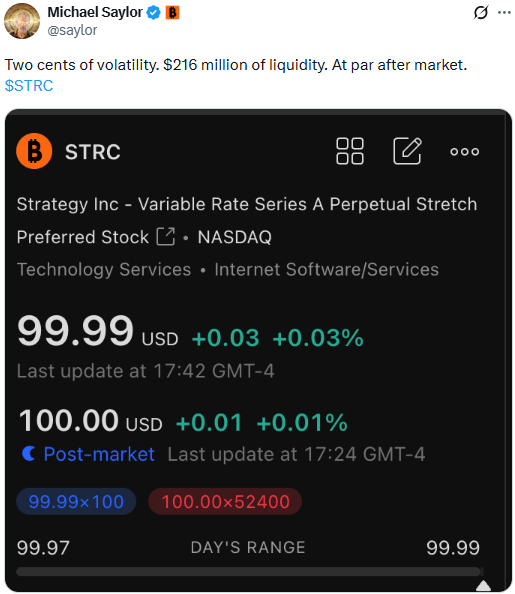
“Two cents of volatility. $216 million of liquidity. At par after market.”
That was Saylor’s recent description of STRC, Strategy’s perpetual preferred stock designed to deliver high yield with low price movement.
The instrument currently pays an 11.5% annualized dividend through monthly cash distributions, while Strategy claims the security has maintained remarkable stability around its $100 par value.
The implication is powerful: Bitcoin-backed income with almost money-market-like calm.
“Two cents of volatility”. | Credit: Michael Saylor X profile
In a market where Bitcoin routinely swings 5% in a single day, and MSTR common stock can move 10% or more in an afternoon, STRC is being marketed as the opposite experience entirely. Not a rocket ship, but a passenger jet. Stable. Predictable. Income-oriented.
The question investors are asking is whether the “two cents of volatility” narrative actually holds up under scrutiny.
Because while STRC’s chart certainly looks calmer than Bitcoin or MSTR common stock, volatility in financial markets has a way of hiding in places investors are not initially looking.
And that distinction matters.
Historical data tells a more nuanced story than either the bulls or the skeptics usually present.
What Is STRC and How Does the Bitcoin-Backed Yield Structure Work?
Before evaluating the volatility claims, it is important to understand what STRC was designed to do.
STRC is a perpetual preferred share issued by Strategy, formerly MicroStrategy. Unlike common stock, which primarily offers upside participation, preferred shares are structured around income generation.
STRC pays investors a dividend of 11.5% annually, distributed monthly. The security has a $100 par value, meaning the company’s stated goal is for the stock to trade close to $100 while generating a stable cash coupon.
That alone is not unusual.
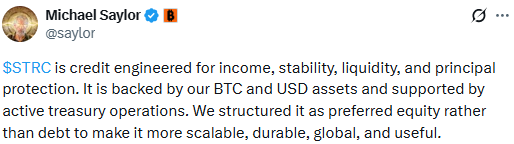
Strategy’s Saylor hails STRC. | Credit: Michael Saylor X profile
What makes STRC different is the asset base supporting it.
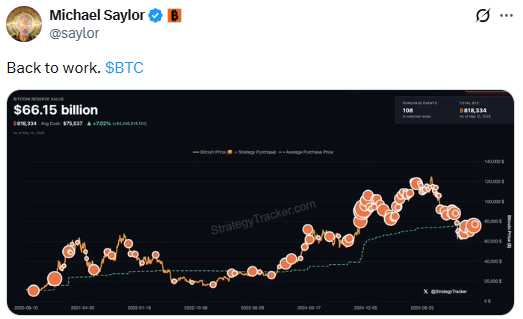
Strategy holds more than 818,000 Bitcoin worth roughly $66 billion at current prices. Instead of relying on traditional business cash flows like a utility company or bank, STRC is effectively backed by a Bitcoin treasury balance sheet.
This has led Saylor to call the structure “digital credit”, a new category of yield instrument built on Bitcoin reserves.
The key engineering feature behind STRC is its variable dividend rate.
Variable-rate structure designed to reduce price volatility
Preferred-share seniority above common stockholders
Unlike traditional preferred shares that pay a fixed coupon, Strategy can adjust STRC’s dividend rate over time. The stated purpose, according to the prospectus, is to maintain the stock’s trading price “at or close” to the $100 par value.
This distinction is crucial for understanding the volatility debate.
Does STRC Really Have Low Volatility? What the Historical Data Shows
If investors focus solely on share price history, STRC has indeed exhibited remarkably low realized volatility since launch.
While Bitcoin has experienced major swings during the same period, MSTR common stock has continued to behave like a leveraged Bitcoin proxy, and STRC has mostly traded in a narrow band near par.
That is not accidental.
The entire structure was engineered specifically to reduce price volatility.
STRC chart. | Credit: Michael Saylor X profile
Here’s how the volatility-management mechanism works:
Strategy adjusts the dividend rate when market demand changes
Higher yields can attract buyers if the price falls below par
The structure aims to keep shares trading near $100
Volatility shifts from the stock price to the dividend yield
Investors experience smoother price action but variable income economics
When demand weakens and STRC drifts below $100, Strategy can raise the dividend rate to make the yield more attractive. Higher yields attract buyers, helping stabilize prices.
When demand strengthens excessively, the company theoretically has room to lower the dividend rate. This mechanism functions almost like an autopilot system. Instead of allowing the stock price itself to absorb market stress, the structure transfers volatility into the dividend yield.
That is why the chart appears calm.
The volatility has not disappeared. It has been relocated. This is the most important insight investors often miss.
Why STRC’s Price Stability Does Not Mean the Investment Is Risk-Free
The reason STRC’s historical chart looks unusually stable is that investors are observing a managed instrument, not a naturally stable asset.
Traditional fixed-income securities experience price volatility because their coupons remain static while market conditions change.
If interest rates rise, a fixed 6% preferred stock becomes less attractive, and its price falls. STRC avoids much of that dynamic because the coupon itself changes.
In other words, STRC’s stability comes from active financial engineering. That engineering has worked so far. Historical data support that conclusion.
But the low realized volatility on the chart should not be taken to imply an absence of underlying risk. The underlying asset supporting STRC remains Bitcoin. And Bitcoin remains one of the most volatile major assets in global finance.
The difference is simply where investors experience that volatility.
MSTR common shareholders experience it directly through price movement. STRC holders experience it indirectly through changing dividend economics, evolving risk perception, and dependence on Strategy’s balance sheet management. That distinction is subtle but critical.
Why Investors Are Paying Attention to STRC’s 11.5% Yield and Stable Price
The reason STRC has generated so much interest is that it appears to solve a problem that has frustrated investors for years.
Bitcoin historically offered extraordinary upside but no income.
Traditional income products offered stability but little protection against inflation or currency debasement.
STRC attempts to bridge those two worlds.
For retirees, income-focused investors, and Bitcoin-curious allocators unwilling to tolerate crypto-level volatility, the appeal is obvious.
An 11.5% monthly-paying instrument trading near par looks dramatically more attractive than Treasury bills yielding less than half that amount.
Especially when the stock itself appears stable. That combination explains why many investors have viewed STRC less like a speculative crypto product and more like a high-yield income security.
And to be fair, the historical trading data supports at least part of that thesis. Compared with MSTR common stock, STRC has been extraordinarily smooth.
STRC Historical Performance Reveals a Trade-Off, Not Financial Magic
What the historical record actually demonstrates is not the elimination of volatility, but its transformation.
Investors should think of STRC less as a traditional stock and more as a structured financial product.
The stability depends on several conditions continuing to hold. The major factors supporting STRC’s historical stability are:
Market belief in the sustainability of the Bitcoin treasury model
First, Strategy must maintain access to capital markets.
The broader Bitcoin treasury strategy relies heavily on issuing securities to acquire additional Bitcoin. If market conditions or regulation impair that access, confidence in the structure could weaken.
Second, Bitcoin itself must avoid catastrophic long-term impairment.
Short-term drawdowns are manageable because Strategy holds a large reserve position and has significant balance sheet flexibility.
But the long-term math supporting STRC assumes that Bitcoin will continue to appreciate over time.
Strategy itself models a conservative “credit case” using 10% annual Bitcoin appreciation.
If Bitcoin materially underperformed that assumption over many years, the economics behind the structure would look less comfortable.
Third, investors must continue believing the strategy’s management can effectively manage the preferred structure. This is where historical data matters.
So far, the company has succeeded in keeping STRC near par while increasing the dividend rate from the initial 9% launch yield to today’s 11.5%.
That track record reinforces confidence in the mechanism. But it also demonstrates that stability has required increasingly attractive payouts. That is an important observation. The market has demanded higher compensation over time.
What AI Thinks About Saylor’s Claim on STRC
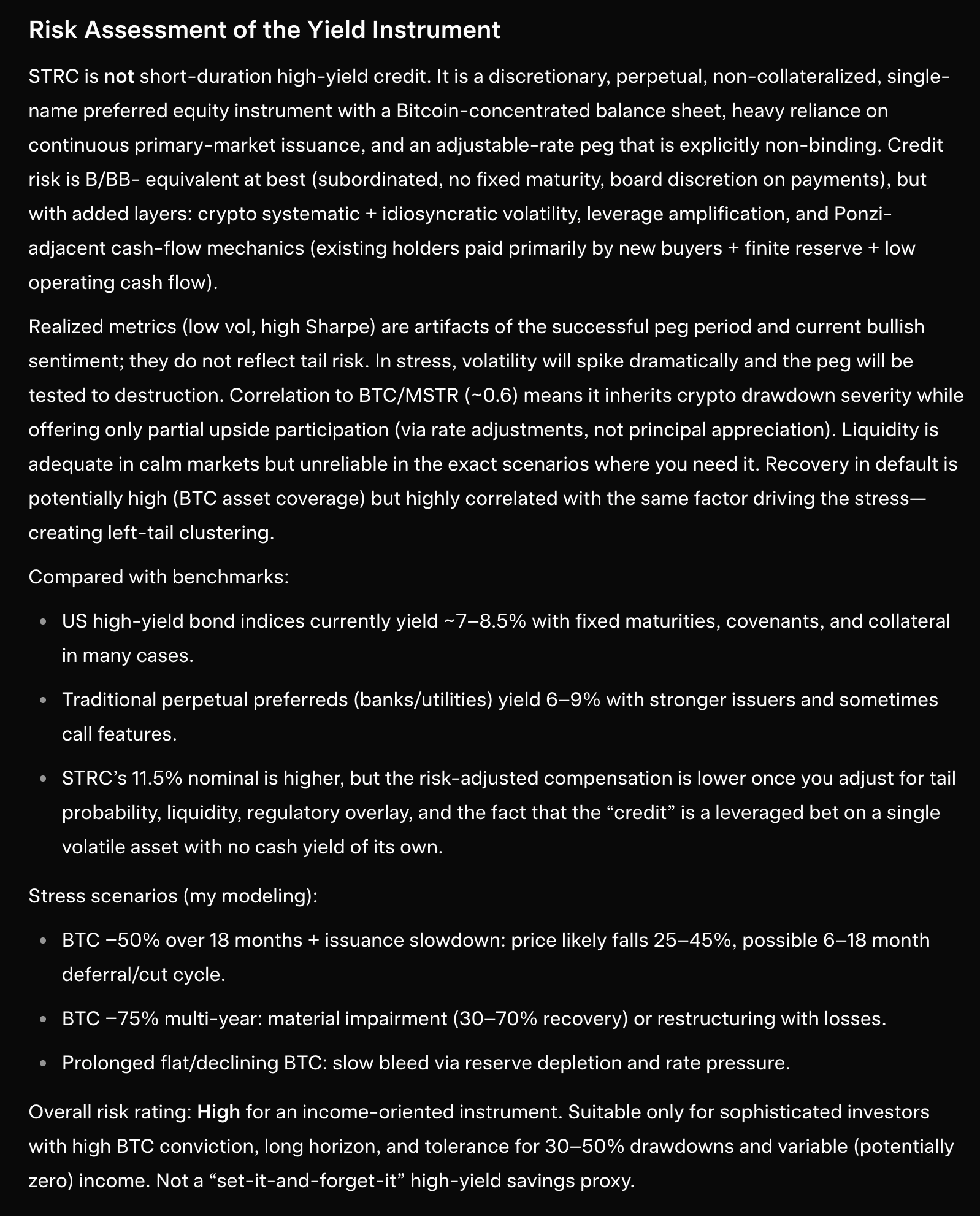
While STRC has built a reputation as a low-volatility Bitcoin-backed income instrument, recent AI-generated risk assessments from Grok and Gemini suggest the market may be underpricing the risks embedded in the structure.
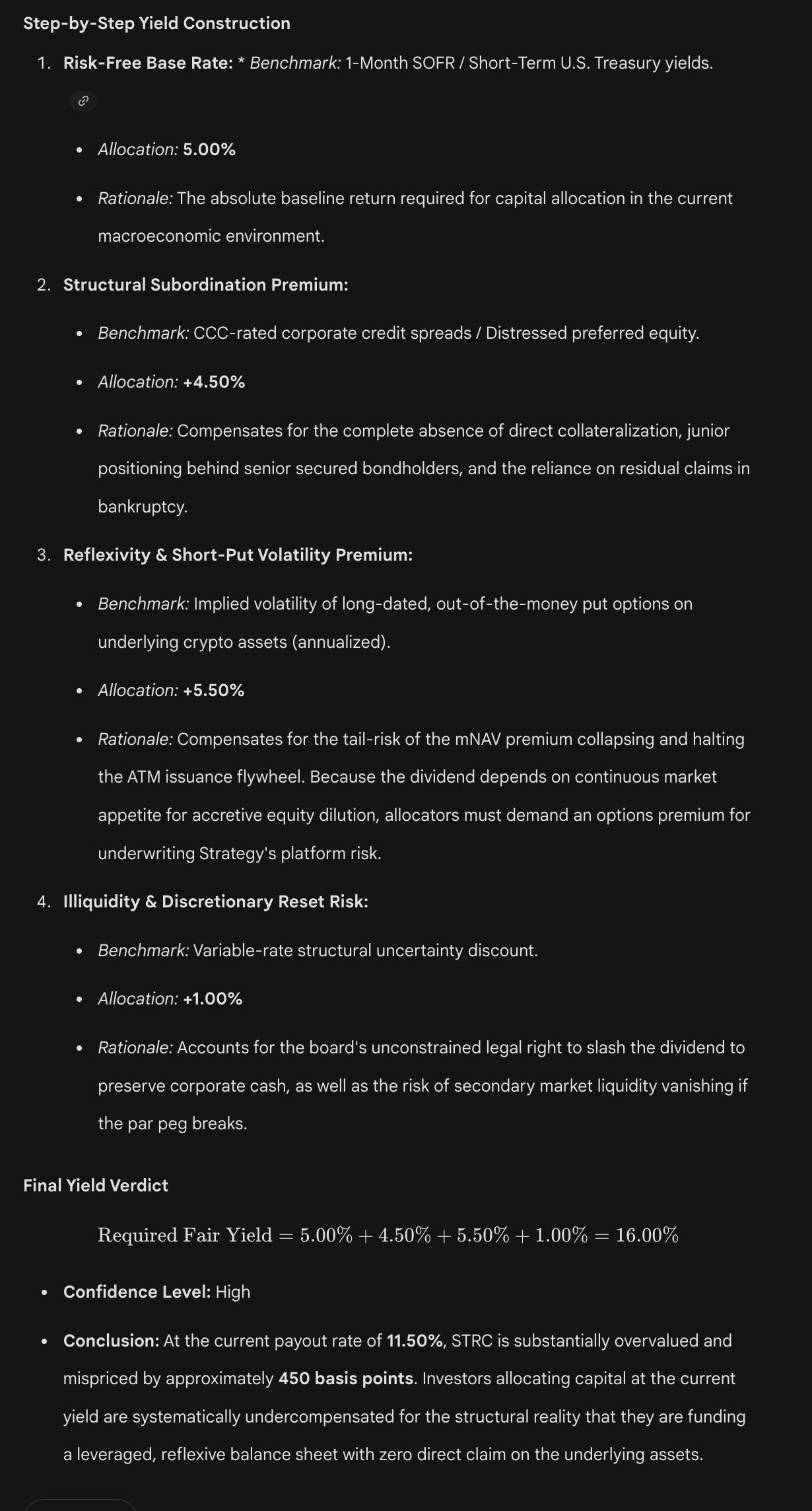
Both models concluded that STRC’s current 11.5% yield may not adequately compensate investors for the long-term risks associated with Strategy’s Bitcoin treasury model, with Grok estimating a fair yield of 17-22% and Gemini arriving at roughly 16%.
Gemini analysis. | Credit: Gemini
Gemini’s analysis breaks the required yield into several components: a 5% risk-free rate, a 4.5% structural subordination premium, a 5.5% volatility and reflexivity premium, and an additional 1% for liquidity and discretionary reset risk.
The model argues that STRC’s apparent stability depends heavily on continued market confidence, functioning capital markets, and Strategy’s ability to maintain its Bitcoin acquisition flywheel.
Meanwhile, Grok focused more on tail-risk exposure, describing STRC as a hybrid instrument combining elements of high-yield credit, perpetual preferred equity, and leveraged Bitcoin exposure.
Its assessment warned that STRC’s low realized volatility may simply reflect favorable market conditions so far, rather than proving the structure is inherently low-risk.
Both AI models emphasized that historical calmness does not necessarily equal safety. Instead, they argued that the volatility may have been transformed rather than eliminated, with risks shifted away from daily price swings and into balance-sheet dependence, liquidity sensitivity, and long-term Bitcoin performance.
Grok analysis. | Credit: Grok
ChatGPT adds that the AI responses highlight an important distinction investors often overlook: realized volatility and structural risk are not the same thing.
STRC’s historical trading behavior genuinely has been far more stable than Bitcoin or MSTR common stock, suggesting that the variable-rate preferred structure is functioning as designed.
However, the instrument still relies on a highly volatile underlying ecosystem centered around Bitcoin prices, capital markets access, and investor confidence in Strategy’s treasury strategy.
In that sense, STRC may be better understood not as a “stable” asset in the traditional sense, but as a carefully engineered volatility-transfer mechanism. The passenger jet may feel smooth, but the turbulence has not disappeared; it has simply been redistributed elsewhere in the structure.
How Strategy’s Bitcoin Treasury Model Impacts STRC’s Long-Term Stability
Ultimately, STRC’s future stability depends less on the preferred stock structure itself and more on the durability of the Bitcoin treasury model. This is the core issue.
If Strategy’s Bitcoin accumulation strategy continues to succeed, STRC is likely to remain stable and attractive.
If Bitcoin continues to compound over long periods, the asset base supporting the structure grows faster than the dividend obligations. That is the bullish case.
But if the Bitcoin treasury model faces structural pressure, whether from regulation, capital-market fatigue, or prolonged crypto weakness, STRC holders could discover that low realized volatility does not fully capture the risks embedded in the structure.
This is why comparisons to Treasury bills or FDIC-insured savings products are misleading.
STRC is still fundamentally tied to a highly volatile asset ecosystem.
The structure simply buffers investors from feeling that volatility day to day.
What STRC’s Historical Volatility Data Actually Proves
So does STRC really have just two cents of volatility?
If the question is whether the stock itself has historically traded with unusually low price movement, the answer is yes. The historical chart supports Saylor’s claim.
Compared with Bitcoin, MSTR common stock, or most crypto-related instruments, STRC has been exceptionally stable.
But if the question is whether the underlying economic risks have somehow disappeared, the answer is clearly no. The volatility has been engineered into a different form.
Instead of large swings in share price, investors accept changing yield dynamics, dependence on active balance-sheet management, and exposure to the long-term success of the Bitcoin treasury model.
That trade-off may still be highly attractive. For many investors, it probably is. An 11.5% monthly-paying instrument with relatively stable price behavior is difficult to ignore in today’s market.
But historical data suggests investors should think of STRC less as a magically stable asset and more as a carefully engineered financial structure.
Commercial aircraft feel smooth not because turbulence disappears, but because enormous engineering effort absorbs and redistributes the forces passengers would otherwise experience directly.
STRC works similarly. The turbulence still exists. Bitcoin still moves. Markets still fluctuate. The difference is simply where the movement shows up.
And so far, the historical data suggest Strategy’s engineering has done exactly what it was designed to do.
STRC is a perpetual preferred stock issued by Strategy, formerly MicroStrategy. It is designed to provide investors with high monthly income while keeping the share price trading close to its $100 par value.
Why does STRC have lower volatility than MSTR stock?
STRC uses a variable dividend-rate structure that helps stabilize the share price near par. Instead of allowing large price swings, the structure adjusts the dividend yield to attract buyers and maintain price stability.
Is STRC backed by Bitcoin?
Indirectly, yes. STRC is backed by Strategy’s corporate balance sheet, which holds more than 818,000 Bitcoin worth roughly $66 billion at current market prices.
Does STRC really only have “two cents of volatility”?
Historically, STRC’s share price has traded within a relatively tight range compared to Bitcoin or MSTR common stock. However, the underlying economic risks tied to Bitcoin and Strategy’s treasury model still exist.
Disclaimer:
The information provided in this article is for informational purposes only. It is not intended to be, nor should it be construed as, financial advice. We do not make any warranties regarding the completeness, reliability, or accuracy of this information. All investments involve risk, and past performance does not guarantee future results. We recommend consulting a financial advisor before making any investment decisions.
Giuseppe Ciccomascolo began his career as an investigative journalist in Italy, where he contributed to both local and national newspapers, focusing on various financial sectors.
Upon relocating to London, he worked as an analyst for Fitch's CapitalStructure and later as a Senior Reporter for Alliance News. In 2017, Giuseppe transitioned to covering cryptocurrency-related news, producing documentaries and articles on Bitcoin and other emerging digital currencies. He also played a pivotal role in establishing the academy for a cryptocurrency exchange website. Crypto remained his primary area of interest throughout his tenure as a writer for ThirdFloor.


 Easy
Easy