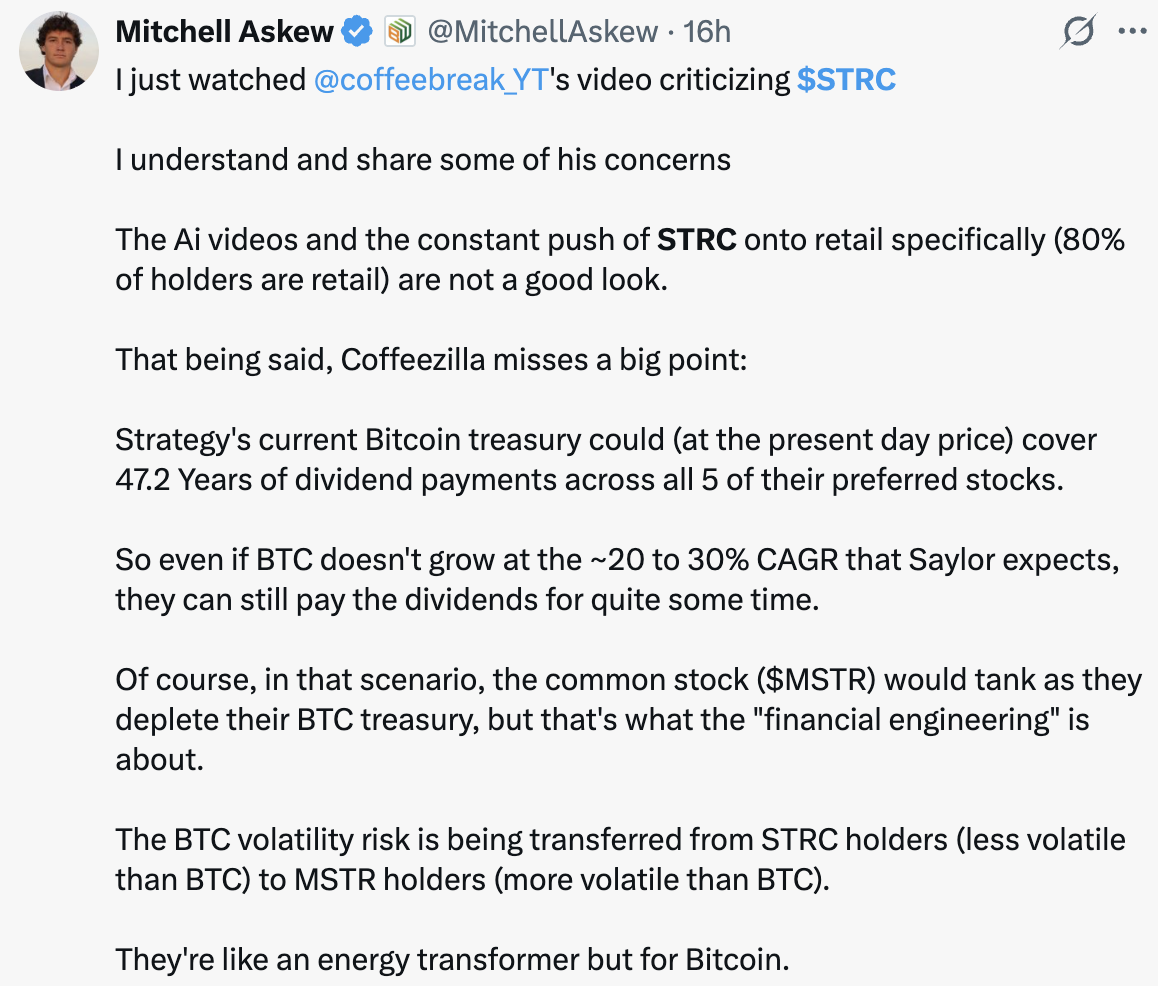
Coffeezilla questions the sustainability of Strategy’s STRC preferred stock, examining its 11.5% yield, structural risks, and reliance on Bitcoin-linked financial engineering. | Source: CCN
Share
Key Takeaways
STRC offers bond-like income but lacks key protections such as maturity and guaranteed principal repayment, making it structurally closer to equity.
Unlike bonds or dividend stocks, STRC’s yield is not backed by stable cash flows, raising questions about its long-term sustainability.
With limited operating cash flow and non-yielding Bitcoin exposure, payouts may depend on capital raising, balance sheet structuring, and market conditions.
STRC’s stability is indirectly tied to Bitcoin’s price, shifting its risk profile from income-based to valuation-based.
The debate surrounding STRC, a high-yield preferred stock issued by Strategy under the leadership of Michael Saylor, has intensified following criticism from Coffeezilla. At the center of the discussion is a fundamental question in finance: does a double-digit yield reflect genuine opportunity, or simply embedded risk?
https://www.youtube.com/watch?v=vS2zr4_PMtQ
This article examines the structure, appeal, and risks of STRC from a neutral, analytical perspective.
STRC Explained: A Hybrid Financial Instrument
STRC is a perpetual preferred stock, a type of security that sits between equity and debt. It offers investors a variable dividend, currently around 11.5% annually, paid in cash, typically on a monthly basis.
In practical terms, investors are not lending money with a fixed repayment schedule: they are buying a subordinate claim on a company’s assets, with income that resembles a bond but legal rights closer to equity,
This is where Coffeezilla’s critique of Michael Saylor’s strategy becomes more pointed and more analytical and raises a fundamental financial question: what is the actual economic source of the yield?
At its core, finance draws a clear distinction between cash-flow-generating assets and non-cash-flow assets. Traditional income investments,, such as bonds, dividend stocks, or rental real estate – derive their yield from predictable, recurring cash flows:
Bonds → funded by issuer earnings or tax revenues
Dividend stocks → funded by corporate profits
Real estate → funded by rental income
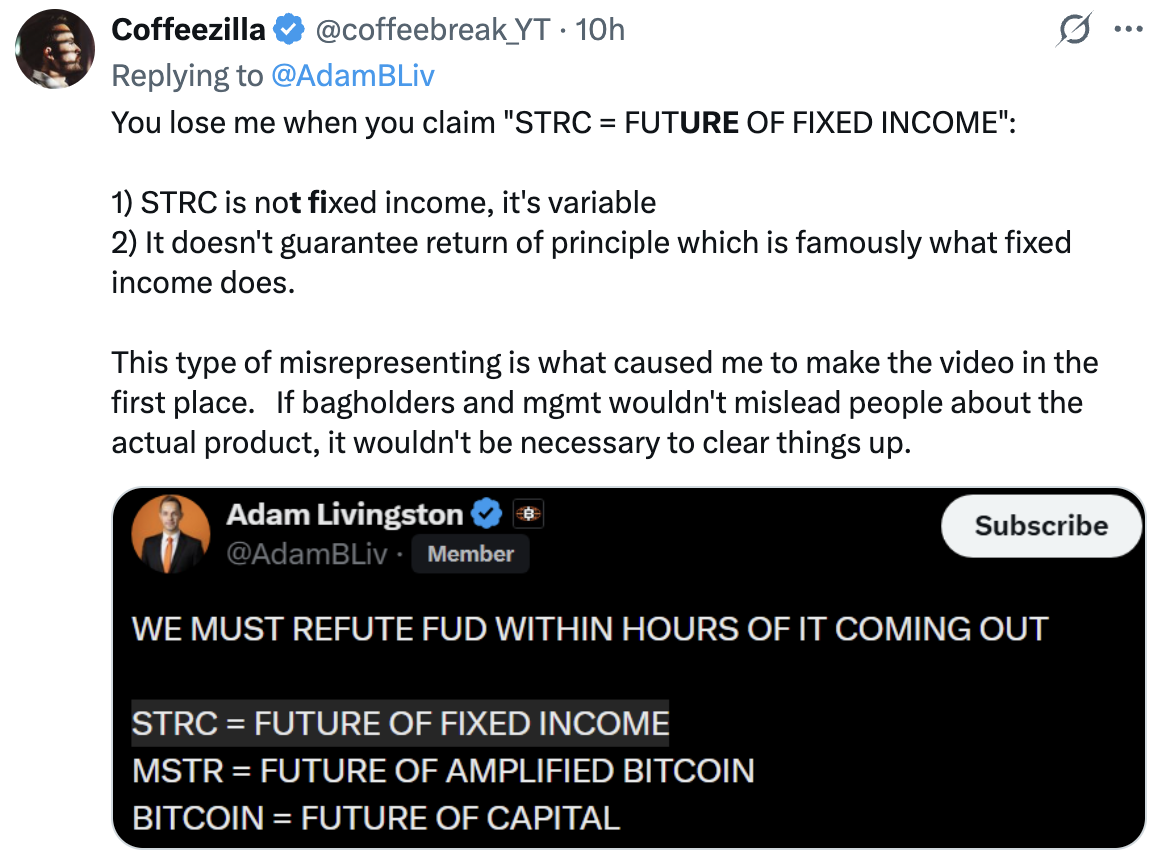
STRC is not fixed income, it’s variable. | Credit: Coffeezilla X profile
In contrast, Bitcoin does not produce cash flow. It is a non-yielding asset, meaning its return profile depends entirely on price appreciation, not income generation.
Similarly, Strategy’s legacy software business contributes limited and relatively stable, but not high-growth, earnings, which are insufficient on their own to support a double-digit yield across a large capital base.
This creates a fundamental financial tension: Yield, by definition, must come from either income, asset appreciation, or capital structure engineering.
If underlying assets do not generate sufficient income, then the yield must be supported through alternative mechanisms:
1. Capital Raising and Financial Recycling
One possibility is that dividends are supported, directly or indirectly, by new capital inflows. This is not inherently problematic, but it introduces refinancing risk:
Sustained payouts depend on continued access to capital markets
If market conditions tighten, this mechanism weakens
This ties into the broader principle of financial sustainability: A yield is only as stable as the system funding it.
2. Balance Sheet Engineering
Strategy’s model relies heavily on active capital structure management:
This reflects a financial engineering approach, where returns are shaped by structuring rather than purely by operating performance. While common in modern finance, it introduces complexity risk – investors must trust both execution and market conditions.
3. Asset Appreciation (Bitcoin Exposure)
A significant implicit assumption is that Bitcoin’s long-term appreciation strengthens the balance sheet:
STRC’s yield appears as income, but its sustainability may depend on total return dynamics, particularly Bitcoin performance.
This mismatch is at the heart of the critique: The instrument presents a high ‘income-like’ yield, but may rely on ‘growth-like’ assumptions.
Structural Risks STRC Investors Must Understand
Understanding the structural risks behind STRC is essential for evaluating its high yield. These risks stem not only from market conditions, but also from its design, capital structure, and reliance on non-traditional sources of financial stability and return generation.
1. No Obligation to Repay Principal (Perpetual Structure)
STRC is a perpetual preferred stock, meaning there is no maturity date and no contractual obligation for Strategy to return investor principal.
This has two important implications:
Investors cannot redeem shares at par ($100) with the issuer
Exit depends entirely on secondary market liquidity and pricing
From a financial perspective, this shifts the investment from a fixed-claim instrument (like a bond) to a market-dependent instrument.
I might have a low IQ and might even be bad at math (even though I earned a PhD in it).
But I understand one or two things about markets. And I want Bitcoin to succeed.
Total preferred stock issuance has reached multi-billion-dollar scale
This scale increases ongoing dividend obligations, which must be managed relative to:
Cash reserves
Market access
Bitcoin valuation
6. Market Pricing and Yield Feedback Loop
STRC is designed to trade near its $100 par value, but this is not guaranteed.
Instead, Strategy uses a dynamic yield mechanism:
If price falls below $100 → dividend is increased
If price rises above $100 → dividend may decrease
This creates a yield–price feedback loop, where:
Yield is used to stabilize price
Price reflects market confidence in sustainability
However, this system depends on investor behavior:
If perceived risk rises sharply, even higher yields may not stabilize price
This introduces convexity risk, where small changes in sentiment can cause disproportionate price moves
7. Limited Operating Cash Flow Support
Despite its scale, Strategy’s core operating business remains relatively small compared to its Bitcoin holdings:
Annual software revenue is modest relative to its tens of billions in Bitcoin exposure
This creates a structural imbalance:
Liabilities (dividends, obligations) are tied to capital raised
Cash flow generation is not proportionally scaled
From a financial standpoint: The model relies more on asset value and financing capacity than on traditional earnings power.
Synthesis: What These Risks Mean in Practice
STRC represents a non-traditional income instrument where stability is not anchored in contractual guarantees, but instead emerges from a combination of market confidence, asset valuation, and financial structuring. In conventional finance, stability is typically derived from enforceable claims – bondholders receive fixed coupons, and principal is repaid at maturity.
STRC, by contrast, relies on its ability to maintain investor demand and trade near its target price. This means that what appears as price stability is למעשה confidence-driven stability. As Coffeezilla has pointed out in his critique, the concern is less about immediate failure and more about whether investors are implicitly relying on a system that works smoothly only as long as sentiment remains supportive.
A second defining characteristic is its asset-driven credit profile, which departs from traditional income investing. In most fixed-income frameworks, creditworthiness is assessed based on predictable cash flows – revenues, margins, and debt coverage ratios.
In STRC’s case, financial strength is more closely tied to the market value of Bitcoin holdings than to recurring operating income. This introduces a valuation-based layer of risk: when Bitcoin prices rise, the balance sheet strengthens and perceived risk declines; when prices fall, the opposite occurs.
From a financial theory perspective, this shifts the investment from a cash-flow-backed model to a mark-to-market model, where solvency and sustainability are influenced by external price movements rather than internally generated earnings.
The third key feature is its structural flexibility, particularly in how dividends and pricing are managed. Unlike bonds with fixed coupons, STRC’s yield is actively adjusted, allowing the company to respond to market conditions, raising yields to support demand or lowering them to reduce payout pressure.
While this flexibility can be seen as a strength, it also highlights the absence of contractual certainty. Dividends are not obligations but policy decisions, and this distinction is critical. As emphasized by Coffeezilla, the framing of such instruments can sometimes blur the line between predictable income and conditional payouts, especially for investors accustomed to traditional yield products.
In practice, these three characteristics, market-dependent stability, asset-driven credit quality, and structural flexibility, interact in a reinforcing loop. Strong market confidence supports price stability, which in turn sustains access to capital and reinforces the perception of reliability.
However, if one element weakens, such as a decline in Bitcoin prices or reduced investor demand, the system may become more fragile. This does not imply inevitability of failure, but it does mean that risk is dynamic rather than static, evolving with both market conditions and investor perception.
Ultimately, STRC’s structure reflects a broader shift in modern finance toward engineered yield products, where returns are shaped as much by financial design as by underlying economics. For investors, the practical takeaway is not simply whether the yield is attractive, but whether they recognize that its stability depends on a set of interlinked assumptions, about markets, assets, and continued participation, rather than on fixed contractual guarantees.
STRC is a perpetual preferred stock issued by Strategy. It offers a variable dividend (currently around 11.5%) but does not have a maturity date or guaranteed principal repayment, placing it between traditional debt and equity.
Why does STRC offer such a high yield?
The double-digit yield reflects higher risk and a non-traditional structure. Unlike bonds, the yield is not purely backed by stable cash flows but may depend on capital markets activity, financial engineering, and Bitcoin price performance.
Is STRC similar to a bond?
Not exactly. While it provides income like a bond, it lacks key protections such as fixed coupons and guaranteed principal repayment. Legally, it behaves more like equity than debt.
Where do STRC’s dividend payments come from?
Dividends may be supported by a mix of sources, including capital raising, balance sheet management, and asset appreciation (particularly Bitcoin), rather than solely from operating income.
Disclaimer:
The information provided in this article is for informational purposes only. It is not intended to be, nor should it be construed as, financial advice. We do not make any warranties regarding the completeness, reliability, or accuracy of this information. All investments involve risk, and past performance does not guarantee future results. We recommend consulting a financial advisor before making any investment decisions.
Giuseppe Ciccomascolo began his career as an investigative journalist in Italy, where he contributed to both local and national newspapers, focusing on various financial sectors.
Upon relocating to London, he worked as an analyst for Fitch's CapitalStructure and later as a Senior Reporter for Alliance News. In 2017, Giuseppe transitioned to covering cryptocurrency-related news, producing documentaries and articles on Bitcoin and other emerging digital currencies. He also played a pivotal role in establishing the academy for a cryptocurrency exchange website. Crypto remained his primary area of interest throughout his tenure as a writer for ThirdFloor.


 Easy
Easy