Coffeezilla questions the sustainability of Strategy’s STRC preferred stock, examining its 11.5% yield, structural risks, and reliance on Bitcoin-linked financial engineering. | Source: CCN
Share
Key Takeaways
Saylor doubles down on extreme long-term bullishness.
Financing model aims to avoid forced liquidation risk.
Bitcoin’s price remains volatile.
Michael Saylor, executive chairman of Bitcoin-buying company Strategy, said Bitcoin could eventually rise to $21 million per coin, again underscoring his long-term bullish view even as the crypto trades well below its recent peak.
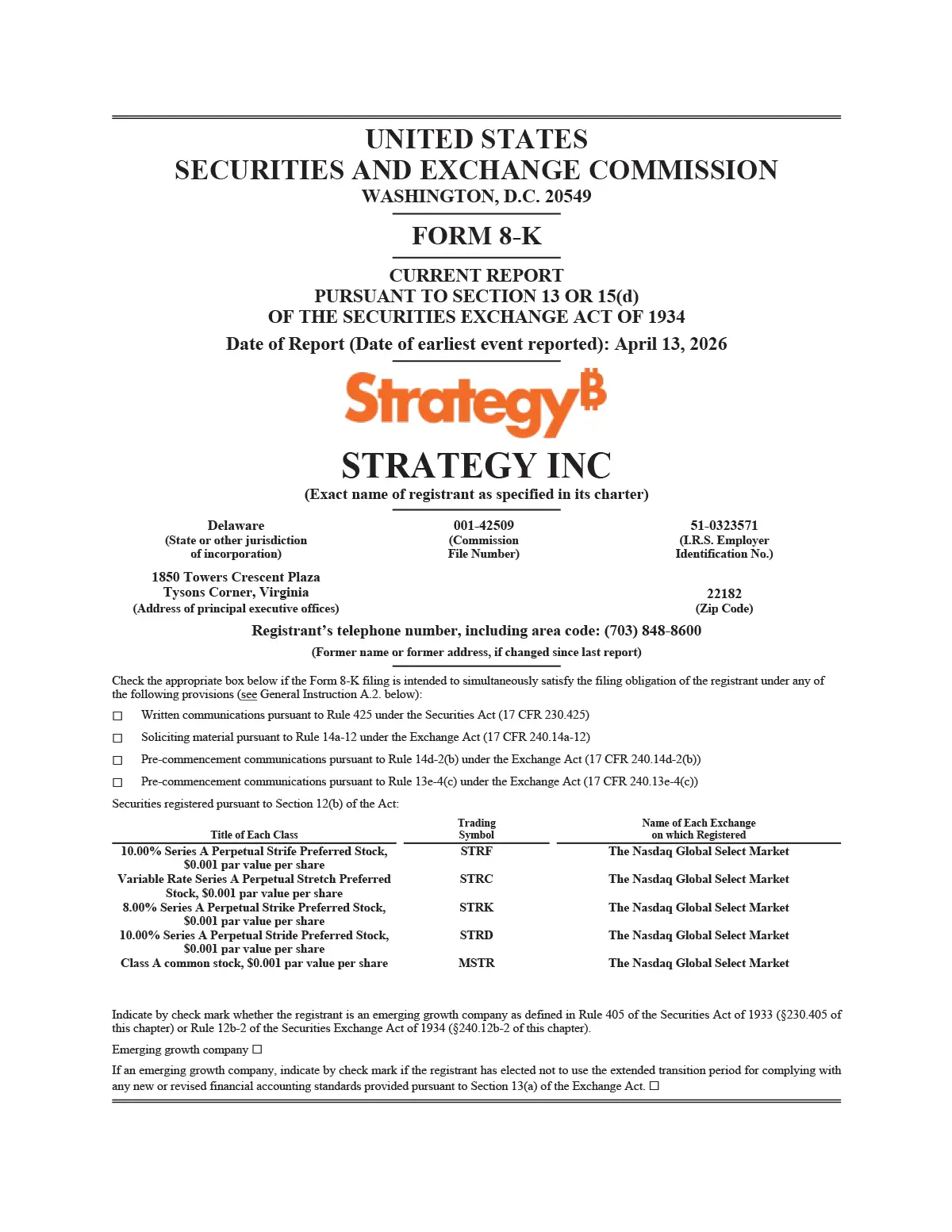
His comments came after Strategy said it had acquired 13,927 BTC for around $1 billion at an average price of roughly $71,902 per token, lifting its total holdings to 780,897 BTC as of April 12, 2026.
The company said those holdings were acquired for about $59.02 billion, or an average price of $75,577 per Bitcoin.
Why Saylor Says Bitcoin Price Can Keep Climbing
Appearing on the Bankless podcast on Monday, Saylor said he sees Bitcoin appreciating at a decelerating but still strong annual rate over a multi-decade period.
He said Bitcoin had grown faster in recent years but could still deliver blended long-term returns high enough to support a far larger market value over time.
“I think eventually it’s going to 21 million a coin,” Saylor said.
However, he explained that several developments would need to occur for Bitcoin to reach the kind of valuation he envisions.
First, he said, major economies including the United States, China, Europe and Japan would need to more fully recognize Bitcoin as a legitimate long-term capital asset and store of value.
Second, Saylor said broader acceptance by the banking system would be critical.
He argued that existing capital rules discourage banks from holding Bitcoin as collateral, limiting the extent to which traditional financial institutions can extend credit against it.
Third, he pointed to the continued “securitization” of Bitcoin through products such as exchange-traded funds and other financial instruments, which he said could channel larger pools of capital into the asset.
He also argued that the growth of bank credit networks around Bitcoin could meaningfully tighten supply.
In the interview, Saylor said every additional $10 billion of credit created against Bitcoin collateral could effectively absorb roughly a year’s worth of newly mined supply at certain price levels, magnifying demand pressure.
Another factor, he said, is the reduction of so-called rehypothecation in the crypto market, where the same Bitcoin is repeatedly used as collateral and can ultimately support short selling.
Saylor said that if more holders pull Bitcoin out of those arrangements and place it in long-term custody, it could force short sellers to buy back the asset and push prices higher.
Strategy’s Latest $1 Billion Buy
Strategy said it funded the latest purchase entirely through sales of its variable-rate preferred stock, STRC, rather than using cash on hand.
That is significant because it shows how the company is increasingly using capital markets to finance Bitcoin accumulation without directly drawing down corporate cash reserves.
In a separate post, Saylor said STRC had generated $1.156 billion of liquidity and described the instrument as having delivered “one penny of volatility” while closing at par.
Strategy purchases $1B. | Source: Strategy
STRC is designed as a high-yield preferred stock that pays a monthly dividend while aiming to keep its share price near $100.
According to Saylor’s description on Bankless, the structure is intended to appeal to income-focused investors who want a more stable security than Bitcoin or Strategy’s common stock.
Strategy’s Bitcoin Approach
Much of Saylor’s interview focused less on Bitcoin’s near-term price than on the financial structure he believes could support wider institutional adoption.
He said Strategy’s approach has evolved in stages.
“First we did equity, and then the middle period was bonds, convertible bonds,” Saylor said.
“And now we’re in the credit stage, where you’re seeing the formation of credit instruments like STRC.”
He added that he sees “two large sources of capital” for Bitcoin going forward: “the formation of digital credit from public companies, and the second is the formation of bank credit networks from the too big to fail banks.”
In Saylor’s telling, Bitcoin becomes more valuable as it becomes easier for mainstream finance to use.
He argued that broader bank acceptance, lending against Bitcoin collateral and the growth of exchange-traded and credit products could all draw more capital into the asset.
He illustrated the point with a real-estate analogy.
“You live in a city, and on one side of this street, it’s kind of scary and dangerous, and you have to buy the houses for cash,” he said.
On the other side, “it’s totally safe … and you can get conforming loan from Fannie Mae or Freddie Mac.”
In that scenario, he said, “when people feel safe and the conventional banking system finances the asset, you know, the price of the houses skyrockets.”
Bitcoin-Linked Instruments For Different Investors
Saylor also explained how Strategy is trying to build different Bitcoin-linked instruments for different types of investors.
He said the company’s common stock targets investors seeking amplified exposure to Bitcoin, while STRC targets those seeking income with less volatility.
“We transfer all of the energy and the volatility to the common equity, and we strip it off of the preferred equity,” he said.
He said that is part of a broader effort to create a simpler product for investors who do not want direct exposure to Bitcoin’s swings.
“The light at the end of the tunnel is becoming clearer, and it’s actually getting very simpler,” Saylor said.
“Everybody would just like a bank account that pays them more than the inflation rate.”
“We have a chance, in my opinion, to fix the money for a billion people,” he said. “Not complicated, just requires that one not get distracted.”
Pushing Back on Leverage Concerns
Saylor pushed back on concerns that Strategy’s approach relies on excessive leverage, arguing that its financing model differs fundamentally from traditional margin-based borrowing.
“There is no margin in the capital structure,” Saylor said.
He contrasted Strategy’s approach with conventional margin loans, which require borrowers to meet short-term collateral calls.
“Margin loans are when I borrow against an underlying asset with the obligation to meet a collateral call on one or two days’ notice,” he said.
Instead, Saylor said the company is raising capital through equity-like instruments rather than relying on debt that could be called in during periods of volatility.
“When we sell STRC, we’re selling equity. It’s the exact opposite,” he said. “If you give me a million dollars for my equity, for common equity, I have the money forever with no obligations.”
He described the preferred stock structure as a long-duration arrangement between investors and the company.
“When you give me a million dollars to buy a preferred equity with a variable dividend … you’re entering into a perpetual swap,” he said.
That distinction is central to Strategy’s strategy, as it allows the company to continue accumulating Bitcoin without facing forced liquidations during market downturns.
Others Turning Bullish on Bitcoin Price
Saylor is not alone in making aggressive long-term calls.
Crypto commentator Adam Livingston said Strategy could hold 2 million BTC by the end of 2027, with Bitcoin at $200,000, implying roughly $400 billion of permanent capital on the company’s balance sheet.
Livingston framed that scenario as large enough to place Strategy among the biggest companies in the S&P 500 by market value, arguing that the company may not need the index as much as the index would need Strategy.
By the end of 2027, Strategy will have 2 million Bitcoin.
Bitcoin will be $200k.
They will have $400 BILLION of PERMANENT CAPITAL on the balance sheet.
For reference, out of all the 503 companies in the S&P 500…
20 OF THEM of a market cap higher than $400 BILLION.
Those projections are speculative, but they reflect a broader bullish camp that sees Strategy as more than a software company with a large Bitcoin treasury.
However, some pushed back on Livingston’s scenario with even higher valuations.
“If they have 2 million Bitcoin and the price is only $200k, they have failed,” one X user wrote.
That said, the gap between bullish projections and current market performance remains wide.
Strategy’s common stock has fallen 59% over the last 12 months to $128.64 per share, showing that investors remain exposed to the risks of the company’s complex capital structure.
Kurt Robson is a London-based reporter at CCN, specialising in the fast-moving worlds of crypto and emerging technology. He began his career covering local news in Cornwall after graduating from Falmouth University with First Class Honours in Journalism. There, he cut his teeth on everything from council meetings to missing swans.
He quickly rose through the ranks to become a frontline journalist at several of the UK’s leading national newspapers. Over the years, he has interviewed musicians and celebrities, reported from courtrooms and crime scenes, and secured multiple front-page exclusives.
Following the upheaval of the COVID-19 pandemic, Kurt shifted his focus to technology journalism—just ahead of the AI boom. With a natural curiosity and a trained eye for emerging trends, he has found a new rhythm in reporting on innovation.
At CCN, Kurt's work focuses on the cutting edge of crypto, blockchain, AI, and the evolving digital world. Drawing on his background in people-first reporting and his deep interest in disruptive tech, Kurt delivers stories that are insightful, entertaining, and human-centric.