‘Someone May Lose Badly’: Arca CIO Warns Strategy’s $15B Preferred Stock Model Has Gotten Out of Hand
Share
Key Takeaways
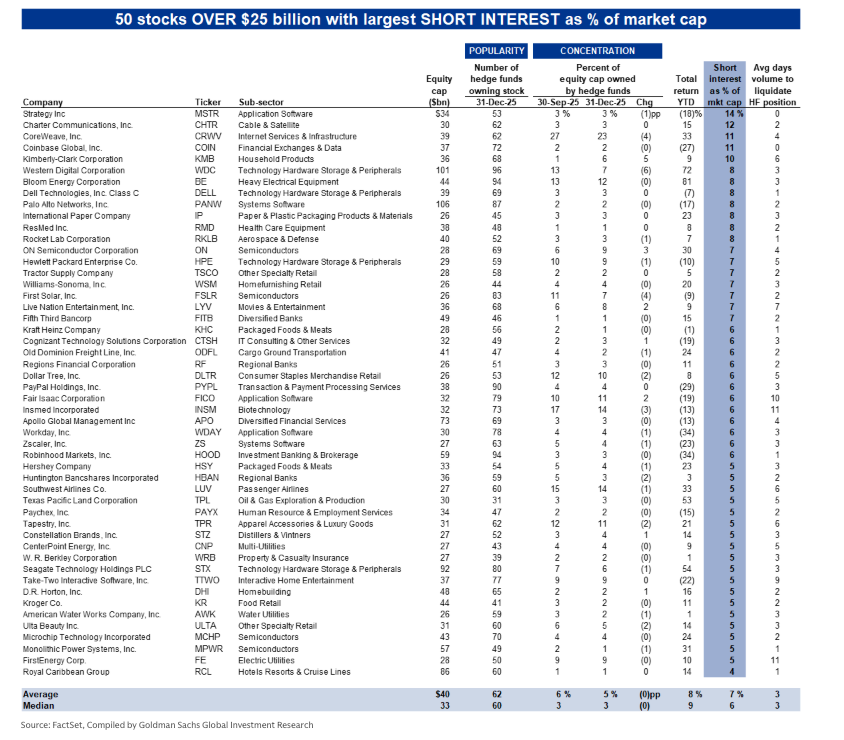
Strategy ranks number 1 globally for short interest among companies with a market cap of over $25 billion, with roughly 14% of its market cap sold short.
Strategy’s stock price is heavily correlated with BTC, meaning investors are essentially betting on or against Bitcoin itself.
Elevated short positioning signals strong bearish sentiment but also raises the possibility of a short squeeze if Bitcoin rallies sharply.
MSTR debt-financed Bitcoin accumulation amplifies upside during bull markets and downside during BTC drawdowns.
Strategy Inc. (MSTR), the company led by Bitcoin bull Michael Saylor, has officially become the most shorted stock in the world among companies valued above $25 billion.
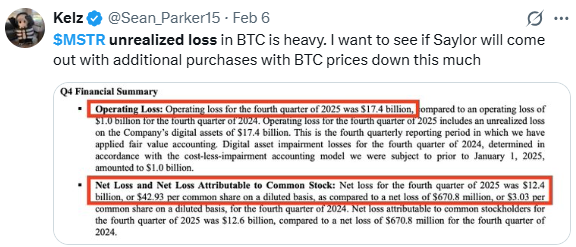
The surge in short interest comes as the firm faces approximately $7 billion in unrealized losses on its corporate treasury holdings denominated in Bitcoin (BTC).
According to recent market data, MSTR now ranks #1 globally for short interest as a percentage of market capitalization, surpassing dozens of major blue-chip companies.
The development has reignited debate across Wall Street and Crypto X alike: Is Michael Saylor’s Bitcoin strategy starting to crack, or is this just another high-volatility chapter in a long-term bet?
Why Strategy (MSTR) Is Now the Most Shorted Stock in the World
Fresh data from a ranking of the 50 stocks with the most significant short interest and market caps over $25 billion shows Strategy at the very top of the list.
Number of hedge funds holding the stock (Dec. 31): 53
Equity cap owned by hedge funds: 3%
Average days to cover: 0
Strategy leads the top 50 most shorted companies. | Credit: FactSet
A 14% short interest ratio is significant for a company of this size. In simple terms, it means a large portion of investors are actively betting that MSTR’s stock price will fall.
Short sellers borrow shares and sell them, hoping to repurchase them later at a lower price. When short interest rises this high, it signals growing skepticism about the company’s near-term outlook.
But this is not just any company. Strategy is effectively a leveraged proxy for Bitcoin.
Understanding Michael Saylor’s Bitcoin Treasury Strategy
Strategy (formerly MicroStrategy) transformed from an enterprise software company into what many now call a Bitcoin holding vehicle.
Under Michael Saylor’s leadership, the company began accumulating Bitcoin as its primary treasury reserve asset. Instead of holding cash or traditional bonds, Strategy used corporate debt and equity financing to buy BTC.
During bull markets, this strategy looked brilliant. As Bitcoin surged, MSTR stock often outperformed both the S&P 500 and BTC itself due to its leveraged exposure.
But leverage works both ways.
$7 Billion in Unrealized Bitcoin Losses: What It Means
The current controversy stems from roughly $7 billion in unrealized losses on Strategy’s Bitcoin holdings.
Important distinction: These are unrealized losses, meaning the company has not sold the Bitcoin. The losses reflect declines in market value, not actual realized cash losses.
However, markets price risk forward.
MSTR has $7 billion unrealized Bitcoin losses. | Credit: Kelz X profile
Investors betting against MSTR are effectively betting against Bitcoin and against Saylor’s conviction that BTC will appreciate in the long term.
What Is Shorting Bitcoin and Why Does It Matter?
To understand why this story is gaining traction, it helps to first understand what it means to short Bitcoin or, in this case, to short a Bitcoin-linked stock like Strategy (MSTR).
Shorting is a trading strategy where investors bet that the price of an asset will fall. Instead of buying low and selling high, short sellers borrow shares (or use derivatives), sell them at the current market price, and aim to repurchase them later at a lower price. The difference becomes their profit.
Short positions are set to be liquidated if BTC price reaches $90,000. | Credit: The Boss X profile
In the context of Strategy, many investors are not directly shorting Bitcoin itself but are shorting MSTR because the company’s valuation is tightly linked to BTC’s price movements. Thanks to Michael Saylor’s aggressive Bitcoin treasury strategy, Strategy has effectively become a leveraged proxy for Bitcoin exposure in public markets.
This dynamic is what makes the situation so explosive.
When traders short MSTR, they are often expressing one (or more) of the following views:
Short sellers would be forced to buy shares to cover losses.
Buying pressure would accelerate upward momentum.
In other words, extreme short interest increases both downside risk and the potential for explosive upside.
As long as Strategy remains deeply tied to BTC’s price action, the battle between bulls and short sellers is likely to remain intense and highly volatile.
Is Michael Saylor’s Bitcoin Bet Failing?
This is the central question.
To answer it properly, we must separate short-term market volatility from long-term strategic positioning.
Strategy’s $7 billion unrealized Bitcoin losses look alarming in isolation. But Bitcoin has always been a high-volatility asset.
The real question is not whether MSTR is currently under pressure, it clearly is.
The real question is: Do investors believe in Bitcoin’s long-term trajectory?
If yes, Strategy’s current short positioning could eventually unwind violently to the upside. If not, the rising short interest may reflect rational risk management by institutional investors.
Either way, one thing is certain: The battle between Bitcoin bulls and Wall Street short sellers is far from over, and Strategy (MSTR) sits squarely at the center of it.
Why is Strategy (MSTR) the most shorted stock right now?
Strategy has become the most shorted large-cap stock because investors are betting against its heavy exposure to Bitcoin. With roughly $7 billion in unrealized losses on its BTC holdings, many traders believe the stock could fall further if Bitcoin’s price declines.
What does “shorted stock” mean?
A shorted stock is one that investors are betting will go down in price. Short sellers borrow shares, sell them, and aim to buy them back later at a lower price to profit from the difference.
Are the $7 billion Bitcoin losses real?
They are unrealized losses. This means Strategy has not sold its Bitcoin at a loss. The figure reflects the drop in Bitcoin’s market price compared to when the company purchased its holdings.
Why is Strategy so closely tied to Bitcoin?
Under Michael Saylor’s leadership, Strategy adopted Bitcoin as its primary treasury reserve asset. The company has used debt and equity financing to accumulate BTC, making its stock price highly correlated with Bitcoin’s performance.
Disclaimer:
The information provided in this article is for informational purposes only. It is not intended to be, nor should it be construed as, financial advice. We do not make any warranties regarding the completeness, reliability, or accuracy of this information. All investments involve risk, and past performance does not guarantee future results. We recommend consulting a financial advisor before making any investment decisions.
Giuseppe Ciccomascolo began his career as an investigative journalist in Italy, where he contributed to both local and national newspapers, focusing on various financial sectors.
Upon relocating to London, he worked as an analyst for Fitch's CapitalStructure and later as a Senior Reporter for Alliance News. In 2017, Giuseppe transitioned to covering cryptocurrency-related news, producing documentaries and articles on Bitcoin and other emerging digital currencies. He also played a pivotal role in establishing the academy for a cryptocurrency exchange website. Crypto remained his primary area of interest throughout his tenure as a writer for ThirdFloor.


 Easy
Easy