Bitcoin’s $57,000 price floor is compounding at 32% CAGR, suggesting a path to $1 million within a decade. Here’s what it means for investors and Bitcoin’s long-term outlook. | Credit: CCN.com
Share
Key Takeaways
Even at a conservative 10th-percentile support level, Bitcoin shows consistent long-term growth rather than true downside instability.
Both Bitcoin’s trend and floor are compounding at 32% annually, implying a path to $1 million within 7.5 to 10.5 years.
While short-term price swings remain extreme, the underlying floor continues to climb over time.
Increasingly, Bitcoin is being positioned alongside gold as a long-term hedge and portfolio diversification tool.
Bitcoin has long been defined by its volatility. Sharp rallies, steep corrections, and unpredictable cycles have made it one of the most debated assets in modern finance. But a growing body of analysis suggests a more nuanced reality: while Bitcoin’s price may be volatile, its long-term floor may be far more stable, and steadily compounding upward.
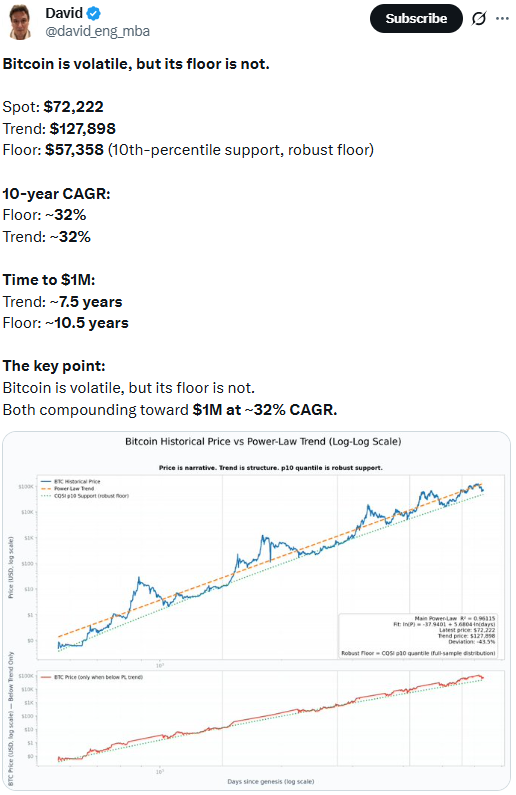
A framework shared by analyst David (@david_eng_mba) captures this idea succinctly. At a spot price of $72,222, Bitcoin’s modeled “trend” sits near $127,898, while its 10th-percentile “floor”, a statistically robust support level, rests around $57,358. Crucially, both the trend and the floor are growing at roughly the same pace: about 32% compound annual growth rate (CAGR).
This leads to a striking conclusion: even if Bitcoin were to track its lower-bound “floor” trajectory, it could still reach $1 million within roughly 10.5 years.
The trend path gets there faster, around 7.5 years, but the implication is the same. Bitcoin’s long-term trajectory may be less about short-term price swings and more about consistent exponential growth.
Bitcoin Price Floor vs Trend: What the $57K Support Level Really Means
To unpack this, it’s important to distinguish between three key concepts:
Spot price ($72,222): The current market price, driven by real-time supply and demand.
Trend ($127,898): A modeled long-term trajectory based on historical growth patterns.
Floor ($57,358): A conservative estimate representing strong support, derived from lower-bound statistical distributions (e.g., 10th percentile outcomes).
Traditionally, investors focus on spot price and trend lines. But the “floor” introduces a different lens: what is the minimum plausible value Bitcoin tends to revert to over time?
Bitcoin is volatile, but its floor is not. | Credit: david_eng_mba X profile
The insight here is powerful: Bitcoin’s volatility largely exists above a steadily rising base.
Even during bear markets, Bitcoin has historically established higher lows across cycles. The floor is not static: it compounds.
How a 32% CAGR Could Take Bitcoin to $1 Million
A 32% CAGR may not sound extraordinary in crypto terms, but over a decade it produces dramatic results due to compounding.
At this rate:
Bitcoin’s trend path reaches $1 million in 7.5 years
Bitcoin’s floor path reaches $1 million in 10.5 years
This means that even in pessimistic scenarios, where Bitcoin underperforms its trend and hugs its lower bound, it still delivers exponential growth.
This creates a ratcheting effect: while price fluctuates, the underlying support level trends upward.
Several structural factors reinforce this:
Fixed supply: Bitcoin’s supply is capped at 21 million coins. Unlike fiat currencies or commodities, supply cannot expand in response to demand.
Halving cycles: Every four years, new supply issuance is cut in half, reducing sell pressure and reinforcing scarcity.
Long-term holder behavior: A growing share of Bitcoin is held in long-term storage, effectively removing it from active circulation.
Institutional accumulation: ETFs, corporate treasuries, and potentially sovereign entities are absorbing supply and locking it away.
Together, these dynamics help explain why Bitcoin’s “floor” can rise steadily even as price remains volatile.
Can Bitcoin Reach $1 Million? Insights from Peer-Reviewed Research
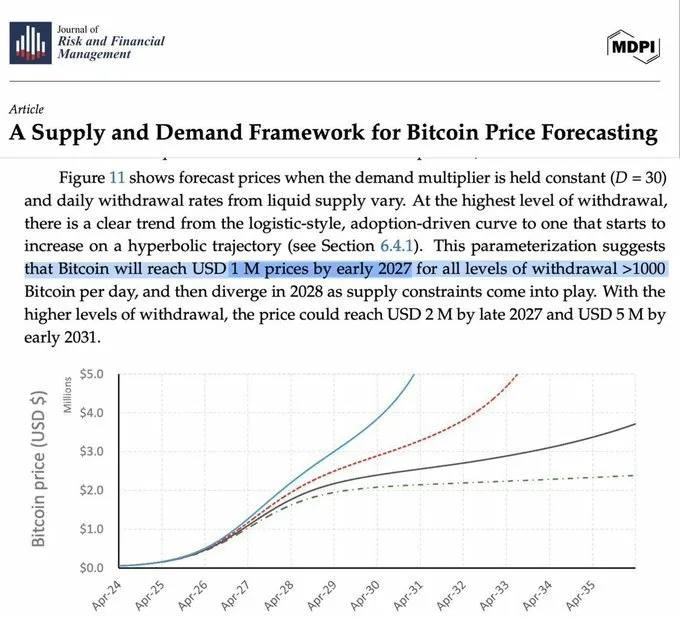
The idea of Bitcoin reaching $1 million is no longer confined to crypto enthusiasts. A peer-reviewed study published in the Journal of Risk and Financial Management (April 2026) provides a formal framework supporting this possibility.
The study models Bitcoin’s price using supply-demand dynamics, focusing on how liquidity constraints interact with growing institutional demand.
A supply and demand framework for Bitcoin price forecasting. | Credit: Journal of Risk and Financial Management
More aggressive scenarios project $2 million by late 2027 and $5 million by 2031.
Monte Carlo simulations suggest a 75% probability of exceeding $4.8 million by 2036.
The mechanism is straightforward but powerful: As more Bitcoin is removed from liquid circulation (via ETFs, treasuries, and long-term holding), price becomes increasingly sensitive to demand.
The study highlights that daily withdrawals of:
1,000 BTC can significantly tighten supply.
2,000-3,000 BTC can create extreme scarcity conditions.
This aligns closely with the “floor” thesis: reduced liquid supply creates a rising baseline value.
Supply Shock and Institutional Demand: The Real Bitcoin Bull Case
One of the most important insights from the research is the transition from adoption-driven growth to scarcity-driven growth.
In Bitcoin’s early years, price growth was driven by increasing awareness and user adoption. Today, growth is increasingly driven by supply constraints.
If the floor is rising, price dips may represent entry points rather than structural risks.
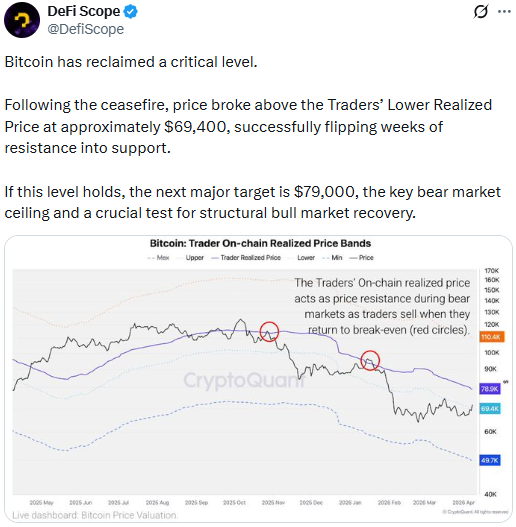
Bitcoin has reclaimed a critical level. | Credit: DeFi Scope X profile
Bitcoin Future as a Store of Value Asset
Bitcoin’s evolution appears to be entering a new phase. What began as a highly speculative asset is increasingly behaving like a scarce monetary asset with predictable long-term dynamics.
The convergence of:
Fixed supply
Institutional demand
Declining liquidity
Long-term holder accumulation
creates a unique environment rarely seen in financial markets.
Whether Bitcoin reaches $1 million in 7 years, 10 years, or longer remains uncertain. But the underlying insight is becoming harder to ignore: Bitcoin’s volatility may dominate headlines, but its long-term floor may be quietly compounding in the background.
For investors, that distinction could make all the difference.
What is Bitcoin’s price “floor” and why does it matter?
Bitcoin’s price “floor” refers to a statistically derived lower-bound support level where the asset tends to stabilize during downturns. It matters because it reflects Bitcoin’s long-term strength and growing baseline value, even amid short-term volatility.
Can Bitcoin really reach $1 million in the next decade?
Based on a 32% compound annual growth rate (CAGR), Bitcoin could reach $1 million in 7.5 to 10.5 years depending on whether it follows its trend or floor trajectory. Some models suggest even faster timelines under strong demand conditions.
What factors could drive Bitcoin to $1 million or higher?
Key drivers include fixed supply (21 million cap), institutional adoption (ETFs, corporate treasuries), reduced liquid supply, halving cycles, and increasing demand as a store-of-value asset.
What does the peer-reviewed study say about Bitcoin’s future price?
A 2026 study published in the Journal of Risk and Financial Management suggests Bitcoin could reach $1 million by early 2027 and potentially $5 million by 2031 under high-demand, low-liquidity scenarios.
Disclaimer:
The information provided in this article is for informational purposes only. It is not intended to be, nor should it be construed as, financial advice. We do not make any warranties regarding the completeness, reliability, or accuracy of this information. All investments involve risk, and past performance does not guarantee future results. We recommend consulting a financial advisor before making any investment decisions.
Giuseppe Ciccomascolo began his career as an investigative journalist in Italy, where he contributed to both local and national newspapers, focusing on various financial sectors.
Upon relocating to London, he worked as an analyst for Fitch's CapitalStructure and later as a Senior Reporter for Alliance News. In 2017, Giuseppe transitioned to covering cryptocurrency-related news, producing documentaries and articles on Bitcoin and other emerging digital currencies. He also played a pivotal role in establishing the academy for a cryptocurrency exchange website. Crypto remained his primary area of interest throughout his tenure as a writer for ThirdFloor.


 Easy
Easy