Michael Saylor vs. Peter Thiel: Bitcoin Maximalism or Crypto Diversification — Who’s Winning in 2025?
Share
Key Takeaways
Michael Saylor treats Bitcoin as the ultimate store of value, building the largest corporate BTC treasury through aggressive debt- and equity-funded purchases.
Peter Thiel takes a venture-style approach, spreading exposure across BTC, ETH, DeFi, and RWAs while backing infrastructure firms like Bullish and BitMine.
Thiel’s ETH-heavy bets and IPO wins have delivered bigger short-term gains, while Saylor’s Strategy dominates cultural influence and scale with 629K BTC.
Saylor faces high leverage and volatility risks tied to Bitcoin, while Thiel’s reliance on ETH and DeFi leaves him vulnerable to scalability, regulation, and competition.
Michael Saylor, the founder and CEO of Strategy, formerly known as MicroStrategy, and Peter Thiel, the billionaire investor and co-founder of PayPal, Palantir, and Founders Fund, are two of the most prominent names in the crypto and Bitcoin world.
Although both tech behemoths are heavily crypto-focused, theBitcoin investment policies of the two tech titans are entirely different.
On one hand, Syalor is aBitcoin absolutist and a flag bearer of the Bitcoin treasury trend among public companies. At the same time, Theil’s approach involves more diversified venture-style bets across assets like Bitcoin and Ethereum.
Try Our Recommended Crypto Exchanges
Sponsored
Disclosure
We sometimes use affiliate links in our content, when clicking on those we might receive a commission at no extra cost to you. By using this website you agree to our terms and conditions and privacy policy.
Michael Saylor vs. Peter Thiel: Contrasting Bitcoin and Crypto Investment Philosophies
Saylor’s coreBitcoin Philosophy revolves around direct investment into the asset ” via debt/equity offerings to buy and hold indefinitely.” He views it as the ultimate store of value and inflation hedge, often referring to BTC as a “Newtonian network” for U.S. dominance.
Peter Thiel’s crypto investment philosophy revolves around indirectventure capital bets, putting money in companies and protocols, VC stakes in crypto-native firms (e.g., Ethereum treasuries like BitMine), and direct token buys.
He balances BTC/ETH investments with traditional assets likeSpaceX andPalantir. Theil views crypto and Bitcoin as another investment tool. He treats crypto as programmable capital in a decentralized ecosystem.
Theil often favorsEthereum forsmart contracts and innovation and is more skeptical of BTC’s anonymity.
Saylor’s Bitcoin Maximalism
Saylor led the Strategy tobuy Bitcoin in 2020, when most institutions didn’t want to touch Bitcoin with a pole. At the time of Strategy’s first Bitcoin purchase, BTC was trading just above $10,000.
The bold move generated industry-wide interest and criticism from naysayers who criticized Strategy for using Bitcoin as atreasury reserve similar to the United States dollar.
However, asBitcoin’s price started to soar to new highs in 2021, more public companies began to buy BTC as a reserve. Saylor also played a key role in convincing Tesla and SpaceX to purchase BTC.
Strategy Bitcoin purchase history. Source: StrategyTracker
Saylor’s model has popularized corporateBTC treasuries (inspiring 70+ firms holding $67B+ in BTC), while Thiel’s VC lens has quietly built Ethereum exposure, capitalizing on ETH’s 160% YTD surge.
Thiel’s Crypto Diversification Approach
Thiel’s approach is indirect, channeling investments throughFounders Fund andBullish. In February 2025, Founders Fund allocated $100 million each to BTC and ETH, maintaining significant but smaller direct crypto holdings than Saylor.
Theil focuses on diversification to manage risks. Hiscrypto portfolio comprises multi-assets with a heavy ETH tilt in 2025. He owns 833K ETH via proxies, 5% of the supply. On the other hand, Theil has invested heavily in BTC over the past couple of months.
Factors
Michael Saylor
Peter Thiel
Philosophy
Bitcoin maximalist
Diversified crypto/VC
Focus
BTC as treasury asset
ETH, BTC, DeFi, RWAs
Method
Direct buys via debt & equity
Indirect via VC funds & ventures
Holdings
629K BTC (64% corp. reserves)
833K ETH (5% supply) + BTC
Strength
Scale & cultural influence
Higher 2025 gains & ecosystem impact
Risk
Debt leverage & volatility
ETH reliance & regulatory pressure
Saylor’s Bitcoin Strategy Offers Explosive Gains and Volatility
Since its 2020BTC pivot, Saylor’s BTC buying has produced astounding results, as evidenced by the 3,300% increase in Strategy’s stock price.
Strategycurrently holds 38,985 BTC acquired for a total investment of $47.23 billion at an average of $73,913 per coin. The investment valuation has soared to $73.97 billion, giving the firm an unrealized profit of roughly 57%.
Due to the increase in Bitcoin’s price in 2025 and $14 billion in unrealizedQ2 profits under fair-value accounting, Saylor’s firm’s stock price has increased by 150% year-to-date in 2025.
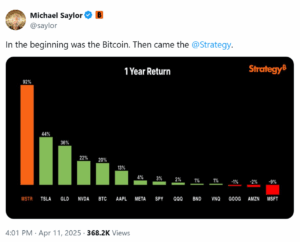
Strategy’s BTC investment return. Source:X
Cementing Saylor’s power, Strategy’s $73 billion, or 629,000 BTC holdings, make up 64% of publicly held corporate Bitcoin reserves.
Thiel’s Diversified Crypto Gains in 2025 (BTC, ETH, DeFi, RWAs)
In 2025, Thiel’s diverse investments have produced larger short-term gains, especially as ETH has surged 55% this year, in contrast to Bitcoin’s more gradual ascent.
Thiel’s direct crypto exposure to Ethereum, which includesBitMine’s 163,000 ETH and Founders Fund’s $100 million+ in ETH, takes advantage of Ethereum’s momentum.
Theil ownedBullish’s successful IPO (shares up 100% since August) and BitMine Immersion’s 400% stock increase, which resulted in estimated portfolio gains of over 200%.
Thiel’s influence is heightened by Bullish’s $2.5 billion daily trading volume, while ETH staking yields (5%) offer consistent cash flow. His emphasis on adoption and infrastructure puts him in a position to gain from the broader expansion of cryptocurrency, especially inDeFi and RWAs.
Cultural Impact of Crypto Investment: Saylor’s Bitcoin Treasury Leadership vs. Thiel’s Venture Ecosystem Strategy
Crypto is a relatively nascent market, and Saylor and Theil have a lasting cultural impact from their investment strategy. Saylor has become a Bitcoin proponent and leader of theBTC treasury proposal.
Theil profoundly impacts the crypto VC market and investments into budding projects. His impact goes beyond a particular crypto token and more towards ecosystem building.
Saylor’s Bitcoin Leadership
Saylor has redefined corporate finance by proving that Bitcoin can be a legitimate treasury asset. His model has inspired thousands of firms, with $108 billion in corporate BTC treasuries by mid-2025.
0:00 – Intro 1:00 – First priority as Director of Bitcoin Strategy 3:11 – Should Bitcoin companies copy MSTR’s preferreds? 5:02 – Structuring credit: BTC Ratings from 2 to 10 6:25 – Long-term CAGR for Bitcoin vs. S&P 500… pic.twitter.com/efZIvZM2m0
His advocacy for a U.S. BTC strategic reserve has positioned him as a policy influencer, especially as the U.S. nears a comprehensive crypto bill by year-end. Strategy’s $121 billion market cap reflects investor faith in its vision, though critics warn of over-reliance on a single asset. Saylor’s mantra, Bitcoin is the solution to all traditional financial problems, captures his relentless optimism.
Thiel, a VC Inspiration
Thiel’s influence is more subtle but profound. He has influenced the development of cryptocurrency beyond store-of-value. The use of ETH has accelerated due to its investments in BitMine and Bullish, especially inRWA tokenization, which has the potential to revolutionize asset management.
In contrast to Saylor’s U.S.-centric statements, Bullish’s focus onglobal scalability is demonstrated by his participation at the Hong Kong summit and Bullish IPO.
Pert Thiel’s crypto investment. Source: Sentiment
Thiel is positioned as a thought leader in the “next phase” ofcryptocurrency, where value is driven by infrastructure and programmability. Institutional investors who are placing bets on a multi-chain ecosystem nevertheless like his more subdued strategy and less public preaching than Saylor.
Risks and Criticisms of Saylor’s Debt-Fueled Bitcoin Strategy vs. Thiel’s Ethereum and Venture Capital Exposure
Saylor and Theil have proven their crypto investment policies successful over the years, but their methodologies have been criticized.
Saylor’s Debt Financing Trap
The main criticisms of Saylor revolve around his use ofdebt and equities to fund more of his BTC purchases, which many critics believe is a vulnerable strategy that could have a devastating impact during bear markets.
Saylor’s approach is a high-wire act that involves using the company’s balance sheet to purchase Bitcoin, exposing it to extreme volatility. Should the price of Bitcoin plummet, mandatorydebt repayment liquidations might set off a “death spiral.”
His concept, which relies on constant dilution throughstock offerings and caused investor reaction in August 2025 when premiums plummeted, is criticized for resembling a bubble.
Theil’s Dependence on ETH and VC Money
Thiel’s diversified approach reduces some volatility, but his dependence on direct andindirect exposure to ETH limits upside due to scalability issues and competition from layer-1 rivals likeSolana.
Saylor’s direct ownership model does not include operational concerns, whereas Thiel’s venture capital bets link returns to business execution.
Theil has also sidelined BTC, which could limit his influence within that community. Another challenge is regulatory monitoring, especially regardingstablecoins and DeFi platforms like Bullish.
Saylor vs. Theil: Whose Winning the Race in 2025
Saylor has the upper hand in scale and cultural influence in 2025. Strategy is the face of corporate Bitcoin adoption thanks to its 629,000 BTC, $14 billion in unrealized gains, and 3,300% stock run since 2020.
With Strategy owning 64% of thepublic Bitcoin reserves and influencing imitators like Metaplanet, his influence has spurred a worldwide treasury movement. However, the instability of his strategy, demonstrated by the 15% stock decline in August, and its dependence on debt cast doubt on its long-term viability.
Peter Thiel vs Michael Saylor. Source: X
In contrast, Thiel is benefiting from diversity and upside potential. His ETH wagers have outperformed Saylor’s 2025 returns, especially considering BitMine’s 400% increase and Bullish’s IPO doubling.
Crypto’s changing use cases align with Thiel’s emphasis on utility-driven assets like tokenized RWAs, which provide robustness in a multi-chain environment. Thanks to his $200 million+ direct Bitcoin/ETH holdings and $2.5 billion daily trading activity through Bullish, he has substantial but less concentrated exposure.
Michael Saylor and Peter Thiel represent two very different but equally influential philosophies in crypto investing.
Saylor’s strategy has reshaped corporate finance by positioning Bitcoin as a treasury reserve asset, making Strategy the global symbol of institutional BTC adoption. His bold, debt-leveraged approach delivers scale and influence but carries significant volatility and systemic risk.
Thiel’s approach reflects a venture capitalist’s lens, such as diversification, ecosystem building, and emphasis on Ethereum and programmable finance. While his strategy lacks the singular, high-profile appeal of Saylor’s Bitcoin maximalism, it aligns better with crypto’s evolving multi-chain and DeFi landscape, producing stronger short-term gains in 2025.
Ultimately, Saylor dominates in cultural leadership and BTC concentration, while Thiel thrives in portfolio performance and infrastructure impact. Who’s winning depends on whether the future belongs to Bitcoin as a store of value or to broader crypto innovation led by Ethereum, DeFi, and tokenized real-world assets.
Why is Michael Saylor called a Bitcoin maximalist?
Because he invests exclusively in Bitcoin, treating it as the ultimate store of value and using corporate debt and equity offerings to expand holdings indefinitely.
How does Peter Thiel’s crypto strategy differ from Saylor’s?
Thiel diversifies across BTC, ETH, and venture bets like Bullish and BitMine, focusing on programmable finance and ecosystem growth rather than a single-asset treasury model.
Who is doing better in 2025—Saylor or Thiel?
Thiel’s ETH-heavy portfolio and VC bets have produced larger short-term gains in 2025, while Saylor’s firm leads in cultural influence and sheer scale of Bitcoin reserves.
What risks do Saylor and Thiel face in their crypto strategies?
Saylor risks a debt-fueled collapse if Bitcoin’s price crashes, while Thiel’s reliance on ETH and DeFi platforms faces scalability challenges, regulatory scrutiny, and competition from rival blockchains.
Disclaimer:
The information provided in this article is for informational purposes only. It is not intended to be, nor should it be construed as, financial advice. We do not make any warranties regarding the completeness, reliability, or accuracy of this information. All investments involve risk, and past performance does not guarantee future results. We recommend consulting a financial advisor before making any investment decisions.
Prashant Jha is a seasoned crypto journalist based in Delhi, India, with a Bachelor’s Degree in Computer Science Engineering. Passionate about the evolving world of blockchain and cryptocurrencies, he has been a dedicated voice in the industry since 2018. Prashant’s expertise lies in regulatory reporting, where he unravels complex legal and financial developments with clarity and precision. Before joining CCN in 2024, he honed his craft at Cointelegraph, establishing himself as a trusted name in crypto journalism.
His coverage spans major industry events, including the high-profile collapses of FTX, Three Arrows Capital (3AC), and LUNA, offering readers insightful analyses of their regulatory and market implications. Prashant’s technical background enables him to bridge the gap between intricate blockchain technology and its real-world applications, making his work accessible to novices and experts.
Beyond his professional pursuits, Prashant is an avid music enthusiast, often exploring diverse genres to unwind. A sports lover, he has a particular passion for cricket and frequently engages in discussions about the game. His multifaceted interests and sharp journalistic instincts make him a valuable contributor to CCN, where he continues shaping the crypto landscape's narrative.


 Easy
Easy