mXRP Explained: XRP’s First Liquid Staking Token That Pays Up to 8%.
Share
Key Takeaways
Ripple brings speed and efficiency, settling cross-border payments in seconds compared to SWIFT’s days-long processes.
SWIFT’s trust and network effect remain unmatched, with over 11,000 institutions globally relying on it.
The future is likely hybrid; SWIFT integrating blockchain elements, and Ripple adapting to regulatory and banking norms.
The rivalry fuels innovation, pushing both Ripple and SWIFT to modernize, with end users set to benefit from faster, cheaper, more transparent payments.
For decades, cross-border payments have been dominated by SWIFT, a cooperative network of banks that acts as the backbone of international money transfers.
Now, Ripple, a technology company closely associated with the XRP cryptocurrency, is posing a challenge. The rivalry of “Ripple vs SWIFT” pits an established banking behemoth against cutting-edge blockchain in banking.
Can a modern blockchain network truly outsmart a 50-year-old system trusted by 11,000 banks?
This article compares their histories, technologies, and recent developments to evaluate if blockchain-based solutions like RippleNet and the XRP Ledger can transform cross-border payments or if SWIFT will adapt and remain on top.
The Legacy of SWIFT: Foundation, Growth, and Criticism
SWIFT (the Society for Worldwide Interbank Financial Telecommunication) was established in 1973 in Brussels by 239 banks across 15 countries. It was created as an answer to the slow, error-prone Telex system, with a vision “to transform the way value travels across borders.”
Try Our Recommended Crypto Exchanges
Sponsored
Disclosure
We sometimes use affiliate links in our content, when clicking on those we might receive a commission at no extra cost to you. By using this website you agree to our terms and conditions and privacy policy.
By the time SWIFT went live in 1977, its secure messaging network had doubled its membership to 518 institutions in 22 countries.
Over the following decades, SWIFT became the backbone of international banking, setting common standards for financial messages and expanding worldwide. Today, it connects over 11,000 financial institutions in more than 200 countries.
How it Works
Despite common misconceptions, SWIFT doesn’t actually move money, it sends payment instructions between banks. Each bank in the SWIFT network has a unique code (BIC/SWIFT code).
When you initiate an international wire transfer, SWIFT securely transmits a standardized message to route funds from your account to the recipient’s account via intermediary banks.
The actual fund settlement is handled by those correspondent banks, but SWIFT’s messaging makes it secure and standardized. This reliability and standardization are why SWIFT remains dominant, it offered a much faster, more reliable alternative to Telex, and over time banks invested heavily in SWIFT-compatible infrastructure.
How SWIFT transfers work. | Source: cambridgecurrencies.com
Milestones
1980s: Expanded to central banks, added value-added services.
1990s: Hundreds of millions of daily messages, 99.98% uptime.
2017: Global Payments Innovation (GPI) enabled tracking and faster settlement.
2020s: Migration to ISO 20022, aiming for richer data and global standardization.
Criticisms
Despite its success, SWIFT faces criticisms in an era of instant information.
Traditional SWIFT transfers can be slow, often 1-3 business days for funds to move through multiple correspondent banks.
Each intermediary may charge fees, making SWIFT payments expensive for businesses and consumers.
They have also been opaque, where senders sometimes didn’t know the exact status or fees until the payment completed (SWIFT GPI has improved this by providing end-to-end payment tracking, akin to tracking a parcel).
The G20 group of nations has explicitly set targets to improve cross-border payment speed, cost and transparency by 2027, indicating the pressure on systems like SWIFT to modernize.
Additionally, SWIFT’s central role means it has been used as a geopolitical tool – for example, certain countries’ banks have been cut off from SWIFT as sanctions, underscoring SWIFT’s centralized control by major economies.
Security has also been a concern: while the SWIFT network itself is secure, high-profile bank hacks (like the 2016 Bangladesh Bank heist) exploited weaknesses in banks’ interfaces to SWIFT, prompting SWIFT to bolster security requirements.
Critics in the fintech and crypto space often call SWIFT outdated, citing its batch processing and limited operating hours (it doesn’t settle on weekends), contrasting it with 24/7 blockchain networks. SWIFT has acknowledged these challenges and, rather than standing still, it’s working on solutions, including exploring blockchain integrations, which will be discussed later in this article.
If America cut South Africa off from SWIFT, it would hit everyone: •Banks can’t move money internationally. •Businesses can’t pay for imports or get export money. •People can’t send/receive money abroad or pay for global services. •Government struggles to settle debts and buy… pic.twitter.com/wCvoZj6tYW
The Rise of Ripple: Crypto’s Cross-Border Contender
Origins and Mission
Ripple is a San Francisco-based fintech company (founded as OpenCoin in 2012 by Chris Larsen and Jed McCaleb) that developed the XRP Ledger, a blockchain designed for fast, low-cost payments.
Ripple’s mission has been to make international money transfers as quick and seamless as sending an email. In contrast to SWIFT’s messaging-only approach, Ripple offers an alternative where value itself can be moved across a distributed ledger in seconds.
The company’s vision is often summarized as enabling the “Internet of Value” – money moving as freely as information. Ripple’s network for institutions, formerly called RippleNet, leverages blockchain to let banks and payment providers settle transactions instantly, with XRP (its native digital asset) acting as a bridge currency for cross-border payments.
XRP Ledger Technology
The XRP Ledger (XRPL) is a decentralized blockchain that launched in 2013. It uses a unique consensus algorithm (not proof-of-work like Bitcoin) which allows it to settle transactions in 3-5 seconds with minimal fees (fractions of a penny).
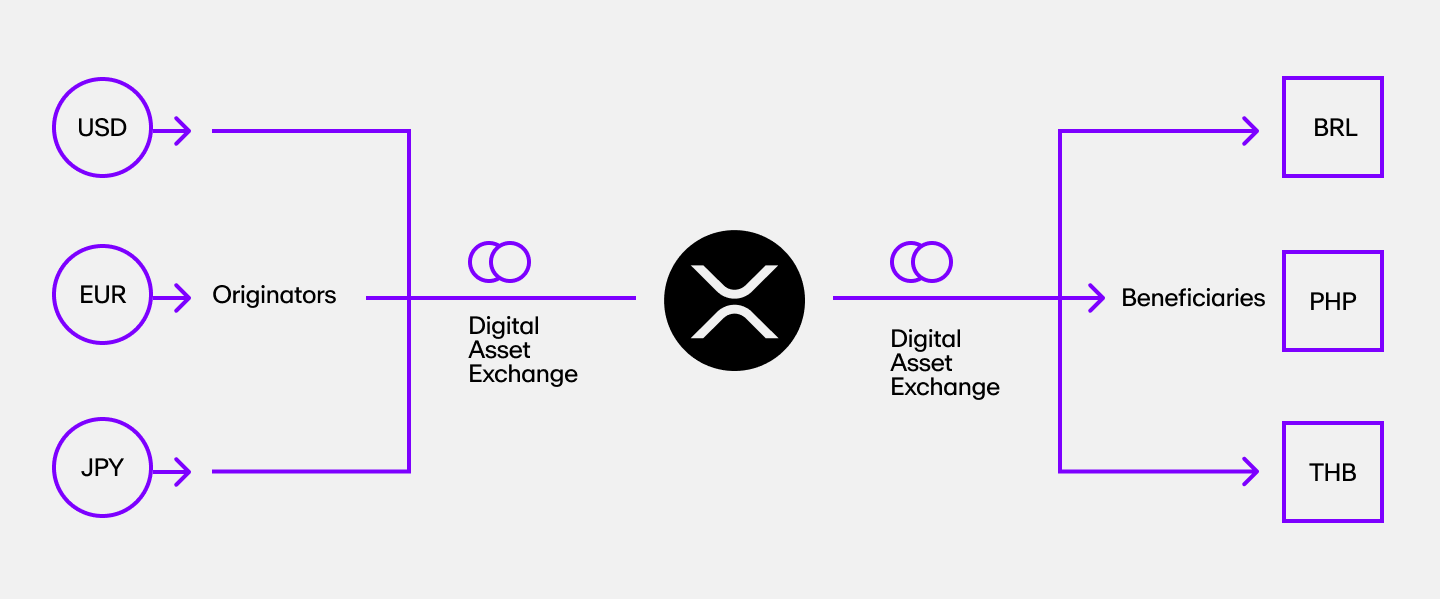
It can handle about 1,500 transactions per second at baseline, far above Bitcoin or Ethereum, and roughly on par with major card networks in throughput.. XRP, the digital currency, can be used as a bridge asset – for example, converting USD to XRP, instantly sending XRP across the globe on the ledger, and converting into, say, EUR or JPY at the destination. This avoids the need for multiple correspondent banks and pre-funded nostro/vostro accounts in various countries.
How value transfer flows through the XRP Ledger. | Source: MoonPay
Ripple’s pitch to banks and remittance companies was that using XRP and Ripple’s technology could dramatically cut the cost and time of cross-border transfers while providing end-to-end visibility.
Notably, more than 100 banks at one point joined Ripple’s network (including Santander, Standard Chartered, and SBI Holdings) to experiment with blockchain for cross-border payments, although many trials were limited in scope.
Some institutions used Ripple’s enterprise software (xCurrent) for instant messaging and settlement (without XRP), while others piloted XRP for liquidity (xRapid). Ripple’s technology saw real-world use in remittances: for example, MoneyGram, a major remittance firm, partnered with Ripple in 2019 to use XRP for settling forex, reporting faster and cheaper transfers – though that deal was suspended after U.S. regulatory issues arose.
In Asia, Ripple’s partner SBI in Japan has used Ripple’s tech for transfers, and Ripple and SBI even launched a joint venture for blockchain-based payments.
Ripple also forged relationships with central banks for research on central bank digital currencies (CBDCs), and its network is part of various pilot programs in regions like the Middle East and Asia-Pacific.
🚨 OF COURSE ITS DOCUMENTED#RIPPLE HAS PARTNERSHIPS WORLD WIDE. ESTABLISHING ITS #ODL SERVICE, ENABLING INSTANT CROSS-BORDER PAYMENTS.
ASIA-PACIFIC ✅ EUROPE ✅ AMERICAS ✅ MENA REGION ✅ MLU AFRICA ✅ JAPAN ✅#XRP WILL SETTLE ALL THE DAMN MONEY 🚀 pic.twitter.com/Nt8mrYmR0k
— HighVibeAssets 💥 AlgoPearRich (@HighVibeAssets) August 18, 2025
Concerns remain about centralization – Ripple Labs holds large XRP reserves.
Despite these challenges, Ripple has pushed forward, even expanding its services. It introduced its own stablecoin (Ripple USD, ticker RLUSD) in 2024 and has been positioning itself not just as a payments company but a broader crypto infrastructure player.
As you’ll see next, recent developments from both Ripple and SWIFT show the race is far from over.
SWIFT vs. Ripple: Key Differences at a Glance
To better understand the “Ripple vs SWIFT” debate, let’s compare them on core aspects:
Aspect
SWIFT
Ripple (XRP Ledger & RippleNet)
Launch & design
1973, bank-owned cooperative; messaging network
2012–2013, blockchain ledger, independent nodes
Speed
Hours–days; GPI can do same-day
3–5 seconds
Cost
$20–$50+ plus FX & intermediary fees
Fractions of a cent; stablecoins reduce costs
Transparency
Limited; GPI tracking improved
Public ledger, instant visibility
Scalability
42M+ daily messages
1,500 TPS (100M/day)
Regulation
Highly regulated, overseen by central banks
Evolving; SEC case; pursuing banking charter
Trust
50+ years, neutral governance
Growing but mixed; concerns over Ripple control
As the table shows, Ripple’s blockchain-based system clearly outpaces SWIFT in speed and nominal transaction cost. Its transparency and continuous availability are also strong points.
‼️RIPPLE = POSITIONED TO OUTLAST SWIFT AND BITCOIN + XRP IS DESIGNED FOR THE NEXT 70,000 YEARS‼️
Read closely.
“…Ripple could survive as it is a better version of SWIFT and Bitcoin network, and it could be used by traditional financial organisations for advanced experience of… pic.twitter.com/F6WxBPtESQ
SWIFT, however, has an entrenched network and the confidence of global banks, along with an established compliance regime. These differences set the stage for how each is innovating to either maintain or chip away at that incumbent advantage.
Ripple vs. SWIFT: Can Stablecoins, Banking Ambitions, and Blockchain Rails Rewrite Global Payments?
Both SWIFT and Ripple have been active recently, taking bold steps that underline their competitive and perhaps complementary directions.
1) Ripple’s $200M Stablecoin Bet – Acquisition of Rail
Ripple is expanding beyond XRP into stablecoins with a plan to acquire Rail for $200 million. Rail is a Toronto-based platform that uses dollar-pegged tokens to move money across borders faster and cheaper than traditional rails.
Ripple says the deal creates an end-to-end stablecoin payments stack, adding virtual accounts, automated back-office workflows, and a ready base of enterprise users already sending stablecoin remittances.
The move reinforces Ripple’s 2024 launch of RLUSD, its U.S. dollar stablecoin, and positions it against established issuers. Rail claims it processes a meaningful share of global stablecoin payment activity and can settle in hours rather than days with lower fees.
Strategically, the acquisition helps Ripple serve institutions that want crypto-speed settlements without asset volatility, while complementing XRP’s role as a bridge asset. It’s a signal that Ripple aims to own both the crypto-native and fiat-linked legs of the value chain.
2) Applying for a US Banking Charter
Ripple has applied for a U.S. national bank charter, seeking to operate as a federally regulated trust bank. This charter doesn’t allow retail deposits or lending, but it does enable custody and specialized banking services under federal oversight.
The strategic prize is a Federal Reserve master account, which could connect Ripple directly to Fed payment rails and allow it to hold reserves, potentially including backing for its RLUSD stablecoin, in central bank money. That combination could support true 24/7 settlement, reduce dependence on intermediaries, and address risk and compliance concerns for institutions.
The bid also signals a cultural shift: crypto firms aren’t just challenging banks from outside; they’re stepping into regulated roles to meet large customers where they are.
For Ripple, a charter could strengthen credibility with conservative financial institutions, simplify onboarding, and cut costs across certain flows. It’s a hedge, too—balancing blockchain speed with the governance, audits, and controls that major counterparties expect in high-stakes cross-border payments.
Ripple’s Resilience Questioned: SWIFT Innovation Boss Sparks Clash With “Dead Chain Walking” Remark
Despite experimentation, not everyone at SWIFT is convinced by Ripple’s approach. In September 2025, Tom Zschach, SWIFT’s Chief Innovation Officer, publicly critiqued Ripple and the notion that surviving a legal battle (like Ripple’s SEC fight) proves resilience. In a LinkedIn post that stirred debate, Zschach argued that “surviving lawsuits isn’t resilience. Neutral, shared governance is.”
Tom Zschach’s Ripple critique. | Source: Tom Zschach on LinkedIn
He contends that true robustness in global payments will come from systems governed by industry-wide consensus, not by any single company or its ability to weather court cases. This was seen as a direct swipe at Ripple, which often points to its regulatory battles as tests of its durability.
Zschach’s point was that banks won’t fully trust a network that is controlled (or perceived to be controlled) by a private company, and that compliance can’t be about one company getting approval, it must be about broad standards that everyone follows.
He went further to label Ripple’s network a “dead chain walking” in terms of future relevance, according to reports of his comments. The SWIFT executive emphasized that trust, legal enforceability, and shared governance have underpinned every major shift in finance, implying that blockchains must meet these criteria to gain institutional adoption.
In his view, many crypto innovations (from early internet payment schemes to decentralized finance) have failed to gain mass adoption due to a lack of this trust and compliance framework. This critique highlights a core philosophical difference: Ripple promotes technology and speed, while SWIFT’s camp stresses governance and risk management.
Zschach acknowledged that by 2025, public blockchains will be “too significant to ignore” and are proving useful in areas such as tokenized bonds and fast cross-border payments. But he maintained they are only part of the solution – the final piece is the legal and institutional frameworks around them.
However, Ripple’s advocates point out that XRP Ledger has been “battle-hardened” by running for a decade and surviving intense scrutiny.
🧐🔥 Most Banks Are Running on 1970s and 1980s Technology—No Wonder SWIFT Hasn’t Been Replaced
So why hasn’t Ripple been adopted yet? Why is SWIFT’s market share so protected? Behind polished banking apps, the global financial system runs on mainframes and COBOL code from the…
They cite Ripple’s partnerships and Ripple’s role in establishing legal precedents during the SEC case as evidence that it’s moving the whole industry toward acceptance. This back-and-forth between the SWIFT and Ripple camps underscores that while technology is key, perception among banks matters.
SWIFT is leveraging that narrative, essentially saying: we have neutral governance and decades of trust, which no fintech upstart can claim yet. It’s a reminder that in the realm of global finance, technology alone doesn’t guarantee success; governance, regulations, and network effects are equally critical.
Governance & trust: SWIFT’s bank-owned cooperative model and central-bank oversight deliver neutrality that institutions are comfortable with. Ripple’s ledger is decentralized in operation, but the company’s influence raises questions for risk committees. Ripple’s agility allows faster product iteration; SWIFT’s consensus culture can slow change but anchors trust.
Regulation & compliance: SWIFT’s ecosystem embeds KYC/AML and sanctions processes at participating banks. Ripple gained clarity from recent legal outcomes and is pursuing a bank charter, while stablecoin frameworks are emerging. Both face ongoing regulatory scrutiny; policy can open doors or set higher bars.
Technology & integration: Banks have deep SWIFT integrations. Ripple must prove low-friction interoperability (hence ISO 20022 alignment) and meet reliability thresholds at scale.
Network effects: SWIFT’s ubiquity is its moat. Ripple is targeting niches, such as remittances, specific corridors, and stablecoin use cases, to build volumes and credibility. Demand for faster, cheaper payments is real; whichever rail meets it with minimal operational disruption will gain momentum.
Conclusion: Coexistence, Competition or Convergence?
You might be wondering how this story will play out?
Rather than a simplistic “blockchain will kill SWIFT” outcome, experts foresee a more nuanced future. It’s very possible SWIFT and Ripple will coexist in the global payments ecosystem, each serving different needs or even interlinking.
SWIFT’s own actions suggest convergence: by testing blockchain networks and eyeing tokenized assets, SWIFT could incorporate aspects of Ripple’s innovation into its service. In such a scenario, banks might continue using the SWIFT network for its compliance and messaging, while actual settlement of funds happens on crypto networks behind the scenes, essentially a hybrid model. This would mirror how the internet’s arrival didn’t eliminate older telecom companies but forced them to modernize; similarly, SWIFT could evolve rather than be outsmarted entirely.
On the other hand, competition remains. Ripple’s long-term vision does challenge SWIFT’s correspondent banking model. Ripple executives have ambitiously predicted capturing a significant share of SWIFT’s volume by 2030.
If Ripple (or others in the crypto industry) succeed in meeting the high bar of trust and compliance, banks may gradually shift certain types of transactions, e.g. low-value remittances or inter-company transfers, to blockchain networks to save cost and time. Smaller financial institutions, fintechs, and remittance providers might adopt Ripple’s technology faster (since they have less legacy infrastructure), nibbling at SWIFT’s edges.
In regions with less developed correspondent banking, leapfrogging to crypto-based rails could occur, giving Ripple a stronger foothold. Thus, a competitive dynamic could see Ripple and SWIFT each trying to expand their share of cross-border flows.
A third outcome is convergence through partnerships. Could Ripple and SWIFT directly collaborate? It might sound far-fetched, but consider that both ultimately aim to serve banks and end-users with seamless global payments.
If market demand forces the issue, one could envision SWIFT establishing standards for using digital assets (maybe even XRP or stablecoins) within its network.
Ripple, by getting a banking license and joining traditional networks, is in a way moving closer to SWIFT’s turf from the opposite side. Their paths may meet in the middle. It’s conceivable that a future cross-border transaction might involve a SWIFT ISO 20022 message to carry compliance information and beneficiary details, while the actual value is transferred via a Ripple-issued stablecoin or XRP on a blockchain.
In that future, users might not even know a blockchain is involved, they’ll simply see faster, cheaper transfers. Coexistence could gradually lead to convergence, as the lines blur between “traditional” and “crypto” finance.
What is the main difference between Ripple and SWIFT?
SWIFT is a messaging network that instructs banks on how to move funds, while Ripple uses blockchain to transfer value directly in seconds, often with lower costs and full transparency.
Why is Ripple seen as a challenger to SWIFT?
Ripple’s XRP Ledger enables instant, low-cost, 24/7 cross-border transfers, addressing SWIFT’s long-standing pain points of delays, high fees, and limited transparency.
Could Ripple replace SWIFT completely?
It’s unlikely in the short term. SWIFT has decades of trust and global bank integration. Ripple may capture niches like remittances or stablecoin corridors, but a hybrid model, where both systems coexist, is more probable.
What does SWIFT think of Ripple?
While SWIFT is experimenting with blockchains like XRP Ledger, some executives remain skeptical. They argue that governance, trust, and compliance matter as much as speed, and call Ripple’s model too centralized for full bank adoption.
Disclaimer:
The information provided in this article is for informational purposes only. It is not intended to be, nor should it be construed as, financial advice. We do not make any warranties regarding the completeness, reliability, or accuracy of this information. All investments involve risk, and past performance does not guarantee future results. We recommend consulting a financial advisor before making any investment decisions.
Dr. Guneet Kaur is a senior editor at CCN.com and a Science Fellow at Exponential Science. She is a fintech and blockchain expert with extensive experience in digital finance education, blockchain ecosystems, and cryptocurrency markets. She has worked with global media such as Cointelegraph, as well as education and blockchain platforms, to design and lead strategic content and learning initiatives. As an educator and assessor for top-tier executive programs, she bridges real-world fintech trends with academic insight.
Dr. Kaur is also a published researcher and peer reviewer across fintech and data science journals, including Financial Innovation Journal and International Journal of Big Data Intelligence and Applications. Her work spans data-driven analysis, Web3 innovation, and technical content development. With a strong foundation in both industry and academia, she translates complex financial technologies into practical applications, empowering learners, professionals, and institutions across the rapidly evolving digital finance landscape.


 Easy
Easy