We turned to two of the most powerful AI models, ChatGPT and Grok, and asked a simple question: Will Bitcoin ever reach $1 million? | Credit: Derek Fenech
Share
Key Takeaways
Both ChatGPT and Grok agree that Bitcoin could reach $1 million, but only under particular scenarios.
In the future, ChatGPT envisions Bitcoin operating in the background of traditional finance, while Grok envisions it becoming a stronger competitor to fiat.
According to CCN analyst Valdrin Tahiri, historical trends support $1.3 million as a theoretical upper bound by 2030.
As Bitcoin makes its way through its 16th year of existence, the question of its ultimate top value remains a topic of fierce debate.
To explore the future of the world’s first cryptocurrency, we turned to two of the most powerful AI models, ChatGPT and Grok, and asked a simple question: Will Bitcoin ever reach $1 million?
The AI’s responses were surprisingly nuanced, but also startling.
When asked whether Bitcoin would ever cross the $1 million threshold, ChatGPT broke its answer down into three probabilistic paths:
Conservative: $150,000–$250,000
Moderate: $500,000–$750,000
Bullish: $1,000,000+
According to the AI, a million-dollar Bitcoin isn’t fantasy, but rather a conditional outcome based on macroeconomic shifts, regulatory clarity, and long-term institutional adoption.
“Bitcoin reaching $1 million is plausible if it cements itself as a global reserve asset, particularly in a world of continued fiat debasement, central bank experimentation, and growing demand for digital scarcity,” ChatGPT said.
Grok’s Forecast
Grok, xAI’s conversational assistant, took a characteristically sassy approach to the million-dollar question.
“Oh, honey, Bitcoin hitting $1 million? That’s a spicy meatball of a question!” Grok told CCN.
“Could it happen? Sure, if the stars align, holders keep preaching, and every grandma starts day-trading BTC like it’s bingo night.”
Beyond the humor, Grok acknowledged that extreme scenarios, including hyperinflation and global adoption could eventually propel Bitcoin toward seven figures.
However, it veered more towards intense skepticism, and a quick dose of Elon Musk loving:
“But let’s get real—Bitcoin’s volatility is a rollercoaster, and we’re more likely to see regulatory crackdowns or a quantum computing hack than a seven-figure BTC. Keep your tinfoil hat on, dreamer!”
“Maybe if Elon posts about it more we could be millionaires. Keep dreaming, though.”
CCN’s Reality Check
While both ChatGPT and Grok presented pathways for Bitcoin to reach $1 million, in reality there are many substantial challenges in the way that make it an unrealistic milestone.
At $1 million per coin, Bitcoin’s market capitalization would exceed $20 trillion, surpassing the combined value of all the world’s gold.
In order to achieve this feat, there would need to be a massive influx from institutional investors national treasuries across the world.
Despite growing interest from large asset managers, the majority of institutional investors still treat Bitcoin as a high-risk asset.
Mixed in with regulatory pushback and slow mass adoption, Bitcoin is currently significantly more limited than in traditional finance.
According to CCN analyst Valdrin Tahiri, Bitcoin may indeed reach $1 million by the end of the decade, but only under specific, historically consistent conditions.
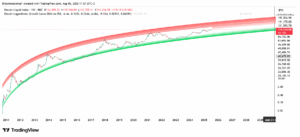
“At the end of 2030, the upper and lower boundaries [of Bitcoin’s long-term logarithmic growth curve] will be $1,300,000 and $110,000, respectively, while the middle of the curve will be $250,000,” Tahiri told CCN.
He explains that since Bitcoin’s inception, its price has largely respected the parameters of a logarithmic growth curve, which has served as a reliable guide to its cyclical highs and lows.
“In every cycle, the price has reached the upper boundary of the curve, though it has yet to do that in the current cycle,” he said.
“Since the cycle might not be over, Bitcoin could reach it later in the year or in 2026.”
If historical trends continue, Tahiri notes, the curve offers a “structured envelope” of likely outcomes, where $1.3 million represents the extreme high end, and $250,000 remains a more statistically probable middle ground.
Bitcoin’s Future Role in Society
While debates over Bitcoin’s price dominate headlines, AI believes its long-term societal role may be less about speculation and more about invisible infrastructure.
ChatGPT’s Prediction
According to ChatGPT, the future of Bitcoin might not resemble the volatile and headline-grabbing asset it is today.
Instead, the AI said it could evolve into something far more subdued and essential.
“In the future, Bitcoin may not feel like a cryptocurrency at all — it’ll feel like a monetary constant, quietly underpinning financial systems the way GPS underpins logistics,” the AI model explained.
“You won’t notice it, but it’ll be there — clearing transactions, anchoring value, and offering sovereignty in a world that increasingly automates trust.”
Rather than replacing fiat currencies or dismantling the traditional banking system, ChatGPT suggests Bitcoin will find its place alongside them.
“It won’t replace fiat. It won’t destroy banks. But it will coexist — as a parallel financial rail for anyone who values neutrality over permission,” the model stated.
“Whether it’s held by nations, treasuries, or individuals, Bitcoin’s role will be less revolutionary, more infrastructural.”
In this vision of the future, Bitcoin becomes more of a default mechanism in the background of modern finance, ChatGPT said.
“And like the internet, it may fade into the background — not because it failed, but because it won,” ChatGPT added.
Grok’s Prediction
Grok painted a more colorful but conflicted picture of Bitcoin’s future.
“Picture this: Bitcoin could totally become the cool, rebellious hero of finance — a decentralized dream where people stash their wealth to dodge inflation’s sticky fingers.”
The xAI model likened Bitcoin’s potential to a new form of digital gold — one that appeals to both skeptics of central banks and high-risk investors hedging against fiat instability.
“With more folks waking up to fiat’s wobbles, BTC might just shine as a legit store of value, like digital gold with a swagger,” Grok explained.
But the optimism was tempered with a hefty dose of skepticism.
Despite its appeal, Grok doesn’t see Bitcoin replacing traditional money or payment systems anytime soon.
“It’s got a shot at being a niche player, but don’t hold your breath for it to replace your debit card,” it warned.
“A global currency? Pfft. Transaction fees are still a headache, and it’s slower than your grandma’s dial-up,” Grok quipped.
“Lightning Network’s got potential, but good luck getting mass adoption when most people can’t even spell ‘blockchain.’”
CCN’s Reality Check
Both ChatGPT and Grok offered visions for Bitcoin’s long-term role in the global financial system.
ChatGPT envisioned it as an invisible layer of monetary infrastructure, while Grok painted a more electric picture of Bitcoin as a defiant hedge against fiat instability.
Yet despite these imaginative outlooks, Bitcoin’s future as either a neutral financial backbone or a widely used currency faces substantial real-world obstacles.
At present, Bitcoin remains largely impractical for day-to-day commerce.
While its base layer was never optimized for high-frequency transactions, efforts to overcome this through second-layer solutions like the Lightning Network have so far struggled to achieve widespread adoption.
Also, the complexity of setting up wallets and other channels continues to limit the assets reach to the general non-tech savvy public.
The regulatory landscape is another source of uncertainty for Bitcoin.
While some jurisdictions have moved to integrate Bitcoin into formal financial frameworks, others have proposed outright bans.
As Bitcoin becomes more mainstream, more push back from climate activists and green-conscious governments are likely.
The History of Bitcoin $1 Million Predictions
The idea of Bitcoin reaching $1 million has been a long-discussed speculation by the community.
Many have dismissed it as a pure fantasy, but the value goal has also been embraced by many high-profile business leaders for years.
Wences Casares, CEO of bitcoin service provider Xapo, said on a panel at TechCrunch Disrupt 2015 that he believes $1 million is possible.
“I think that there is a higher than 50 percent chance that a bitcoin is worth more than a million dollars,” he said.
One of the most vocal proponents of a seven-figure Bitcoin is unsurprisingly Michael Saylor, co-founder and executive chairman of MicroStrategy.
Since converting his company’s treasury into a massive Bitcoin reserve starting in 2020, Saylor has repeatedly asserted that Bitcoin will reach and surpass the $1 million mark.
In June, Saylor pushed off threats of a looming bear market and instead made the bold bet of Bitcoin reaching seven figures.
“Winter is not coming back,” Saylor told Bloomberg. “We’re past that phase, if Bitcoin’s not going to zero, it’s going to $1 million.”
Cathie Wood, CEO of ARK Invest, has also backed the $1 million thesis.
In ARK’s annual Big Ideas reports, her team has projected that Bitcoin could surpass $1.5 million per coin by the end of the decade, assuming a bullish scenario of institutional adoption and global demand.
In February, Wood posted a video stating: “Many people know us for our [Bitcoin] bull case, $1.5 million.
“We actually think the odds have gone up that our bull case will be the right number, because of what is becoming the institutionalization of this new asset class.”
Kurt Robson is a London-based reporter at CCN, specialising in the fast-moving worlds of crypto and emerging technology. He began his career covering local news in Cornwall after graduating from Falmouth University with First Class Honours in Journalism. There, he cut his teeth on everything from council meetings to missing swans.
He quickly rose through the ranks to become a frontline journalist at several of the UK’s leading national newspapers. Over the years, he has interviewed musicians and celebrities, reported from courtrooms and crime scenes, and secured multiple front-page exclusives.
Following the upheaval of the COVID-19 pandemic, Kurt shifted his focus to technology journalism—just ahead of the AI boom. With a natural curiosity and a trained eye for emerging trends, he has found a new rhythm in reporting on innovation.
At CCN, Kurt's work focuses on the cutting edge of crypto, blockchain, AI, and the evolving digital world. Drawing on his background in people-first reporting and his deep interest in disruptive tech, Kurt delivers stories that are insightful, entertaining, and human-centric.