Hargreaves Lansdown warns Bitcoin has no intrinsic value. | Credit: CCN.com
Share
Key Takeaways
Hargreaves Lansdown warned clients that Bitcoin has no intrinsic value and is unsuitable for growth or income portfolios.
Yet, paradoxically, it will offer access to crypto ETNs starting in early 2026, after regulatory checks.
This underscores a “cautious acceptance” approach, acknowledging investor demand but distancing from endorsing crypto fundamentals.
Hargreaves Lansdown’s stance could temper retail enthusiasm, especially among cautious investors who rely on trusted advisors.
In October 2025, Hargreaves Lansdown, the UK’s largest retail investment platform, stirred up significant debate by warning about Bitcoin and cryptocurrencies in general.
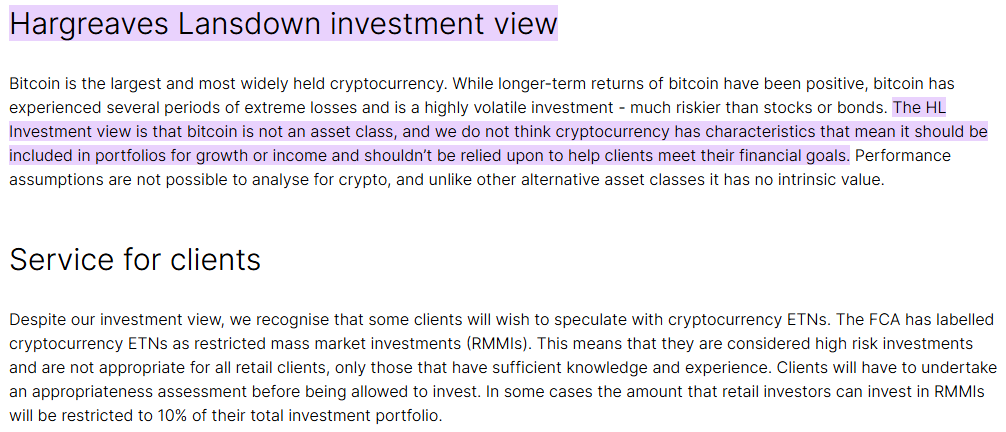
The firm disclosed to its clients (via a crypto statement) that Bitcoin lacks intrinsic value, is not an asset class, and should not be relied on as part of portfolios aimed at income or growth.
Yet, almost paradoxically, it also plans to provide access to regulated crypto products via exchange-traded notes (ETNs) starting in early 2026, after appropriate risk assessments.
This moment marks a crossroads in how mainstream finance views crypto: a blend of regulatory change, institutional skepticism, and evolving market expectations.
Let’s break down what Hargreaves Lansdown said, why it matters, and what it reveals more broadly about the current and future state of Bitcoin and crypto.
Try Our Recommended Crypto Exchanges
Sponsored
Disclosure
We sometimes use affiliate links in our content, when clicking on those we might receive a commission at no extra cost to you. By using this website you agree to our terms and conditions and privacy policy.
Here are the key statements from Hargreaves Lansdown’s crypto statement:
Bitcoin has no intrinsic value: The firm questioned whether cryptocurrencies possess the characteristics that would allow them to be considered asset classes.
Not suitable for growth or income-focused portfolios: They suggested crypto’s volatility and past steep losses make it ill-equipped to serve clients whose goals are stable growth or income.
Warning despite regulatory changes: This statement came shortly after the UK’s Financial Conduct Authority (FCA) reversed a ban (in place since 2021) on retail investors using crypto ETNs. So, although crypto products are becoming more accessible, HL is urging caution.
Hargreaves Lansdown’s warning to UK crypto investors. | Credit: Hargreaves Lansdown
How Hargreaves Lansdown’s Bitcoin Stance Could Shape UK Investor Sentiment
Hargreaves Lansdown isn’t a fringe voice. It manages over £170-£175 billion in client assets and serves millions of retail investors throughout the UK.
Its stance can ripple through the marketplace in several ways:
Investor sentiment: When a trusted platform warns that Bitcoin is not an asset class and has “no intrinsic value,” many retail investors who rely on such platforms may become more cautious, delay investments, or demand more explicit guarantees.
Regulatory and fiduciary caution: Firms like HL operate under regulatory frameworks that demand they put clients’ interests first. Their warning signals that platforms are still very concerned about risk, compliance, and reputational exposure even as crypto products become legal and more available.
Polarization of market narratives: On one side, you have increasing institutional adoption, interest in crypto ETFs/ETNs, and efforts to regulate responsibly. On the other hand, statements like this reinforce the view among skeptics that crypto is speculative, volatile, and not (yet) trustworthy enough for mainstream investment.
Impact on valuation and pricing: Suppose a growing number of significant institutions regard Bitcoin as lacking intrinsic fundamentals. That may affect how Bitcoin is valued, especially by risk-averse investors or those who require a steady income, not just potential upside.
How the FCA’s ETN Policy Shapes Hargreaves Lansdown’s Cautious Approach
To understand the whole story, it helps to map the regulatory and market backdrop:
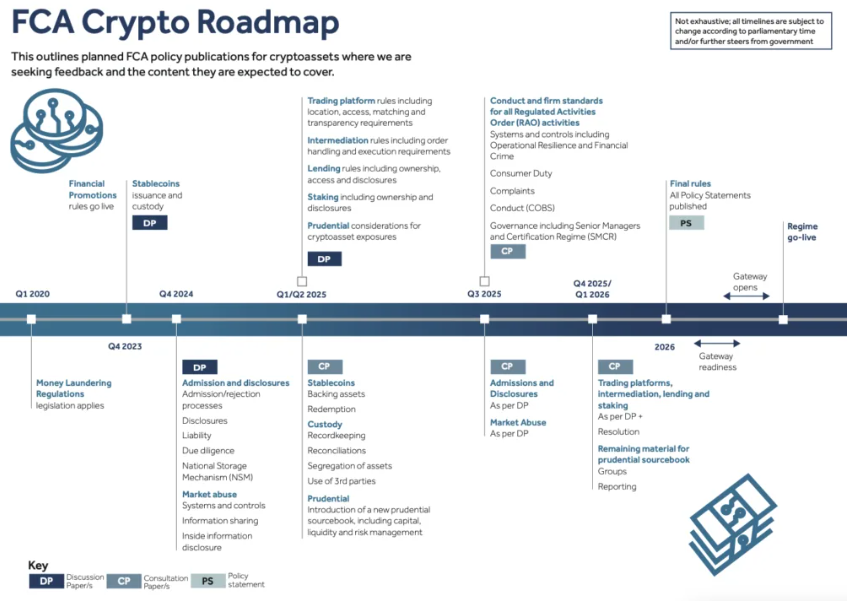
The UK’s Financial Conduct Authority (FCA) has lifted its ban on retail investors holding crypto ETNs (exchange-traded notes). As of Oct. 15, 2025, retail investors can keep these products in regulated environments (like ISAs) under stricter oversight.
ETNs are financial instruments that mimic the price behavior of underlying assets (in this case, cryptocurrencies like Bitcoin and Ethereum) but do not require direct ownership of the tokens. That means exposure, without necessarily handling the token itself (and its associated custody, wallet, and security risks).
Hargreaves Lansdown has said it will offer these products “early next year” but only after conducting appropriateness testing and ensuring clients understand risks and that offerings align with their financial goals.
FCA crypto roadmap. | Credit: ComplyCube
Two Sides of the Coin: Weighing Hargreaves Lansdown’s Bitcoin Skepticism Against the Case for Legitimacy
To understand this fully, it helps to consider both sides: those who share HL’s skepticism and those who argue for Bitcoin’s legitimacy.
Volatility and risk: Bitcoin has shown large, rapid swings in price. Institutions still worry about liquidity, regulatory, technological risks (e.g., network attacks, forks), and environmental criticisms.
Regulatory uncertainty: Even as the UK opens the door to regulated crypto products, rules are still evolving (tax, consumer protection, reporting, etc.). Firms must manage the risk of regulatory changes.
Behavioral and psychological risk: Investors may overestimate their understanding, underestimate worst-case scenarios, or be exposed to scams and fraud (less-regulated market segments remain dangerous).
Arguments in Favor of Bitcoin’s Legitimacy
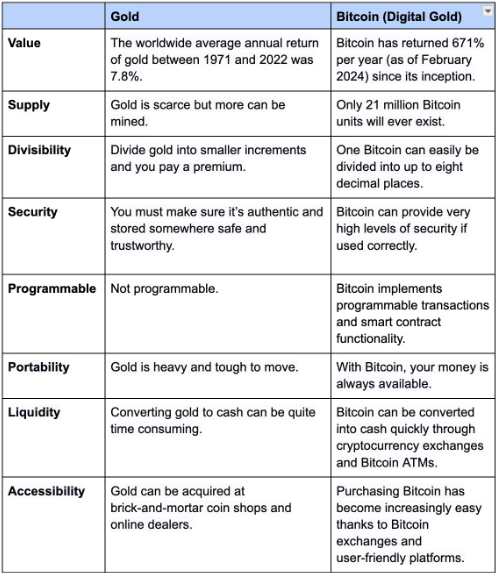
Digital gold/store of value: Many see Bitcoin as a hedge against inflation, currency debasement, or institutional risk. It has a track record of significant appreciation over the last decade.
Network effect and adoption: The more people, companies, and applications that use Bitcoin, the more value accrues (e.g. BlackRock’s IBIT). Increased institutional interest and infrastructure build-out (custody, regulation) add legitimacy.
Regulated exposure now possible: With ETNs and regulated products, investors can gain exposure without some of the risks of unregulated exchanges or holding private keys.
Innovative uses and narratives: Arguments about Bitcoin helping with financial inclusion, renewable energy, or as part of decentralized finance are increasingly part of its legitimacy story.
Bitcoin vs. gold. | Credit: Swan Bitcoin
Unresolved Questions: The Grey Areas Behind Bitcoin’s Value and Legitimacy
There remain significant grey areas, and what HL’s statement highlights is that many of these are still open:
“Intrinsic value” is a philosophical and financial debate. What counts as intrinsic? When people talk about value, do they mean utility, scarcity, widespread trust, acceptance, or cash flows? With Bitcoin, value is often derived more from beliefs, utility, trust, and protocol design than from cash flow.
Regulation and consumer protection. Even regulated products (ETNs) must satisfy issues like transparency, custody risk, counterparty risk, market abuse, and fraud. Platforms must ensure clients understand what they’re buying.
Volatility vs utility trade-off.Bitcoin’s volatility makes it risky, but it’s also part of its attraction (potential high returns). How many investors are willing and able to absorb the downside?
Environmental, energy, and ESG concerns continue to loom large. Energy use, carbon footprint, andmining practices remain controversial. Statements about legitimacy frequently mention these concerns.
Adoption in mainstream portfolios. Will institutional investors gradually treat Bitcoin more like an “alternative asset class” (in diversifying portfolios, risk modeling) or will it remain niche/speculative?
What Investors Should Do
Here are actionable lessons for individual investors, financial professionals, or anyone thinking of putting money into Bitcoin or crypto following Hargreaves Lansdown’s statement:
Do your homework: Understand what you’re investing in, recognize risk, and know whether you are using regulated products (ETNs, funds) or directly holding crypto (wallets, exchanges).
Don’t over-allocate: Given volatility and uncertainty, many experts recommend limiting crypto exposure to a small portion of the overall portfolio, particularly for those seeking steady returns.
Assess your tolerance for loss: Crypto is high-risk. Be comfortable with how much you might lose, not just how much you gain.
Stay informed about regulation: What’s allowed in your jurisdiction (UK, EU, US, etc.)? Are there tax implications? Are products fully transparent and regulated?
Watch the infrastructure: Custody, security, insurance, and auditing are areas where many failures occur. If you are using regulated ETNs or funds, check how they handle these aspects.
Balance innovation with caution: Crypto’s growth in technology, use cases, adoption remains compelling. But it doesn’t mean throwing caution out the window.
Ripple Effects: How Hargreaves Lansdown’s Caution Could Redefine Mainstream Crypto Adoption
Hargreaves Lansdown’s statement may represent more than just caution; it may shift how mainstream finance frames digital assets.
Shifts in messaging from other platforms: Others may follow suit, being more critical and cautious even as they provide crypto exposure. This could lead to more detailed disclosures, suitability/appropriateness tests, and explicit risk warnings.
There is more demand for transparency and ESG: Investors increasingly want to know “where” their Bitcoin is mined, how sustainable it is, how it is used, etc. Products that deliver on those transparency features may gain premium status (similar to what we see in green bonds or ethical funds).
Regulatory tightening: As crypto becomes more accessible to retail in places like the UK, regulators will likely focus more on protecting consumers, advertising, disclosures, fraud prevention, and perhaps tighter rules around stablecoins and custodians.
Potential change in institutional adoption curves: If major platforms and advisors continue questioning Bitcoin’s fundamentals, institutional demand may grow more slowly. However, if regulated, transparent products gain trust, which could unlock broader participation.
BlackRock’s Dual Warnings: Portfolio Risk Limits and the Quantum Threat to Bitcoin
In December 2024, BlackRock flagged that although Bitcoin is gaining traction as a digital-asset option, it still carries substantial risks. The firm’s analysis recommends that even investors interested in Bitcoin keep its allocation to around 2 % of a diversified portfolio — beyond that, the risk profile becomes “outsized.”
In particular, BlackRock cautions that Bitcoin remains highly volatile, subject to sharp sell-offs, and its future broader adoption is uncertain. This warning mirrors how major institutions are treating crypto. Interesting as an addition to portfolios, but not something to rely on as a stable backbone.
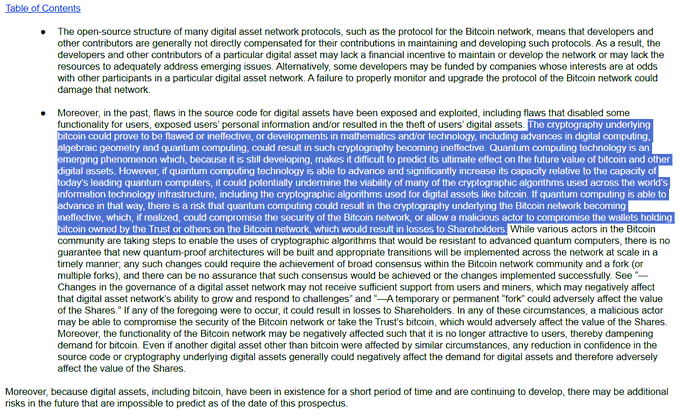
In May 2025, BlackRock quietly updated the prospectus for its iShares Bitcoin Trust ETF (IBIT) to include a warning about quantum-computing risk. The filing states that should quantum technology or corresponding advances in mathematics render the cryptography underlying Bitcoin ineffective, the network’s security could be compromised — e.g., malicious actors might access wallets held by the Trust.
Preparing your projects for the quantum era. | Credit: QANplatform
While the threat could be years away, BlackRock’s acknowledgement marks one of the most prominent institutional recognitions of a quantum-computing risk to Bitcoin.
Between Caution and Innovation — Bitcoin’s Ongoing Legitimacy Test
Hargreaves Lansdown’s position is not necessarily definitive or aligned with all Bitcoin proponents. But it is significant because:
The debate about legitimacy is far from settled. Even major financial institutions see Bitcoin as risky, speculative, and lacking in traditional foundations of value.
But that doesn’t mean Bitcoin is doomed. Product innovation (ETNs, ETFs, green mining, transparency) alongside broader institutional adoption continues to push it forward.
For many investors, the story will be one of trade-offs: risk vs potential reward, novelty vs proven track record, speculation vs utility.
Conclusion
When the UK’s biggest investment platform asserts that Bitcoin “is not an asset class” and “has no intrinsic value,” it stirs concern and thought. The message is strong: regulatory acceptance doesn’t automatically mean universal endorsement. Accessibility and legitimacy remain distinct.
But importantly, HL is not rejecting Bitcoin entirely; it’s urging caution. The institution is also preparing to offer regulated pathways (ETNs) for those who understand and accept the risks.
For the investor, this is a moment to be especially discerning. Define your goals, understand what characteristics make something an “asset.” And move forward only when you are confident in the trade-offs.
Why did Hargreaves Lansdown issue a warning about Bitcoin?
Hargreaves Lansdown cautioned clients that Bitcoin lacks intrinsic value and is unsuitable for income or long-term growth portfolios. The firm’s stance reflects ongoing institutional skepticism toward crypto’s volatility, speculative nature, and lack of underlying cash flows.
Does Hargreaves Lansdown completely reject crypto?
No. Despite the warning, HL plans to offer crypto exchange-traded notes (ETNs) starting in early 2026, once risk assessments and suitability checks are complete. The platform will allow regulated, indirect exposure to cryptocurrencies, not direct token ownership.
What’s an ETN, and how is it different from holding Bitcoin directly?
A crypto ETN (exchange-traded note) is a financial product that tracks the price of a cryptocurrency, such as Bitcoin or Ethereum. Investors gain price exposure without managing wallets, private keys, or custody risk. However, they don’t own the underlying crypto, but the ETN issuer does.
Does Hargreaves Lansdown’s view reflect the entire financial industry?
Not entirely. While many traditional institutions share HL’s caution, others, including prominent asset managers and ETF issuers, are embracing regulated crypto exposure. The divide reflects the ongoing transition from speculative hype to institutional adoption.
Disclaimer:
The information provided in this article is for informational purposes only. It is not intended to be, nor should it be construed as, financial advice. We do not make any warranties regarding the completeness, reliability, or accuracy of this information. All investments involve risk, and past performance does not guarantee future results. We recommend consulting a financial advisor before making any investment decisions.
Giuseppe Ciccomascolo began his career as an investigative journalist in Italy, where he contributed to both local and national newspapers, focusing on various financial sectors.
Upon relocating to London, he worked as an analyst for Fitch's CapitalStructure and later as a Senior Reporter for Alliance News. In 2017, Giuseppe transitioned to covering cryptocurrency-related news, producing documentaries and articles on Bitcoin and other emerging digital currencies. He also played a pivotal role in establishing the academy for a cryptocurrency exchange website. Crypto remained his primary area of interest throughout his tenure as a writer for ThirdFloor.


 Easy
Easy