Key Takeaways
- The number of public companies holding Bitcoin surged nearly 40% in Q3 2025.
- Despite the record accumulation, Bitcoin’s price has stayed below $115,000.
- Companies heavily exposed to Bitcoin, such as Metaplanet, have seen sharp declines in share prices.
Public companies are continuing to snap up Bitcoin at a record pace, yet the world’s largest cryptocurrency has remained stubbornly stuck below $115,000.
New data from Bitwise shows corporate Bitcoin holdings jumped nearly 40% in the third quarter, the most significant quarterly surge on record, even as the coin’s price has barely moved.
This clear divergence is raising questions about why the boom in institutional adoption is not having an immediate effect on investor sentiment.
Corporate Bitcoin Holdings Hit Record Levels
According to Bitwise’s Corporate Bitcoin Adoption, Q3 2025 report, the number of public companies holding Bitcoin surged nearly 40% quarter-on-quarter to 172 firms, marking a new record.
Collectively, these companies now hold about 1.02 million BTC, roughly 4.8% of the total supply, valued at $117 billion as of September 30, 2025.
The report attributes the sharp rise in corporate accumulation to a series of high-profile transactions and new entrants into the market.
Strategy, the largest corporate Bitcoin holder, added 40,000 BTC in the third quarter, lifting its total to more than 640,000 BTC.
Meanwhile, payments firm Strike completed the first major Bitcoin treasury merger by acquiring Semler Scientific, signaling growing consolidation in the space.
In Japan, Metaplanet, often described as the country’s answer to MicroStrategy, doubled its holdings during the quarter.
However, despite the record inflows, enthusiasm remains uneven after recent turbulence in crypto-related equities.
Bitcoin’s Price Holds Steady
Bitcoin’s price has struggled to keep pace with rising institutional accumulation.
CCN analyst Valdrin Tahiri said that while Bitcoin’s price has rebounded since the October 10 flash crash, which triggered the largest-ever liquidation event in crypto markets, the recovery may be losing steam.
Tahiri pointed to a long lower wick on the weekly BTC/USDT chart that prevented a breakdown from a key ascending support trend line, but cautioned that it could be at risk of another decline.
“The bounce was substantial,” he said, “but the price action suggests Bitcoin could test lower levels again.”
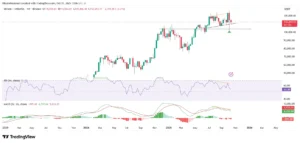
- BTC/USDT Weekly Chart | Credit: Valdrin Tahiri/TradingView
According to Tahiri’s analysis, the weakness stems partly from shaken trader confidence following the mass liquidations and the negative community response to Binance’s proposed compensation plan.
Technically, Tahiri identified $105,000 as the key zone of diagonal and horizontal support, warning that if these levels fail, Bitcoin could fall below $100,000 for the first time since June.
Crypto Treasuries Lose Shine
Earlier this week, Metaplanet’s market value slipped below the worth of its Bitcoin holdings for the first time, amplifying concerns that investor appetite for “crypto treasuries” is fading.
The Tokyo-based firm has seen its shares plunge 70% from their June peak.
The decline comes after Bitcoin itself was caught in a broader sell-off triggered by Donald Trump’s new tariffs.
Despite a reported record in Q3, CryptoQuant said Bitcoin purchases by publicly traded digital-asset treasuries fell from 64,000 Bitcoin in July to 12,600 in August.
Strategy, a leading buyer in the treasury space, also paused its purchases for a week — the first time since mid-2025 — although buying has since resumed.
The Disconnect
The sharp rise in corporate Bitcoin holdings has done little to lift the cryptocurrency’s price, exposing a widening disconnect between on-chain fundamentals and market sentiment.
Despite nearly 40% more public companies adding Bitcoin to their balance sheets in the past quarter, the price has remained largely rangebound.
When zoomed out, several contributing factors may explain the lack of upward momentum.
The broader economic backdrop remains challenged, with renewed trade tensions and shifting expectations around U.S. monetary policy keeping risk appetite low.
CCN analyst Victor Olanrewaju explained that Bitcoin’s price “hasn’t reacted strongly to corporate adoption because most institutional purchases happen over-the-counter.”
“These private transactions don’t hit public exchanges, so they have minimal immediate impact on the coin’s value,” he added. “In the short term, BTC might experiences consolidation. However, a notable correction is unlikely,” he said.
At the same time, liquidity in crypto markets has thinned following a huge wave of liquidations earlier in the month, again spurred by rising trade tensions.
But despite this, many analysts believe the underlying story is still bullish.
“Still, the price will likely hit new highs before the year ends once retail and whales begin to size in again,” Olanrewaju said.

Kurt Robson is a London-based reporter at CCN, specialising in the fast-moving worlds of crypto and emerging technology. He began his career covering local news in Cornwall after graduating from Falmouth University with First Class Honours in Journalism. There, he cut his teeth on everything from council meetings to missing swans.
He quickly rose through the ranks to become a frontline journalist at several of the UK’s leading national newspapers. Over the years, he has interviewed musicians and celebrities, reported from courtrooms and crime scenes, and secured multiple front-page exclusives.
Following the upheaval of the COVID-19 pandemic, Kurt shifted his focus to technology journalism—just ahead of the AI boom. With a natural curiosity and a trained eye for emerging trends, he has found a new rhythm in reporting on innovation.
At CCN, Kurt's work focuses on the cutting edge of crypto, blockchain, AI, and the evolving digital world. Drawing on his background in people-first reporting and his deep interest in disruptive tech, Kurt delivers stories that are insightful, entertaining, and human-centric.