Crypto predictions for 2030 suggest Bitcoin may reach $500K, Ethereum $20K, XRP $20 as adoption and blockchain innovation reshape the market. | Credit: CCN.com
Share
Key Takeaways
ChatGPT estimates price ranges for major cryptocurrencies by 2030, reflecting market uncertainty and volatility.
With limited supply and increasing adoption through spot ETFs and institutional investment, some projections place Bitcoin between $180,000 and $500,000 by 2030.
As the leading platform for smart contracts, DeFi, and tokenized assets, Ethereum could reach $5,000 to $20,000 if its ecosystem continues expanding.
XRP’s price could range from $1 to $20 depending on adoption by banks, payment providers, and financial institutions.
Cryptocurrencies have evolved rapidly over the past decade, moving from a niche technology experiment to a global financial market attracting banks, governments, and major investors. Today, assets like Bitcoin (BTC), Ethereum (ETH), and XRP are among the most widely recognized digital currencies in the world.
As adoption grows, many investors are asking a long-term question: what might these cryptocurrencies be worth by 2030?
While no prediction can be guaranteed, analysts often estimate future price ranges based on trends such as institutional adoption, regulatory changes, and technological development. Recent industry news, from the expansion of crypto ETFs to increasing involvement from traditional financial institutions, also offers clues about where the market may be heading.
This guide explains possible price scenarios for Bitcoin, Ethereum, and XRP in 2030, highlighting recent developments shaping their futures.
Why Crypto Predictions Are Becoming More Serious
In the early days of cryptocurrency, price predictions were mostly speculative. Today, the industry is increasingly influenced by large financial institutions, regulated investment products, and global policy decisions.
For example, spot crypto ETFs (exchange-traded funds) have become one of the biggest drivers of market activity. These funds allow investors to gain exposure to cryptocurrencies through traditional stock markets.
Recent reports show strong demand for these products, with Bitcoin ETFs seeing hundreds of millions of dollars in inflows in just a few days, reflecting growing institutional interest in the asset class.
At the same time, more traditional financial companies are beginning to integrate crypto into their platforms. Large asset managers and banks now offer investment products tied to Bitcoin and Ethereum, signaling that digital assets are gradually becoming part of mainstream finance
These developments make long-term forecasts more grounded than in the past.
Bitcoin Price Prediction for 2030
Bitcoin is the first and largest cryptocurrency, often described as digital gold because of its limited supply and decentralized design.
Only 21 million bitcoins will ever exist, making scarcity a key factor that could drive long-term value.
Why Bitcoin Could Grow by 2030
Several major trends support Bitcoin’s long-term outlook:
Institutional investment: Financial institutions are increasingly entering the market through ETFs and trading platforms. This has brought large pools of capital into Bitcoin.
Growing financial integration: Banks and brokerages are gradually offering crypto investment products to customers, making it easier for traditional investors to access Bitcoin.
Macroeconomic demand: Some investors use Bitcoin as a hedge against inflation or currency instability, which could increase demand during economic uncertainty.
Recent market activity shows Bitcoin still responding to macro trends and institutional flows. As of early March 2026, Bitcoin climbed to around $72,000 amid strong inflows into ETFs, demonstrating how institutional demand can influence price movements.
Possible Bitcoin Price Range in 2030
Based on current projections:
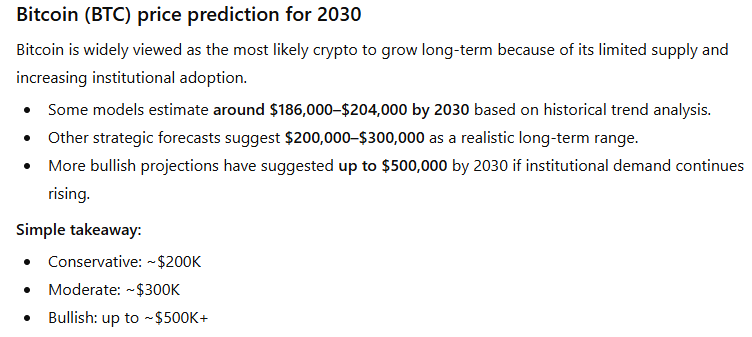
Conservative estimate: $180,000-$200,000
Moderate estimate: $250,000-$300,000
Bullish estimate: $500,000 or more
These projections assume continued adoption by institutional investors and governments.
Price predictions for Bitcoin for 2023. | Credit: ChatGPT
Risks That Could Affect Bitcoin
Despite its strong position, Bitcoin still faces challenges:
Market volatility is tied to global economic conditions.
Even so, Bitcoin remains the most established cryptocurrency, which many analysts believe gives it long-term staying power.
Ethereum Price Prediction for 2030
Ethereum is the second-largest cryptocurrency and the most widely used platform for decentralized applications.
Unlike Bitcoin, which mainly serves as a store of value, Ethereum enables developers to build software on its blockchain using smart contracts, automated programs that run without intermediaries.
These smart contracts power a range of industries, including:
Ethereum’s value is closely tied to the extent to which these applications are adopted.
Decentralized finance growth: DeFi platforms allow people to borrow, lend, and trade assets without banks.
Tokenized assets: Real-world assets such as stocks or real estate may eventually be represented on blockchains like Ethereum.
Developer ecosystem: Ethereum has one of the largest communities of blockchain developers, which helps maintain its dominant position.
Institutional interest is also increasing. Analysts say institutional capital is becoming a major force shaping the price discovery of both Bitcoin and Ethereum.
Possible Ethereum Price Range in 2030
Typical forecasts include:
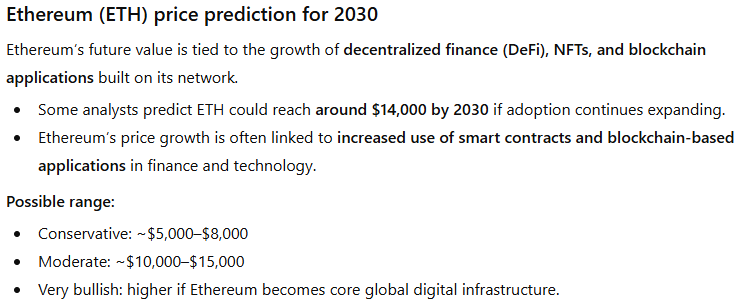
Conservative range: $5,000-$8,000
Moderate range: $10,000-$15,000
Highly bullish projections: $20,000
These projections assume that Ethereum will continue to dominate the smart-contract market.
Ethereum price predictions for 2030. | Credit: ChatGPT
However, its strong developer ecosystem and applications give it a significant advantage.
XRP Price Prediction for 2030
XRP is a cryptocurrency designed for fast international payments.
Ripple Labs created it to help financial institutions transfer money across borders more quickly and cheaply than traditional banking systems.
Why XRP Could Grow by 2030
The key factor influencing XRP’s future is real-world adoption in financial systems.
Several developments in recent years have improved its outlook.
For example, regulatory clarity in the United States helped restore confidence in the asset and allowed exchanges to relist XRP. This also enabled the launch of new investment products such as XRP-based ETFs, which attracted significant investor interest shortly after launch.
In addition, institutional investors have shown increasing interest in XRP-related funds, with some products receiving strong inflows in early 2026.
Ripple continues expanding its payment technology partnerships with financial institutions worldwide.
Possible XRP Price Range in 2030
Typical projections include:
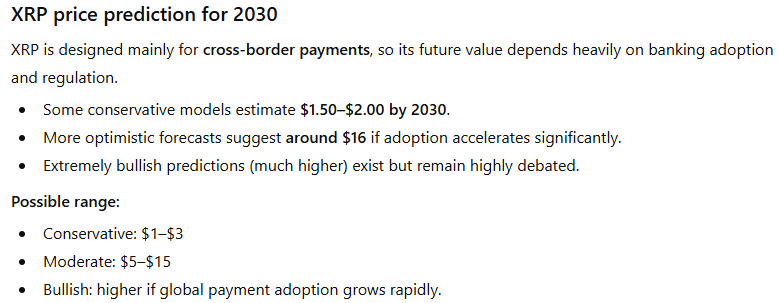
Conservative estimate: $1-$3
Moderate estimate: $5-$15
Bullish scenario: $20
Higher price projections depend on widespread adoption by banks and payment networks.
XRP estimates for 2030. | Credit: ChatGPT
Challenges XRP Faces
Despite progress, XRP still faces several uncertainties:
Competition from stablecoins and digital payment networks.
The speed at which banks adopt blockchain payment systems.
Nevertheless, XRP remains one of the most recognized cryptocurrencies focused on global payments.
Major Trends That Could Shape Crypto Prices by 2030
Several broader industry trends could influence the future of Bitcoin, Ethereum, and XRP:
Institutional adoption: The biggest shift in recent years has been the entry of large financial institutions into the crypto market. Banks, asset managers, and investment funds are increasingly offering crypto investment products, which could significantly increase demand.
Regulatory clarity: Governments around the world are developing clearer rules for cryptocurrencies. Regulation can provide legitimacy to the market, encouraging companies and institutions to participate.
Integration with traditional finance: Cryptocurrency is slowly becoming part of the traditional financial system. For example, large brokerages and financial platforms now allow customers to invest in crypto ETFs alongside traditional assets.
Market cycles: Crypto markets historically move in cycles, often influenced by Bitcoin’s halving events, technological upgrades, and global economic conditions.
Analysts expect the current decade to include multiple growth cycles before 2030.
What Could the Crypto Market Look Like by 2030?
Predicting cryptocurrency prices years in advance is extremely difficult, but trends such as institutional investment, regulatory clarity, and technological innovation are making the industry more mature.
Based on current projections, typical estimates for 2030 look like this:
Cryptocurrency
Conservative
Moderate
Bullish
Bitcoin
$180K
$250K–$300K
$500K+
Ethereum
$5K
$10K–$15K
$20K+
XRP
$1–$3
$5–$15
$20+
Whether these predictions come true will depend on how widely cryptocurrencies are adopted in finance, technology, and everyday payments.
What is clear, however, is that cryptocurrency is no longer a fringe technology. With banks, asset managers, and governments increasingly involved, the next few years could play a major role in determining how large the crypto market becomes by 2030.
Reality Check on AI-Powered Crypto Predictions
While ChatGPT’s projections highlight possible price ranges for Bitcoin, Ethereum and XRP by 2030, they should not be treated as guaranteed outcomes.
Cryptocurrency markets are highly volatile and influenced by many unpredictable factors, including regulation, technological changes, macroeconomic conditions and investor sentiment.
Long-term forecasts are typically based on assumptions about growing adoption, institutional investment and continued development of blockchain technology. If these trends slow down or reverse, prices could end up far below the projected ranges.
It is also important to remember that AI models like ChatGPT do not predict the future. They generate estimates based on existing data, historical trends and widely discussed scenarios in the industry.
For this reason, such projections should be viewed as possible scenarios rather than financial advice. Investors should always conduct their own research and consider the risks before making investment decisions.
Why do analysts believe Bitcoin could reach high prices by 2030?
Many analysts believe Bitcoin could grow due to its limited supply of 21 million coins, increased institutional investment, and its reputation as a store of value similar to digital gold. Growing adoption by financial institutions and investment products like ETFs could also increase demand.
What could drive Ethereum’s price higher in the future?
Ethereum’s price is closely tied to the growth of blockchain applications and decentralized finance (DeFi). If more businesses and developers continue building applications on Ethereum, demand for its native token (ETH) could increase.
What makes XRP different from Bitcoin and Ethereum?
XRP focuses mainly on international payments. It is designed to help financial institutions move money across borders quickly and cheaply, while Bitcoin is often used as a store of value and Ethereum powers decentralized applications.
What risks could affect crypto prices before 2030?
Several factors could influence crypto prices, including government regulation, technological competition, security risks, and overall market volatility. Global economic conditions may also play a role.
Disclaimer:
The information provided in this article is for informational purposes only. It is not intended to be, nor should it be construed as, financial advice. We do not make any warranties regarding the completeness, reliability, or accuracy of this information. All investments involve risk, and past performance does not guarantee future results. We recommend consulting a financial advisor before making any investment decisions.
Giuseppe Ciccomascolo began his career as an investigative journalist in Italy, where he contributed to both local and national newspapers, focusing on various financial sectors.
Upon relocating to London, he worked as an analyst for Fitch's CapitalStructure and later as a Senior Reporter for Alliance News. In 2017, Giuseppe transitioned to covering cryptocurrency-related news, producing documentaries and articles on Bitcoin and other emerging digital currencies. He also played a pivotal role in establishing the academy for a cryptocurrency exchange website. Crypto remained his primary area of interest throughout his tenure as a writer for ThirdFloor.


 Easy
Easy