Key Takeaways
- The White House is bringing banks and crypto firms to the same table as lawmakers try to revive stalled digital-asset legislation, with “rewards” for stablecoin holders a central flash point.
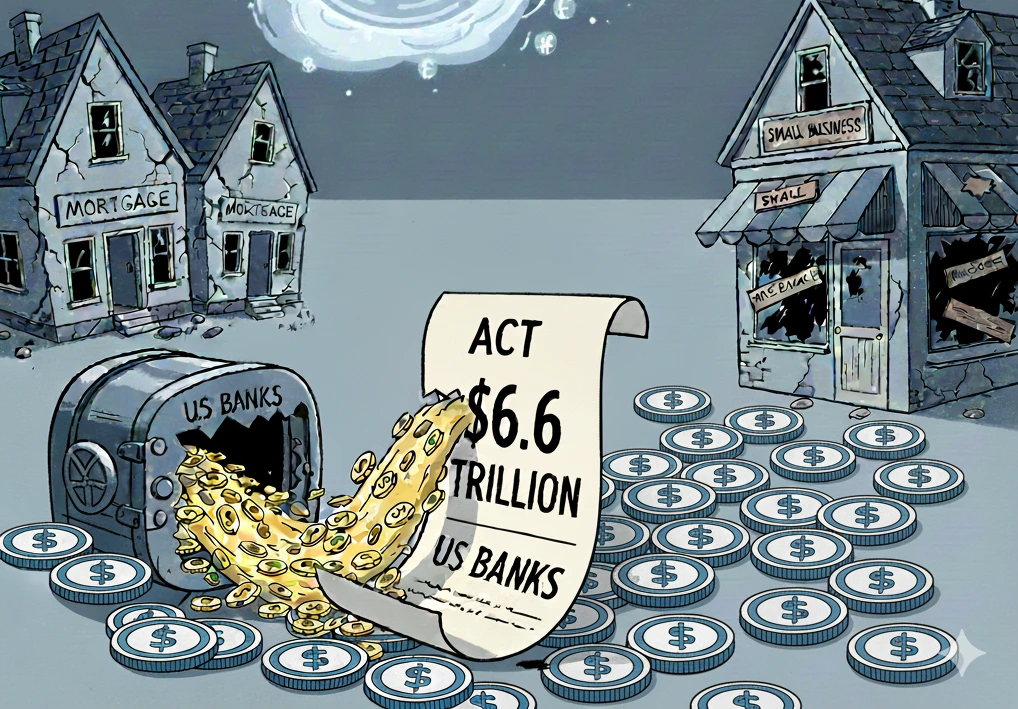
- Standard Chartered warned stablecoins could pull up to $500 billion from U.S. bank deposits by 2028, a hit that would land hardest on regional lenders.
- Payment incumbents are building stablecoin settlement into mainstream rails, including Visa’s U.S. stablecoin settlement push and Stripe’s stablecoin payment tooling.
Stablecoins, digital assets designed to track the United States dollar, were supposed to be boring.
A dollar token. A digital cashier’s check. A way to move money without taking a view on the price of Bitcoin (BTC).
Now they are being treated as something else entirely: a live test of who gets to “own” dollars in motion, and whether banks can keep deposits from leaking out of the system.
That tension is showing up in two places at once.
In Washington, stablecoin policy has become a legislative traffic jam, with the White House reportedly convening senior banking and crypto executives to find a path forward on crypto market structure.
In markets, stablecoins are behaving less like a crypto niche and more like payments infrastructure, as major financial and fintech firms put stablecoin settlement and stablecoin payments into production tooling.
The fight looks technical—licensing, reserves, redemption rights, disclosure. The emotional core is not technical at all.
It is deposits.
Washington Tries To Break the Stablecoin Logjam
The immediate hook is political: Reuters reported the White House is set to meet with executives from major banks and crypto firms as lawmakers attempt to revive a market-structure bill that has bogged down amid open conflict between the two sectors.
The argument is about what stablecoins are allowed to become.
Banks have pushed for hard constraints on anything that makes a stablecoin feel like a better bank account, especially “rewards,” a loose category that can include issuer-paid interest, platform incentives, or yield passed through from third parties.
Crypto firms, by contrast, see restrictions on rewards as protectionism dressed up as stability policy.
In other words, the U.S. is trying to decide whether stablecoins stay in the payments lane, or graduate into a deposit-like product at scale.
Why “Rewards” Are a Red Line for Banks
Banks are not being subtle about the threat model.
A stablecoin that pays something—even indirectly—starts to compete with deposits on the feature most consumers actually care about: “Why should my dollars sit here instead of there?”
Deposits are not just a customer relationship. They are a core funding base. Banks use them to finance lending and to manage liquidity.
If deposits migrate into stablecoins, banks either shrink their balance sheets or pay up to keep customers, both of which can tighten credit and raise funding costs.
Standard Chartered put a number on the scenario in a Reuters-cited note: stablecoins could pull around $500 billion from U.S. bank deposits by the end of 2028, with regional banks most exposed.
The point is not that the figure is destiny. It is that the industry now has a “bank run” narrative with a plausible magnitude attached to it.
Rewards matter because they change behavior. A zero-yield token is easier to frame as a payments tool. A token with incentives starts to look like a money-market substitute that happens to settle 24/7.
A Bank Run, but in One Click
Traditional bank runs are slow until they are not. Stablecoin runs are designed to be fast from the start.
If users decide they would rather hold tokenized dollars than bank deposits, they do not need a branch, a wire, or business hours.
They can convert and move value instantly, any time of day, often inside the same app they already use to trade or pay.
That is the stability anxiety: not simply that money can leave, but that it can leave all at once, in a single interface, with almost no friction.
This is also why reserve composition and redemption mechanics keep returning to the center of policy debates.
A stablecoin’s promise is simple—“$1 in, $1 out”—but keeping that promise under stress depends on how liquid the reserves really are, and how quickly redemptions can be honored.
Research has also started to quantify spillovers.
A 2025 BIS working paper found stablecoin flows can move short-term U.S. Treasury yields, with outflows producing larger yield effects than inflows—an asymmetry that matters in a stress event.
Stablecoins Are Also Becoming a Payments Network
Stablecoins are scaling as settlement rails.
A Bitget Wallet onchain finance report said stablecoins processed roughly $33 trillion in on-chain settlement while total supply grew more than 50% to about $308 billion.
It frames the growth as a post-clarity wave, with regulatory frameworks rolling out across the U.S., EU, and Hong Kong, and it points to a shift in usage.
USDC is overtaking USDT in annual transaction volume, a sign the flow mix is trending toward institutional and B2B settlement rather than retail trading.
Even if you discount headline numbers, the direction is hard to miss: stablecoins are no longer “crypto plumbing.” They are increasingly payments plumbing.
That dual identity is why the policy fight is so sharp.
If stablecoins are a settlement network, policymakers worry about oversight, consumer protection, and illicit finance controls.
If stablecoins are also a deposit alternative, policymakers worry about bank funding, credit creation, and run dynamics.
Both can be true.
Payment Giants Are Quietly Building the Rails
The most consequential adoption stories are not always the loudest. They are the integrations that make stablecoins disappear behind familiar payment experiences.
Visa has been expanding stablecoin settlement, including a push to bring stablecoin settlement capabilities into the U.S. and a broader effort to position stablecoins inside institutional payments workflows.
Stripe, meanwhile, has been rolling out stablecoin payment capabilities, including support aimed at recurring or subscription-style payments, starting with USDC-based flows in initial implementations.
This is what scares banks in a slower, more structural way. A consumer does not need to “adopt crypto” for stablecoins to drain deposits.
They just need a wallet or a checkout flow that makes stablecoin settlement feel like a better version of what they already do.
When stablecoins become the invisible settlement layer, “crypto adoption” turns into “payments modernization,” and the center of gravity shifts.
Stablecoin Regulation Is Getting Clearer Elsewhere
The U.S. is not legislating in a vacuum.
Other jurisdictions have moved ahead with stablecoin regimes that set baselines for reserves, licensing, governance, and disclosure.
- In the EU, the Markets in Crypto-Assets Regulation (MiCA) phased rollout made stablecoin-related rules applicable before the broader crypto service-provider framework, pushing issuers toward more formal compliance expectations.
- In Hong Kong, the Hong Kong Monetary Authority (HKMA) describes a licensing regime for fiat-referenced stablecoin issuers under the Stablecoins Ordinance, implemented from Aug. 1, 2025.
- Global standard setters have also been explicit. The Financial Stability Board’s high-level recommendations call for consistent regulation and oversight of global stablecoin arrangements, specifically because of the financial stability risk they can pose at scale.
That global momentum matters for U.S. politics.
Crypto firms can argue, credibly, that if the U.S. blocks product features too aggressively, activity will route around it.
Banks can argue, credibly, that if the U.S. allows deposit-like stablecoins without bank-grade oversight, it invites instability.
The Real Question: Who Earns the Spread on Digital Dollars?
Underneath the slogans is a very old fight in a very new outfit: who earns the economics of money?
Banks earn on the spread between what deposits cost them and what loans or assets return.
Stablecoin issuers earn on the return from reserves (often Treasuries) net of operational costs, and sometimes share economics with platforms that distribute the coins.
At scale, that is not a side business. It is a parallel model for capturing monetary plumbing profits.
That is why banks keep returning to the same line: stablecoins should not become deposit substitutes without deposit-like regulation.
That is also why crypto firms keep returning to their line: stablecoins are an upgrade to payments and should not be kneecapped to protect incumbents.
What To Watch Next
Three practical signals matter more than rhetoric:
- How “rewards” gets defined. A narrow ban can be sidestepped via third-party incentives. A broad ban may push activity offshore or into less transparent structures.
- Reserve and redemption standards. In stress, the mechanics matter more than the marketing.
- Whether stablecoin settlement becomes normal business infrastructure. Visa and Stripe moving from pilots to repeatable tooling is not about hype—it is about habit formation in payments.
Stablecoins are not just “crypto money.” They are a redesign of how dollars move, and a contest over whether bank deposits remain the default place those dollars live.
And banks, very clearly, are acting like they know it.
Visit Our Stablecoin Partners

PhD, researcher and writer exploring AI, blockchain, and the philosophy of tech, with a focus on DeScAI, governance, and trust.