Bitcoin could retest $100,000 if the Clarity Act advances in March. Here’s how regulatory clarity may impact BTC’s next move, according to ChatGPT analysis. | Credit: CCN.com
Share
Key Takeaways
If the Clarity Act passes in March, Bitcoin’s potential upside ranges widely.
The White House has reportedly set a March 1 deadline to advance the crypto market structure bill.
While the yield restriction may hurt certain crypto firms and stablecoin growth models, it does not directly impact Bitcoin’s structure or utility.
Clearer rules could reduce enforcement uncertainty that has limited institutional participation.
If the Clarity Act passes in March, Bitcoin could see anything from a modest 5% bump to a sustained 50% rally, depending on how markets interpret its real-world impact.
With the White House now setting a Mar. 1 deadline to move the crypto market structure bill forward, regulatory clarity in the U.S. is no longer theoretical: it’s becoming time-bound. That urgency alone could shape near-term market expectations.
Here’s a structured breakdown of what could happen.
Why the Clarity Act Matters for Bitcoin Price and US Crypto Regulation
At its core, the Clarity Act aims to provide clearer regulatory definitions for digital assets in the U.S., particularly around whether certain tokens fall under securities or commodities law.
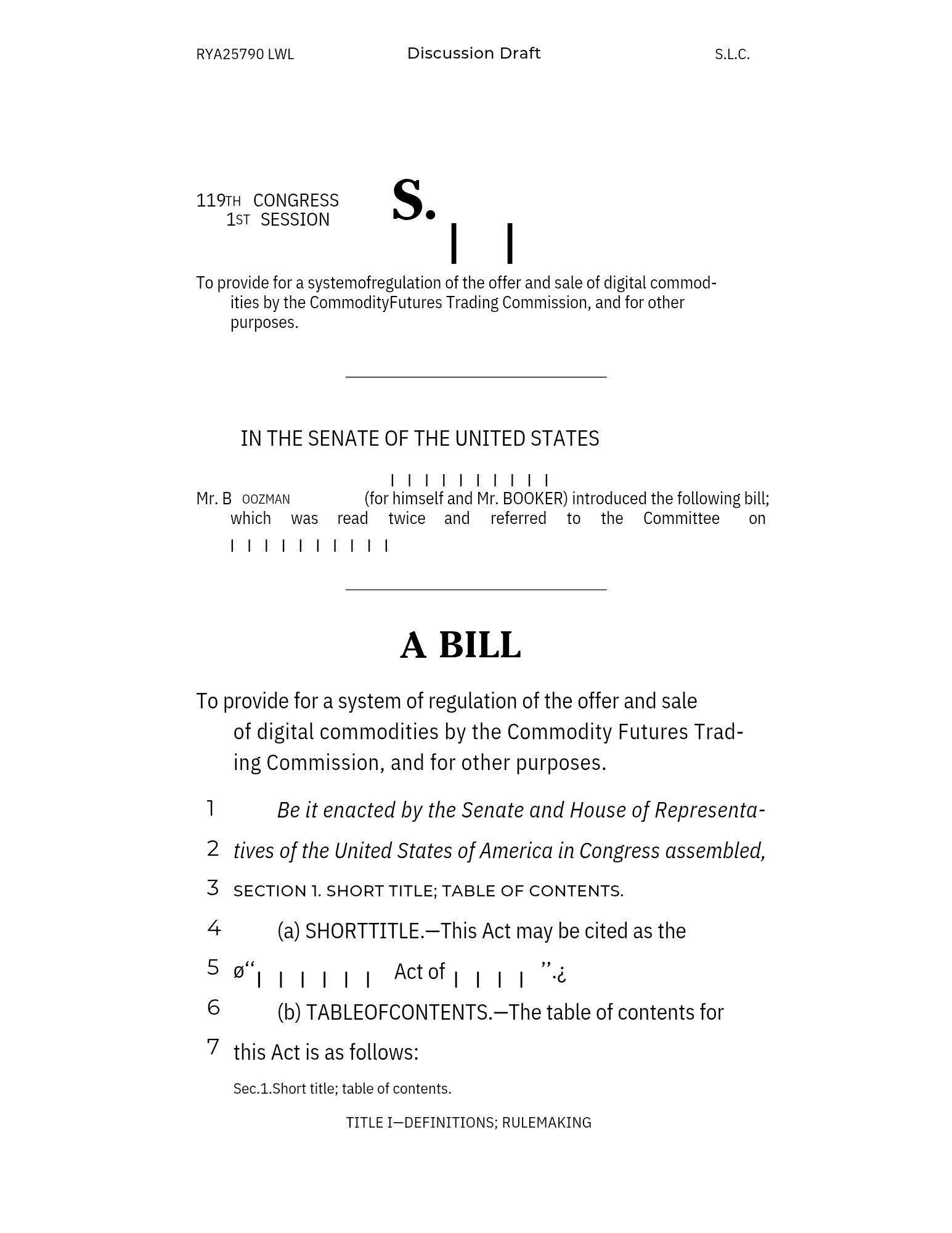
Clarity Act bill. | Credit: U.S. Senate
For Bitcoin specifically, the implications would likely include:
With penalties of up to $500,000 per violation per day.
How the Stablecoin Yield Restriction Could Impact Crypto Markets
The ban on idle stablecoin yield is a setback for certain crypto business models, especially platforms that relied on passive reward structures to attract deposits.
It also reflects banking sector concerns about:
Potential deposit outflows.
Stablecoins functioning as quasi-savings alternatives.
However, while this may constrain the growth of stablecoin models, the broader market structure bill is still widely viewed as positive for crypto overall.
For Bitcoin, which is already widely treated as a commodity, this clarity could reduce systemic regulatory risk without materially affecting its core use case.
ChatGPT’s Bitcoin Price Prediction if the Clarity Act Passes: 5%–15% Relief Rally
In a “buy the rumor, sell the news” scenario, Bitcoin could rise between 5% and 15%, according to ChatGPT, so to a range between $70,350 and $77,050.
The AI app said that if markets have already priced in passage, especially given the widely discussed Mar. 1 deadline, confirmation may trigger a short-term spike followed by consolidation.
This would be the most conservative and historically common outcome following regulatory announcements.
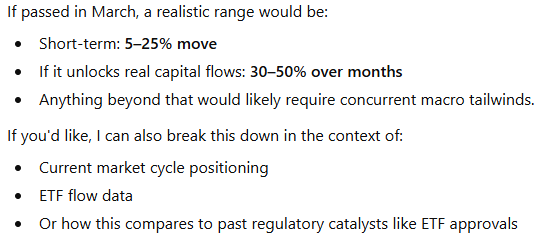
ChatGPT sees a potential jump to $100,000 for Bitcoin if Clarity Act passes. | Credit: ChatGPT
Bitcoin Could Rise 20%–40% on Regulatory Clarity and Institutional Inflows
If the Clarity Act meaningfully reduces enforcement uncertainty and creates durable legal boundaries, Bitcoin could reprice by 20% to 40% over weeks or months, then reach the $80,400-$93,800 range.
This would likely happen if:
Institutional compliance departments gain confidence.
The stablecoin yield restriction may reshape parts of crypto finance, but for Bitcoin specifically, reduced regulatory uncertainty could outweigh those constraints.
Clarity may not guarantee a rally.
But in financial markets, removing uncertainty often unlocks capital, and capital ultimately sets the price.
The Clarity Act is a proposed U.S. crypto market structure bill designed to define how digital assets are regulated. It aims to clarify whether certain tokens fall under SEC or CFTC jurisdiction, establish custody and exchange rules, and reduce regulatory uncertainty for crypto companies and investors.
Why could the Clarity Act affect Bitcoin’s price?
Bitcoin’s price could react positively because regulatory clarity reduces legal uncertainty for institutions. If compliance risks decline and oversight boundaries become clearer, banks, asset managers, and ETFs may feel more comfortable increasing Bitcoin exposure.
What is the March 1 deadline for the crypto bill?
The White House has reportedly set a Mar. 1 deadline to move the crypto market structure legislation forward. This increases the urgency around negotiations and raises the likelihood of near-term regulatory clarity.
Would the stablecoin yield restriction hurt Bitcoin?
Not directly. The restriction primarily affects stablecoin business models and crypto savings-style products. Bitcoin itself is less impacted, as it is already widely treated as a commodity and does not rely on idle yield structures.
Disclaimer:
The information provided in this article is for informational purposes only. It is not intended to be, nor should it be construed as, financial advice. We do not make any warranties regarding the completeness, reliability, or accuracy of this information. All investments involve risk, and past performance does not guarantee future results. We recommend consulting a financial advisor before making any investment decisions.
Giuseppe Ciccomascolo began his career as an investigative journalist in Italy, where he contributed to both local and national newspapers, focusing on various financial sectors.
Upon relocating to London, he worked as an analyst for Fitch's CapitalStructure and later as a Senior Reporter for Alliance News. In 2017, Giuseppe transitioned to covering cryptocurrency-related news, producing documentaries and articles on Bitcoin and other emerging digital currencies. He also played a pivotal role in establishing the academy for a cryptocurrency exchange website. Crypto remained his primary area of interest throughout his tenure as a writer for ThirdFloor.


 Easy
Easy