Bitcoin demand in Iran surge amid escalating war. Credit: CCN.
Share
Key Takeaways
Record Bitcoin outflows hit Iranian exchanges as U.S.–Israel strikes escalate.
Citizens are moving funds to self-custody wallets amid fears of sanctions, bank controls, and internet blackouts.
In Iran’s hyperinflation-hit economy, crypto is increasingly used as a lifeline to protect savings.
War has a way of testing financial systems. In Iran, the latest escalation appears to be testing them in real time.
Following fresh U.S.–Israeli airstrikes that began on Feb. 28, 2026, on-chain data suggests a surge of cryptocurrency withdrawals from Iranian exchanges.
This is a clear sign that citizens may be trying to secure savings outside the reach of sanctions, financial restrictions, or potential infrastructure disruptions.
For a country already grappling with years of sanctions, inflation, and limited access to global banking, the latest conflict appears to have accelerated an existing trend: using crypto as a financial escape route.
Try Our Recommended Crypto Exchanges
Sponsored
Disclosure
We sometimes use affiliate links in our content, when clicking on those we might receive a commission at no extra cost to you. By using this website you agree to our terms and conditions and privacy policy.
For many Iranians, Bitcoin has evolved beyond a speculative asset.
In a country where the national currency has suffered repeated devaluations and international payment systems remain largely inaccessible, digital assets have increasingly served as an alternative financial rail.
Hourly volumes reached 873% above the 2026 average. At peak moments, withdrawals approached $2 million per hour.
The surge was particularly visible on Nobitex, Iran’s largest crypto trading platform.
According to blockchain intelligence firm Elliptic, outgoing transactions from the exchange jumped 700% or more shortly after the first reports of strikes.
These flows appear to be moving in two directions: some funds are heading toward overseas exchanges, while a significant portion is being transferred to private wallets — a typical pattern during periods of economic uncertainty or political unrest.
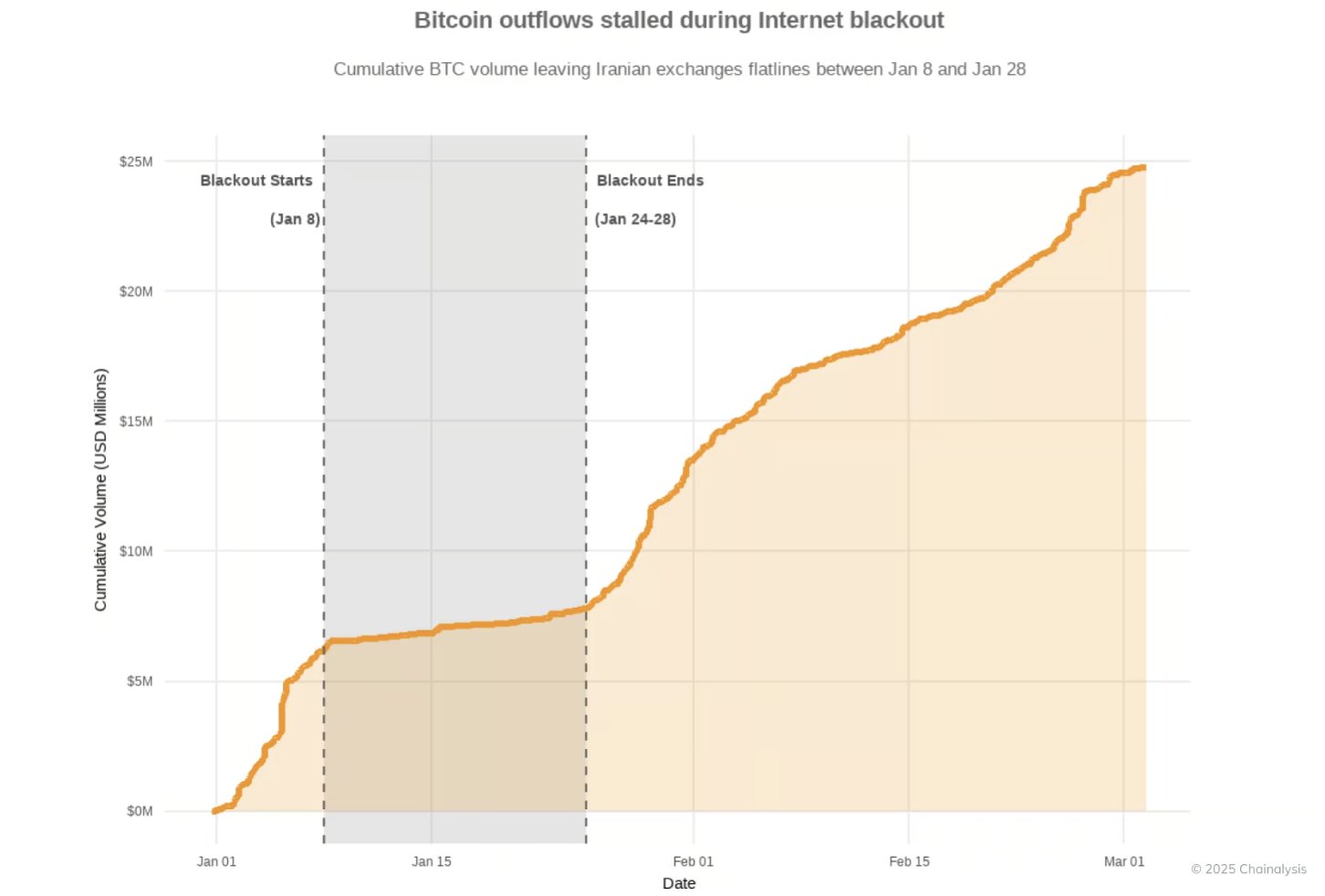
Bitcoin outflow from Iranian centralized exchanges. Credit: Chainalysis.
The distinction matters.
Buying Bitcoin is only the first step. The more telling signal is the immediate transfer of those funds from centralized platforms to self-custody wallets controlled directly by users.
During previous periods of unrest in Iran — including protests and internet shutdowns — withdrawals to private wallets have spiked as citizens attempt to safeguard assets from both government oversight and exchange vulnerabilities.
The latest wave of withdrawals appears to follow that same pattern.
A Crypto Economy Built Under Sanctions
Iran’s relationship with cryptocurrency did not begin with the latest escalation.
Analysts estimate that Iran’s crypto ecosystem reached roughly $7.8 billion in value in 2025, with annual transaction volumes ranging between $8 billion and $11 billion.
Much of that activity has emerged in response to structural constraints in the financial system.
Since the United States reimposed sanctions in 2018, international wire transfers have become extremely difficult for Iranian citizens and businesses.
At the same time, the Iranian rial has lost more than 90% of its value, while inflation has hovered between 40% and 50% annually.
Traditional wealth-preservation options carry their own risks.
Gold is difficult to move across borders and can be confiscated. Bank accounts are tightly monitored. Access to global financial networks remains severely restricted.
Cryptocurrency, by contrast, operates outside those systems.
The result has been a steady rise in crypto adoption — with usage often spiking during geopolitical shocks such as regional conflicts, domestic protests, or terrorist attacks.
Capital Flight in Real Time
The recent surge in outflows fits a pattern often seen in crisis economies.
When political or military events raise uncertainty about financial stability, citizens frequently attempt to move assets into forms that are portable, difficult to confiscate, and internationally transferable.
Crypto provides exactly that combination.
While some of the observed activity could reflect exchanges adjusting liquidity or institutional transfers, analysts say the repeated pattern of withdrawals into personal wallets suggests a significant portion of the flows are coming from individual users.
In other words, ordinary Iranians appear to be trying to protect their savings.
Bitcoin’s Role During Global Crises
The surge in Iranian activity coincided with broader volatility in Bitcoin markets.
Following the outbreak of hostilities, Bitcoin briefly dipped amid global risk-off sentiment before recovering toward $68,000.
Yet the Iranian trend highlights a broader dynamic that has played out repeatedly over the past decade.
In countries facing sanctions, currency crises, or political instability — including Venezuela, Argentina, Lebanon, Turkey, and Ukraine — cryptocurrency adoption has often accelerated as citizens look for alternatives to failing financial systems.
Bitcoin’s appeal in these situations stems from its design: a decentralized network that allows individuals to store and transfer value without relying on banks or government approval.
For people living under sanctions or capital controls, that feature can be decisive.
A Growing Role for Crypto in Crisis Economies
As tensions in the Middle East ripple through global markets — pushing oil prices higher and increasing geopolitical risk — Iran’s crypto activity offers a glimpse into how digital assets function in real-world crises.
The country’s crypto economy, built gradually under years of economic pressure, now serves two distinct roles.
For the Iranian government, cryptocurrency has occasionally been used to mitigate the effects of sanctions and facilitate international trade.
For citizens, it increasingly represents a way to preserve wealth outside the domestic financial system.
How large that parallel financial system becomes in the coming weeks may depend on how the conflict evolves.
But the pattern emerging from blockchain data is already clear: when confidence in traditional financial rails weakens, demand for decentralized alternatives rises quickly.
And for many Iranians facing an uncertain future, moving savings into Bitcoin — and holding it in self-custody — appears to be one of the few options available.
Prashant Jha is a seasoned crypto journalist based in Delhi, India, with a Bachelor’s Degree in Computer Science Engineering. Passionate about the evolving world of blockchain and cryptocurrencies, he has been a dedicated voice in the industry since 2018. Prashant’s expertise lies in regulatory reporting, where he unravels complex legal and financial developments with clarity and precision. Before joining CCN in 2024, he honed his craft at Cointelegraph, establishing himself as a trusted name in crypto journalism.
His coverage spans major industry events, including the high-profile collapses of FTX, Three Arrows Capital (3AC), and LUNA, offering readers insightful analyses of their regulatory and market implications. Prashant’s technical background enables him to bridge the gap between intricate blockchain technology and its real-world applications, making his work accessible to novices and experts.
Beyond his professional pursuits, Prashant is an avid music enthusiast, often exploring diverse genres to unwind. A sports lover, he has a particular passion for cricket and frequently engages in discussions about the game. His multifaceted interests and sharp journalistic instincts make him a valuable contributor to CCN, where he continues shaping the crypto landscape's narrative.