On-chain data shows a resurgence in US-based buying activity, with the Coinbase Premium Index flipping positive— a historically bullish signal.
Bitcoin’s futures open interest hit a 30-day high while the Elder-Ray Index logged its fourth consecutive green bar, as both derivatives and technical indicators align behind a potential push toward $78,000.
Bitcoin has finally broken free from the consolidation zone that has kept its price range-bound for weeks, closing above the critical $70,000 mark yesterday.
At press time, the king coin is up nearly 10% over the past 24 hours, trading at $72,448 as of this writing.
Accompanying that price move is a 50% surge in trading volume over the same period, a signal that buy-side pressure is building gradually amongst market participants.
When price climbs alongside a spike in volume, it reflects genuine demand for an asset, and on-chain data confirms this is the case for BTC.
US-Based Investors Return to the Fold
Activity from US-based investors has surged in recent days, suggesting they may be positioning ahead of a larger upward move.
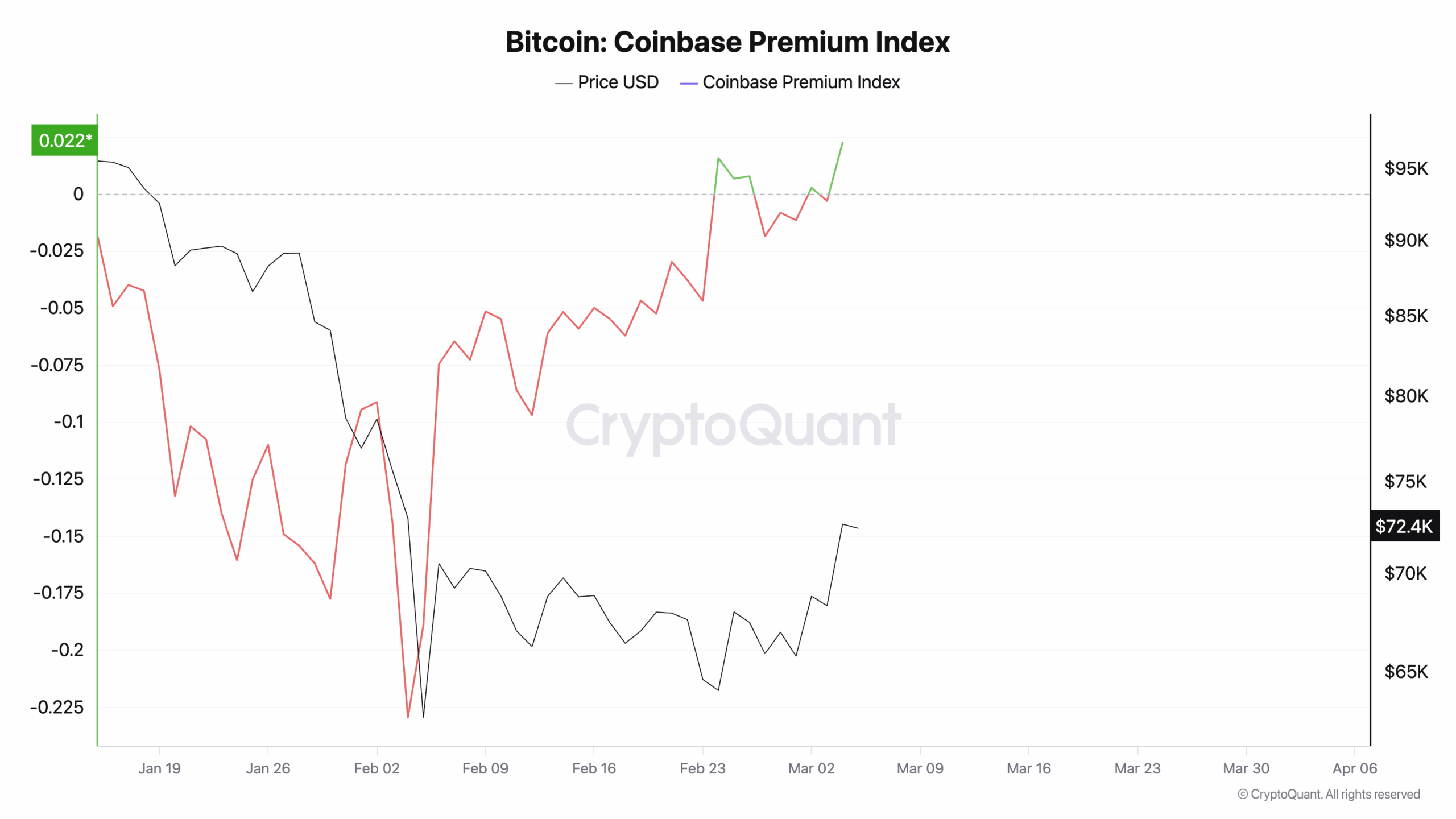
Readings from BTC’s Coinbase Premium Index (CPI) show that it has flipped positive, highlighting a shift in sentiment from this cohort of coin holders.
At the time of writing, BTC’s CPI stands at a 30-day high of 0.022. This metric measures the difference between BTC prices on Coinbase and Binance and is a good indicator of U.S. investor sentiment.
Bitcoin Coinbase Premium Index | Credit: CryptoQuant
When the CPI falls—or worse, turns negative—it signals that demand on Coinbase is lagging behind global markets, due to profit-taking or waning interest among U.S. buyers.
Conversely, when the CPI rises, as is the case here, BTC trades at a premium on Coinbase compared to international exchanges. This reflects stronger buying pressure from U.S.-based investors.
For context, BTC’s CPI remained deeply in negative territory for much of January and into early February.
This prolonged negative reading indicated that US-based investors were consistently paying less for BTC than their counterparts on other global exchanges, a sign of poor American demand and net selling pressure from investors from that region.
During that period, BTC price reflected that sentiment, stuck in a sideways trend as buy-side conviction remained weak.
With sentiment gradually shifting, the index is staging a recovery. This highlights the return of US-based demand, as reflected in the coin’s price rally over the past day.
Derivatives Traders Are No Longer on the Sidelines
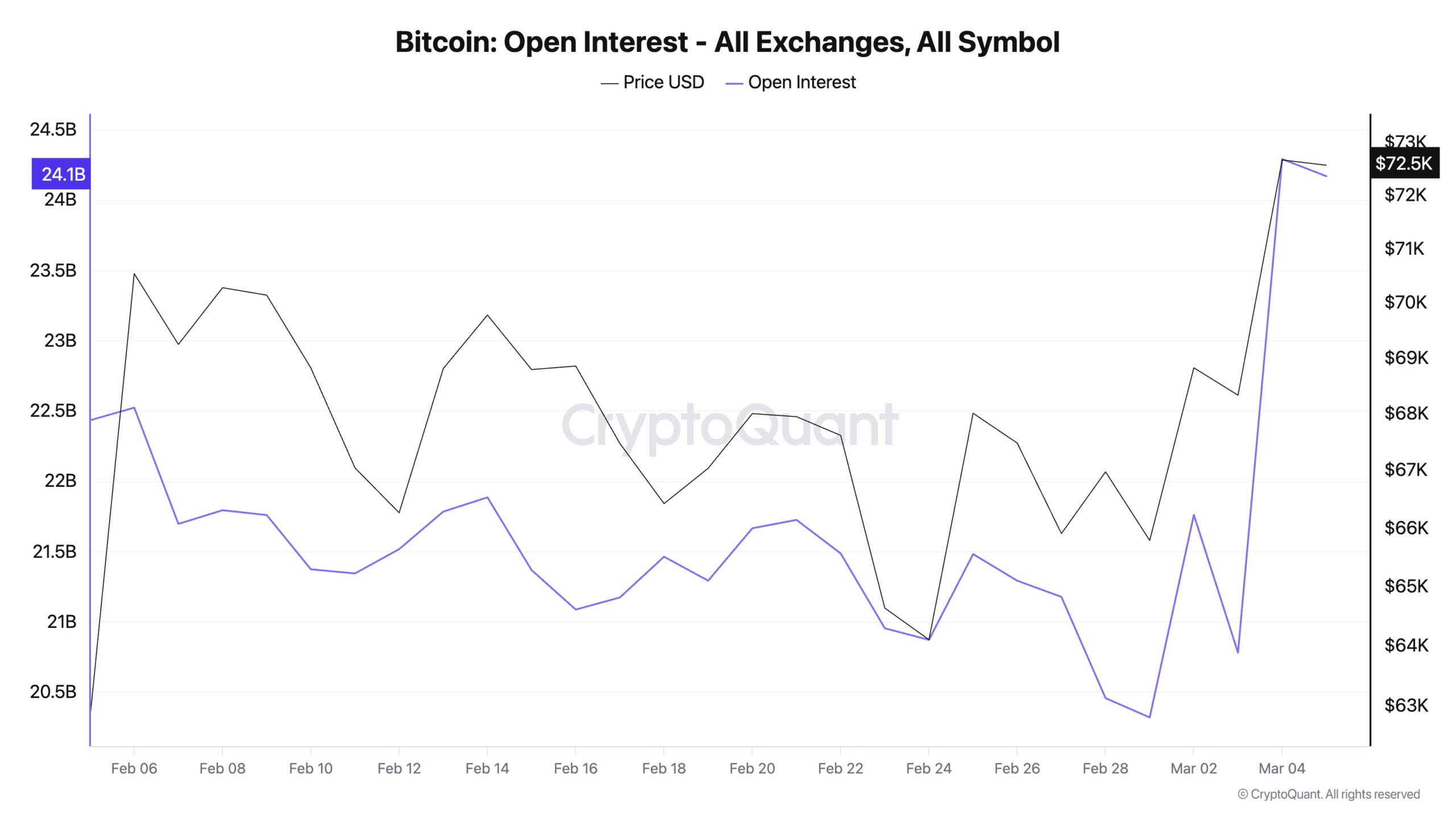
BTC’s price recovery over the past day has led to a notable rise in open interest among its futures traders. Per CryptoQuant, BTC’s closing above the critical $70,000 mark yesterday pushed its futures open interest to a 30-day high of $24.29 billion.
An asset’s open interest measures the total number of outstanding derivative contracts, such as futures or options, that have not been settled. When it rises alongside price like this, it indicates new money is entering the market.
This trend signals a meaningful shift in conviction among BTC traders who are actively betting on a price rally even as conflict between the US, Israel, and Iran continues to weigh on global risk sentiment.
The Charts Are Catching Up to the On-Chain Story
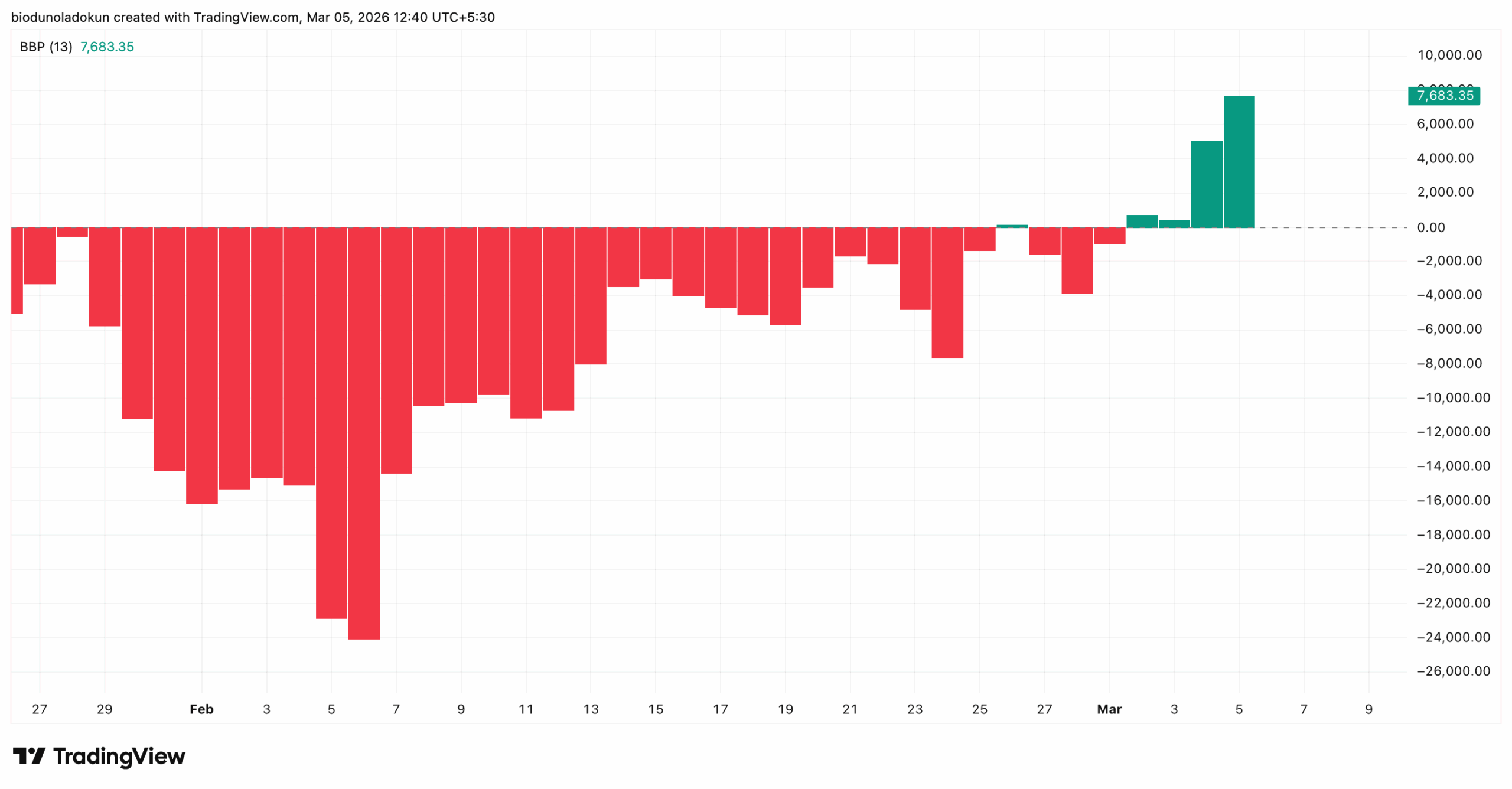
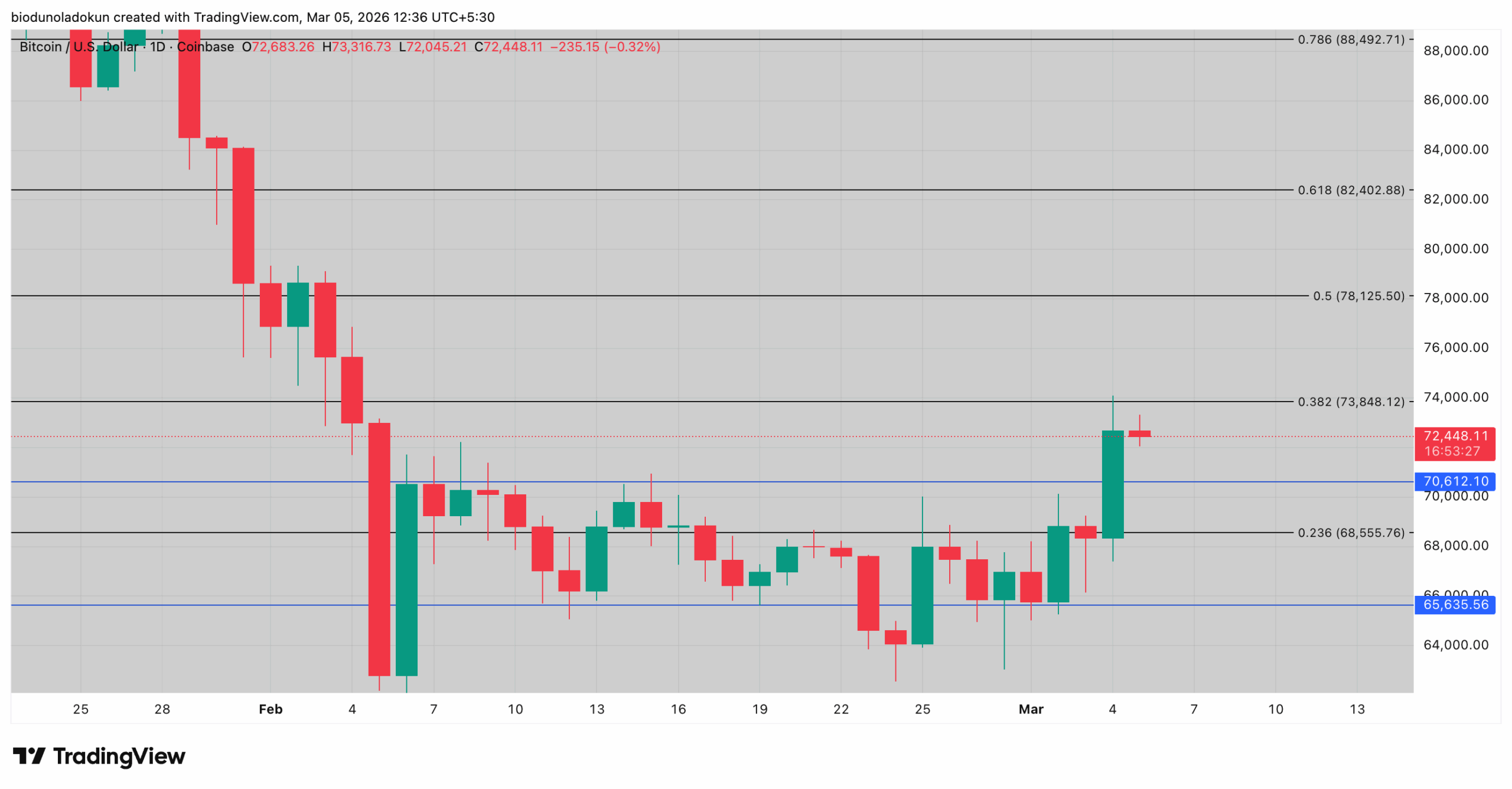
On the daily chart, BTC’s Elder-Ray Index also reflects buy-side dominance among spot traders. As of this writing, the indicator’s value stands at 7,683.35, above the zero line and marking the fourth consecutive day of a green histogram bar after an extended period of red bars and negative values.
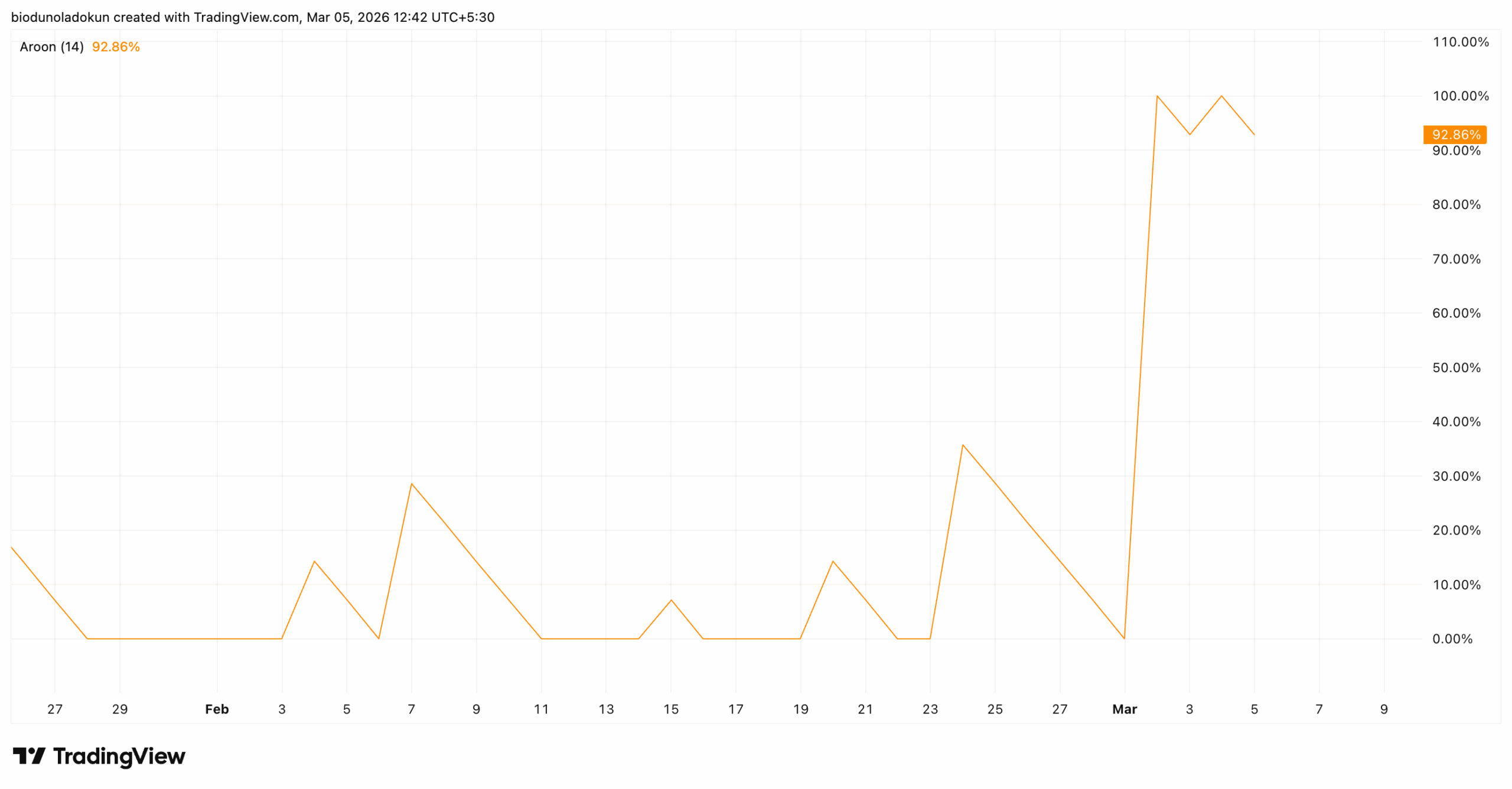
The Aroon indicator measures the strength and direction of a trend. It consists of two lines: the Aroon Up, which tracks the time since the last high, and the Aroon Down, which tracks the time since the previous low.
When the Aroon Up Line nears 100%, the asset has recently made a new high within the chosen period, indicating a strong upward trend. This is true of BTC, which currently trades at a 30-day high of $72,448.
This suggests that BTC buyers are slowly regaining control, and the current uptick could continue. In this scenario, BTC could breach the $73,843 support and push towards $78,125.
BTC/USD Daily Chart | Credit: TradingView
However, if profit-taking resumes and new demand slows, BTC risks shedding its recent gains and plunging to support at $70,612. If the retest fails, its price could drop to $68,555.
Disclaimer:
The information provided in this article is for informational purposes only. It is not intended to be, nor should it be construed as, financial advice. We do not make any warranties regarding the completeness, reliability, or accuracy of this information. All investments involve risk, and past performance does not guarantee future results. We recommend consulting a financial advisor before making any investment decisions.
Abiodun Oladokun is a Research Analyst at CCN, where he covers cryptocurrency markets with a focus on on-chain analysis, technical assessments, and emerging trends across decentralized finance (DeFi), real-world assets (RWA), artificial intelligence (AI), decentralized physical infrastructure networks (DePIN), Layer 2s, and meme coins.
Prior to CCN, he served as a Senior On-Chain Analyst at BeInCrypto, producing market reports spanning diverse crypto sectors.
Before that, he conducted technical analysis and market assessments of various altcoins at AMBCrypto, where he also contributed long-form quarterly research papers on DeFi, NFTs, DAOs, and scaling architectures, leveraging on-chain platforms including Messari, Santiment, DefiLlama, and Dune Analytics.
He began his crypto career as a research analyst at SixthSense DAO, developing blockchain forensic tools to trace the history of stolen assets.
Abiodun is a lawyer called to the Nigerian Bar and the founder of Ilé Ijó, a Lagos-based electronic dance music collective.